
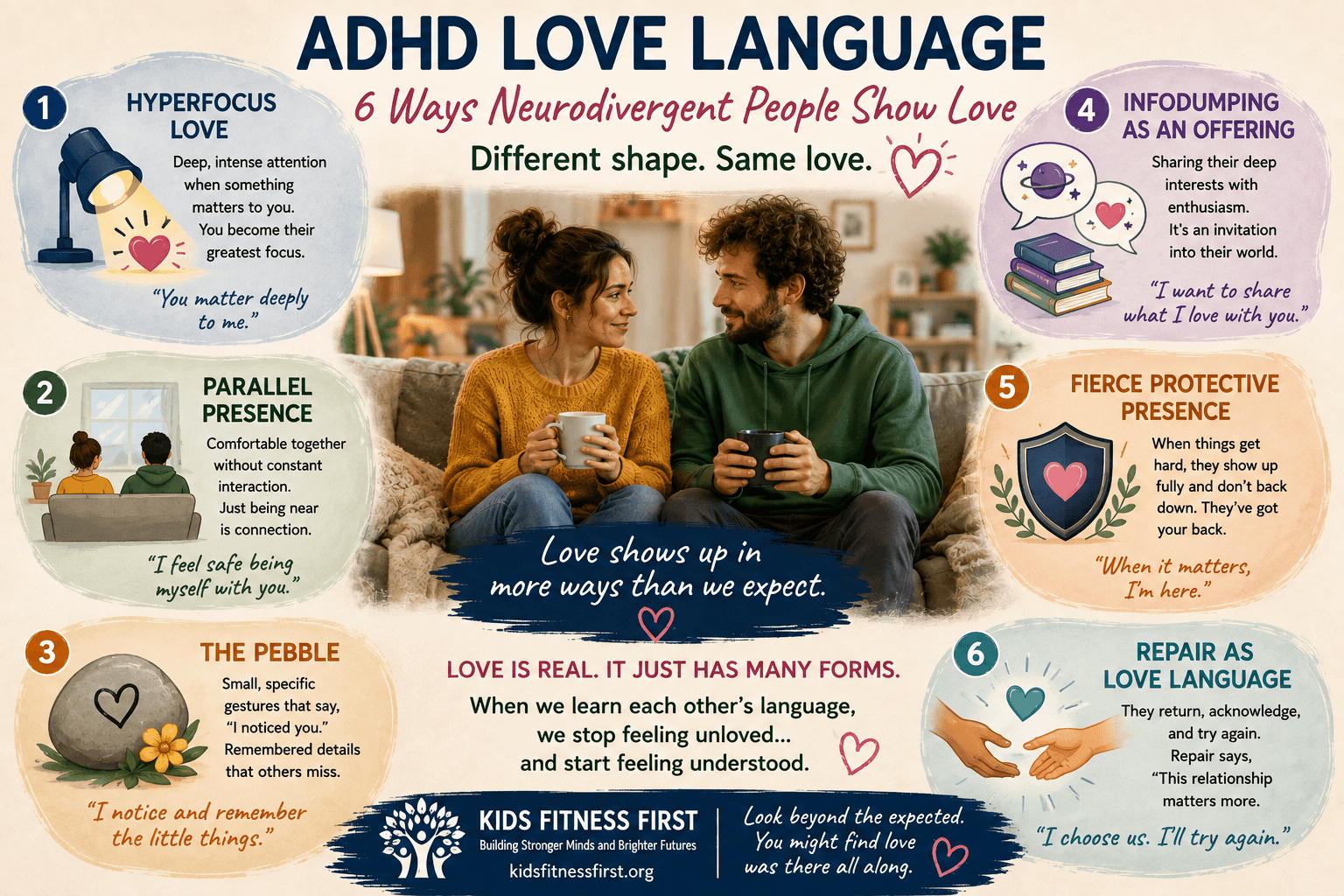
ADHD Love Language: 6 Ways Neurodivergent People Show Love
An ADHD love language may not always look like the kind of love we have been taught to recognise.
For example, somebody may forget an appointment but remember, three weeks later, the exact coffee shop you once said looked interesting.
Likewise, they may struggle to maintain continuous attention during an ordinary evening. However, when something genuinely matters to you, they may suddenly become completely focused.
Alternatively, they may not want hours of conversation. Instead, they may simply want to sit beside you while each of you does something different.
From the outside, these behaviours can appear inconsistent.
However, from inside a neurodivergent relationship, they can carry considerable meaning.
The problem, therefore, is not always that love is missing.
Sometimes the real problem is that love is being expressed in a language the other person has not yet learned to read.
That is the central idea behind Article 4 of Book Five.
When Love Does Not Look Like the Cultural Template
Most of us grow up absorbing a fairly narrow picture of romantic love.
For example, we are taught to expect:
- regular verbal reassurance;
- constant emotional availability;
- remembered anniversaries;
- long conversations;
- spontaneous affection;
- perfectly timed gestures;
- and consistent demonstrations of attention.
Naturally, many people genuinely enjoy those things.
However, they are not the only evidence of love.
For some neurodivergent people, continuous social and emotional performance can be exhausting. Therefore, asking them to prove love through constant availability may measure performance rather than connection.
Likewise, an ADHD partner may show intense periods of attention rather than perfectly even attention.
An autistic partner may value quiet shared space rather than continuous conversation.
Meanwhile, a dyslexic partner may express care more clearly through actions than through long written or verbal explanations.
Consequently, relationships become healthier when both people learn to recognise the form love actually takes rather than judging it exclusively by the form they expected.
1. Hyperfocus Love
One particularly recognisable form of ADHD love language is hyperfocus.
When attention locks onto a person, idea or problem, the intensity can be remarkable.
For example, an ADHD partner may become deeply interested in something that matters to you.
They may research it.
Then they may send you links.
Afterwards, they may remember unusual details.
Moreover, if you have a problem, they may spend hours trying to solve it.
During those moments, the attention can feel unusually bright and complete.
However, hyperfocus has an important complication.
It is not always consistent.
The same person who gave you extraordinary attention yesterday may appear distracted today.
Consequently, their partner may interpret the change as:
“You used to care more.”
Yet the underlying love may not have changed at all.
Instead, the attention system has changed state.
That does not mean inconsistency has no impact. However, separating attention regulation from emotional commitment can prevent a painful misunderstanding.
A useful question
Instead of asking:
“Why don’t you love me like you did at the beginning?”
consider asking:
“Has the way your attention shows love changed, even though the relationship itself has not?”
Sometimes that creates a very different conversation.
2. Parallel Presence
Another important form of neurodivergent love is parallel presence.
This is the ability to be comfortably together without constantly interacting.
For example, you might:
- sit in the same room reading different books;
- work at the same table on different projects;
- walk together without talking;
- watch television quietly;
- or simply share a room while each person follows their own interest.
From a conventional romantic perspective, this may look like distance.
However, for some neurodivergent people, especially some autistic and ADHD people, it can represent considerable trust.
Why?
Because social interaction often requires performance.
There is eye contact to manage.
There are responses to generate.
There are expressions to interpret.
There is the pressure to appear engaged in the expected way.
By contrast, parallel presence can say:
“I do not have to perform around you.”
Therefore, if somebody consistently chooses to be physically near you while doing their own thing, do not automatically assume they are avoiding connection.
Instead, they may be showing one of the deepest forms of nervous-system safety available to them.
3. The Pebble: Small Details That Carry Big Meaning
One of the most beautiful forms of neurodivergent love is also one of the easiest to overlook.
Book Five calls it the pebble.
A pebble is a small, highly specific thing that says:
“I noticed you.”
For example:
You once mentioned a biscuit you liked.
Three weeks later, your partner sees it in a shop and brings it home.
Or perhaps they send you a photograph of something because it reminded them of you.
Likewise, they may send an article about a subject you briefly mentioned.
Perhaps they remember a particular flower, song, colour or unusual detail.
The gesture is small.
However, the specificity is the point.
In fact, the gesture may represent a surprising amount of attention.
The person noticed something about you.
Then they retained it.
Later, they recognised it again.
Finally, they brought it back into the relationship.
Therefore, the size of the gesture is not necessarily the size of the love.
A small pebble can carry enormous emotional weight.
Try This: Find the Last Pebble
Think back over the last seven days.
Then ask yourself:
Did the person I love do something small and specific that I almost overlooked?
Perhaps they:
- bought something you like;
- sent you a link;
- remembered a detail;
- saved you the better seat;
- made your drink the way you prefer it;
- mentioned something you had forgotten telling them;
- or noticed that you were struggling before you said anything.
At first, these actions may seem ordinary.
However, once you start recognising them as pebbles, the relationship may look different.
You may discover that love was appearing more often than you realised.
4. Infodumping Can Be an Offering
Imagine that your partner spends twenty minutes enthusiastically explaining a subject you know almost nothing about.
Perhaps it is:
- a game;
- a historical event;
- a technology;
- trains;
- animals;
- football statistics;
- films;
- a specialist hobby;
- or an incredibly specific fact that has captured their attention.
You might understandably think:
“Why are they telling me all of this?”
However, for some autistic and AuDHD people, sharing a deep interest can be a form of intimacy.
They are effectively saying:
“This matters to me, and therefore I want to bring you inside it.”
That does not mean the listener has unlimited capacity.
You are still allowed to say:
“I want to hear this, but I only have ten minutes of attention right now.”
Nevertheless, understanding the intention changes the emotional meaning.
Instead of hearing:
“I am being talked at.”
you may begin to hear:
“I am being invited into something important.”
That is a very different interpretation.
5. Fierce Protective Presence
Another form of ADHD love language may become most visible when something goes wrong.
In everyday life, the person may appear distracted.
They may forget practical details.
They may sometimes seem mentally elsewhere.
However, during a genuine crisis, something remarkable may happen.
Suddenly, they are there.
Completely.
They become focused.
They make calls.
They solve problems.
They defend the person they love.
They stay awake.
They research.
They drive across town.
They sit beside a hospital bed.
They confront a problem that frightened everyone else.
In other words, their attention becomes fully mobilised by urgency and emotional importance.
Consequently, some partners discover that the person who struggles with ordinary consistency can show extraordinary consistency when the situation becomes serious.
This does not erase everyday responsibilities.
However, it is still important evidence.
Love can sometimes look like:
“When everything went wrong, you were the person who did not leave.”
That deserves to be seen.
6. Repair Can Become a Love Language
The sixth form is less romantic on the surface.
Nevertheless, it may be one of the strongest.
Repair is love.
Every long relationship contains mistakes.
People forget things.
They say the wrong thing.
They become defensive.
They misunderstand.
They withdraw.
Therefore, a healthy relationship cannot depend on never getting anything wrong.
Instead, it depends partly on what happens afterwards.
For example:
“I can see that I hurt you.”
“I understand the impact.”
“I became defensive earlier, and that made things worse.”
“I want to try that conversation again.”
“Here is what I will do differently.”
Those sentences may not appear in a romantic film.
However, over twenty years, they can matter more than flowers.
Why?
Because repair says:
“The relationship matters more to me than protecting my pride.”
Therefore, a person who learns to return after conflict may be developing one of the most durable forms of love available.
Six Neurodivergent Forms of Love at a Glance
| Form of Love | What It May Look Like | What It May Mean |
|---|---|---|
| Hyperfocus love | Intense bursts of attention and interest | “You matter deeply to me right now.” |
| Parallel presence | Being together without constant interaction | “I feel safe being fully myself beside you.” |
| The pebble | Small, specific remembered details | “I notice and remember you.” |
| Infodumping | Sharing a deep interest enthusiastically | “I want to bring you into my world.” |
| Fierce protective presence | Becoming intensely present during difficulty | “When it matters, I am here.” |
| Repair as love | Returning, acknowledging and changing after conflict | “This relationship matters enough to repair.” |
Naturally, not every neurodivergent person will use all six.
Likewise, not every gesture should automatically be interpreted as love.
However, the framework gives couples a wider vocabulary.
ADHD and Love: Seeing the Full Picture
There is an important caution here.
Recognising neurodivergent love does not mean pretending difficult behaviour does not hurt.
For example, if one partner carries all the household administration, a remembered biscuit does not solve that imbalance.
Likewise, intense affection does not cancel repeated unreliability.
A beautiful pebble does not erase a broken promise.
Therefore, the goal is not to replace accountability with romantic reinterpretation.
Instead, the goal is to hold two truths at once:
“This behaviour is difficult for me.”
and:
“I can also see the love that is genuinely present.”
Both can be true.
In fact, mature relationships often depend on holding both.
How Different Neurodivergent People May Show Love
Although Article 4 focuses strongly on ADHD relationships, Book Five deliberately widens the picture.
ADHD
For some ADHD people, love may commonly appear through:
- hyperfocus;
- impulsive pebbles;
- intense enthusiasm;
- problem-solving;
- and fierce presence during difficulty.
However, attention may fluctuate considerably.
Therefore, partners often benefit from distinguishing fluctuating attention from fluctuating affection.
Autism
For some autistic people, love may appear through:
- parallel presence;
- sharing specialist interests;
- remembering precise details;
- reliability in specific routines;
- and allowing someone into carefully protected personal space.
Consequently, quietness should not automatically be interpreted as emotional absence.
Dyslexia
For some dyslexic people, love may be particularly visible through action.
For example, they may fix something, solve a problem, protect someone practically or quietly take responsibility when it matters.
Therefore, as the Book Five manuscript puts it conceptually, sometimes you need to watch the hands rather than only the sentences.
Stop Measuring Your Relationship Against a Film
One of the larger problems is comparison.
We compare our relationships with:
- films;
- social media;
- friends;
- family;
- romantic clichés;
- and cultural expectations.
As a result, couples can believe something is missing simply because their relationship does not look like somebody else’s.
However, a neurodivergent relationship may need a different measurement system.
Instead of asking:
“Do we look like a normal couple?”
ask:
“Do both of us feel understood, respected and loved in ways our nervous systems can actually receive?”
That is a much more useful standard.
Three Signs Neurodivergent Love Is Working
Book Five identifies a quieter way of evaluating whether a neurodivergent relationship is becoming healthier.
1. Both people can recognise the other’s love
First, each partner begins to recognise how the other naturally expresses care.
Therefore, the ADHD partner’s pebble is no longer dismissed as random.
Likewise, the autistic partner’s quiet presence is no longer automatically read as distance.
Meanwhile, practical acts of service are recognised as meaningful rather than emotionally empty.
2. Difficult conversations repair faster
Secondly, arguments still happen.
However, they stop becoming endless evidence that the entire relationship is broken.
Instead, both people have language and tools.
They recognise the loop.
They recognise shame.
Then they return more quickly.
Consequently, conflict becomes something the relationship can survive rather than something that constantly threatens it.
3. Ordinary life begins to feel safe
Finally, there is something even quieter.
An ordinary Tuesday evening becomes enough.
One person reads.
The other watches something.
There is a cup of tea.
Perhaps there is a pebble sitting on the kitchen counter.
Later, somebody asks:
“What time are we leaving tomorrow?”
Nothing dramatic happens.
However, both nervous systems feel safe.
That ordinary contentment can represent enormous invisible work.
Try This: Build Your Own Love Translation Map
Each partner can complete this separately.
What makes me feel loved?
Write down three specific things.
For example:
- uninterrupted conversation;
- physical affection;
- practical help;
- being remembered;
- shared activities;
- quiet time together.
How do I naturally show love?
Now list three ways you tend to express care.
Perhaps:
- solving problems;
- sending links;
- bringing home small things;
- sharing interests;
- giving space;
- checking practical details.
Where is the translation gap?
Finally, compare the two lists.
Perhaps one person says:
“I show love by giving you space.”
Meanwhile, the other says:
“I feel loved through conversation.”
Neither is wrong.
However, without translation, each may believe they are giving love while simultaneously feeling unloved.
That is the gap the relationship needs to bridge.
Love Is Not Less Because Its Shape Is Different
This is the central message.
A neurodivergent partner may not always love predictably.
They may not always love conventionally.
Likewise, the emotional packaging may sometimes look completely different from what popular culture taught us to expect.
However, different is not automatically less.
Sometimes love appears as a person who notices peonies in a coffee-shop window because they know you would like them.
Sometimes it appears as someone sitting silently beside you while you both do something different.
Sometimes it arrives as twenty minutes of excited information about a subject they desperately want to share with you.
Sometimes it appears when a crisis happens and the distracted person suddenly becomes the most dependable person in the room.
And sometimes love appears after an argument, when somebody returns and says:
“I got that wrong. Can we try again?”
Those things count.
Therefore, learning to recognise them does not mean lowering your standards.
It means improving your eyesight.
Conclusion: Learn to Read the Love Already in the Room
An ADHD love language may be inconsistent in form while remaining deeply consistent in feeling.
That distinction matters.
Therefore, do not judge the entire relationship only by the gestures that are missing.
Instead, also look for the gestures that are already there.
Look for hyperfocus.
Notice parallel presence.
Find the pebble.
Listen differently to the infodump.
Remember who appears when life becomes difficult.
And, most importantly, notice who comes back to repair.
However, keep accountability in the room as well.
Love should not be used to excuse damaging patterns.
Likewise, difficult patterns should not automatically erase genuine love.
A strong neurodivergent relationship learns to hold both truths.
The love can be real.
The difficulty can also be real.
And once both people learn to read the full picture, something important changes.
They stop asking:
“Why don’t you love me properly?”
Instead, they can begin asking:
“How does your love arrive — and how can I learn to recognise it?”
Sometimes that question reveals that the love was never absent.
It was simply speaking another language.
SUGGESTED INTERNAL LINKS
Article 1: ADHD Shame Cycle: Why Small Criticism Can Feel So Big
Suggested anchor:
Neurodivergent Relationship Communication: Two Brains, One Relationship
DISCLAIMER
This article is provided for general educational and informational purposes only. It is not medical, psychological, diagnostic or therapeutic advice.
Neurodivergent people are individuals. Therefore, ADHD, autism, dyslexia and other forms of neurodivergence should never be assumed to produce the same relationship behaviours in everyone.
Likewise, recognising different expressions of love should never be used to excuse abuse, coercion, intimidation, persistent harmful behaviour or an unwillingness to take responsibility.