Neurodivergent Self-Advocacy: How to Ask for What You Need
Neurodivergent self-advocacy can begin with one of the simplest sentences in the English language:
“I need this.”
However, for many neurodivergent adults, those three words can feel remarkably difficult.
Instead, the sentence often becomes:
“I’m sorry, but would it possibly be okay if…”
Or:
“I don’t want to be difficult, but…”
Or:
“It’s fine if you can’t, but I was just wondering…”
At first, this may sound polite.
However, underneath the politeness there can be something else:
fear that having a need will make you difficult.
As a result, the actual request becomes buried beneath apology, explanation and self-diminishing language.
Sometimes, therefore, nobody even knows what you were asking for.
Other times, you do not ask at all.
Instead, you tolerate the noise.
You stay at the social event.
You answer the phone when a text would have been easier.
You continue talking when you needed silence.
Eventually, however, the unmet need appears somewhere else — as exhaustion, irritability, shutdown, resentment or withdrawal.
That is why self-advocacy matters.
It is not selfishness.
Instead, it is the skill of recognising what your nervous system needs and communicating it clearly enough for another person to respond.
Why Asking Can Feel Like Being Difficult
Many neurodivergent adults have spent years adapting themselves around other people’s expectations.
For example, perhaps you learned:
- not to complain about noise;
- not to ask for instructions twice;
- not to say social situations were exhausting;
- not to admit that written information was difficult;
- not to ask for additional processing time;
- or not to say that a change of plan was genuinely destabilising.
Consequently, you learned a particular rule:
Other people’s comfort matters more than my needs.
At first, this may have helped you fit in.
However, over time, it can become expensive.
You may become very good at tolerating things.
Yet, meanwhile, you become less able to recognise your own limits.
Therefore, the difficulty is often not simply finding the courage to ask.
The difficulty starts much earlier.
First, you must notice that there is actually something to ask for.
Self-Advocacy Starts Before the Words
Most advice on advocacy focuses on communication.
For example:
“Speak clearly.”
“Set boundaries.”
“Ask for what you need.”
Those suggestions sound reasonable.
However, the Book Five framework makes an important distinction.
For many neurodivergent adults, the difficult work happens before the request is spoken.
The manuscript names this process:
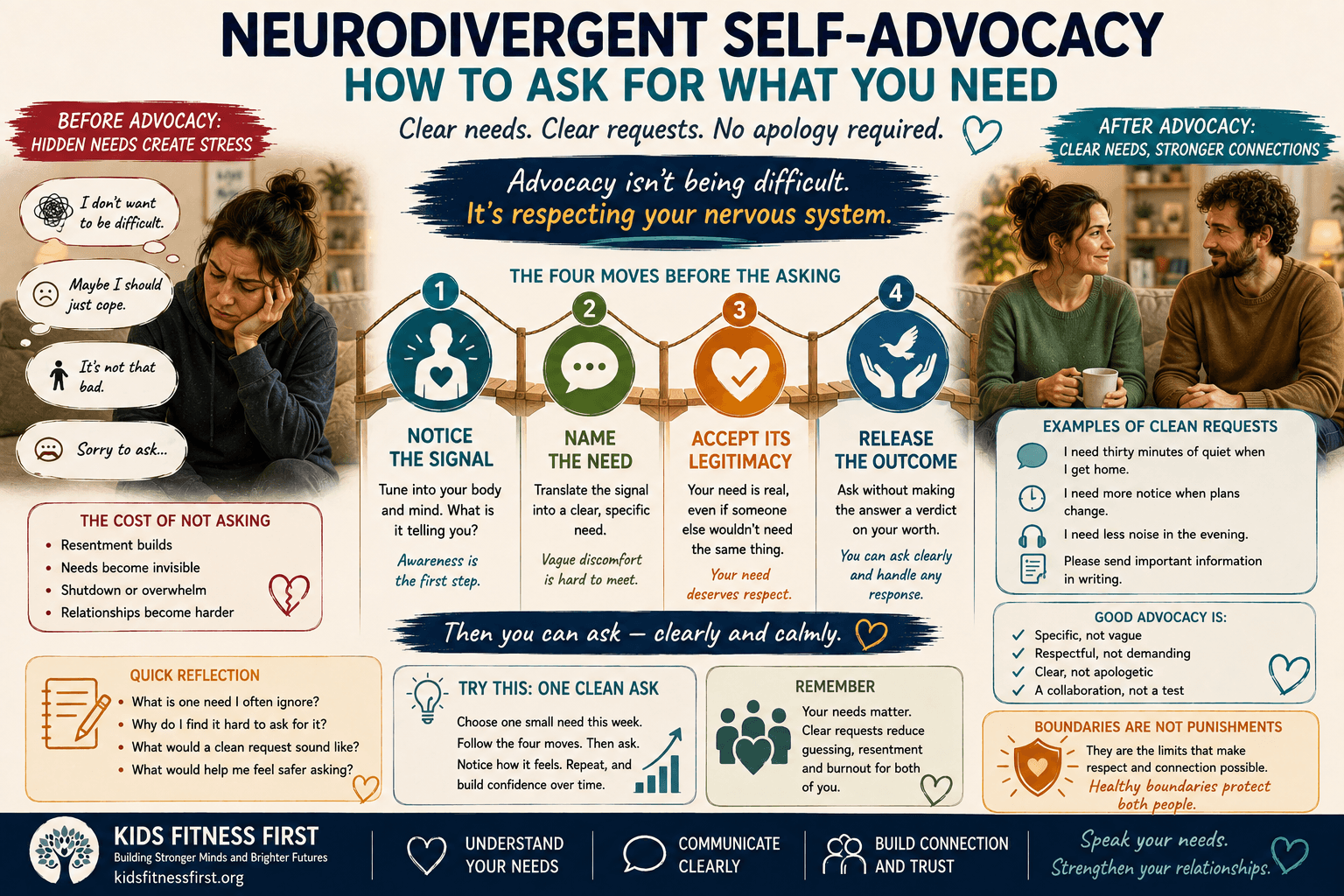
The Four Moves Before The Asking.
They are:
- Notice the signal
- Name the need
- Accept its legitimacy
- Release the outcome
Only after those four internal steps does the actual asking become possible.
Therefore, if you repeatedly struggle to advocate for yourself, the problem may not be your communication technique.
Instead, one of these earlier moves may be missing.
The Four Moves Before The Asking
Move 1: Notice the Signal
Before you can ask for something, you first need to know that you need something.
That sounds obvious.
However, for many neurodivergent adults, the signals have become faint.
Perhaps you do not notice that the room is overwhelming until you are already irritable.
Likewise, you may not realise that you are exhausted until you suddenly cannot speak to anyone.
Perhaps hunger arrives as anger.
Sensory overload arrives as a need to escape.
Social exhaustion arrives as unexplained sadness.
Therefore, the first step in neurodivergent self-advocacy is not speaking.
It is listening.
Ask:
What is my body telling me right now?
For example:
- Are my shoulders tight?
- Am I holding my breath?
- Is my jaw tense?
- Am I hungry?
- Am I too warm?
- Is the room too loud?
- Am I exhausted?
- Do I need movement?
- Do I need quiet?
- Do I need connection?
- Do I need to stop?
At first, you may have few answers.
That is okay.
However, asking the question repeatedly begins rebuilding the connection.
Over time, you may notice the signal sooner.
Instead of realising three hours later that you were overwhelmed, you begin recognising it while it is happening.
That changes everything.
A Simple Body Check-In
Try this now.
Stop reading for ten seconds.
Then notice:
Shoulders: relaxed or tense?
Breathing: deep, shallow or held?
Eyes: comfortable or tired?
Stomach: neutral, hungry or unsettled?
Temperature: comfortable, warm or cold?
Mind: calm, busy or overloaded?
Social capacity: available or depleted?
Finally, ask:
What is one thing my body may be asking for right now?
Do not judge the answer.
Instead, simply notice it.
That is Move One.
Move 2: Name the Need
Once you notice a signal, the next step is translation.
For example:
Signal: “I feel bad.”
That is useful information.
However, it is still too vague to advocate from.
Therefore, move closer.
Perhaps:
“I feel overwhelmed.”
Then closer again:
“I have been around people and noise for six hours.”
Finally:
“I need thirty minutes alone in a quiet room before I can continue talking.”
Now the need is specific.
That matters because specific needs are easier to communicate.
Compare:
“I can’t cope.”
with:
“I need twenty minutes of silence.”
Likewise, compare:
“Everything is too much.”
with:
“I can deal with this conversation, but I need us to discuss one issue at a time.”
The clearer the need, the clearer the request.
Therefore, Move Two is about moving from vague discomfort towards something concrete.
Examples of Naming the Need
| Vague Signal | More Specific Need |
|---|---|
| “I feel awful.” | “I am overstimulated.” |
| “Leave me alone.” | “I need twenty minutes without conversation.” |
| “I can’t deal with this.” | “I need one issue at a time.” |
| “I’m stressed.” | “I need the plan written down.” |
| “This is too much.” | “I need fewer people around me right now.” |
| “I don’t want to go.” | “I do not have enough social capacity for another event this weekend.” |
Specific language does not make the need more demanding.
Instead, it makes the need easier to understand.
Move 3: Accept That the Need Is Legitimate
This move is often the hidden one.
You have noticed the signal.
You have named the need.
However, now another voice appears:
“But is this reasonable?”
Perhaps:
“Other people can cope.”
“I should be able to do this.”
“I’m making a fuss.”
“My partner already does enough.”
“I don’t want to be difficult.”
At this point, many requests disappear.
Therefore, Move Three is the internal decision:
My need is real even if another person would not have the same need.
This does not mean every need must automatically be granted.
Likewise, it does not mean other people’s needs disappear.
However, your need does not have to pass a test of neurotypicality before it becomes valid.
For example, perhaps you need:
- more notice before plans change;
- written information rather than verbal instructions;
- silence after work;
- fewer social commitments;
- direct language rather than hints;
- help with a literacy-heavy task;
- separate time;
- or reduced sensory input.
Another person may not need any of those things.
Nevertheless, that does not make your need fictional.
A Need Is Not the Same as a Demand
This distinction is important.
Self-advocacy says:
“I need thirty minutes of quiet after work.”
A demand says:
“Everybody in this house must stop what they are doing whenever I arrive.”
Those are not the same.
Likewise:
“I need advance notice wherever possible.”
is different from:
“Nothing is ever allowed to change.”
Therefore, accepting the legitimacy of your need does not mean insisting that everybody else must automatically reorganise around it.
Instead, it means allowing the need into the conversation without shame.
That is a healthier starting point.
Move 4: Release the Outcome
This may be the most mature part of self-advocacy.
You recognise the need.
You accept its legitimacy.
Then you ask clearly.
However, the other person may still say no.
Or they may say:
“Not exactly, but could we do this instead?”
Self-advocacy does not guarantee agreement.
Therefore, the fourth move is releasing the belief that the answer determines whether your need was valid.
For example:
You say:
“I need quiet tonight.”
Your partner may reply:
“I understand. However, we already have family coming at seven. Could you take forty minutes alone before they arrive?”
That is negotiation.
Your need remains real.
Their commitments also remain real.
Therefore, clean advocacy makes space for both.
This is very different from asking in a way that secretly means:
“If you love me, you must say yes.”
The Four Moves at a Glance
| Move | Internal Question | Example |
| 1. Notice the Signal | What is happening in my body or mind? | “I am becoming overloaded.” |
| 2. Name the Need | What specifically would help? | “I need thirty minutes of quiet.” |
| 3. Accept Its Legitimacy | Am I allowing myself to need this? | “This need is real even if yours is different.” |
| 4. Release the Outcome | Can I ask without making the answer a verdict on me? | “I can ask clearly and then negotiate.” |
These four moves transform the request.
Instead of:
“Sorry, would it maybe be okay if…”
the request becomes:
“I need thirty minutes of quiet when I get home. Can we make that work?”
Clear.
Respectful.
Adult.
ADHD Self-Advocacy
For some ADHD adults, advocacy may centre on executive function and regulation.
For example, you may need:
- reminders;
- written plans;
- fewer simultaneous requests;
- transition time;
- external systems;
- movement;
- or shorter conversations.
However, shame may make those requests feel like evidence that you are incapable.
Therefore, instead of asking, you try to manage alone.
Eventually, the system fails.
Consequently, everyone deals with the larger problem.
Self-advocacy can therefore sound like:
“If something is important, I need it in the shared calendar rather than only discussed verbally.”
That is not weakness.
Instead, it is system design.
Autistic Self-Advocacy
For autistic adults, self-advocacy may often involve sensory, social or predictability needs.
For example:
“I need advance notice before people come to the house.”
“I need direct wording rather than hints.”
“I can do the family event on Saturday, but I need Sunday without plans.”
Again, the request may feel difficult if you have spent years masking.
However, masking the need does not remove the cost.
It simply delays it.
Therefore, clear advocacy can reduce the later shutdown, exhaustion or withdrawal that occurs when the need stays invisible.
Dyslexia and Self-Advocacy
For dyslexic adults, advocacy may include asking for information in a form that reduces unnecessary cognitive load.
For example:
“Can you explain the main points verbally first?”
Or:
“Please send me the important dates separately rather than inside the long document.”
Likewise:
“I need more time to read this properly before I respond.”
Those are practical requests.
However, years of being judged around reading, writing or administration can make them feel exposing.
Therefore, accepting legitimacy is especially important.
The request does not mean:
“I am incapable.”
Instead, it means:
“I know how I process information best.”
Clean Advocacy Versus Apologetic Advocacy
Consider the difference.
Apologetic:
“I’m really sorry, and I know you’ve had a long day, and I don’t want to be difficult, but I was just wondering if maybe I could have a little bit of time to myself?”
Clean:
“I need half an hour alone when I get home. After that, I can reconnect.”
The second version may initially feel abrupt.
However, it is also clearer.
Likewise, it is easier for the other person to answer.
Importantly, clarity does not require coldness.
You can say:
“I love you, and I need half an hour alone when I get home. After that, let’s have dinner together.”
That is both connected and specific.
Why Unspoken Needs Often Become Resentment
When you repeatedly avoid asking, the need does not vanish.
Instead, you continue paying for it.
Perhaps you attend the event.
However, you are exhausted afterwards.
You take the phone call.
Nevertheless, you resent being interrupted.
You stay in the noisy room.
Consequently, you become irritable.
Over time, another thought may appear:
“Why don’t they understand what I need?”
But perhaps you never clearly told them.
This is painful but important.
People who love us cannot reliably meet needs that remain hidden.
Therefore, self-advocacy protects both people.
It reduces guessing.
It also reduces the expectation that love should produce mind-reading.
Reflection: What Need Have You Been Hiding?
Pause here.
Think about the last month.
Now identify one recurring situation in which you regularly feel uncomfortable, depleted or resentful.
Perhaps it is:
- coming home from work;
- family visits;
- weekends;
- phone calls;
- household administration;
- social events;
- noise;
- conversations late at night;
- last-minute plans;
- or being asked several questions at once.
Now answer these questions.
1. What is the signal?
What happens first?
For example:
- tension;
- irritability;
- exhaustion;
- headache;
- withdrawal;
- racing thoughts;
- shutting down;
- or wanting to escape.
2. What is the actual need?
Move from vague to specific.
Not:
“I need things to be easier.”
Instead:
“I need one evening a week without social plans.”
Or:
“I need fifteen minutes between getting home and talking about household problems.”
3. Do I believe I am allowed to need this?
If not, finish this sentence:
“I believe asking for this would make me…”
Perhaps:
selfish.
difficult.
weak.
demanding.
lazy.
unreasonable.
Now ask:
Is that fact, or is that an old rule?
4. What is the clean version of the request?
Write it without:
- sorry;
- maybe;
- just;
- if it’s not too much trouble;
- I know I’m difficult;
- or excessive explanation.
For example:
“I need thirty minutes of quiet after work before we talk about the evening.”
5. What outcome am I trying to control?
Are you afraid that a no would mean:
- they do not love you;
- your need is unreasonable;
- you were wrong to ask;
- or you are too much?
Remember:
A request can be valid even if negotiation is needed.
Reflection Takeaway
Complete this sentence:
“My need does not become legitimate only when someone else agrees with it.”
Then write:
“I can notice it, name it, respect it and communicate it.”
That is self-advocacy.
Try This: One Clean Ask
Choose one small need.
Do not start with the most emotionally difficult issue in your relationship.
Instead, choose something manageable.
For example:
- ten minutes of quiet;
- a written reminder;
- a change from phone call to text;
- one fewer social commitment;
- direct wording;
- advance notice;
- or a specific household adjustment.
Then follow the Four Moves.
Step 1: Notice
Write down the signal.
Step 2: Name
Write the exact need.
Step 3: Legitimate
Write one sentence explaining why the need is real without defending it.
For example:
“Noise drains my capacity quickly.”
Step 4: Release
Write:
“The other person can respond honestly. Their response does not determine whether my need was real.”
Then make the request.
Keep it short.
For example:
“I need important plans in writing. Can we put them in the shared calendar when we agree them?”
Afterwards, notice how your body feels.
Did shame appear?
Did you over-explain?
Did you apologise?
Did the request actually land more clearly?
Repeat this with one small request each week.
Over time, clean asking becomes less unfamiliar.
Boundaries Are Not Punishments
Self-advocacy also includes boundaries.
However, boundaries are often misunderstood.
A boundary is not:
“You are not allowed to do that.”
Instead, a boundary describes what you will do in response to a situation.
For example:
“If the conversation becomes shouting, I will pause it and return when we are calmer.”
Likewise:
“I am not available for social plans every weekend.”
Or:
“I will not discuss major relationship issues after midnight.”
The boundary is about your participation.
Therefore, it is different from controlling another person’s behaviour.
This distinction keeps advocacy grounded.
Self-Advocacy and Compromise Can Coexist
Sometimes neurodivergent people fear that advocacy means demanding perfect conditions.
It does not.
Instead, advocacy makes negotiation more honest.
For example, one partner may need spontaneity.
The other may need predictability.
Therefore, they may agree:
“Saturday morning is planned. Saturday afternoon stays flexible.”
Likewise, one partner may need quiet after work.
The other may need connection.
Therefore, they agree:
“Thirty minutes alone, then dinner together.”
Neither person gets everything.
However, both nervous systems are represented.
That is the point.
The Cost of Waiting Until Crisis
One reason advocacy matters is timing.
If you wait until the need becomes unbearable, the request may come out as anger.
For example:
You tolerate noise for three hours.
Then suddenly shout:
“Can everybody just be quiet?”
From outside, that looks disproportionate.
However, the nervous system may have been signalling for hours.
Therefore, early advocacy is often gentler advocacy.
Saying:
“I’m reaching my limit. I need twenty minutes somewhere quiet.”
is easier for everyone than waiting until the nervous system has already gone past capacity.
That is why Move One matters so much.
Advocacy Is Not a Diagnosis Speech
You do not always need to explain your diagnosis in order to ask.
For example, you may be tempted to say:
“Because I have ADHD, my executive function means…”
Sometimes explanation is useful.
However, often the request is enough.
For example:
“Please put the date in writing so I don’t lose it.”
Likewise:
“I need ten minutes before I answer.”
The other person does not always need a neurological lecture.
Instead, they often need clear information about what will help.
That keeps advocacy practical.
From “Can I?” to “This Is What Helps Me”
Another shift is moving from permission language towards information language.
Instead of:
“Would it be okay if I needed a bit of quiet?”
try:
“Quiet helps me reset after work.”
Then ask:
“Can we build thirty minutes of that into the evening?”
Likewise, instead of:
“Is it unreasonable to ask you to text me?”
try:
“I process information better in writing. Please text important arrangements.”
That does not mean becoming rigid.
However, it does mean communicating from self-knowledge rather than self-doubt.
What If the Other Person Thinks Your Need Is Unreasonable?
This is where Move Four becomes important.
Sometimes the other person may genuinely disagree.
For example:
You need fewer social events.
Your partner values a busy social life.
Neither need disappears.
Therefore, the conversation becomes one of negotiation.
Perhaps:
- you attend fewer events;
- your partner attends some alone;
- you leave earlier;
- or you plan recovery time afterwards.
Self-advocacy does not mean winning.
Instead, it means ensuring your nervous system has a seat at the table.
Without advocacy, negotiation cannot even begin.
Accountability and Advocacy Are Two Directions of the Same Skill
Article 7 focused on accountability.
It asked:
What have I done that affected somebody else, and how do I repair it?
Article 8 turns the same adult capacity around.
Now the question is:
What do I need, and how do I communicate it honestly?
These two skills belong together.
If you only advocate and never take accountability, the relationship becomes one-sided.
However, if you only take accountability and never advocate, you disappear.
Therefore, healthy partnership requires both.
You can say:
“I was wrong there.”
and:
“I need something here.”
Neither sentence diminishes you.
Together, they allow you to participate as an adult equal.
Conclusion: Ask Clearly, Without Disappearing
Neurodivergent self-advocacy is not about becoming louder.
Instead, it is about becoming clearer.
First, notice the signal.
Then name the need.
Next, accept that the need is legitimate.
Finally, release the outcome enough to ask without making your worth depend on the answer.
Only then do you speak.
Perhaps the sentence is:
“I need half an hour of silence.”
Or:
“I need this written down.”
Or:
“I need more notice.”
Or:
“I cannot do another social event this weekend.”
The words may be simple.
However, for somebody who has spent decades apologising before every request, those words can represent enormous change.
Most importantly, remember:
A need is not an accusation.
A request is not a demand.
A boundary is not a punishment.
And asking clearly does not make you difficult.
It makes you visible.
That is what self-advocacy is for.
SUGGESTED INTERNAL LINKS
Article 1: Neurodivergent Relationship Repair: When You Hurt the People You Love
Article 2: Neurodivergent Understanding: Why Being Truly Seen Can Feel Uncomfortable
DISCLAIMER
This article is provided for general educational and informational purposes only. It is not medical, psychological, diagnostic, legal or therapeutic advice and should not replace individual support from an appropriately qualified professional.
Neurodivergent people are individuals. Therefore, ADHD, autism, dyslexia and other neurodivergent experiences should not be assumed to create identical needs or relationship patterns.
Self-advocacy does not require another person to agree to every request. Likewise, it should not be used to justify controlling, coercive or harmful behaviour. Healthy advocacy includes communication, negotiation, accountability and respect for both people’s needs.