
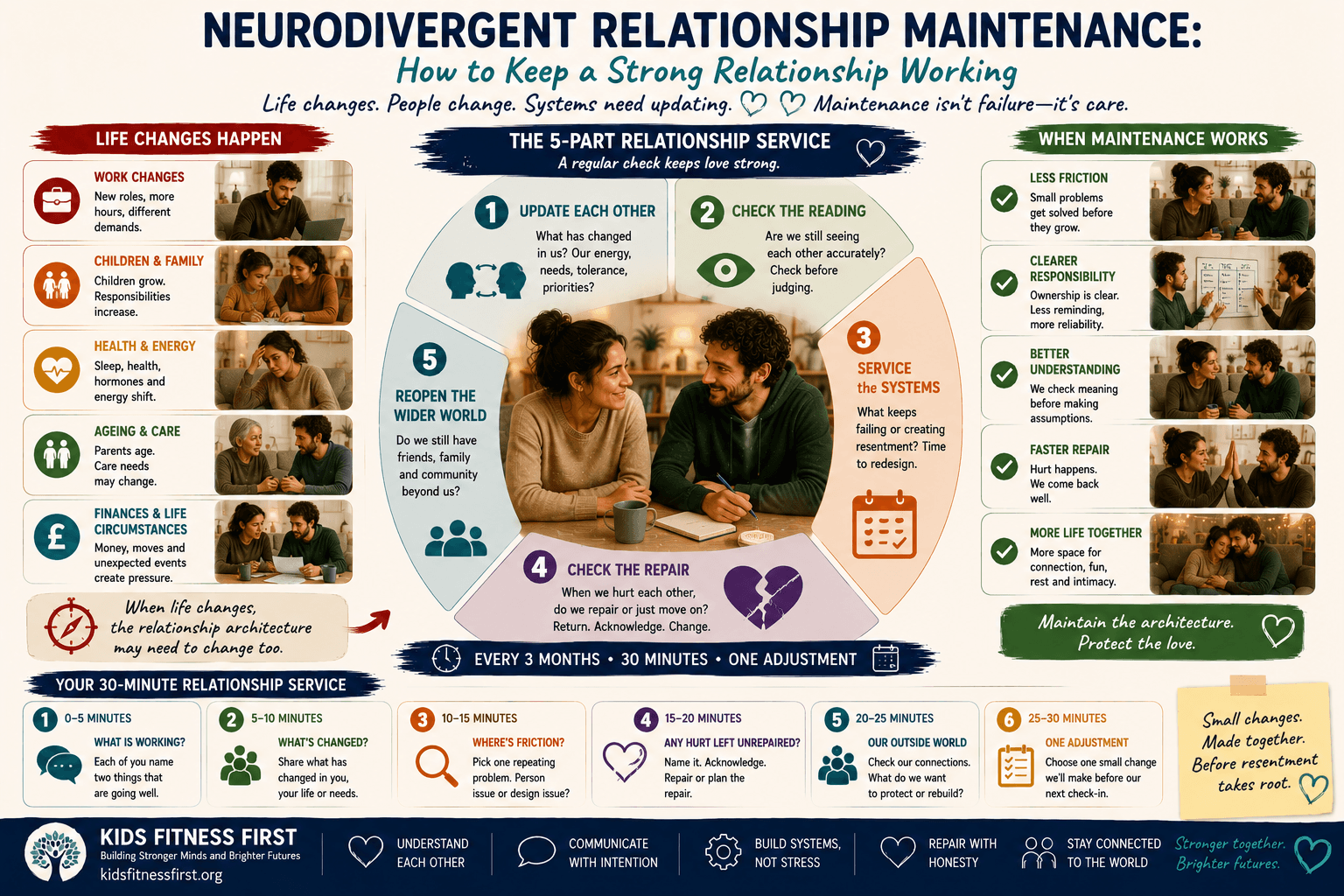
Neurodivergent Relationship Maintenance: How to Keep a Strong Relationship Working
Neurodivergent relationship maintenance often becomes necessary just when you think everything has finally started working.
Perhaps you have built the shared calendar. Likewise, responsibilities may have become clearer, communication may have improved, and arguments may repair faster.
However, life rarely stays still.
A new job begins. Meanwhile, a child enters a demanding school year. Perhaps one partner starts caring for an ageing parent. Alternatively, health, sleep, finances or energy levels may change.
As a result, something that worked beautifully for several years may suddenly begin failing.
At first, that failure can feel personal.
You may wonder:
“Why are we slipping backwards?”
However, another explanation may be more accurate:
The people changed. The circumstances changed. Therefore, the system now needs to change too.
This page is about ongoing maintenance once a workable relationship structure already exists. If you are still building that structure, start with the Neurodivergent Relationship Blueprint. During periods when both partners have very little capacity, use the separate Low-Capacity Plan.
That distinction matters.
A strong relationship is not one that discovers one perfect system and then keeps it forever. Instead, a strong relationship notices when the old system no longer fits and redesigns it together.
A Good Relationship Is Not a Finished Relationship
We often talk about relationships as though success means reaching a stable destination.
First, you solve the communication problem. Then, you divide household responsibilities. Afterwards, you understand each other’s neurodivergence and establish clearer boundaries.
However, real relationships do not remain frozen at that point.
For example, a system that works before children may fail after children arrive. Likewise, something that works during a quiet period may no longer work during illness, bereavement, career change or financial pressure.
Therefore, maintenance is not evidence that something went wrong.
Instead, maintenance is evidence that the relationship is adapting to real life.
Consider a house.
A well-built house still needs repairs. Moreover, it may eventually need new heating, different furniture, replacement appliances or substantial renovation.
Nobody says:
“This house was obviously badly built because the boiler needed replacing twenty years later.”
Nevertheless, couples sometimes think this way about relationships.
They say:
“We solved this five years ago. Why are we dealing with it again?”
The answer may simply be:
Because life changed.
Therefore, the earlier work was not wasted. It simply belongs to an earlier version of your life.
The Five Areas That Need Regular Maintenance
Article 15 introduced five foundations in the Relationship Blueprint.
They were:
- Two people doing their own work
- Accurate mutual recognition
- Shared practical architecture
- Honest repair after rupture
- A breathable ecology
Now, however, the question changes.
Instead of asking:
“Do we have these foundations?”
ask:
“Do these foundations still work for the lives we have today?”
That is the heart of relationship maintenance.
1. Has Either Person Changed?
First, look at the individuals.
Your partner today is not exactly the person you met ten or twenty years ago. Likewise, you are not exactly the same person either.
Therefore, ask:
What has changed inside each of us?
Perhaps somebody understands their neurodivergence more clearly now. Alternatively, their tolerance for noise, social demands or unpredictability may have changed.
Moreover, medication, health, employment, hormones or ageing may have altered attention, mood or energy.
For example, one partner who previously enjoyed constant activity may now need more quiet. Meanwhile, the person who historically carried most of the household organisation may no longer have enough capacity to continue doing so.
These changes matter.
However, long-term couples can accidentally continue relating to outdated versions of each other.
You may still think:
“You are the organised one.”
But are they still able to carry that role?
Likewise, you may say:
“You never enjoy social events.”
Yet perhaps that is no longer completely true.
Therefore, relationship maintenance begins by updating what you know about each other.
Stop Treating Old Knowledge as Permanent Knowledge
Long-term familiarity can feel comforting.
However, familiarity can also create assumptions.
You think:
“I know this person.”
And, of course, you do.
Nevertheless, people change.
Therefore, occasionally ask questions that you think you already know the answers to.
For example:
“What drains you most at the moment?”
“What part of our week currently feels hardest?”
“What do you need more of now?”
“What has stopped working for you?”
“What are you enjoying more than you used to?”
Sometimes the answers will surprise you.
Most importantly, these questions keep curiosity alive.
2. Are You Still Reading Each Other Accurately?
Next, examine interpretation.
Earlier Book Five articles explored how easily behaviour can be misread.
For example, forgetting can become:
“You don’t care.”
Likewise, silence can become:
“You are rejecting me.”
Meanwhile, exhaustion can become:
“You are not interested anymore.”
However, even couples who understand these patterns can slip back into old interpretations during stressful periods.
Why?
Because stress reduces curiosity.
As a result, familiar stories return.
You may begin saying:
“You always…”
“You never…”
“Here we go again…”
“You obviously don’t care…”
These phrases are useful warning signs.
In other words, the person may have stopped investigating and started concluding.
Replace Certainty With One Question
When you notice yourself making an automatic interpretation, ask:
“What else could be happening?”
This does not mean your first interpretation is necessarily wrong.
Instead, it means that your first interpretation may be incomplete.
For example:
Observed behaviour: Your partner is unusually quiet.
Immediate story: “They are angry with me.”
Better question: “Are you upset with me, or are you overloaded?”
That single question may prevent an unnecessary argument.
Therefore, accurate mutual recognition is not something a couple achieves once.
It is an ongoing habit of checking before judging.
3. Do Your Practical Systems Still Fit?
The third maintenance area is practical architecture.
Often, this is where strain appears first.
Perhaps the shared calendar once worked perfectly. However, your children may now have several activities each week.
Maybe one partner changed jobs. Consequently, the old routine no longer matches the household.
Likewise, a system designed for two working adults may collapse once elderly parents also need support.
The mistake is continuing to demand more effort from a system that no longer fits reality.
Therefore, ask:
“What keeps failing repeatedly?”
Do not immediately ask:
“Who keeps failing?”
That difference is crucial.
Repeated Failure Is Often Design Information
Suppose school messages keep being missed.
One response is:
“Why can’t you remember to check them?”
However, another response is:
“Our current school-message system is unreliable.”
The second response opens possibilities.
For example:
- notifications may need changing;
- ownership may need changing;
- messages may need forwarding;
- a daily check may need scheduling;
- or the task may suit a different partner better.
Likewise, if household administration has again become concentrated in one person’s head, the Invisible Labour Map may need revisiting.
Therefore, repeated failure should often be treated as design information rather than immediate evidence of bad character.
Three Signs a System Needs Updating
A practical system probably needs attention when three patterns appear repeatedly.
First, reminders are becoming personal again.
For example:
“Did you remember?”
“Have you done it?”
“Why haven’t you…?”
Second, one person has quietly become the backup again.
Although the task technically belongs to the other person, one partner is still monitoring it.
Finally, resentment begins returning around something that was supposedly solved.
Consequently, the real issue may be:
ownership has drifted again.
Therefore, do not wait for a major argument.
Treat repeated friction as useful maintenance information.
4. Is Repair Still Happening?
Healthy couples do not stop hurting each other completely.
Instead, they become more skilled at returning after hurt.
However, repair can weaken during stressful periods.
At first, you may have said:
“I spoke sharply. That wasn’t okay.”
Later, the language may become:
“Well, we were both tired.”
Eventually, nobody repairs at all.
Instead, enough time simply passes.
For small irritation, this may occasionally be fine.
However, repeated genuine hurt tends to accumulate when it is never addressed.
Therefore, maintenance should include one simple question:
“When we hurt each other now, do we actually come back?”
Returning Is Different From Merely Moving On
Moving on means enough time passed that nobody wanted to continue the argument.
By contrast, repair means something actively happened afterwards.
For example:
- somebody acknowledged the harm;
- ownership was taken;
- clarification occurred;
- an apology was offered;
- a practical repair was made;
- or behaviour changed.
Therefore, if you are merely moving on more often than repairing, that is a maintenance signal.
However, it does not mean the relationship is failing.
It simply means a useful skill may need attention again.
Watch for Apology Inflation
Another warning sign is repeated apology without behavioural change.
For example:
“I’m sorry.”
Then the same problem happens again.
Afterwards, the apology becomes:
“I’m really sorry.”
Then it happens again.
Eventually, the apology becomes more emotional while the behaviour remains unchanged.
Therefore, remember:
A stronger apology does not automatically create a stronger repair.
Sometimes the relationship needs a stronger system instead.
5. Has Your World Become Too Small Again?
Finally, examine the wider social world.
Article 14 introduced the Inward Drift.
However, outside connections are easy to lose during difficult periods.
For example, children may need more time. Meanwhile, work may become demanding. Perhaps health changes or financial pressure reduces social activity.
Therefore, friendships are postponed.
Community involvement stops.
Couple friendships fade.
At first, this may be completely necessary.
Nevertheless, temporary contraction can quietly become permanent.
Therefore, every few months ask:
“Who exists in our lives beyond us?”
Not because you need a large social circle.
Instead, because a relationship benefits from some air around it.
Maintenance Does Not Mean Restoring an Old Life
Perhaps you had six close friends twenty years ago.
That does not mean you need six close friends now.
Instead, ask:
“What wider social ecology supports us at this stage of life?”
For example, perhaps the answer is:
- one individual friend;
- one close relative;
- one community activity;
- one shared friendship.
That may be enough.
Therefore, design for your current life rather than trying to recreate a previous one.
The Five-Part Maintenance Check
Every three months, review these five areas:
| Area | Maintenance Question |
|---|---|
| Individual Work | Have either of us changed in ways the relationship has not yet recognised? |
| Mutual Recognition | Are we still checking meaning before judging behaviour? |
| Practical Architecture | Which system keeps failing or creating resentment? |
| Repair | Are we repairing hurt or simply waiting for it to fade? |
| Breathable Ecology | Do we still have a meaningful world beyond each other? |
You do not need a lengthy relationship summit.
In fact, twenty or thirty minutes may be enough.
The goal is not to search for problems.
Instead, the goal is to notice small misalignments before they become large ones.
Maintenance Is Not Constant Relationship Analysis
There is an important difference between maintenance and over-analysis.
Some couples can accidentally turn relationship work into the whole relationship.
Every dinner becomes:
“How are we doing?”
Every disagreement becomes a framework.
Consequently, nobody is simply enjoying the relationship anymore.
That is not the goal.
Therefore, relationship maintenance should be periodic rather than constant.
For example, schedule a quarterly check-in.
Then, between those reviews, live.
That structure allows the relationship to receive attention without becoming a full-time project.
Schedule Maintenance So You Can Forget About It
A quarterly review can work well.
For example:
- January;
- April;
- July;
- October.
Put the dates in the shared calendar.
Therefore, neither person needs to continually carry the thought:
“We should probably talk about the relationship sometime.”
The calendar carries it.
Again, structure reduces mental load.
Reflection: What Has Changed Since Your Systems Were Built?
Pause here.
Think about your relationship twelve months ago.
Then, compare it with today.
Do not begin with what is wrong.
Instead, begin with what changed.
What Changed in You?
Perhaps your:
- energy changed;
- health changed;
- workload changed;
- confidence changed;
- sensory needs changed;
- boundaries changed;
- or understanding of your neurodivergence changed.
Complete:
“Something about me that is different now is…”
Then complete:
“Our relationship may not yet have adjusted to that because…”
This question can reveal where an outdated system remains in place.
What Changed in Your Partner?
Next, consider your partner.
Perhaps they have:
- less capacity;
- different priorities;
- greater need for quiet;
- more desire for connection;
- increased confidence;
- or different responsibilities.
However, do not assume you know the answer completely.
Ask them.
Then complete:
“I may still be relating to an older version of you when I assume…”
That sentence can be surprisingly powerful.
What Changed Around You?
Sometimes the biggest change belongs to neither person individually.
Instead, life changed around both of you.
For example:
- children became teenagers;
- employment changed;
- money became tighter;
- family care increased;
- health changed;
- or you moved house.
Therefore, ask:
“Which old system was designed for a life we no longer live?”
Often, that question identifies the maintenance issue quickly.
Which Foundation Is Strongest?
Choose one:
- individual work;
- mutual recognition;
- practical architecture;
- repair;
- wider ecology.
Then ask:
“What are we doing that keeps this strong?”
Do not skip this part.
After all, maintenance should protect what already works as well as repair what does not.
Which Foundation Needs Attention?
Now choose only one weaker area.
Then complete:
“The smallest useful change would be…”
For example:
“No serious conversations after 10pm.”
Or:
“School messages go directly into the shared calendar.”
Or:
“We will each contact one friend this month.”
Small changes are usually easier to sustain.
Reflection Takeaway
Complete this sentence:
“We are not necessarily going backwards. Instead, our life has changed, and our relationship now needs…”
Perhaps:
- a new system;
- more recovery;
- clearer ownership;
- more connection;
- more independence;
- better repair;
- or a wider outside world.
This reframes failure as redesign.
Try This: The 30-Minute Relationship Service
Think of this as a service rather than a summit.
Set a timer for thirty minutes.
Then, move through six short stages.
Minutes 0–5: What Is Working?
First, each person names two things that currently work.
For example:
“The shared calendar has made mornings easier.”
Or:
“We are repairing arguments faster.”
Do not immediately add:
“but…”
Instead, let the strength stand on its own.
Minutes 5–10: What Has Changed?
Next, each person answers:
“What has changed in my capacity, needs or life since our last check-in?”
Listen first.
Do not solve yet.
Minutes 10–15: Where Is Friction Repeating?
Then identify one recurring area of friction.
Perhaps:
- mornings;
- money;
- household work;
- communication;
- social plans;
- intimacy;
- or parenting.
Now ask:
“Is this mainly a person problem, a system problem, or both?”
Often, the answer will include design.
Minutes 15–20: Is Anything Unrepaired?
Next, ask:
“Is there anything small between us that we moved past but never actually repaired?”
If a large historical issue appears, schedule a separate discussion.
Instead, use this review for something manageable.
Minutes 20–25: What About Our Wider World?
Then ask:
“Are we still connected to people beyond the relationship?”
If not, choose one small action.
For example, send one message.
That may be enough.
Minutes 25–30: Choose One Adjustment
Finally, choose one action.
Only one.
For example:
“From Monday, I own the school administration.”
Or:
“We protect thirty minutes of quiet after work.”
Or:
“Sunday morning becomes phone-free coffee together.”
Write the adjustment down.
Then stop.
Most importantly, do not turn a thirty-minute service into a two-hour relationship summit.
What If Everything Feels Weak?
Sometimes several areas may be struggling simultaneously.
Perhaps both people are exhausted.
Meanwhile, systems are failing.
Repair has become slower.
Likewise, the outside world may have disappeared.
In that situation, attempting to fix everything at once will probably create more overwhelm.
Therefore, ask:
“Which change would create the most immediate relief?”
Start there.
For example, if sleep deprivation is driving most conflict, redesigning communication may not be the first priority.
Likewise, if invisible labour is overwhelming one partner, rebuilding friendships may need to wait briefly.
Therefore, stabilise first and rebuild afterwards.
Celebrate Maintenance That Prevents Drama
Relationship success is often invisible.
For example:
“We noticed the old system was failing and changed it before resentment built up.”
That is not dramatic.
However, it is highly valuable.
Likewise:
“We recognised that both of us were exhausted and cancelled something unnecessary.”
Again, not dramatic.
Nevertheless, that decision may prevent an argument.
Or:
“We realised we’d stopped seeing friends and arranged one quiet dinner.”
Small action.
Potentially large benefit.
Therefore, healthy relationship maintenance often looks ordinary precisely because it prevents the crisis that would otherwise become visible.
Relationship Maintenance Across Life Stages
The same five foundations may look different across decades.
For example:
Early relationship: learning each other’s nervous systems.
Young family: building practical architecture around children and depleted capacity.
Midlife: reassessing workload, health, identity and friendships.
Later life: redesigning routines after retirement, changing health or children leaving home.
Therefore, do not expect the version of your relationship that worked at thirty-five to look identical at sixty-five.
The people change.
The demands change.
However, the five foundations can still guide the redesign.
Relationship Work Should Create More Life
This may be the best test of all.
Ask:
“Is the work we are doing on our relationship creating more room to enjoy the relationship?”
If the answer is no, reconsider the process.
The purpose of:
- calendars;
- communication systems;
- repair protocols;
- household architecture;
- and regular check-ins
is not to transform your partnership into a management project.
Instead, these structures should reduce unnecessary friction.
Consequently, more room becomes available for:
- affection;
- humour;
- intimacy;
- shared interests;
- quiet evenings;
- curiosity;
- and ordinary life.
Eventually, the best systems fade into the background.
You stop noticing them because they work.
That is exactly what good relationship architecture should do.
Conclusion: Strong Relationships Are Maintained, Not Finished
Neurodivergent relationship maintenance is not evidence that your partnership is failing.
Instead, it recognises that two nervous systems and one shared life continue to change.
Therefore:
First, update what you know about each other.
Next, check whether you are still reading each other’s behaviour accurately.
Then, redesign systems that no longer fit.
Afterwards, make sure repair is still happening.
Finally, protect some connection to the wider world.
Then return to living.
Most importantly, stop treating every recurrence of an old problem as proof that all your earlier work failed.
Sometimes an old difficulty returns because the old system belonged to a life you no longer have.
Therefore, instead of asking:
“Why are we back here?”
ask:
“What changed, and what needs redesigning now?”
That question contains far more possibility.
Because a long relationship is not created by finding one perfect arrangement.
Instead, it is created by two adults who keep noticing when the arrangement needs to evolve — and who are willing to evolve it together.
This revision deliberately puts recognised transition words into well over one-third of the prose sentences, with many sections closer to half.
Use this revised version to replace the Article 16 body text. The SEO fields, Featured Image SEO, internal links and disclaimer from the existing Article 16 can stay unchanged.
SUGGESTED INTERNAL LINKS
Article 7: Neurodivergent Relationship Repair: When You Hurt the People You Love
Article 9: Understanding Your Neurodivergent Partner: 4 Behaviours You May Be Misreading
DISCLAIMER
This article is provided for general educational and informational purposes only. It is not medical, psychological, diagnostic, relationship or couples-therapy advice.
Neurodivergent people and relationships vary considerably. Therefore, relationship systems and maintenance routines should be adapted to the specific people, circumstances and nervous systems involved.
The maintenance framework in this article is an extension derived from the five-element Relationship Blueprint in the final Book Five manuscript; it is not a separate Chapter 16 from the book, because the manuscript ends at Chapter 15.
Where relationships involve persistent harmful behaviour, coercion, intimidation, abuse or safety concerns, ordinary relationship-maintenance frameworks may not be appropriate and qualified professional support may be necessary.