
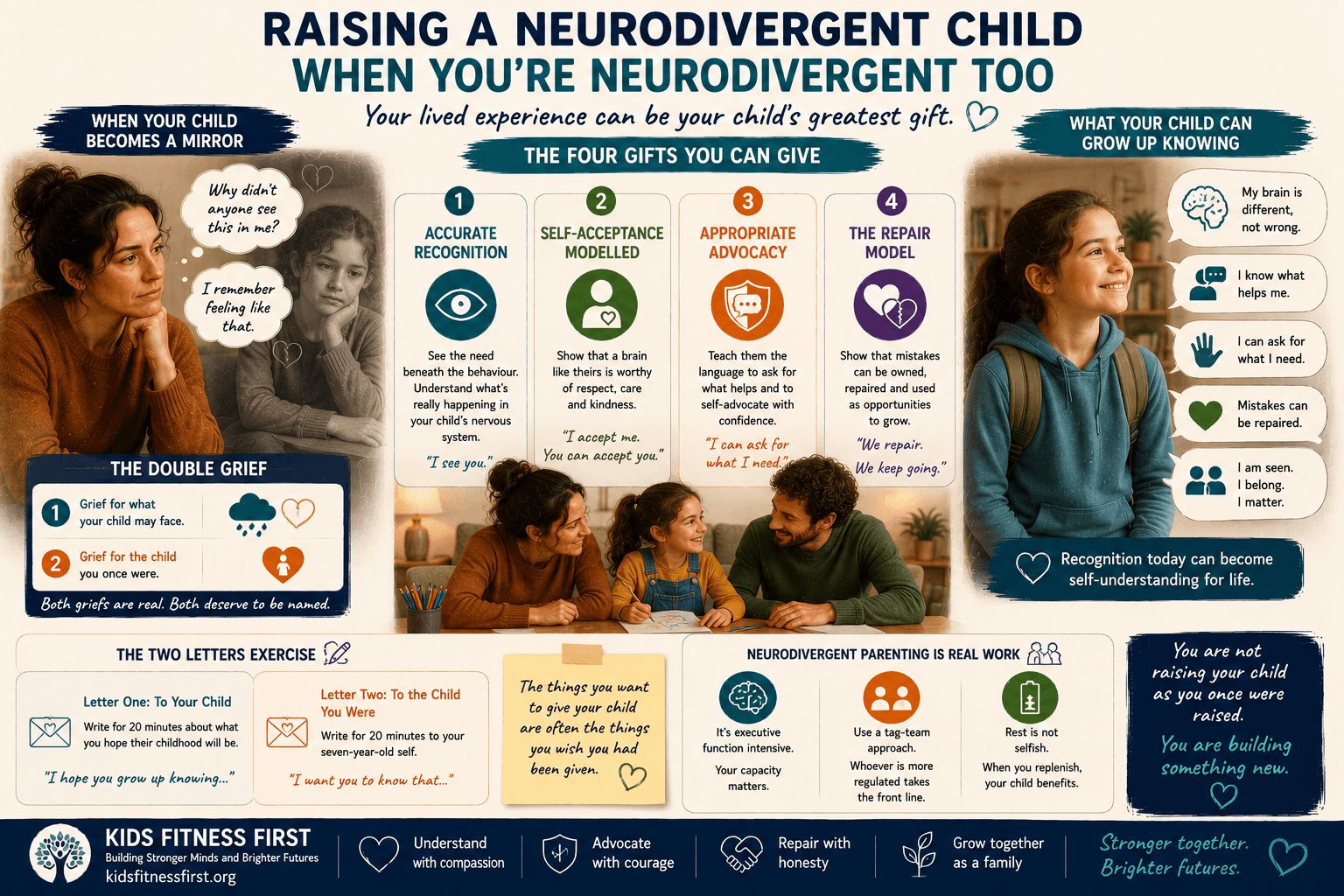
Raising a Neurodivergent Child When You’re Neurodivergent Too: 4 Gifts You Can Give
Raising a neurodivergent child can change the way you understand your own childhood.
Sometimes the recognition arrives gradually.
Perhaps a teacher describes your child’s behaviour.
They mention:
- difficulty sitting still;
- intense focus;
- sensory overload;
- unusual reading struggles;
- emotional intensity;
- social exhaustion;
- or a need for routines.
Then something strange happens.
You listen to the description and think:
That sounds familiar.
Perhaps very familiar.
In fact, for some parents, their child’s assessment becomes one of the first moments when they recognise their own neurodivergence.
Suddenly, the conversation is not only about the child in front of you.
It is also about the child you once were.
That can bring relief.
However, it can also bring grief.
You may think:
Why did nobody see this in me?
At the same time, another thought arrives:
What can I do differently for my child?
That question sits at the heart of Article 13.
Because raising a neurodivergent child as a neurodivergent parent can be extraordinarily demanding.
However, it can also become a specific form of intergenerational repair.
When Your Child Becomes a Mirror
Imagine sitting in a school meeting.
A teacher describes your child.
Perhaps they say:
“She becomes overwhelmed when the classroom gets noisy.”
Or:
“He can focus for hours on one subject but struggles to start ordinary homework.”
Or:
“She needs instructions broken down into smaller pieces.”
You may recognise your child.
However, you may also recognise yourself.
Perhaps you remember hiding after school because you needed silence.
Maybe you remember teachers calling you lazy when reading took twice as much effort.
Likewise, you may remember feeling unable to explain why an apparently small change in plans felt enormous.
Therefore, your child’s experience can open two timelines simultaneously:
their childhood
and
your childhood.
That is why neurodivergent parenting can feel emotionally complicated.
You are not only helping your child navigate the present.
Sometimes you are also meeting the younger version of yourself who never received the same understanding.
Recognition Can Bring Relief and Fear at the Same Time
When a child’s neurodivergence becomes visible, several emotions can arrive together.
For example:
Relief — because behaviour finally makes more sense.
Clarity — because there is language for what has been happening.
Fear — because you know from experience that the world may misunderstand your child.
Grief — because your child’s experience reminds you of what you carried alone.
These emotions do not cancel one another.
Instead, they can coexist.
You can feel grateful that your child has been recognised early while simultaneously feeling sad that you were not.
Likewise, you can feel hopeful about their future while knowing that some difficulties cannot be removed completely.
Therefore, one of the first tasks is allowing the emotional complexity to exist without judging it.
The Double Grief
Book Five names one specific experience The Double Grief.
Neurodivergent parents may find themselves grieving in two directions at once.
Grief One: For Your Child
The first grief is forward-looking.
You know your child may encounter:
- misunderstanding;
- exclusion;
- frustration;
- systems that do not fit;
- criticism;
- self-doubt;
- or pressure to hide parts of themselves.
Because you have experienced some version of these things yourself, you know what they can cost.
Therefore, part of you may desperately want to prevent every difficult experience.
However, no parent can remove all difficulty.
That realisation can hurt.
You can prepare.
You can advocate.
You can teach language.
Nevertheless, you cannot control every classroom, friendship, employer or institution your child will eventually meet.
Therefore, some grief belongs simply to knowing that your child will sometimes be misunderstood.
Grief Two: For the Child You Were
The second grief looks backwards.
You watch your child receive something you did not have.
Perhaps their teacher says:
“They need movement to concentrate.”
Perhaps their school provides reading support.
Maybe your partner says:
“She needs quiet after school. Let her decompress.”
And suddenly you think:
Nobody said that about me.
You may remember being punished for exactly the behaviour your child is now being supported through.
Consequently, their progress may reopen parts of your own childhood.
That is not selfish.
Instead, it may be a delayed recognition of how much harder your own childhood was than it needed to be.
Both Griefs Deserve Language
The two griefs can become tangled.
Therefore, it may help to separate them deliberately.
Try saying:
“I am grieving for my child because…”
Then:
“I am grieving for the child I was because…”
Do not immediately fix the sentences.
Instead, let both exist.
For example:
“I grieve that my child may sometimes feel different or misunderstood.”
And:
“I grieve that nobody helped me understand why I felt different.”
Those are different losses.
Naming them separately can reduce the risk that your child’s present becomes completely entangled with your past.
The Other Half of the Story: The Four Gifts
The grief is real.
However, it is only half of the picture.
The Book Five manuscript identifies four gifts that neurodivergent parents can offer neurodivergent children in a particularly direct form:
- Accurate Recognition
- Self-Acceptance Modelled
- Appropriate Advocacy
- The Repair Model
These gifts do not remove difficulty.
Likewise, they do not make neurodivergent parenting easy.
However, they can fundamentally change how a child understands themselves.
Gift One: Accurate Recognition
The first gift is the ability to see behaviour from the inside.
Perhaps your child comes home from school and immediately disappears into their bedroom.
Someone else may interpret that as:
rudeness
or
antisocial behaviour.
However, you may recognise:
decompression.
Perhaps your child loses control after a noisy day.
Someone else may see:
bad behaviour.
However, you may recognise:
a nervous system that has reached capacity.
Likewise, a dyslexic child may appear to avoid reading.
Another adult may assume:
lack of effort.
However, you may understand that the task carries a cognitive cost that is not visible from the outside.
That is accurate recognition.
Accurate Recognition Changes the Question
Instead of asking:
“Why are you behaving like this?”
you may ask:
“What happened before this?”
Instead of:
“Why won’t you just do it?”
you may ask:
“What part of this task is difficult?”
Likewise, instead of:
“Why are you being difficult?”
you may ask:
“Is your nervous system overloaded?”
Those questions do not automatically remove boundaries.
However, they change what happens before discipline or correction.
First, you investigate.
Then you respond to the real mechanism.
That is a powerful difference.
Gift Two: Self-Acceptance Modelled
Children do not only listen to what we tell them.
They also watch how we speak about ourselves.
Therefore, if you constantly say:
“My brain is useless.”
or:
“I’m such a mess.”
your child may absorb an important message:
A brain like mine is something adults dislike about themselves.
However, imagine something different.
You say:
“I need to write that down because my working memory is unreliable.”
Or:
“This room is too noisy for me, so I’m going somewhere quieter.”
Or:
“Reading this takes me longer, so I’m giving myself more time.”
Now your child sees a different model.
You are not pretending difficulty does not exist.
Instead, you are treating your brain as something to understand and work with.
That is self-acceptance modelled.
Your Child Is Watching How You Treat Yourself
Consider what happens when you make a mistake.
Do you say:
“I’m so stupid.”
Or do you say:
“I forgot that. I need a better reminder.”
The second response teaches something important.
It separates identity from difficulty.
Likewise, if you become overwhelmed, do you force yourself through it until you snap?
Or do you say:
“I’m reaching my limit. I need ten minutes.”
Again, the child is learning.
They are learning whether adult self-respect includes taking neurological needs seriously.
Therefore, one of the most powerful parenting lessons may happen without any formal teaching at all.
Your child sees you accepting yourself.
Then they begin to learn that they may be allowed to accept themselves too.
Gift Three: Appropriate Advocacy
The third gift is language.
Many neurodivergent adults reached adulthood knowing they struggled but not knowing how to explain what they needed.
Therefore, they may have spent years learning advocacy through failure.
Your child does not have to wait that long.
You can teach them, from young:
“This is what I need.”
For example:
“I need the instructions written down.”
“The room is too noisy for me.”
“I need a few minutes before I answer.”
“Can you show me the first step?”
“I need a quiet space.”
Those sentences are not weakness.
Instead, they are tools.
Advocacy Can Begin Very Young
A seven-year-old does not need clinical terminology.
Instead, they need usable language.
For example:
“My brain needs a movement break.”
Or:
“I can’t hear properly when everybody talks at once.”
Likewise:
“I need help reading this part.”
As the child becomes older, the language can become more precise.
Therefore, the skill grows with them.
By adolescence, they may be able to communicate with:
- teachers;
- coaches;
- employers;
- friends;
- university staff;
- or healthcare professionals
without first having to discover that they are allowed to ask for what they need.
That is a significant inheritance.
Gift Four: The Repair Model
The fourth gift may be the most important.
You are going to get things wrong.
That is unavoidable.
You will become tired.
Sometimes you will react too quickly.
Perhaps you will misread your child.
You may snap.
You may lose patience.
However, the lesson your child learns is not determined only by the rupture.
It is also determined by what happens afterwards.
If you pretend nothing happened, your child may learn that adults hide mistakes.
If you defend yourself completely, they may learn that responsibility belongs somewhere else.
Likewise, if you collapse into:
“I’m a terrible parent,”
your child may end up comforting you.
Instead, repair can look like:
“I got that wrong.”
“I spoke too sharply.”
“You did not deserve that.”
“I was overloaded, but that does not make the way I spoke okay.”
“I’m sorry.”
“I want to do it differently next time.”
That is the repair model.
Repair Teaches More Than Perfection Ever Could
No child grows up in a home without rupture.
Therefore, trying to model perfection is unrealistic.
What you can model is:
what responsible adults do after getting something wrong.
First, they notice.
Then they name it.
Next, they apologise without collapsing.
Afterwards, they repair what can be repaired.
Finally, they try to change the pattern.
Your child may witness that process hundreds of times.
Consequently, they learn that mistakes do not have to become shame.
They can become repair.
That skill will travel into their friendships, relationships and adult life.
The Four Gifts at a Glance
| Gift | What the Parent Provides | What the Child Learns |
|---|---|---|
| Accurate Recognition | Reads behaviour through neurological understanding | “My behaviour has a reason.” |
| Self-Acceptance Modelled | Treats their own neurodivergence with respect | “A brain like mine is allowed to exist.” |
| Appropriate Advocacy | Teaches clear language for needs | “I can ask for what helps me.” |
| Repair Model | Returns honestly after rupture | “Mistakes can be repaired without shame.” |
These gifts are not about being the perfect neurodivergent parent.
Instead, they are about offering something more useful:
recognition, language, dignity and repair.
How the Four Gifts May Look Across Different Neurologies
The manuscript deliberately notes that the gifts will look different depending on the child’s neurology.
ADHD
For a child with ADHD, accurate recognition may mean noticing when apparent “bad behaviour” is actually dysregulation or depleted capacity.
For example, instead of assuming:
“You are refusing.”
you may realise:
“You cannot organise the next step yet.”
Likewise, advocacy may include teaching the child to say:
“I need this broken into smaller steps.”
Or:
“I need somewhere to move.”
Therefore, they grow up with language for attention and energy rather than only language about failure.
Dyslexia
For a dyslexic child, accurate recognition may mean understanding that effort and visible output are not always proportional.
A task that looks simple to another child may carry a much higher literacy cost.
Therefore, instead of:
“You didn’t try hard enough,”
the question becomes:
“What support would make this task accessible?”
Advocacy may then include teaching your child to request:
- extra processing time;
- spoken explanation;
- text-to-speech;
- reading support;
- or clearer written materials.
Most importantly, they learn that difficulty with literacy is not evidence of low intelligence.
Autism
For an autistic child, accurate recognition may centre on:
- sensory load;
- social exhaustion;
- predictability;
- transitions;
- quiet;
- and recovery.
Therefore, you may treat downtime after school as a legitimate need rather than withdrawal that must immediately be corrected.
Likewise, advocacy may include teaching:
“I need somewhere quieter.”
Or:
“I need to know the plan before we go.”
Again, the child learns that their needs can be communicated rather than hidden.
The Specific Strain of Neurodivergent Parenting
The four gifts are real.
However, the strain is also real.
Parenting requires enormous executive function.
For example, you need:
- working memory;
- planning;
- emotional regulation;
- sustained attention;
- decision-making;
- transitions;
- time management;
- and constant prioritisation.
If those are already costly areas for your own nervous system, parenting can stretch capacity significantly.
Then add a neurodivergent child.
Perhaps they also become overloaded.
They may need advocacy.
Likewise, they may bring home accumulated stress from environments that do not fit them.
Therefore, the parent may be trying to regulate one nervous system while their own nervous system is also close to capacity.
That is demanding work.
Naming that is not complaining.
It is accuracy.
Neurodivergent Parenting Often Needs a Tag-Team Model
One practical idea from the manuscript is particularly useful:
the parent who is currently more regulated takes the front line.
The parent who is depleted steps back long enough to recover.
Then roles can reverse later.
This is different from one parent permanently carrying everything.
Instead, the arrangement is dynamic.
For example:
One parent comes home overloaded.
Therefore, the other handles the child’s bedtime.
However, the following morning, the first parent may be more regulated and takes responsibility.
The goal is not:
“Who is the better parent?”
Instead, ask:
“Whose nervous system currently has the most capacity?”
That is a much more useful question.
When Your Child’s Behaviour Triggers Your Own Childhood
This may be one of the hardest parts.
Your child has a meltdown.
Suddenly, you remember being punished for one.
Your child refuses to read.
You remember being humiliated in class.
Likewise, your child asks for quiet.
You remember being told:
“Stop being so sensitive.”
Therefore, the present moment becomes emotionally crowded.
Your child is there.
However, your younger self is there too.
That can make reactions surprisingly intense.
The goal is not to erase those memories.
Instead, recognise when they have entered the room.
Ask:
“Am I responding only to my child right now, or am I also responding to what happened to me?”
That question can create useful distance.
Compassion for Your Own Parents Can Be Complicated
Another emotional layer may appear.
Once you become a parent, you may suddenly understand how exhausted your own parents sometimes were.
That may bring compassion.
However, compassion does not require rewriting history.
You can understand that a parent had limited capacity while still recognising that something they did hurt you.
Both can be true.
Therefore, retrospective compassion should not be forced.
Instead, allow it where it genuinely belongs.
Perhaps becoming a neurodivergent parent allows you to understand something about the adults who raised you.
However, understanding is not the same as excusing everything.
That balance matters.
Reflection: Which Gift Are You Already Giving?
Pause here.
Think about the four gifts:
Accurate Recognition
Self-Acceptance Modelled
Appropriate Advocacy
The Repair Model
Now answer the following questions.
1. Which Gift Feels Most Natural?
Which one makes you think:
“I already do that.”
Perhaps you instinctively recognise overload.
Maybe advocacy comes naturally because you know how difficult it was to learn as an adult.
Likewise, perhaps you are already comfortable repairing after mistakes.
Write down the gift that feels strongest.
Then ask:
How is my child already benefiting from this?
2. Which Gift Feels Hardest?
Perhaps self-acceptance is difficult because you still criticise yourself constantly.
Maybe repair is difficult because apologising activates shame.
Likewise, perhaps advocacy feels frightening because you do not want your child labelled as difficult.
Do not judge the answer.
Instead, ask:
What would one small improvement look like over the next year?
3. What Do You Recognise in Your Child That Nobody Recognised in You?
Complete:
“When my child __________, I recognise that it may mean __________.”
For example:
“When my child goes quiet after school, I recognise that they may be decompressing rather than rejecting us.”
Now ask:
What did adults assume about me when I did something similar?
Notice what comes up.
4. What Do You Want Your Child to Believe About Their Brain?
Complete:
“I want my child to grow up knowing that their brain…”
Perhaps:
- deserves respect;
- needs support sometimes;
- has strengths and difficulties;
- is allowed to be different;
- does not make them less intelligent;
- or is not something they need to apologise for.
Write the sentence clearly.
Then ask:
Do they see me applying that same belief to myself?
That question matters.
5. What Need Could You Teach Them to Name More Clearly?
Perhaps:
“I need quiet.”
“I need more time.”
“I don’t understand that instruction yet.”
“Please write that down.”
“I need a break.”
The goal is not to make the child responsible for solving every environment.
Instead, it is to give them usable language.
6. Think About Your Last Parenting Rupture
Perhaps you became impatient.
Maybe you raised your voice.
Likewise, perhaps you dismissed a feeling too quickly.
Ask:
Did I repair afterwards?
If not, it may not be too late.
A repair can happen later.
Sometimes much later.
7. Name the Double Grief
Complete:
“I grieve for my child because…”
Then:
“I grieve for the child I was because…”
Pause after each.
These sentences do not need immediate solutions.
They only need honesty.
Reflection Takeaway
Your child’s neurodivergence may reopen parts of your own story.
However, that does not mean you are doomed to repeat it.
In fact, recognition creates choice.
You can give your child some of what you did not receive.
And, in doing so, you may also begin treating the younger version of yourself with more compassion.
That is one form of intergenerational repair.
Try This: The Two Letters
The Book Five manuscript includes a simple but powerful exercise called The Two Letters.
Set aside around an hour.
Do not send the letters.
They are for you.
Letter One: To Your Child
Begin:
“I hope you grow up knowing…”
Then write for around twenty minutes.
Do not focus on achievements.
Instead, describe the emotional texture of the childhood you hope they experience.
Perhaps you hope they know:
- they are understood;
- they are not broken;
- they can ask for help;
- they are intelligent even when a task is difficult;
- they can rest;
- they can repair mistakes;
- they can have boundaries;
- and their needs are not shameful.
Write honestly.
Letter Two: To the Child You Were
Now begin:
“I want you to know that…”
Write to your younger self.
Perhaps seven years old.
Or nine.
Or twelve.
Choose the age that feels right.
Then tell that child one or two things you wish an adult had told you.
For example:
“You are not lazy.”
“You are overwhelmed.”
“Reading being hard does not mean you are stupid.”
“You are allowed to need quiet.”
“You are not deliberately difficult.”
Again, write honestly.
Put the Letters Side by Side
Then read both.
What repeats?
Often, the things you most want to give your child are closely related to the things you most needed yourself.
That is not accidental.
It is the map.
One letter describes the future you want to create.
The other describes the past you are trying not to repeat.
Together, they show the kind of parent you are trying to become.
Keep both letters.
Return to them later.
What the Four Gifts Are Not
The Four Gifts are not:
perfection.
They are not:
protecting your child from every difficulty.
Likewise, they are not:
turning every difficult behaviour into something nobody can challenge.
Your child still needs:
- boundaries;
- responsibility;
- consequences;
- learning;
- and increasing independence.
However, those things can happen without shame becoming the teaching method.
For example:
“I understand why you were overwhelmed. However, hitting your brother is still not okay. Let’s work out what you can do when you reach that point next time.”
Recognition and accountability can exist together.
That is one of the central lessons running through Book Five.
Do Not Make Your Child Carry Your Childhood
There is also an important boundary.
Your child’s neurodivergence may remind you strongly of yourself.
However, your child is not you.
Their life is not a second attempt at your childhood.
Therefore, be careful not to turn:
“I wish somebody had done this for me”
into:
“My child must want exactly what I wanted.”
For example, perhaps you desperately wanted more independence.
Your child may currently need more support.
Likewise, perhaps you hated a particular school environment.
Your child may enjoy it.
Recognition should remain curious.
Do not replace neurotypical assumptions with your own assumptions.
Instead, ask:
“What does this specific child need?”
That question keeps the child at the centre.
Your Child Needs a Regulated Parent More Than a Perfect Parent
You may read articles like this and immediately create another impossible standard.
Now you must:
- understand perfectly;
- advocate perfectly;
- regulate perfectly;
- repair perfectly;
- and never pass any of your own difficulty forward.
That is not realistic.
Instead, sustainable neurodivergent parenting requires respect for parental capacity too.
Sometimes the best parenting move is:
“I am too overloaded to handle this well. Your other parent is taking over for ten minutes.”
Or:
“I need to calm down before we continue.”
That is not abandonment when it is communicated and contained.
Instead, it can model nervous-system responsibility.
Your child learns:
Adults notice when they are reaching capacity and take action before the situation becomes worse.
That is a useful lesson.
A Family Can Learn Shared Nervous-System Language
One of the strongest possibilities in a neurodivergent household is shared language.
For example:
“I am overloaded.”
“I need decompression.”
“Too many instructions.”
“Can we do one thing at a time?”
“I need movement.”
“My reading brain is tired.”
“I need a repair.”
These phrases make invisible experiences easier to discuss.
Therefore, the family does not need to decide immediately who is difficult or unreasonable.
Instead, people can communicate what is happening.
That does not solve everything.
However, it gives the household better raw material to work with.
From Inheritance to Intergenerational Repair
Neurodivergence may travel through families.
However, misunderstanding does not have to travel in exactly the same way.
That is the deeper point.
Perhaps your child inherits:
- ADHD;
- dyslexia;
- autism;
- or another neurodivergent pattern.
However, they may also inherit something you had to build much later:
language.
They may inherit:
recognition.
They may inherit:
advocacy.
They may inherit:
repair.
And they may inherit the sight of a neurodivergent adult who does not treat their own brain as something shameful.
That is an inheritance too.
Conclusion: Your Child Has Something You Did Not
Raising a neurodivergent child when you are neurodivergent yourself can be emotionally demanding.
Your child’s experience may reopen your own.
Therefore, you may feel relief and grief in the same hour.
You may fear what lies ahead for them because you remember what lay behind you.
However, your child is not entering exactly the same world you entered.
One important difference is already present.
You are there.
You can offer four gifts:
Accurate Recognition
You can look beneath behaviour and ask what is actually happening.
Self-Acceptance Modelled
You can show that a neurodivergent brain can be respected rather than apologised for.
Appropriate Advocacy
You can teach the language of asking for what helps.
The Repair Model
You can show that adults make mistakes, own them and come back.
None of those gifts makes childhood effortless.
However, together they change the emotional architecture around the child.
Most importantly, they give the child something many neurodivergent adults had to spend decades finding for themselves:
a way to understand who they are without first deciding that something is wrong with them.
You may not be able to rewrite your own childhood.
However, you can allow what you learned from it to change what happens next.
That is not perfection.
It is repair moving forward through a family.
SUGGESTED INTERNAL LINKS
Article 3: Communication in Neurodivergent Relationships: 4 Principles That Make Conversations Land
Article 5: ADHD Shame Cycle: Why Small Criticism Can Feel So Big
DISCLAIMER
This article is provided for general educational and informational purposes only. It is not medical, psychological, diagnostic, parenting or therapeutic advice.
Neurodivergent children and adults are individuals. Therefore, ADHD, autism, dyslexia and other neurodivergent experiences should not be assumed to look the same in every family.
A parent’s personal neurodivergent experience may provide useful insight, but it should not replace individual assessment of the child’s own needs. Likewise, support strategies should be adapted to the specific child rather than based only on the parent’s own childhood experiences.
Where there are concerns about a child’s development, mental health, learning, safety or wellbeing, appropriately qualified professional advice may be necessary.