The Inward Drift in Neurodivergent Relationships: When Your World Slowly Becomes Too Small
The Inward Drift in neurodivergent relationships rarely announces itself.
There is usually no dramatic falling-out.
No single friendship ends with a major argument.
Likewise, nobody sits down and says:
“From now on, we are going to make our world smaller.”
Instead, it happens one reasonable decision at a time.
You decline the noisy dinner.
Then you skip the large family gathering.
Afterwards, you decide not to go to the birthday because the previous week was exhausting.
Meanwhile, an old friend sends fewer messages because you have turned down the last three invitations.
Nothing terrible happens.
In fact, each individual choice may make perfect sense.
However, years later, something may force you to look around.
Perhaps it is a wedding.
A funeral.
A milestone birthday.
Or simply a quiet weekend when you realise that nobody is likely to call.
Then the question appears:
Where did everybody go?
The uncomfortable answer may be:
They did not all go anywhere.
Instead, the relationship slowly moved inward.
That is what Book Five calls The Inward Drift.
It is the gradual narrowing of the couple’s connections to the world outside the partnership until, eventually, the relationship itself becomes the primary — and sometimes almost the only — source of adult companionship, emotional support and social life.
What Is the Inward Drift?
The Inward Drift is not simply introversion.
Likewise, it is not a criticism of couples who enjoy spending time together.
Many healthy couples have small social circles.
Some people genuinely prefer a quieter life.
Therefore, the issue is not the number of invitations in your diary.
Instead, the issue is structural dependence.
Ask:
Does our relationship still exist inside a wider human world?
Or:
Have we gradually become each other’s only meaningful adult connection?
That distinction matters.
A partnership can be extremely loving and still become overloaded if it must provide:
- all emotional support;
- all recreational companionship;
- all intellectual connection;
- all social identity;
- all witnessing of adult life;
- and nearly all meaningful human contact.
Eventually, that is too much weight for one relationship.
Therefore, the goal is not to become more social for the sake of being social.
The goal is to keep enough doors open to the wider world that the partnership can continue to breathe.
Why the Inward Drift Happens
The most important point is this:
The Drift is often built from sensible decisions.
Consider one Saturday night.
You have been invited to dinner.
However, attending means:
- several hours of conversation;
- unfamiliar people;
- background noise;
- multiple conversation threads;
- possible masking;
- travel;
- unpredictable timing;
- and perhaps one or two days of recovery afterwards.
By contrast, declining requires one short message.
Therefore, the rational decision may be:
Stay home.
There is nothing inherently wrong with that.
Now multiply the same calculation across ten or fifteen years.
Dinner parties are declined.
Large family gatherings become rarer.
Group events become more effort than they seem worth.
Meanwhile, friends gradually learn that invitations are often declined.
Consequently, they invite less frequently.
Eventually, there are fewer invitations to decide about.
That is when the Drift becomes difficult to notice.
What originally felt like:
“We are protecting our energy.”
may gradually become:
“Nobody invites us anymore.”
Both statements can be true.
Social Life Can Carry a Higher Cost for Neurodivergent Nervous Systems
The Drift is especially understandable when social interaction is genuinely expensive.
For example, some neurodivergent adults may need substantial recovery after:
- loud restaurants;
- crowded homes;
- mixed social groups;
- unfamiliar people;
- lengthy gatherings;
- emotionally complicated family events;
- or social situations that require heavy masking.
Likewise, following several conversation threads can require considerable attention.
Reading expressions may require more deliberate work.
Meanwhile, managing sensory input may already be consuming capacity before the conversation itself is even processed.
Therefore, social exhaustion is not necessarily reluctance or antisocial behaviour.
It may reflect a genuine nervous-system cost.
That matters because resisting the Inward Drift should never mean forcing someone repeatedly into environments that leave them depleted.
Instead, the challenge is to build lower-cost forms of connection that remain sustainable.
The Four Stages of the Inward Drift
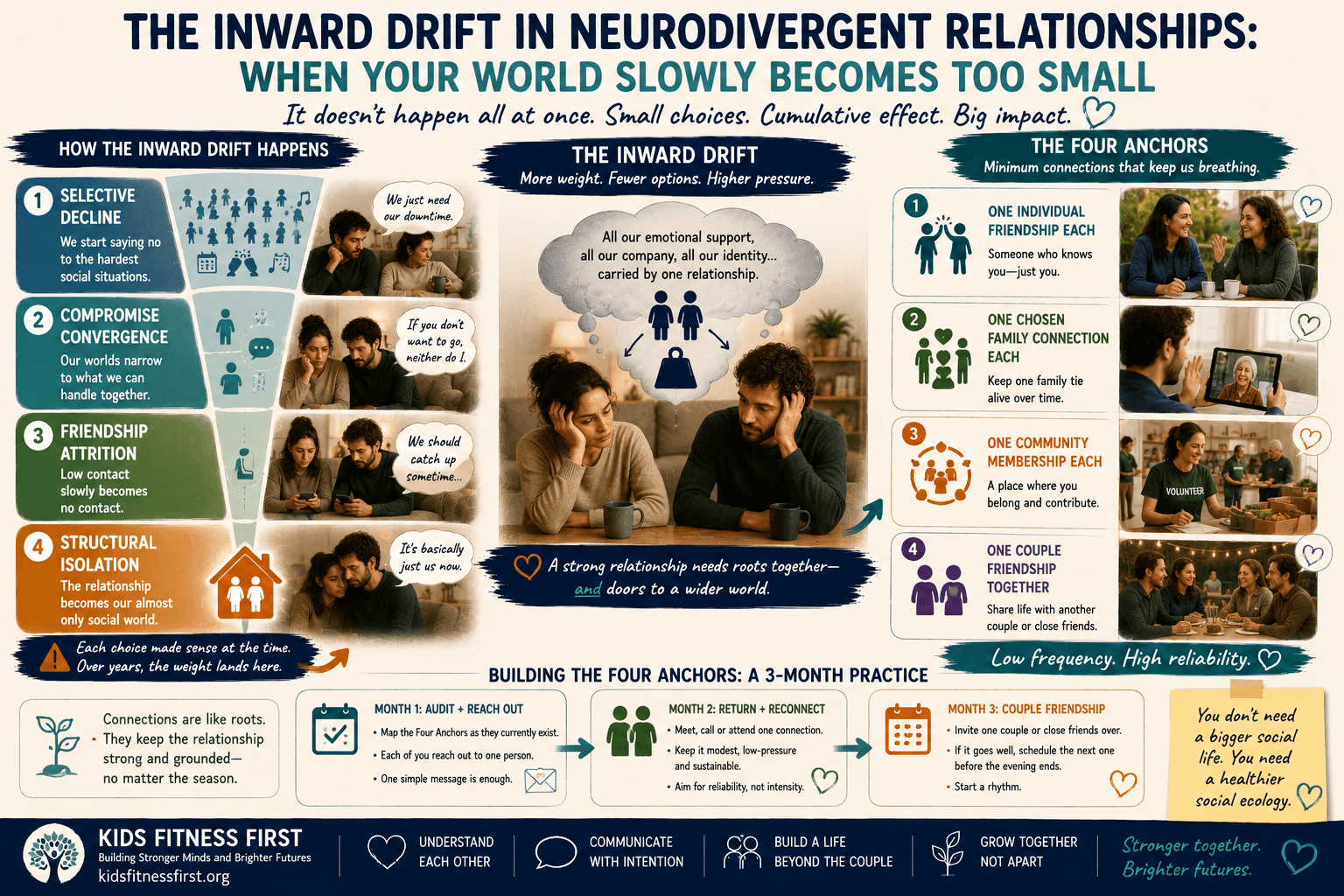
Book Five describes four stages.
They are:
- Selective Decline
- Compromise Convergence
- Friendship Attrition
- Structural Isolation
Each stage makes sense while it is happening.
However, the cumulative direction matters.
Stage 1: Selective Decline
First, one or both partners begin declining certain categories of social activity.
For example:
- the very large party;
- the loud restaurant;
- the family gathering with several difficult dynamics;
- the event with no clear finish time;
- or the gathering where many unfamiliar people will attend.
At this stage, the couple may still have an active social life.
However, certain environments are quietly removed from consideration.
This can be healthy.
In fact, learning which social environments cost too much can be an important part of self-understanding.
The risk appears only when:
selective decline gradually becomes general decline.
Therefore, occasionally ask:
Are we declining the environments that do not work for us — or are we now declining almost everything?
Those are different patterns.
Stage 2: Compromise Convergence
Next, the couple’s shared social life begins adjusting towards the nervous system with the lowest social capacity.
Again, this often happens through love.
For example, one partner does not enjoy a particular gathering.
Therefore, the other stops going too.
At first, attending alone feels awkward.
Later, the invitation is declined automatically.
Likewise, one partner may stop initiating social events because they already expect the answer to be no.
Consequently, both people’s social lives begin narrowing towards what the couple can comfortably do together.
This is Compromise Convergence.
The difficulty is that the non-neurodivergent or more socially energetic partner may gradually lose their own independent relationships without consciously deciding to do so.
Eventually, they may feel lonely.
However, they may also feel guilty for wanting something outside the relationship.
That is an important warning sign.
A healthy partnership does not require both people to have identical social needs.
Stage 3: Friendship Attrition
Friendships rarely survive indefinitely without reciprocal contact.
However, they also rarely end dramatically when contact fades.
Instead, they simply become thinner.
A message goes unanswered.
Then a meeting is postponed.
Afterwards, several months pass.
Eventually, a person who once knew your everyday life becomes someone you see occasionally at a wedding.
There may have been no conflict.
Nevertheless, the friendship has dissolved through lack of maintenance.
This is Friendship Attrition.
One of the reasons it is dangerous is precisely because nothing dramatic happens.
There is no obvious moment to repair.
Instead, the friendship simply becomes history.
Therefore, couples may not realise how much of their social ecology has disappeared until much later.
Stage 4: Structural Isolation
The fourth stage is the point where the relationship itself has become the main source of adult social connection for both people.
Other humans still exist.
There may be:
- colleagues;
- neighbours;
- school parents;
- relatives seen occasionally;
- shopkeepers;
- acquaintances;
- or online contacts.
However, meaningful adult friendship has largely disappeared.
This is Structural Isolation.
At that point, the partnership is asked to carry almost everything.
Your partner becomes:
- best friend;
- primary confidant;
- emotional regulator;
- recreational companion;
- main conversational partner;
- social identity;
- and the person who witnesses nearly your entire adult life.
That is an enormous structural load.
Therefore, relationship tensions become amplified.
An argument does not simply threaten connection with your partner.
It can feel as though it threatens your whole world.
That is why structural isolation can make a relationship more brittle over time.
The Four Stages at a Glance
| Stage | What Happens | What It Can Sound Like |
|---|---|---|
| Selective Decline | Certain difficult social situations are increasingly avoided | “That kind of event just isn’t worth the recovery.” |
| Compromise Convergence | Both partners’ social lives narrow around the lower-capacity nervous system | “If you aren’t going, I probably won’t either.” |
| Friendship Attrition | Low contact slowly dissolves friendships | “We should really see them sometime.” |
| Structural Isolation | The relationship becomes the main adult social world | “It’s basically just us now.” |
The question is not:
Which stage proves our relationship is failing?
Instead, ask:
What direction are we moving in?
That is much more useful.
Why Structural Isolation Puts Pressure on Love
Love can carry a great deal.
However, love should not have to carry everything.
If one relationship becomes the only source of:
- encouragement;
- intellectual stimulation;
- fun;
- perspective;
- reassurance;
- advice;
- shared memory;
- emotional release;
- and social identity,
then every disappointment inside that relationship becomes heavier.
There is nowhere else for emotional pressure to go.
Likewise, there is less outside perspective.
Small disagreements may become larger.
Resentment may have fewer places to dissipate.
Meanwhile, the relationship can begin feeling claustrophobic even though both people genuinely love each other.
Therefore, outside connection is not a competitor to intimacy.
In many cases, it protects intimacy.
The Solution Is Not “Go Out More”
This is crucial.
Telling an exhausted neurodivergent couple:
“You just need to socialise more.”
misses the entire point.
The environments that produced the withdrawal may still be genuinely difficult.
Therefore, rebuilding connection needs to respect:
- sensory capacity;
- social energy;
- masking cost;
- family commitments;
- recovery needs;
- and individual temperament.
The Book Five answer is not a bigger social calendar.
Instead, it is a minimum sustainable relational ecology.
That is where the Four Anchors come in.
The Four Anchors
The Four Anchors are deliberately modest.
They are:
- One Individual Friendship Each
- One Chosen Family Connection Each
- One Community Membership Each
- One Couple Friendship Together
These are not quotas.
Likewise, they are not a formula for popularity.
Instead, they are structural anchors that keep the relationship connected to something beyond itself.
Anchor 1: One Individual Friendship Each
Each partner needs at least one relationship that belongs primarily to them.
This does not mean a weekly social schedule.
For some people, meeting every six or eight weeks may be enough.
Likewise, a friendship may include:
- occasional coffee;
- a walk;
- regular messages;
- watching football together;
- gaming online;
- or another low-pressure activity.
The point is that there is another adult in your life who knows you, not only the couple.
That matters.
Because individual friendship preserves parts of identity that can disappear when everything becomes shared.
Anchor 2: One Chosen Family Connection Each
This anchor may involve:
- a sibling;
- cousin;
- parent;
- adult child;
- long-standing family friend;
- or someone who functions as chosen family.
The key is not biological relationship.
Instead, it is durable connection.
Somebody who carries history.
Somebody who can remain in your life across time.
This relationship may be low-frequency.
However, it should remain alive.
For example, one phone call every few weeks may be enough.
The goal is continuity rather than intensity.
Anchor 3: One Community Membership Each
This anchor is different because it does not depend primarily on one-to-one intimacy.
It gives each person a place where they belong.
For example:
- a sports club;
- a charity;
- volunteering;
- a class;
- a faith community;
- a gaming group;
- a walking group;
- a professional network;
- a hobby group;
- or another interest-based community.
For some neurodivergent people, interest-based social connection may be significantly easier than unstructured socialising.
Therefore, community membership can provide connection without requiring the emotional intensity of close friendship.
The key is reliability.
You return.
People recognise you.
You become part of something.
Anchor 4: One Couple Friendship Together
Finally, the relationship itself benefits from at least one shared outside friendship.
Perhaps another couple.
A family you both enjoy.
Or two friends who comfortably form a small group.
The connection does not need to be glamorous.
In fact, low-demand friendship may work best.
For example:
- supper every two months;
- a walk;
- coffee;
- a shared activity;
- or occasional visits.
The purpose is to allow the relationship to exist in company.
You see each other interact with other people.
You laugh in a wider group.
Likewise, the couple develops shared memories that are not only about managing daily life.
That can be surprisingly protective.
The Four Anchors at a Glance
| Anchor | Purpose | Possible Low-Cost Version |
| Individual Friendship Each | Protects individual identity and support | Coffee or messages every 6–8 weeks |
| Chosen Family Connection Each | Keeps long-term continuity alive | Regular call or occasional visit |
| Community Membership Each | Creates belonging outside the couple | Monthly volunteering or interest group |
| Couple Friendship Together | Gives the partnership shared social connection | Supper or activity every 2–3 months |
Notice the frequency.
None of this requires becoming highly social.
The structure matters more than the volume.
Low Frequency, High Reliability
One of the strongest principles in the chapter is:
low frequency, high reliability.
Many neurodivergent adults cannot sustainably maintain a dense social calendar.
That is fine.
However, relationships often survive through predictable recurrence.
For example:
“We see them every eight weeks.”
may be more sustainable than:
“We really must organise something sometime.”
Therefore, do not necessarily aim for more contact.
Aim for reliable contact at a dose you can maintain.
That changes friendship from good intention into structure.
Reflection: Has Your World Become Smaller?
Pause here and think about your relationship as it exists today.
Not five years ago.
Not before children.
Not before diagnosis.
Today.
Then answer these questions separately before comparing answers.
Where Are Your Old Friends?
List three people who once mattered to you.
Then write:
- when you last saw them;
- when you last spoke properly;
- whether you still want the relationship;
- and what caused contact to reduce.
Do not assume the answer is blame.
Perhaps both of you simply became busy.
Perhaps social recovery became harder.
However, make the pattern visible.
How Many Invitations Do You Still Receive?
Think about the last six months.
How many invitations came from:
- friends;
- extended family;
- community groups;
- or social acquaintances?
Now ask:
Has the number reduced because we have intentionally chosen a quieter life — or because people stopped asking after repeated declines?
Those are different.
Do You Still Have Separate Relationships?
Ask:
Who knows me independently of my partner?
Not:
Who knows us?
Who knows me?
If the answer is nobody, notice that.
Likewise, ask the same question for your partner.
Individual connection does not threaten the couple.
Instead, it can help prevent the couple becoming the entire social ecosystem.
Does One Partner Carry More Social Loss?
Perhaps one person always preferred fewer social relationships.
Meanwhile, the other once had a much wider circle.
Has the couple’s life gradually converged almost completely around the lower social capacity?
If so, ask:
What has the more socially active partner lost?
Do not immediately defend or solve.
First, recognise it.
Compromise can still involve genuine loss.
What Social Situations Actually Work for Your Nervous Systems?
Do not simply list what you avoid.
Instead, ask:
What works?
Perhaps:
- one couple at home;
- walking with one friend;
- daytime rather than evening;
- familiar people;
- small groups;
- outside environments;
- activity-based connection;
- planned finish times;
- or events with recovery time afterwards.
This answer is crucial.
Because rebuilding social ecology should happen through conditions that fit you.
Which Stage of the Inward Drift Feels Closest?
Choose:
Selective Decline
Compromise Convergence
Friendship Attrition
Structural Isolation
You may each choose a different answer.
That difference itself is worth discussing.
Which Anchor Is Strongest?
Which of the Four Anchors already exists?
Perhaps you each have individual friends.
However, community membership is missing.
Alternatively, you may have strong family ties but no couple friendship.
Start by recognising what is already working.
Then identify the largest gap.
Reflection Takeaway
Complete this sentence:
“Our world has become smaller in these ways…”
Then:
“The part of our wider world I most want to protect or rebuild is…”
Finally:
“The smallest sustainable step we could take is…”
Keep the step small.
A single message may be enough.
Try This: Building the Four Anchors Over Three Months
The Book Five manuscript recommends a three-month process rather than trying to rebuild an entire social life immediately.
Month One: Audit the Anchors
Take one evening together.
Write down the Four Anchors:
- Individual friendship each
- Chosen family connection each
- Community membership each
- Couple friendship together
For each, write:
Strong
Weak
or
Missing
Then identify one realistic person or context that might strengthen each weak or missing anchor.
Do not contact everybody immediately.
First, map.
Month One: One Reach-Out Each
Each partner chooses one person.
Perhaps:
- an old friend;
- a cousin;
- a sibling;
- an old work colleague;
- or somebody you genuinely miss.
Then send one simple message.
For example:
“I realised it’s been far too long. Would you like to have coffee sometime in the next few weeks?”
Do not write a long explanation about why you disappeared.
Likewise, do not attempt to rebuild ten years of friendship through one message.
Simply reopen the door.
Month Two: Make One Return
Now act on one connection.
Perhaps:
- meet the friend;
- make the family call;
- attend the interest group;
- volunteer;
- or try the community activity.
However, do not commit immediately to an exhausting schedule.
Instead, ask:
What frequency could I genuinely sustain?
The answer may be:
once a month.
Every six weeks.
Every two months.
That is enough if it remains reliable.
Month Three: Build One Couple Friendship
Together, identify one connection you both like.
Perhaps another couple.
A family.
Or two friends you both find comfortable.
Then initiate one small shared meeting.
For example:
“Would you like to come over for dinner next month?”
If the evening goes well, schedule another before too much time passes.
Again:
low frequency, high reliability.
That is the principle.
At the End of Three Months
Sit down together.
Ask:
- Which anchors now feel stronger?
- Which remain missing?
- Did any contact feel energising?
- Which contact cost too much?
- What format worked best?
- What frequency feels realistic?
- Has the relationship itself felt different?
Do not treat the Four Anchors as a project you eventually finish.
Instead, treat them as infrastructure.
Relationships need maintenance because human connection changes over time.
Protecting Energy While Protecting Connection
There will still be invitations you should decline.
Likewise, there will still be weekends when recovery matters more than socialising.
The goal is not to replace self-knowledge with obligation.
Instead, use more precise questions.
Rather than:
“Do we have the energy to go to this large party?”
ask:
“Is there another lower-cost way to maintain this relationship?”
Perhaps:
- coffee next week;
- a short visit;
- one-to-one contact;
- a phone call;
- or meeting outdoors.
That creates a third option between:
attend everything
and
disappear completely.
That middle ground is often where sustainable connection lives.
Separate Social Lives Can Protect the Relationship
Another important principle is permission to go separately.
If one partner wants to attend an event and the other does not, the answer does not always need to be:
both go
or
both stay home.
Sometimes the healthiest solution is:
one goes.
The neurodivergent partner protects their capacity.
Meanwhile, the other partner maintains the relationship or activity that matters to them.
This can feel unusual if the couple has spent years operating socially as one unit.
However, adult partnership does not require identical participation.
A breathable relationship allows difference.
Do Not Turn the Four Anchors Into Another Performance Standard
There is a danger with any framework.
The framework itself can become another thing to fail at.
You may think:
“We only have two anchors. We are doing relationships badly.”
That is not the purpose.
Instead, the Four Anchors are a diagnostic tool.
They help you notice where too much structural weight may have accumulated.
Therefore, use them gently.
You are not trying to become socially impressive.
You are trying to prevent one relationship from becoming responsible for the entire human world of two people.
That is all.
Why This Matters After Parenting
Article 13 examined raising a neurodivergent child.
Parenting often accelerates the Inward Drift.
Why?
Because children’s needs consume time and executive capacity.
Meanwhile, sleep may reduce.
Work continues.
Family logistics increase.
Therefore, the easiest category to cut is often:
adult friendship.
At first, this feels temporary.
However, ten years later, the child is older and the friendships may no longer exist.
Therefore, couples raising children may need to protect a very small amount of adult social life deliberately.
Not because parenting matters less.
Instead, because parents are still adults who need a wider relational world too.
A Wider World Gives the Relationship More Oxygen
Think of your relationship as a house.
A house can be safe, warm and deeply loved.
However, if every door and window is permanently closed, the air eventually changes.
The Four Anchors are not an attempt to move you out of the house.
They are simply openings.
An individual friendship.
A family connection.
A community.
A shared friendship.
Each one allows something from the wider world to enter.
Perspective.
Stories.
Humour.
Difference.
New experiences.
And, importantly, relief from the expectation that your partner must provide everything.
That is why the wider ecology matters.
Conclusion: Your Relationship Needs a World Around It
The Inward Drift in neurodivergent relationships happens slowly.
First comes Selective Decline.
Then Compromise Convergence.
Afterwards, Friendship Attrition.
Finally, Structural Isolation.
None of these stages necessarily begins with a bad decision.
In fact, each individual decision may be completely reasonable.
However, the cumulative direction can still create a life that neither person consciously chose.
Therefore, do not ask:
“Were we wrong to protect our energy?”
Probably not.
Instead, ask:
“Has protecting our energy gradually cost us too much connection?”
If the answer is yes, the solution does not require becoming extroverts.
It requires a minimum ecology.
One individual friendship each.
One chosen family connection each.
One community membership each.
One couple friendship together.
That is the Four Anchors.
Small.
Modest.
Sustainable.
Most importantly, enough to remind both people that the partnership exists inside a wider human world.
Because your partner can be the most important person in your life.
However, they should not have to be the only person in it.
SUGGESTED INTERNAL LINKS
Article 9: Understanding Your Neurodivergent Partner: 4 Behaviours You May Be Misreading
Article 10: Invisible Labour in Neurodivergent Relationships: Why You Feel So
DISCLAIMER
This article is provided for general educational and informational purposes only. It is not medical, psychological, diagnostic, relationship or therapeutic advice.
Neurodivergent people and couples vary widely in their desired level of social contact. Therefore, a small social circle should not automatically be treated as a problem, and introversion should not be pathologised.
The Inward Drift framework is intended to help couples notice whether their wider connections have narrowed unintentionally to a level that places excessive pressure on the partnership. Any social rebuilding should respect sensory needs, energy limits, individual preferences and personal boundaries.
Where isolation is associated with severe depression, abuse, coercive control or serious mental-health concerns, appropriately qualified professional support may be necessary.