
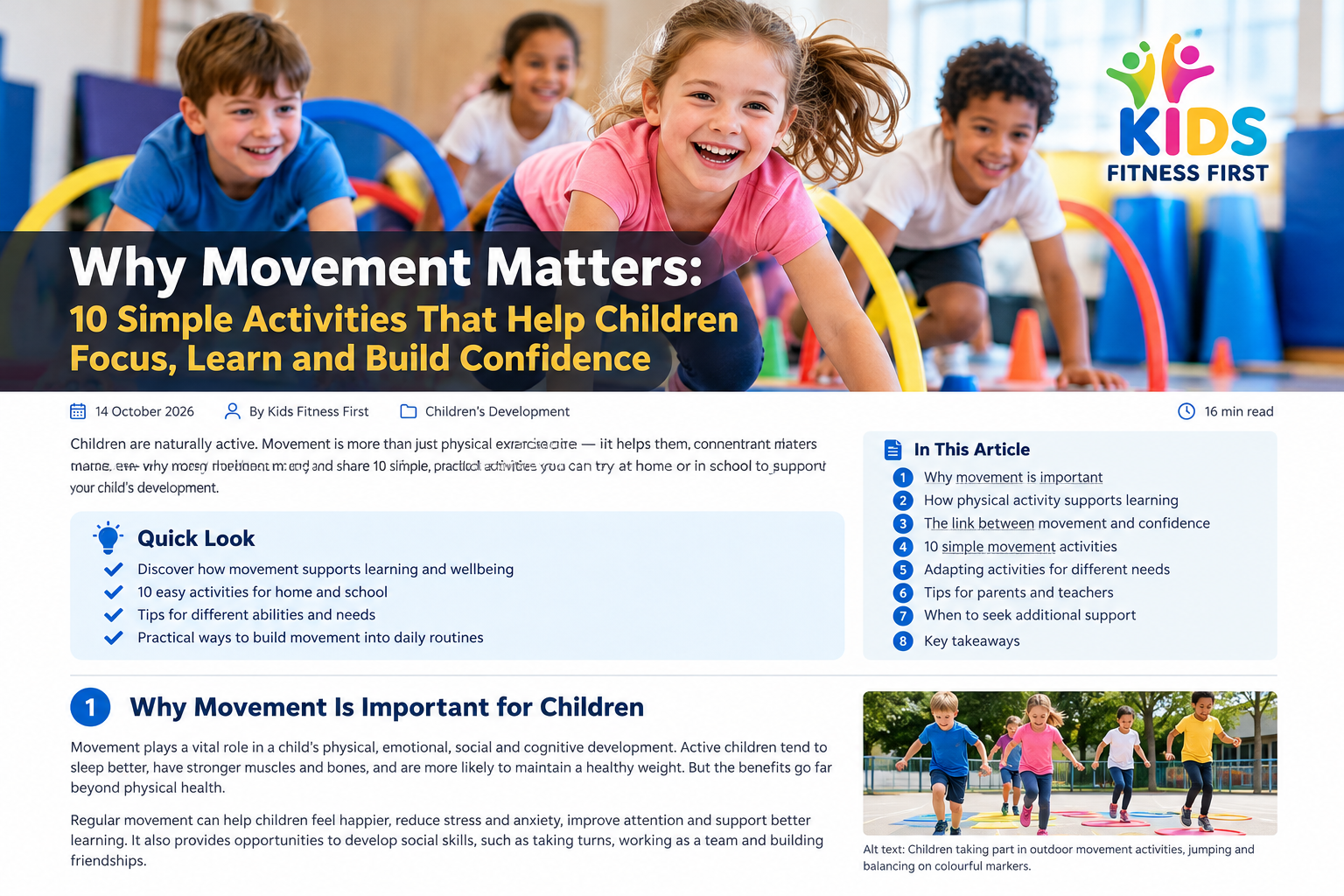
Children learn through doing, exploring and moving. Physical activity supports healthy development and offers everyday opportunities to practise attention, teamwork and confidence. Here are ten low-cost activities that parents, carers and teachers can adapt for home or school.
Quick guide: Most activities need little or no equipment. Supervise according to each child’s age and abilities, and adapt for accessibility and safety.
Why movement matters
Movement gives children opportunities to develop coordination, strength, balance and physical confidence. It also creates chances to practise cooperation, persistence and problem-solving. A short active break may help some children return to a task feeling more alert, although effects vary from child to child. Physical activity is a valuable part of a healthy routine, not a substitute for teaching support, assessment or medical care.
How activity can support attention and learning
Movement breaks divide long periods of sitting into manageable sections. Activities involving instructions, sequences or changes of direction also give children opportunities to practise listening, working memory and self-regulation. The goal is not to make every child sit still afterwards; it is to find a rhythm of activity and rest that helps them participate.
Movement and confidence
Confidence often grows through small, achievable challenges. A child who learns to balance for five seconds, catch a soft ball or complete a simple obstacle course experiences progress they can recognise. Praise effort, experimentation and teamwork rather than speed or comparison. Give children choices and permission to adapt an activity.
Ten simple movement activities
- Animal walks: Travel across a room like a bear, crab or frog for 20–30 seconds. Make it easier by walking normally with animal-themed arm movements.
- Colour corners: Place four coloured sheets around the room. Call a colour and invite children to walk, wheel or move towards it. Add a memory challenge by calling two colours in sequence.
- Balloon keep-up: Tap a balloon gently into the air and count the group’s touches. Check latex allergies; use a soft lightweight ball instead where appropriate, and supervise closely.
- Balance trail: Follow a taped line on the floor, stepping forwards, sideways or backwards. Use a wall or adult’s hand for support.
- Move-and-freeze: Dance or move to music, then pause when it stops. Offer a visual stop sign for children who prefer visual cues.
- Mini obstacle course: Arrange cushions, cones or tape markers for stepping around, crawling under or navigating through. Keep obstacles low and stable.
- Mirror movements: In pairs, one person leads slow arm, head and body movements while the other mirrors them. Switch roles.
- Alphabet actions: Choose a letter and invent a matching action, such as B for balance or S for stretch. Build a short sequence to remember.
- Target toss: Throw soft beanbags or rolled-up socks into a basket from different distances. Move the target closer to keep success achievable.
- Nature movement hunt: Outdoors, find something round, green or textured and travel between safe landmarks. Indoors, use picture cards instead.
Adapting activities for different needs
Inclusive movement is flexible movement. Offer seated and standing versions, clear demonstrations, quieter spaces, shorter turns and predictable transitions. Avoid forcing touch, eye contact, competitive scoring or noisy music. For children with mobility differences, adapt the action rather than excluding the participant: rolling, reaching, pointing and guiding a partner can all count. Ask children what feels comfortable and enjoyable.
Building movement into a typical day
Start small: a three-minute movement break before homework, a walk after lunch, or a five-minute game between lessons. Let children choose between two activities and watch for signs of fatigue or sensory overload. For school-age children, UK guidance generally recommends an average of at least 60 minutes of moderate-to-vigorous activity per day across the week, but any safe increase in activity can be worthwhile. Breaks and everyday play contribute to an active lifestyle.
When additional support may help
If a child frequently experiences pain, dizziness, breathlessness out of proportion to activity, repeated falls or distress during movement, stop the activity and seek appropriate medical advice. If coordination, attention or participation difficulties persist and affect everyday life, speak with a GP, teacher, SENCO or relevant health professional. An article cannot diagnose a condition.
A simple seven-day starter plan
- Monday: Animal walks and stretching.
- Tuesday: Colour corners and mirror movements.
- Wednesday: Balance trail and target toss.
- Thursday: Move-and-freeze with a quiet option.
- Friday: Mini obstacle course.
- Saturday: Outdoor nature movement hunt.
- Sunday: Child’s choice: repeat a favourite game.
Keep sessions brief, adjust the pace and focus on enjoyment rather than completing every activity.
Key takeaway
There is no single perfect movement activity for every child. The most useful activity is one a child can access, enjoy and practise regularly. By combining movement, encouragement and choice, parents and educators can create opportunities for children to develop physical skills, confidence and participation.
Further reading and guidance
For evidence-based physical activity recommendations, see the NHS physical activity guidelines for children and young people and the UK Chief Medical Officers’ physical activity guidelines.
Explore more educational resources from Kids Fitness First.