Mirror movement is a partner game in which one person makes a slow action and the other copies it, as though looking in a mirror. It needs no special equipment and can be adapted for different ages, abilities and spaces. The goal is to notice, respond and enjoy moving together, not to copy perfectly.
Set up a gentle mirror game
Stand or sit facing a partner at a comfortable distance. Clear the floor and choose a quiet space. Agree that anyone can pause or choose a smaller movement. One person is the leader for about 30 seconds; then swap. Adults should demonstrate slowly before inviting a child to lead.
Five mirror movement ideas
1. Slow-motion hands
Move one hand from side to side, open and close the fingers or draw a small circle. The partner follows at their own pace. Keep the actions slow enough to notice.
2. Shape makers
Make a star, triangle or rounded shape using your arms. Invite the partner to make a similar shape. For a seated version, use hands or fingers. Ask which shape they would like next.
3. Animal-inspired actions
Try a gentle cat stretch, a bird’s wings or a turtle pulling its head in. Avoid jumping or floor movements unless everyone is comfortable and the space is safe.
4. Mirror to music
Play quiet music at a comfortable volume. Change one movement when the musical phrase changes. Children who prefer silence can use a visual signal instead.
5. Take turns inventing
After two rounds, ask the child to invent an action and name it. They might create ‘wavy seaweed’ or ‘sleepy robot’. The adult copies without correcting the child. This gives the child control of the activity.
Ways to adapt for different children
Use a seated position, simplify to one movement at a time or show a picture cue. For a child who finds eye contact uncomfortable, stand side by side and copy movements while looking at a shared object. For a child who dislikes noise, skip music and use hand signals. Some children will prefer watching first; observation can be a useful way to become familiar with the game.
There is no need to judge the accuracy of each movement. Instead, notice the child’s choices: ‘I saw you make that circle very slowly’ or ‘You invented a new movement.’ If a child wants to stop, finish positively.
How long should you play?
Try two or three minutes, then ask whether the child wants another round. This is a playful activity, not a treatment or a guaranteed way to improve attention. The NHS recommends varied physical activity throughout the week for children aged 5–18; short games can contribute to a more active day.
Explore more movement ideas
Try our coordination and balance activities or guide to physical activity and confidence.
Further reading: NHS physical activity guidance for children.
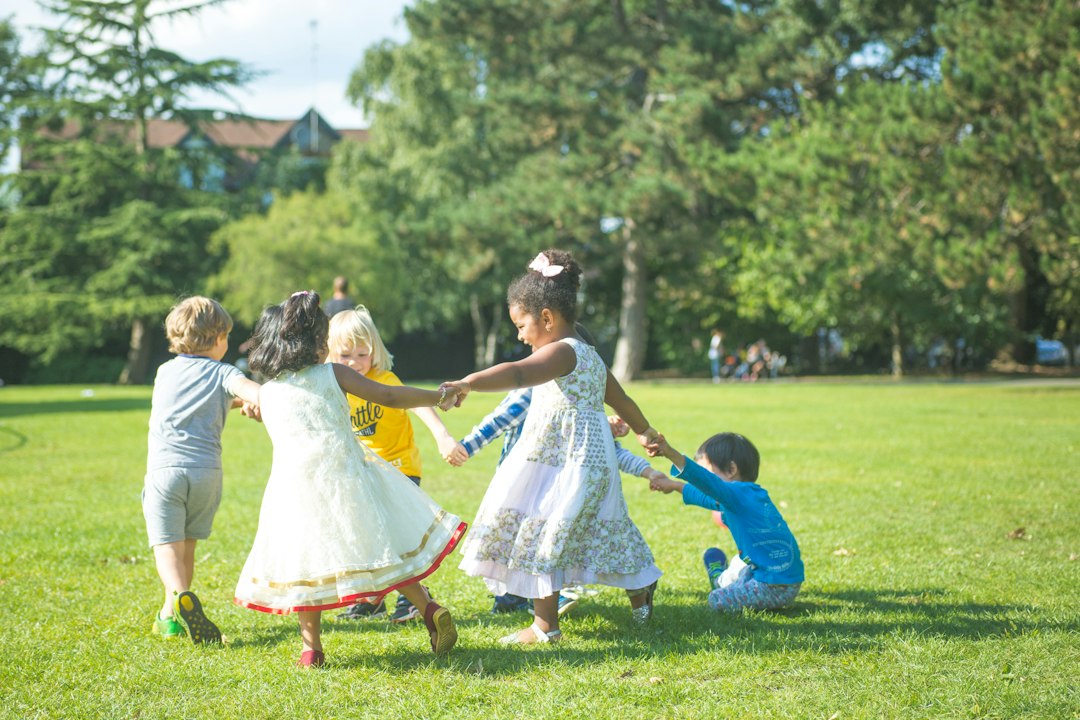
Featured photograph: children holding hands in a circle, by Jay Chen, via Unsplash.