
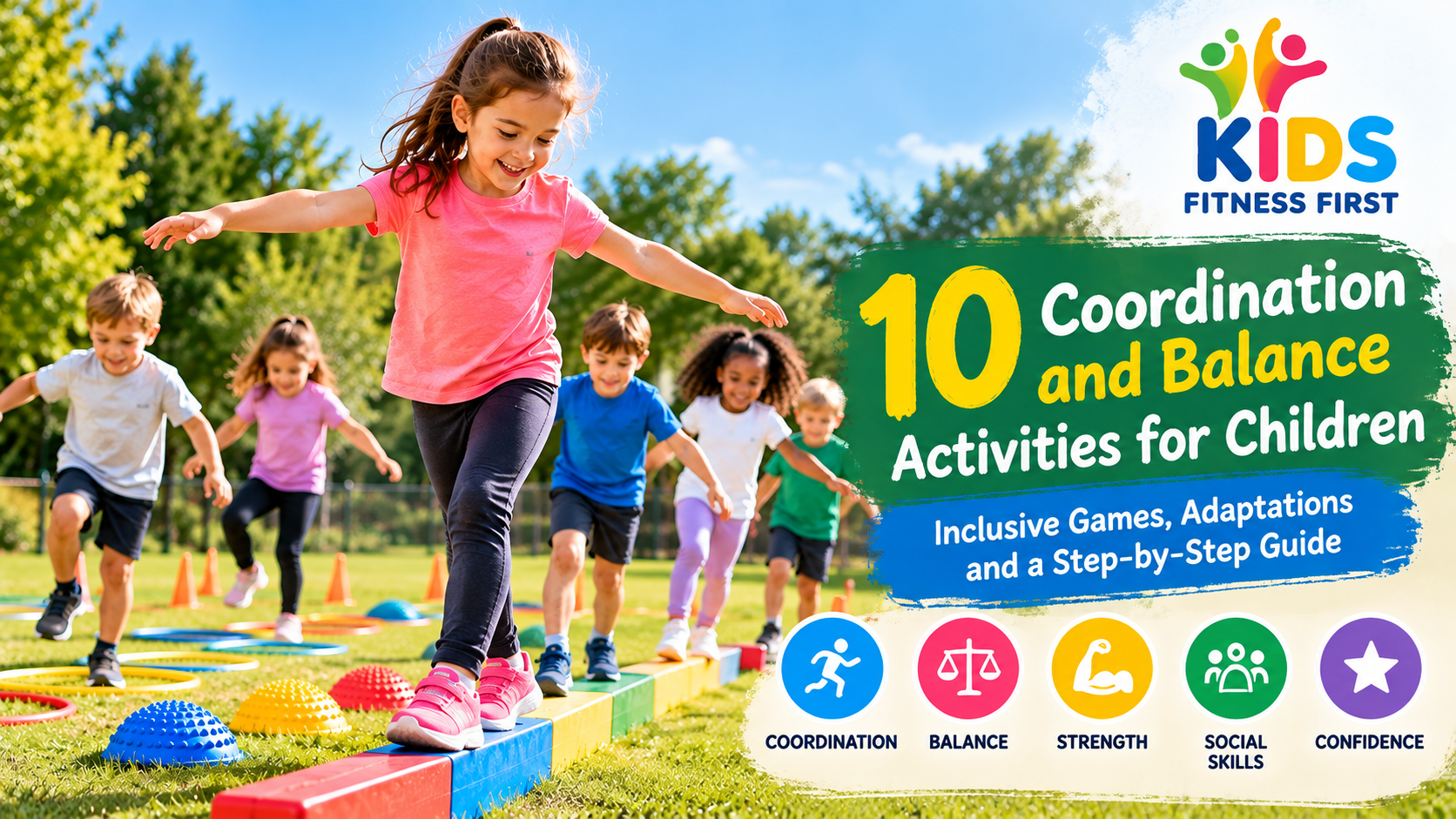
Practical guide for parents, carers and teachers. Try 10 inclusive coordination and balance activities for children, with simple adaptations for home, school and different physical abilities. These ideas are flexible, inclusive and intended for everyday participation rather than diagnosis or treatment.
Why coordination and balance matter
Coordination helps children organise movements such as reaching, catching, writing, dressing and navigating spaces. Balance helps with standing, changing direction and feeling secure during play. Children develop these skills at different rates, and progress is not a competition.
Ten accessible activities
- Tape-line trail: Follow a line on the floor; wheel alongside or trace the route with a hand.
- Beanbag delivery: Carry or move a beanbag between two baskets.
- Ball roll partners: Roll a soft ball back and forth, changing distance gradually.
- Stepping stones: Use flat paper markers for stepping, reaching or pointing.
- Target throw: Toss rolled socks into a large basket at an achievable distance.
- Mirror game: Copy slow movements of a partner, seated or standing.
- Statue poses: Hold a comfortable pose briefly, with support if needed.
- Scarf catch: Toss a lightweight scarf and catch or touch it before it lands.
- Cross-body taps: Reach one hand towards the opposite knee, or towards a comfortable target.
- Obstacle navigation: Travel around stable cones or markers, with a wide accessible route.
Make success achievable
Begin with a larger target, shorter distance, slower movement and more time. Change one variable at a time. Offer stable seating, hand support or a partner where useful. Praise experimentation and persistence rather than comparing children.
Adaptations for different abilities
A child using a wheelchair can practise reaching, turning, rolling or directing a partner. Children who find visual tracking difficult may benefit from contrasting colours or audible cues. Children who find noisy spaces overwhelming may prefer a quieter room and a predictable sequence.
Safety first
Use non-slip surfaces and low, stable obstacles. Keep routes clear and supervise according to age and individual needs. Do not encourage a child to practise through pain, repeated falls or significant distress. Seek advice from a GP or relevant professional if difficulties interfere with everyday life.
A 15-minute sample session
- Three minutes: gentle warm-up movements.
- Four minutes: tape-line trail and stepping stones.
- Four minutes: ball rolling and target throw.
- Four minutes: mirror movements and a calm finish.
Reduce the duration or substitute seated versions when appropriate.
Explore related Kids Fitness First guides
- Why Movement Matters: 10 Simple Activities
- Movement Breaks for Children with ADHD: Practical Ideas for Home and School
- How Physical Activity Can Help Children Build Confidence and Social Skills
- Sensory-Friendly Physical Activities for Autistic and Neurodivergent Children
Further information
See the NHS physical activity guidelines for children and young people and UK Chief Medical Officers’ physical activity guidelines. For individual concerns, consult a qualified professional.
This article provides general educational information and is not medical or diagnostic advice.