
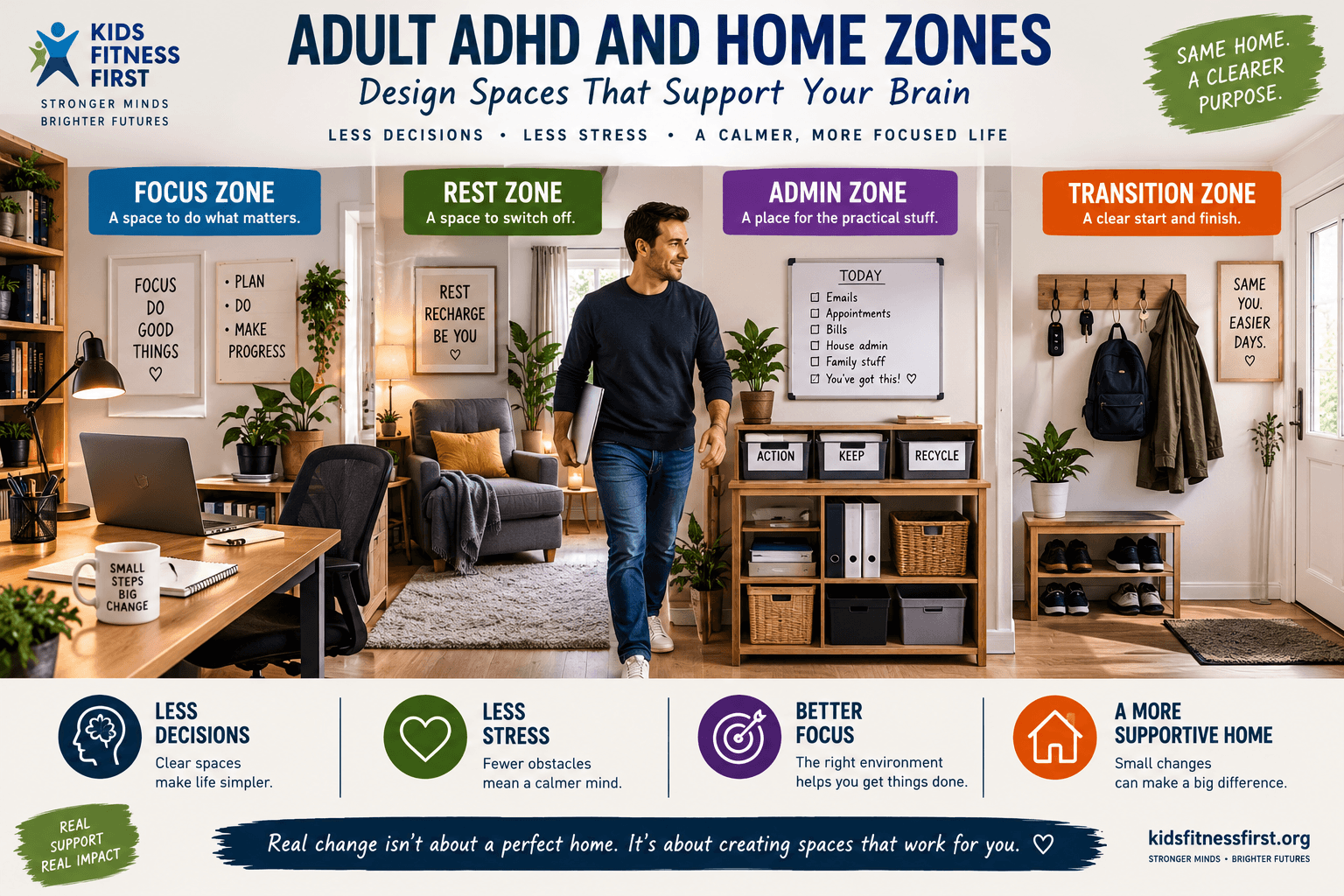
Adult ADHD and Home Zones: How to Design Spaces That Support Your Brain
Adult ADHD and home zones can be a surprisingly useful combination.
Imagine trying to work at the kitchen table.
Your laptop is open. However, the post is beside you. At the same time, someone’s shopping list is underneath your notebook, while a half-finished drink sits nearby.
Meanwhile, the kitchen reminds you about washing up, food, shopping and everything else that happens there.
You are trying to complete one task. Yet, the space around you is quietly suggesting several others.
Eventually, concentration begins to drift.
The problem may not simply be your ability to focus. Instead, the environment may be sending too many different signals at once.
That is where zones can help.
A zone is simply a part of your home with a clear purpose. Importantly, it does not need its own room, expensive furniture or a complicated organisation system.
Most importantly, it does not need to look perfect.
The aim is much simpler: make it easier for your brain to understand:
“This is what happens here.”
Why Adult ADHD and Home Zones Can Work Well Together
Most homes are organised around rooms.
Kitchen.
Bedroom.
Living room.
Hallway.
However, modern rooms often have several jobs.
For example, the kitchen may also be:
- a workplace;
- a homework area;
- a paperwork area;
- a social space;
- a place where parcels wait.
Likewise, the bedroom may become a sleeping space, dressing area, laundry area and somewhere to use a phone.
Sometimes, it even becomes another workplace.
When one area has too many purposes, your attention may be pulled in several directions. As a result, starting or staying with one activity can become more difficult.
Therefore, adult ADHD and home zones can be approached differently.
Instead of asking one room to do everything, give smaller areas clearer jobs.
What Is a Home Zone?
A home zone is a defined space for one main activity.
For example:
A focus zone is where concentrated work happens.
A rest zone is where you deliberately switch off.
An admin zone is where paperwork and practical household tasks live.
A transition zone is where the things you need when entering or leaving home are kept.
The important word is not room.
Instead, it is purpose.
A zone might be one desk, one chair, one shelf, one corner or one section of a table.
In addition, a zone does not necessarily need to exist permanently. In a small home, for instance, the same table might serve different purposes at different times.
Therefore, you do not necessarily need more space.
You need more clarity about what the space is for.
The Focus Zone
A focus zone is somewhere you deliberately reduce competing signals.
Perhaps you already have a desk. If so, that may be the obvious place to begin.
However, you could also use one end of the dining table or a small corner of another room.
The important part is what happens when the zone is active.
For example, you might keep only:
- your laptop;
- the current document;
- a notebook;
- a pen;
- a drink.
Meanwhile, unrelated paperwork can stay somewhere else.
Your phone may also move away during focused work. As a result, the zone communicates one clear message:
“This is where I work on the current task.”
That clarity can make starting easier.
Keep the Focus Zone Simple
It is tempting to turn a focus zone into a major project.
New desk.
New chair.
Storage.
Lighting.
Accessories.
However, none of those things is essential at the beginning.
Instead, test the principle first.
First, clear enough space for one task.
Next, remove obvious distractions.
Then, put everything you need within easy reach.
Finally, try working there.
After a week, ask:
- Did I start more easily?
- Was I distracted less often?
- Did the space help me stay with the task?
If so, the zone may already be doing its job.
You can improve it later if necessary.
The Rest Zone
Rest deserves its own space too.
This can be difficult because work often follows us everywhere.
Emails reach the sofa.
Phone messages reach the bedroom.
Paperwork sits beside the television.
Meanwhile, a laptop may remain on the dining table throughout the evening.
As a result, the brain may receive fewer clear signals that work has ended.
Therefore, consider creating at least one area where work does not normally happen.
Perhaps it is:
- one particular chair;
- one end of the sofa;
- the bedroom after a certain time;
- a small outside area.
The exact location matters less than the boundary.
When you enter the rest zone, its main purpose is recovery.
Protect Rest From Work
A rest zone loses some of its value when work repeatedly enters it.
Therefore, make the boundary easier to maintain.
For example, leave the laptop elsewhere.
In addition, keep work paperwork out of sight and silence unnecessary notifications.
Where possible, avoid using the same rest chair for household admin.
These changes may sound small. However, they create clearer signals.
Work happens there.
Rest happens here.
Consequently, the separation may make both activities easier to recognise.
The Admin Zone
Paperwork is especially good at spreading.
A bill lands on the kitchen counter.
Then, a letter moves to the table.
Meanwhile, an appointment card stays in your bag and a form sits beside the computer.
Eventually, paperwork appears everywhere.
Therefore, create one admin zone.
It can be very small.
For example:
- one tray for action items;
- one folder for important documents;
- one drawer containing household admin supplies;
- one specific place where you deal with paperwork.
The objective is simple:
Household admin has one obvious home.
Make the Admin Zone Easy to Use
Complicated filing systems can create additional friction.
Therefore, begin with broad categories.
For example:
Needs Action
Keep
Recycle
For many everyday documents, that may be enough.
Once paperwork requiring action is in one place, choose a regular time to review it.
Perhaps Tuesday evening works.
Alternatively, Saturday morning may suit you better.
Even fifteen minutes after dinner could be enough.
As a result, paperwork no longer needs to remain visible throughout the entire house simply because you are worried about forgetting it.
The Transition Zone
Of all the zones, the transition zone may be one of the most useful.
It normally sits close to the entrance and helps manage everything that comes into or leaves the home.
For example:
- keys;
- wallet;
- bag;
- coat;
- glasses;
- work pass;
- letters that need posting;
- parcels that need returning.
Instead of these objects moving randomly around the house, they have a home close to where you need them.
Consequently, leaving home may become much simpler.
Adult ADHD and Home Zones Around the Front Door
Think about your normal morning.
How much time is spent asking:
Where are my keys?
Where did I put my wallet?
Did I remember the parcel?
Where is my work pass?
These are transition problems.
Therefore, a small area near the door can remove several repeated decisions.
You might use a hook, tray, basket or small shelf.
Importantly, nothing elaborate is required.
The best transition zone is the one you naturally use.
After all, an organisational system only helps if it works with your actual behaviour.
Zones Do Not Need Separate Rooms
This is important.
Many people hear the word “zone” and imagine a large house.
One room for work.
Another for exercise.
Another for admin.
However, that is not necessary.
A one-bedroom flat can still contain several zones.
For example:
One desk = focus zone.
One chair = rest zone.
One drawer = admin zone.
One hook and tray beside the door = transition zone.
The zones may be only a few feet apart. Nevertheless, they can still have different purposes.
That distinction is what matters.
Use Time as a Boundary When Space Is Limited
Sometimes one table must do several jobs.
That is perfectly reasonable.
Instead of separating activities by space, separate them by time.
For example:
7:00–9:00 → focus zone
9:00 onward → dining table
Saturday morning → admin zone
The table itself does not change. However, the objects and rules do.
During focus time, remove unrelated items.
Then, when work finishes, clear the laptop away.
As a result, the same physical space can provide different signals at different times.
Use Visual Signals to Define a Zone
A zone does not always need a wall.
Sometimes, one simple visual cue is enough.
For example:
A particular desk mat means work.
A basket means admin.
A lamp comes on during focused activity.
A blanket marks the rest chair.
A tray identifies the transition area.
These cues make the boundary clearer.
Therefore, your brain does not need to decide from scratch every time.
Instead, the environment provides the signal.
Adult ADHD and Home Zones Can Reduce Decisions
Every unclear space creates questions.
Where does this go?
Where should I sit?
Where is the paperwork?
Where are the keys?
What should I do first?
A clear zone answers some of those questions automatically.
The keys go there.
The paperwork goes here.
Focused work happens there.
Rest happens here.
Therefore, adult ADHD and home zones are not mainly about decorating.
Instead, they are about reducing unnecessary decisions.
When fewer decisions are required, more attention may remain available for the activity itself.
One Zone, One Main Purpose
A useful rule is:
One zone. One main purpose.
This does not need to be absolute. After all, real homes are rarely perfect.
However, the clearer the main purpose, the stronger the signal.
Suppose your work desk also contains bills, shopping lists, children’s homework, exercise equipment and unopened parcels.
Now the desk communicates several different tasks.
Instead, move unrelated things elsewhere where practical.
As a result, the desk becomes easier to understand and easier to use.
Create an Exercise Zone
If physical activity is important to you, a small movement zone can also help.
Again, this does not require a home gym.
Perhaps it contains:
- a yoga mat;
- resistance bands;
- trainers;
- a small set of weights.
If the equipment remains easy to access, beginning requires fewer steps.
In contrast, equipment hidden at the back of a cupboard creates an additional barrier before the activity even begins.
The exercise itself is the same. However, one environment contains less friction.
Create a Charging Zone
Digital devices create their own daily friction.
Where is the charger?
Which cable belongs to which device?
Why is the phone at five per cent again?
Therefore, a charging zone may be useful.
First, choose one location.
Then, keep the necessary cables there.
Finally, return frequently used devices to the same place for charging.
This removes another repeated search from the day.
Furthermore, you may choose a charging location away from the bedroom or work desk if greater separation from the phone would be useful.
Create a Family Zone
Families generate large amounts of information and equipment.
School letters.
Bags.
Homework.
Sports equipment.
Appointments.
Lunchboxes.
Therefore, a simple family zone can reduce some of the confusion.
For example, you might create:
- one place for school bags;
- a visible family calendar;
- one tray for school letters;
- a basket for items that need to leave tomorrow.
Again, the goal is not perfect organisation.
Instead, create one place where related items naturally gather.
As a result, family members have a clearer idea of where to look.
Use Zones to Support Task Switching
Zones can also make transitions easier.
Moving physically from one zone to another provides a natural cue.
For example:
Leave focus zone → work has ended.
Enter kitchen → prepare food.
Sit in admin zone → paperwork begins.
Move to rest zone → time to slow down.
As a result, the environment helps signal a change in activity.
Sometimes changing physical location can provide a useful mental reset.
Therefore, zones may support not only organisation but also the movement between different parts of the day.
Adult ADHD and Home Zones When Working From Home
Working from home can make boundaries especially difficult because work happens where you live.
Consequently, work can start spreading everywhere.
Emails on the sofa.
Meetings in the kitchen.
Laptop in bed.
Soon, there may be very little visible difference between work and personal time.
A focus zone can help create separation.
Even if it is only one chair and one section of a table, consider creating a simple rule:
When work ends, work equipment leaves this space.
First, close the laptop.
Next, put papers away.
Then, move somewhere else.
In this way, the physical change helps make the end of work more visible.
Keep Zones Easy to Reset
A zone will not stay perfect.
That is normal.
The focus desk will collect things.
The admin tray will fill.
Shoes will move away from the transition area.
Therefore, every zone needs an easy reset.
For example:
Focus zone → clear current paperwork.
Admin zone → review the tray once a week.
Transition zone → return keys and bags each evening.
Rest zone → remove work items.
A reset should take minutes, not hours.
If restoring the zone becomes difficult, the system may be too complicated.
Do Not Overbuild the Zone
Another common mistake is adding too much.
First comes special stationery.
Then new storage.
Next come several organisers.
After that, perhaps new lighting seems necessary.
Eventually, designing the zone becomes more interesting than using it.
Therefore, begin with less.
Ask:
“What is the minimum this space needs to do its job?”
Start there.
Then, add something only when it solves a real problem.
This keeps the zone practical.
Let the Zone Evolve
The first version may not work perfectly.
That is fine.
Perhaps the key hook is in the wrong place.
Maybe the desk faces too many distractions.
The paperwork tray may be too small.
Instead of abandoning the whole idea, adjust it.
Move the hook.
Turn the desk.
Change the tray.
Afterwards, notice whether the change helped.
Zones are experiments.
Therefore, allow them to evolve around your real behaviour rather than forcing yourself to follow a system that does not fit.
Functional Is Better Than Perfect
A zone does not have to look like a magazine.
Your transition area may contain a brightly coloured basket.
The paperwork tray might remain visible.
Your exercise mat may lean against the wall.
If those things help the system work, they are doing their job.
Therefore, ask:
“Does this space make the activity easier?”
That question is more useful than asking whether everything looks perfectly organised.
Adult ADHD and Home Zones on Difficult Days
Good environments can become especially valuable when energy is limited.
On a high-energy day, you may tolerate searching for things.
You may clear a desk before working.
You might remember what needs to leave the house.
However, low-energy days can make every additional step feel larger.
This is where adult ADHD and home zones may become particularly useful.
The environment already gives important items and activities a place.
Therefore, you do not need to recreate the system every morning.
Instead, you simply return to it.
Start With the Transition Zone
If creating several zones feels overwhelming, begin with one.
A transition zone can be a particularly useful starting point because it may solve several repeated problems at once.
For example:
Missing keys.
Lost wallets.
Forgotten parcels.
Misplaced bags.
Stressful departures.
Yet, the solution may require only a hook, tray and basket.
Therefore, start there.
Use it for a week.
Afterwards, notice whether mornings or departures become easier.
If they do, consider which zone would help next.
Build One Zone at a Time
Do not redesign the whole house this weekend.
That would create another large project.
Instead, build gradually.
For example:
First → transition zone
Next → focus zone
Then → admin zone
Later → rest zone
There is no fixed schedule.
Most importantly, allow each zone to become useful before introducing another one.
Small changes can gradually create a very different environment.
Ask What Job the Space Should Do
Whenever a room feels distracting or difficult, ask:
“What job is this part of the room supposed to do?”
If the answer is unclear, that may be part of the problem.
Perhaps the kitchen table is currently doing six jobs.
Instead of immediately buying more storage, decide which jobs genuinely need to happen there.
Then, move the others where possible.
You may discover that you do not need more space.
Instead, the space you already have may simply need clearer responsibilities.
Adult ADHD and Home Zones After a Late Diagnosis
After a late ADHD diagnosis, you may begin recognising why some environments always felt easier than others.
Perhaps you worked well in libraries but struggled at home.
Maybe a certain chair always helped you concentrate.
Perhaps an office felt easier because work had a defined physical location.
In other words, these patterns may contain useful information about the environments in which you function most comfortably.
Understanding adult ADHD and home zones gives you a way to experiment with recreating some of those helpful conditions.
Instead of expecting concentration to appear anywhere, you can create clearer environmental signals around the activity you want to do.
A Simple Four-Zone Starting Plan
If you want to experiment with this approach, keep the first version simple.
1. Focus Zone
Choose one small place for concentrated work.
Then, remove unrelated items before beginning.
2. Rest Zone
Choose somewhere where work does not normally happen.
Where possible, keep work equipment away from it.
3. Admin Zone
Give paperwork one obvious location.
Then, choose a regular time to review it.
4. Transition Zone
Give keys, wallet, bags and outgoing items a permanent place near the door.
Finally, use the system for a week before deciding what needs changing.
This approach allows you to test adult ADHD and home zones without turning organisation into another overwhelming project.
Reflection Questions
- Which room in your home currently has too many different jobs?
- Where do you concentrate most easily?
- Do you have a space where you genuinely switch off?
- Where does your paperwork currently collect?
- What causes the most stress when leaving home?
- Could one chair, table or corner become a clear focus zone?
- Which frequently used items belong in your transition zone?
- Could time boundaries help if you have limited space?
- Which zone would reduce the most daily friction?
- What is the smallest zone you could create today?
Conclusion
Adult ADHD and home zones can provide a simple way to make everyday spaces clearer and easier to use.
You do not need a large home.
Likewise, you do not need a separate office.
And you certainly do not need to redesign every room.
Instead, give small areas clearer purposes.
Create somewhere to focus.
Protect somewhere to rest.
Give paperwork one home.
In addition, build a simple transition area beside the door.
Most importantly, keep each system easy to use and easy to reset.
A successful zone does not need to look perfect. Instead, it needs to reduce unnecessary decisions and make the activity connected with that space easier to begin.
Therefore, when a room feels distracting or overwhelming, ask:
“Is this space trying to do too many jobs?”
If the answer is yes, separate some of those jobs.
Then give each one a clearer home.
Over time, adult ADHD and home zones can help turn the environment from another source of daily friction into a practical support for everyday life.
Suggested Internal Links
- Adult ADHD and Task Switching: How to Make Transitions Easier
- Decision Fatigue and Adult ADHD: How to Reduce Everyday Overwhel
Disclaimer
This article is provided for general educational and informational purposes only. It does not provide medical, psychological, diagnostic or therapeutic advice. Therefore, it should not be used as a substitute for individual guidance from an appropriately qualified healthcare professional.
ADHD experiences vary considerably between individuals. If you have concerns about ADHD, mental health, medication, diagnosis or treatment, please speak with an appropriately qualified healthcare professional.