
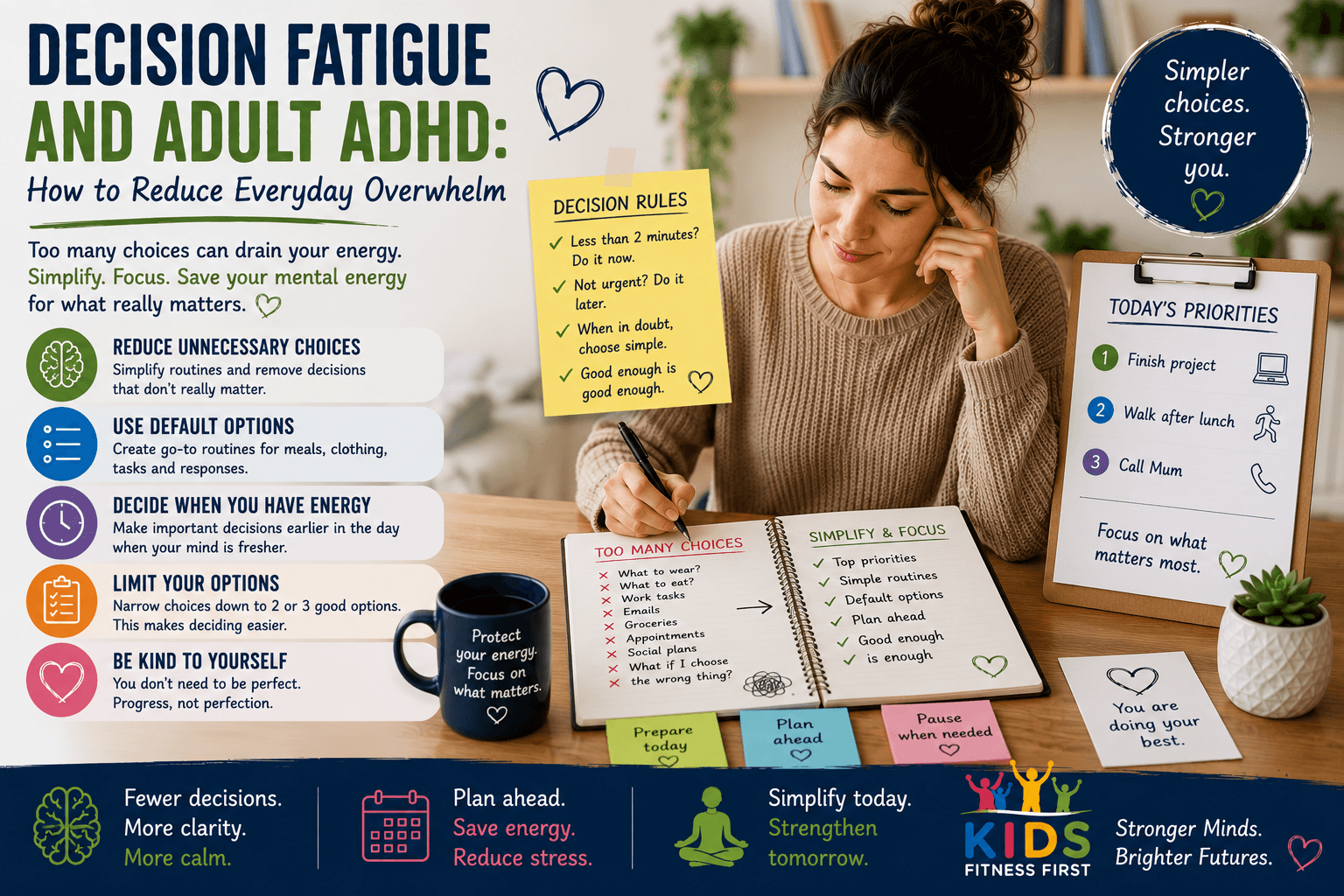
Decision Fatigue and Adult ADHD: How to Reduce Everyday Overwhelm
Every day involves hundreds of decisions.
What should you wear? Which task should you start first? What should you eat? Should you answer that message now or later? Which appointment needs to be arranged first?
Individually, these choices may seem small. However, when they continue from morning until night, they can become mentally exhausting.
For adults with ADHD, decision-making may feel particularly demanding. Difficulties with prioritising, estimating time, holding information in mind and filtering distractions can make even simple choices feel surprisingly complicated.
You may spend twenty minutes deciding where to begin, only to feel too tired to start anything. Alternatively, you might make a quick decision simply to escape the pressure, then regret it later.
This experience is often described as decision fatigue.
Decision fatigue does not mean that you are incapable of making good choices. Instead, it means your mental resources have become overloaded.
This article focuses on recognising decision fatigue: what it is, why repeated choices can become exhausting and the signs that your decision-making capacity is becoming overloaded. If you already recognise the pattern and want a more systems-based approach, continue to reducing ADHD decision fatigue with defaults and simpler recurring choices.
What Is Decision Fatigue?
Decision fatigue is the mental exhaustion that can develop after making too many choices.
As your energy decreases, you may find it harder to:
- compare different options
- identify what matters most
- think about long-term consequences
- resist impulsive choices
- begin tasks
- make confident decisions
- stay patient
- process new information
As a result, you may postpone decisions, choose the easiest option or avoid the situation completely.
For example, after a demanding day at work, deciding what to cook may feel impossible. Although several meals are available, the number of options can create more stress rather than more freedom.
At that point, the problem may not be hunger or motivation.
Instead, your decision-making energy may simply be depleted.
Why Decision-Making Can Feel Harder With ADHD
ADHD can affect several skills involved in making decisions.
You may need to remember multiple pieces of information, compare possible outcomes, ignore distractions and decide which factor matters most.
That process can become difficult when your thoughts are moving quickly or when every option feels equally urgent.
Additional challenges may include:
- difficulty identifying priorities
- fear of making the wrong choice
- perfectionism
- impulsivity
- becoming distracted by new options
- forgetting previous decisions
- feeling overwhelmed by too much information
- struggling to estimate how long something will take
In addition, earlier experiences of criticism may reduce confidence.
After being told that you are careless, disorganised or unreliable, you may begin questioning every choice you make. Consequently, even low-risk decisions can feel emotionally loaded.
Understanding this pattern can help you separate decision-making difficulties from personal failure.
Recognise the Signs of Decision Fatigue
Decision fatigue may appear differently from one person to another.
However, common signs include:
- repeatedly changing your mind
- asking several people for reassurance
- avoiding messages or paperwork
- feeling irritated by simple questions
- impulsive shopping
- ordering takeaway because choosing food feels exhausting
- spending too long comparing similar options
- abandoning a task before making the first decision
- feeling mentally foggy
- agreeing to something simply to end the conversation
You may also notice that decision-making becomes harder at particular times of day.
For example, choices may feel manageable in the morning but overwhelming by late afternoon.
Recognising when your mental energy is strongest allows you to plan more effectively.
Reduce Unnecessary Choices
Not every decision deserves equal attention.
Therefore, one of the most effective strategies is removing small, repetitive choices from your day.
You could simplify decisions about:
- breakfast
- work clothes
- shopping
- exercise
- household tasks
- regular appointments
- weekly meals
- bedtime routines
For example, you might choose from three reliable breakfasts instead of deciding from every possible option each morning.
Likewise, preparing several suitable outfits in advance can reduce pressure before work.
The aim is not to make life rigid.
Instead, it is to preserve mental energy for decisions that genuinely matter.
Create Default Options
A default option is a choice you use when you do not have the time or energy to decide.
Helpful defaults might include:
- a simple breakfast
- a basic packed lunch
- a ten-minute walking route
- a regular grocery list
- a standard reply for common emails
- a set time for checking your calendar
- one place for keys and important documents
- a basic evening routine
For instance, your default evening meal might be an easy combination of protein, vegetables and a simple carbohydrate.
You can still choose something different when you have the energy. However, the default removes the pressure to create a new plan every time.
Defaults can be especially useful on busy or low-energy days.
Limit the Number of Options
Too many choices can create paralysis.
Although having twenty possibilities may seem helpful, it can make comparing them much harder.
Instead, reduce the choice to two or three suitable options.
For example, rather than asking:
“What should I do today?”
Ask:
“Should I complete the report first or answer the urgent emails?”
Similarly, instead of searching through dozens of meals, choose between two familiar options.
Narrowing the decision does not remove your freedom.
Rather, it makes the choice easier to process.
Decide What Matters Most
Some decisions feel difficult because the goal is unclear.
Before comparing options, ask yourself:
“What matters most in this situation?”
The answer may be:
- saving time
- spending less money
- reducing stress
- protecting your health
- meeting a deadline
- supporting your family
- choosing the safest option
- making the task easier to maintain
Once the priority is clear, unsuitable options can be removed.
For example, if your main priority is reducing morning stress, the best breakfast may be the one that is quickest and easiest to prepare—not the most creative option.
Clarity often makes decision-making faster.
Use Simple Decision Rules
Decision rules are short guidelines that prevent you from reconsidering the same issue repeatedly.
Examples include:
- If a task takes less than two minutes, do it now.
- If an appointment is important, put it in the calendar immediately.
- If I buy something new, I wait twenty-four hours before paying.
- If I am too tired to cook, I use my prepared meal.
- If a request is not urgent, I respond the following morning.
- If I cannot decide after ten minutes, I choose the simplest suitable option.
These rules do not need to cover every situation.
However, they can reduce uncertainty during common everyday decisions.
Make Important Decisions Earlier
Mental energy often changes throughout the day.
Therefore, it may help to make important decisions when you feel most alert.
This might mean:
- reviewing finances in the morning
- planning tomorrow before becoming tired
- arranging appointments early in the day
- choosing meals before you become hungry
- discussing difficult subjects after resting
- avoiding major purchases late at night
By contrast, decisions made while exhausted, hungry or emotionally overwhelmed may be more impulsive.
Pay attention to your own energy pattern.
Then try to protect your strongest period for work that requires judgement, planning or concentration.
Write Information Down
Holding several options in your head places pressure on working memory.
Consequently, writing the information down can make the decision feel more manageable.
You could use:
- a short list
- a comparison table
- a notebook
- a phone note
- a whiteboard
- a pros-and-cons list
- a simple scoring system
For example, when choosing between two services, write down the price, convenience and main benefit of each.
Seeing the information clearly often reduces mental clutter.
It also prevents you from repeatedly reviewing the same details.
Set a Time Limit
Some decisions expand to fill all the time available.
You may spend hours comparing products or researching options because there is no clear stopping point.
Instead, set a reasonable time limit.
For example:
- ten minutes for choosing dinner
- twenty minutes for comparing everyday purchases
- one evening for reviewing a larger decision
- five minutes for selecting tomorrow’s priorities
When the time ends, choose the best available option based on the information you have.
Not every decision requires complete certainty.
Often, a good-enough choice is more useful than endless research.
Be Careful With Perfectionism
Perfectionism can make ordinary decisions feel permanent and dangerous.
You may believe there is one perfect answer and that choosing incorrectly will create serious consequences.
However, many decisions are adjustable.
A meal can change tomorrow.
A routine can be revised next week.
An organisational system can be replaced if it does not work.
Ask yourself:
“Is this decision permanent, or can I change it later?”
Recognising that a choice is reversible can reduce pressure.
The aim is not always to find the perfect solution.
Instead, it is often to choose a workable next step.
Plan Before You Become Overwhelmed
Certain situations predictably create decision fatigue.
These may include:
- grocery shopping
- busy mornings
- preparing for travel
- completing paperwork
- organising family activities
- planning meals
- making purchases
- managing appointments
Preparing in advance can reduce the number of choices required in the moment.
For example, before shopping, create a list based on several familiar meals.
Before travelling, use a standard packing checklist.
Before a busy morning, prepare clothing, food and essential items the night before.
A small amount of planning can remove dozens of later decisions.
Protect Yourself From Impulsive Decisions
Mental exhaustion may increase the temptation to make quick choices.
This can affect spending, communication, food, work and relationships.
Helpful safeguards may include:
- waiting before making non-essential purchases
- removing saved payment details
- writing messages without sending them immediately
- discussing major decisions with a trusted person
- avoiding financial choices while distressed
- leaving a situation before responding
- using a written budget
- setting spending limits
These safeguards create a pause between the urge and the action.
As a result, you gain time to decide whether the choice still feels right later.
Ask for Support Without Giving Away Control
Talking through a decision can help organise your thoughts.
However, support is most useful when the other person helps you clarify your priorities rather than choosing everything for you.
You might ask:
- “Can you help me reduce this to two options?”
- “Which factors do you think I am overlooking?”
- “Can I talk through the advantages and disadvantages?”
- “Would you remind me what I said mattered most?”
- “Can we review this tomorrow before I decide?”
Support may come from a partner, friend, colleague, coach or qualified professional.
The final decision can still remain yours.
Create a Weekly Reset
A short weekly planning session can reduce decisions throughout the following days.
During this time, you might:
- review appointments
- select several meals
- identify important tasks
- prepare a shopping list
- arrange clothing
- plan exercise
- organise medication or health reminders
- note anything requiring a decision
This does not need to become a complicated system.
Even fifteen minutes can create useful structure.
By making several choices in advance, you reduce the number of decisions competing for attention during the week.
Allow Yourself to Pause
When decision fatigue becomes intense, continuing to push may not help.
Instead, take a short break.
You could:
- drink water
- eat something
- walk outside
- stretch
- rest quietly
- move to a less distracting environment
- return to the decision later
A pause is particularly important when you notice irritability, mental fog or impulsiveness.
Rest does not solve every problem. Nevertheless, it can restore enough mental energy to approach the choice more clearly.
Accept That Some Decisions Will Be Imperfect
No one makes the best possible choice every time.
Occasionally, you will select something that does not work as expected.
That does not mean you cannot trust yourself.
Instead, ask:
- What information did I have at the time?
- What did I learn?
- Can the decision be adjusted?
- What would make the process easier next time?
Mistakes can provide useful information.
Therefore, treat them as part of learning rather than proof of failure.
Final Thoughts
Decision fatigue and adult ADHD can make everyday life feel more demanding than it appears from the outside.
Repeated choices about food, work, appointments, money and household responsibilities can gradually use up your mental energy.
However, you do not need to approach every decision from the beginning.
Create default options.
Reduce unnecessary choices.
Write information down.
Use simple rules.
Make important decisions when your energy is strongest.
Most importantly, remember that many choices do not need to be perfect. They only need to be suitable enough to move you forward.
By simplifying everyday decisions, you can preserve more energy for the people, goals and experiences that matter most.
Reflection Questions
- Which everyday decisions use most of your mental energy?
- At what time of day do you make decisions most clearly?
- Which repeated choice could become a default routine?
- Where could you reduce your options to two or three?
- Which decision rule could make your daily life easier?
- Do you tend to delay decisions or make them impulsively?
- What could you prepare in advance this week?
- Who could help you talk through a difficult decision?
Internal Links
- Nutrition and Adult ADHD: How Healthy Eating Can Support Your Brain
- Exercise and Adult ADHD: How Movement Supports Focus and Wellbeing
Disclaimer
This article is provided for educational and informational purposes only. It is not a substitute for medical, psychological, financial or therapeutic advice. If ADHD symptoms, decision-making difficulties or emotional distress are significantly affecting your daily life, please seek guidance from an appropriately qualified professional.