
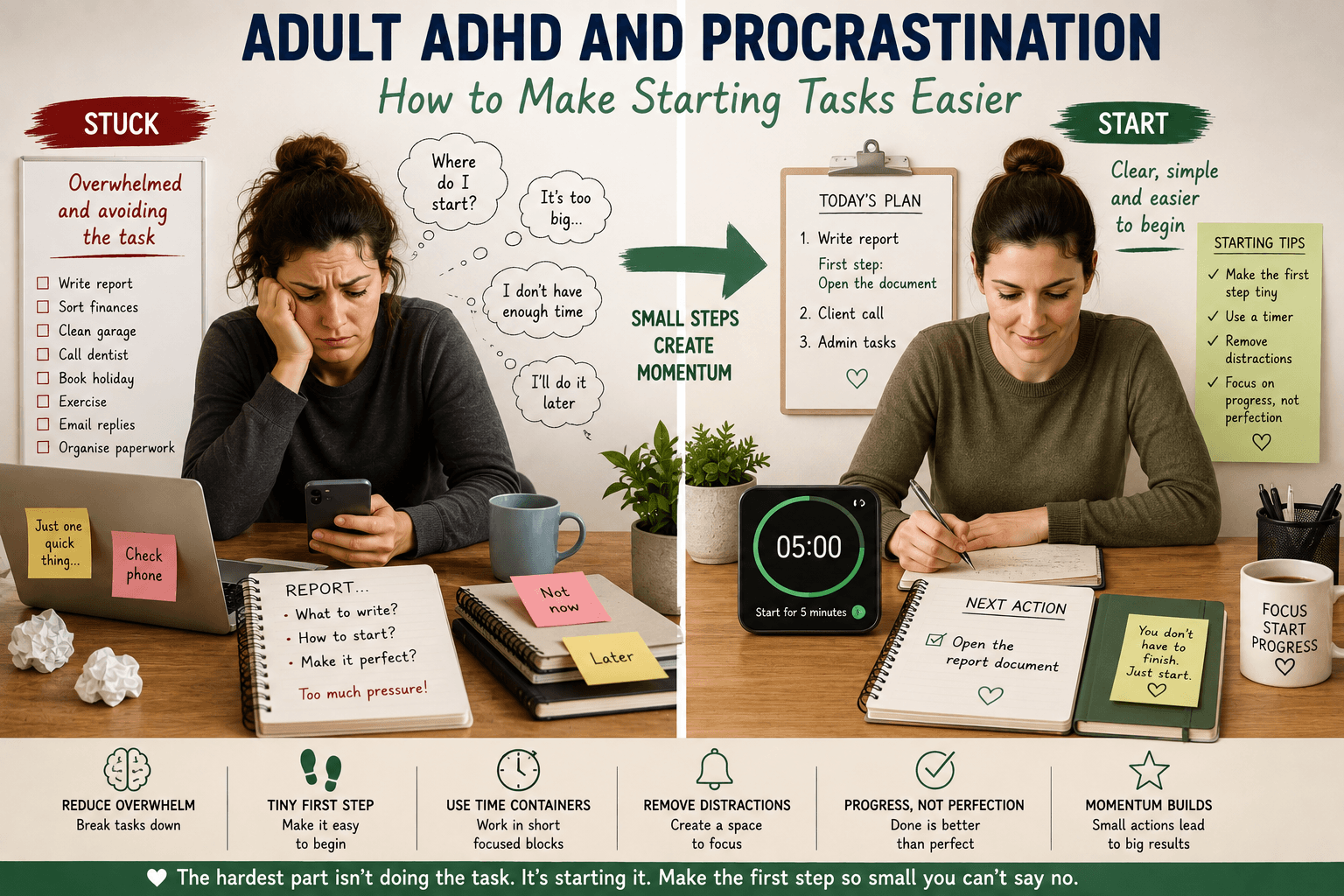
Adult ADHD and Procrastination: How to Make Starting Tasks Easier
Adult ADHD and procrastination can create a frustrating situation.
You know what needs to be done.
You may even want to do it.
The task might be important.
However, you still cannot seem to begin.
Instead, you check your phone.
You make another drink.
You answer an easier email.
Meanwhile, the original task remains untouched.
Eventually, the deadline gets closer.
Now the pressure increases.
Suddenly, the task that felt almost impossible to start becomes urgent enough to demand your attention.
You complete it quickly and wonder:
“Why couldn’t I have done this three days ago?”
It can be tempting to describe this as laziness or lack of motivation.
However, that explanation may overlook something important.
Sometimes the hardest part is not doing the task.
Instead, the hardest part is crossing the gap between intending to start and actually beginning.
Therefore, rather than simply demanding more motivation, it can be useful to make the starting point easier.
Why Can Starting Feel So Difficult?
Consider a task such as:
“Sort out my finances.”
That sounds like one task.
However, what does it actually mean?
Open the banking app?
Find statements?
Check bills?
Create a budget?
Cancel subscriptions?
Pay something?
The instruction is too broad.
As a result, your brain must make several decisions before any action can begin.
Compare that with:
“Open the banking app.”
That is clear.
It has a beginning.
Therefore, one useful approach to adult ADHD and procrastination is to make the first action extremely obvious.
Procrastination Is Not Always About Not Caring
People often assume that if something matters enough, they will automatically do it.
Real life is more complicated.
In fact, you may procrastinate on things that matter enormously.
A job application.
An important form.
A difficult telephone call.
A project you genuinely care about.
Therefore, procrastination does not necessarily tell you how important something is to you.
Sometimes a task matters so much that it creates additional pressure.
You want to do it properly.
You do not know where to begin.
Perhaps you are worried about making a mistake.
Consequently, avoiding the task temporarily reduces that discomfort.
Unfortunately, the task remains.
Find the Real Barrier
When you notice yourself avoiding something, ask:
“What exactly is making this difficult to start?”
The answer may be:
- the task is too large;
- the first step is unclear;
- you need information you do not have;
- the task feels boring;
- there are too many decisions;
- you are worried about doing it badly;
- the environment is distracting;
- you are tired;
- you do not know how long it will take.
Different barriers require different solutions.
Therefore, identifying the barrier can be more useful than simply telling yourself to try harder.
Make the First Step Smaller
Suppose the task is:
“Write the report.”
That can feel substantial.
Instead, reduce it.
First: open the document.
Still difficult?
Make it smaller.
First: sit at the desk.
Still difficult?
Reduce it again.
First: put the laptop on the desk.
The objective is not to pretend the whole task is tiny.
Instead, you are creating a starting action that requires very little negotiation.
Once movement begins, the next step may become easier.
Adult ADHD and Procrastination: Use the Five-Minute Start
A useful experiment is to commit to only five minutes.
Tell yourself:
“I do not need to finish this. I only need to work on it for five minutes.”
Then set a timer.
Begin.
When five minutes ends, you can decide whether to stop.
Often, starting changes how the task feels.
You now understand what you are doing.
The document is open.
The materials are ready.
You may already have some momentum.
However, if you genuinely want to stop after five minutes, you can.
The purpose of the technique is not to trick yourself.
It is to make beginning feel smaller.
Separate Starting From Finishing
A common hidden expectation is:
“If I start this, I need to finish it.”
That makes beginning feel expensive.
A two-hour task now seems to require two free hours before you can even start.
Instead, separate the two ideas.
Starting is one action.
Finishing is another.
For example:
Today → outline the document.
Tomorrow → write the first section.
Thursday → finish the draft.
Friday → review it.
As a result, you no longer need a perfect block of uninterrupted time before making progress.
Define the Next Physical Action
Vague tasks create friction.
Consider:
“Deal with insurance.”
What does that mean?
Instead, identify the next physical action.
For example:
“Search email for insurance renewal.”
Now you know exactly what to do.
Similarly:
“Sort garage” becomes:
“Put empty cardboard boxes into recycling.”
“Organise holiday” becomes:
“Check passport expiry date.”
“Improve CV” becomes:
“Open current CV document.”
The clearer the action, the less thinking is required at the starting line.
Use Verbs
A useful task list normally begins with actions.
Compare:
Dentist
with:
Call dentist to book check-up.
Compare:
Tax
with:
Find last year’s tax documents.
Compare:
Presentation
with:
Write three headings for presentation.
The second versions tell you what to do.
Therefore, whenever a task feels vague, add a verb.
Reduce the Number of Steps Before Starting
Imagine you want to exercise.
Your trainers are upstairs.
Your exercise clothes are in the wash.
The resistance bands are inside a cupboard.
You need to move furniture before beginning.
Each step creates friction.
Therefore, reduce the preparation.
Put the equipment somewhere accessible.
Prepare clothes beforehand.
Keep the area easy to use.
As a result, starting requires fewer actions.
This is one reason environment design can be so useful.
Adult ADHD and Procrastination at Work
Work can create particularly complex starting problems.
You sit down to work on an important project.
However, email is already open.
Messages are arriving.
Your phone is beside you.
Several browser tabs are visible.
Consequently, starting the important task now competes with several easier activities.
Therefore, create a clearer starting environment.
For example:
Close email.
Silence unnecessary notifications.
Open only the document you need.
Put the phone out of immediate reach.
Write the first action on paper.
Then begin.
The environment now gives fewer competing instructions.
Decide the First Task Before Work Begins
Morning decision-making can become another form of procrastination.
You open the computer.
Then you ask:
What should I do first?
Perhaps you check email while deciding.
Twenty minutes disappear.
Instead, decide tomorrow’s first task before finishing today.
Write:
9:00 — complete first draft of introduction.
Now the morning has a starting point.
Consequently, you remove one decision from the moment when you are trying to begin.
Prepare the Starting Point the Night Before
This principle works outside work too.
If you want to exercise tomorrow morning:
Put out your clothes.
Prepare your shoes.
Fill the water bottle.
If you need to post something:
Put the parcel beside the door.
If you want to complete paperwork:
Put the form and necessary documents together.
Therefore, tomorrow’s first step has already been partially completed.
Use Visible Starting Cues
Sometimes a task disappears because it is out of sight.
A notebook inside a drawer may not remind you to use it.
Exercise equipment hidden in a cupboard may not trigger action.
Therefore, where appropriate, make the next action visible.
For example:
Put the book on your pillow.
Leave the document on the desk.
Put the gym bag beside the door.
Keep the current project in your focus zone.
The environment can act as a prompt.
Be Careful With Visual Clutter
Visibility helps only when the signal is clear.
If twenty tasks are visible, they compete with one another.
Therefore, show the next important action rather than everything.
For example:
One document on the desk.
One priority on the whiteboard.
One parcel beside the door.
One exercise mat ready.
In this way, visibility becomes a cue rather than another source of overwhelm.
Adult ADHD and Procrastination With Boring Tasks
Some tasks are simply boring.
There is no need to pretend otherwise.
Filing paperwork.
Cleaning.
Routine data entry.
Sorting receipts.
However, boring tasks still need doing.
Therefore, consider changing the conditions around the task.
For example:
Use a short timer.
Listen to suitable music where the task allows it.
Work alongside another person.
Complete the task in a different environment.
Break it into very small sections.
Add a clear finish point.
The task may remain boring.
Nevertheless, the starting conditions can become easier.
Use a Time Container
Instead of:
“I need to sort all this paperwork.”
try:
“I will sort paperwork for 15 minutes.”
Now the task has a boundary.
Set a timer.
Start.
When it ends, decide whether to continue.
As a result, you are committing to a period of effort rather than an undefined amount of work.
This can make large or unpleasant tasks feel more approachable.
Try Body Doubling
Some people find it easier to begin or continue a task when another person is present.
The other person does not necessarily need to help.
They might simply work nearby.
For example:
You complete paperwork while someone else works on their laptop.
You tidy while another person completes their own task.
You join a virtual work session.
This approach is often referred to as body doubling.
However, it is not a treatment or guaranteed ADHD strategy.
It is simply an environmental technique that some people find useful.
If it helps you begin, it may be worth using.
Create Accountability
Sometimes telling another person what you intend to do can make the task more concrete.
For example:
“I’m going to send the application by 3:00.”
You might then message them when it is done.
Again, this should be supportive rather than punitive.
Therefore, choose someone who helps create useful accountability without adding unnecessary pressure.
Use Momentum From Another Task
Starting from complete inactivity can sometimes feel harder than moving from one action into another.
Therefore, use momentum.
For example:
Make the bed.
Then immediately open the curtains.
Then get dressed.
Then prepare breakfast.
At work:
Open the computer.
Check today’s top three.
Then immediately open the first task.
In this way, one completed action leads into the next.
Create a Starting Ritual
A repeated starting ritual can signal that it is time to begin.
For example:
- Put phone on silent.
- Make a drink.
- Clear the desk.
- Open the document.
- Set a 25-minute timer.
- Begin.
After repeated use, the routine itself may become a familiar cue.
Therefore, you spend less time deciding how to start.
Do Not Make the Ritual Too Long
There is a danger here.
Preparing to work can become another form of avoiding work.
You tidy the entire desk.
Then make coffee.
Then organise files.
Then choose music.
Then adjust the chair.
Thirty minutes later, the task has not started.
Therefore, keep the ritual short.
The ritual should lead to the work.
It should not replace it.
Adult ADHD and Procrastination When Perfectionism Appears
Sometimes the barrier is not the task itself.
It is the standard you believe the task must meet.
You think:
“If I cannot do this properly, there is no point starting.”
That creates an enormous starting threshold.
Instead, allow the first version to be imperfect.
For example:
Write a rough paragraph.
Create a messy outline.
Make an incomplete list.
Produce the first draft.
Afterwards, improve it.
A rough beginning gives you something to work with.
A perfect blank page gives you nothing.
Use the “Bad First Version” Rule
For creative or complex work, try giving yourself permission to produce a deliberately imperfect first version.
The first draft does not need to impress anyone.
Its job is simply to exist.
Then, editing becomes a separate task.
This reduces the number of demands placed on the starting moment.
You are not trying to begin, finish and perfect the task simultaneously.
You are simply creating version one.
Break Emotional Tasks Into Mechanical Steps
Some tasks carry emotional weight.
Opening a difficult letter.
Responding to a complaint.
Checking a financial account.
Completing an important application.
Therefore, reduce the first step to something mechanical.
For example:
Step 1 → find the letter.
Step 2 → sit at the desk.
Step 3 → open it.
Step 4 → read the first paragraph.
Step 5 → highlight what requires action.
The emotional difficulty may remain.
However, the practical path becomes clearer.
Use External Memory to Protect the Task
Article 8 explored adult ADHD and external memory.
The same principle can help with procrastination.
If a task only exists in your head, it can disappear.
Therefore:
Write it down.
Add a deadline.
Record the next action.
Put preparation into the calendar.
Use a reminder where appropriate.
As a result, you do not need to repeatedly remember that the task exists.
Use Decision Reduction to Make Starting Easier
Article 9 explored adult ADHD and decision fatigue.
Decision fatigue can directly affect starting.
If beginning requires choosing:
which task;
which method;
which document;
which location;
which priority;
you may become stuck before doing anything.
Therefore, make some decisions in advance.
Choose the task.
Choose the time.
Choose the location.
Define the first action.
Then, when the moment arrives, there is less to decide.
Use Time Visibility to Reduce Procrastination
Article 10 explored adult ADHD and time blindness.
Procrastination and time can interact.
A deadline next month may not feel immediate.
Therefore, create nearer milestones.
For example:
Monday → outline.
Wednesday → first section.
Friday → draft.
Next Tuesday → edit.
As a result, the task has several visible starting points rather than one distant final deadline.
Create Artificial Beginnings Before Urgency Arrives
Urgency can sometimes create the activation needed to begin.
However, relying on last-minute pressure can be stressful.
Therefore, create earlier starting points.
For example:
Real deadline: Friday.
Personal first-draft deadline: Wednesday.
Now Wednesday becomes meaningful.
You may also schedule a work session with another person or put preparation time into the calendar.
These external structures can help create momentum before the final deadline becomes an emergency.
Do Not Confuse Planning With Starting
Planning can be useful.
However, planning can also become a safe substitute for action.
You create lists.
You research methods.
You reorganise your calendar.
You download another productivity app.
Yet the task remains untouched.
Therefore, after a reasonable amount of planning, ask:
“What physical action can I take now?”
Then do that action.
Use the One-Action Rule
When you notice yourself repeatedly thinking about a task, take one physical action towards it.
For example:
Thinking about booking dentist → find telephone number.
Thinking about application → open website.
Thinking about cleaning garage → take one empty box outside.
Thinking about report → create document.
The action may take less than a minute.
Nevertheless, the task has moved from thought into reality.
Adult ADHD and Procrastination Around Household Tasks
Household jobs can feel endless.
Cleaning is never permanently finished.
Laundry returns.
Dishes return.
Shopping returns.
Therefore, avoid defining household tasks too broadly.
Instead of:
“Clean the house.”
choose:
“Clear kitchen surfaces for ten minutes.”
Instead of:
“Sort laundry.”
choose:
“Put one load into the washing machine.”
Clear endpoints make starting easier.
Use Minimum Versions
On difficult days, create a minimum version of the task.
For example:
Full exercise session → minimum ten-minute walk.
Full kitchen clean → minimum clear sink.
Full admin session → minimum open and sort five letters.
Full report session → minimum write one paragraph.
The minimum version keeps the task moving.
Importantly, it also prevents an all-or-nothing approach.
Some progress can still be valuable.
Adult ADHD and Procrastination on Low-Energy Days
Energy matters.
A strategy that works when you feel alert may not work when you are exhausted.
Therefore, adjust expectations.
On lower-energy days:
make the first step smaller;
reduce the number of priorities;
use more external reminders;
choose easier environments;
use minimum versions;
allow more recovery.
The objective is not identical performance every day.
Instead, it is creating systems flexible enough to work across different kinds of days.
Notice When You Are Waiting to “Feel Like It”
Sometimes we delay because we are waiting for motivation.
“I’ll do it when I feel ready.”
The difficulty is that the feeling may not arrive.
Sometimes action comes first.
You open the document.
You write one sentence.
Then another.
Gradually, motivation may increase because the task is already moving.
Therefore, rather than asking:
“Do I feel motivated?”
try asking:
“What is the smallest useful action I can take?”
Reward Completion of Difficult Starts
If starting a particular task is genuinely difficult, acknowledge when you do it.
This does not require an elaborate reward system.
Perhaps after completing an unpleasant admin task, you make a coffee.
After finishing a focused work block, you take a short walk.
However, keep rewards proportionate and practical.
The aim is to recognise effort, not turn every routine responsibility into a complicated negotiation.
Keep Evidence That You Can Start
When procrastination has been a repeated problem, you may begin expecting yourself not to start.
Therefore, notice successful starts.
You opened the form.
You made the call.
You began the report.
You went for the walk.
These may look small.
However, they provide evidence that the starting barrier can be crossed.
Over time, that can change how you approach future tasks.
Adult ADHD and Procrastination After a Late Diagnosis
After a late ADHD diagnosis, procrastination may look different in hindsight.
Perhaps you spent years being told:
“You just need more discipline.”
Maybe you repeatedly completed important work at the last minute.
Perhaps you performed very well under pressure but struggled to begin when deadlines were distant.
Understanding adult ADHD and procrastination can provide a different framework for examining these patterns.
The goal is not to excuse every delay.
Instead, it is to understand what conditions make action easier or harder.
Once the barrier becomes clearer, you can design better support around it.
Build a Personal Starting Toolkit
You do not need every strategy in this article.
Choose the ones that fit your difficulties.
Your toolkit might include:
Five-Minute Start
Commit only to beginning.
Next Physical Action
Define exactly what to do.
Time Container
Work for a defined period.
Body Doubling
Work alongside someone.
Visible Cue
Put the next action where you can see it.
Starting Ritual
Use the same short sequence before focused work.
Minimum Version
Create a smaller version for difficult days.
External Deadline
Create an earlier checkpoint before the real deadline.
The best toolkit is the one you actually use.
A Simple Anti-Procrastination Routine
When you notice yourself avoiding a task, try this:
Step 1: Name the task.
Step 2: Ask what is making it difficult.
Step 3: Define the next physical action.
Step 4: Reduce that action if necessary.
Step 5: Remove obvious distractions.
Step 6: Set a five- or ten-minute timer.
Step 7: Begin.
When the timer ends, decide whether to continue.
This creates a practical path from intention to action.
Start With One Task You Have Been Avoiding
Choose one task.
Not ten.
One.
Then ask:
What exactly is stopping me from beginning?
Perhaps the task is unclear.
Clarify it.
Perhaps it feels too large.
Reduce it.
Perhaps you need information.
Find the information.
Perhaps the environment is distracting.
Change the environment.
Then define the smallest useful first action.
Do that action.
Afterwards, decide what comes next.
Reflection Questions
- Which tasks do you procrastinate on most often?
- Is the first step of those tasks clear?
- Are you waiting for motivation before beginning?
- Could the task be reduced to a five-minute start?
- Which environmental distractions make starting harder?
- Would a time container help?
- Could you prepare the starting point the night before?
- Are perfectionism or fear of mistakes raising the starting threshold?
- Which task could have a minimum version?
- What is one physical action you could take today?
Conclusion
Adult ADHD and procrastination can make the gap between intending to do something and actually starting it feel much larger than expected.
However, the answer does not always need to be more pressure.
Instead, examine the starting point.
Make the first action smaller.
Define the next physical step.
Remove unnecessary preparation.
Use short time containers.
Prepare important tasks in advance.
In addition, use external reminders, visible cues and supportive accountability where they help.
Most importantly, separate starting from finishing.
You do not need to complete the entire task before you are allowed to begin it.
Sometimes the most useful question is not:
“How am I going to finish all of this?”
Instead, ask:
“What is the smallest useful action I can take right now?”
Then begin there.
Over time, adult ADHD and procrastination may become easier to manage when tasks have clearer starting points, fewer barriers and practical systems that help turn intention into action.
SUGGESTED INTERNAL LINKS
- Adult ADHD and Time Blindness: How to Make Time More Visible
- Adult ADHD and Decision Fatigue: How to Make Everyday Choices Easier
DISCLAIMER
This article is provided for general educational and informational purposes only. It does not provide medical, psychological, diagnostic or therapeutic advice and should not be used as a substitute for individual guidance from an appropriately qualified healthcare professional.
Procrastination and difficulties starting tasks can have many causes, and ADHD experiences vary considerably between individuals. If these difficulties are significantly affecting your wellbeing or daily life, or if you have concerns about ADHD, mental health, diagnosis, medication or treatment, please speak with an appropriately qualified healthcare professional.