
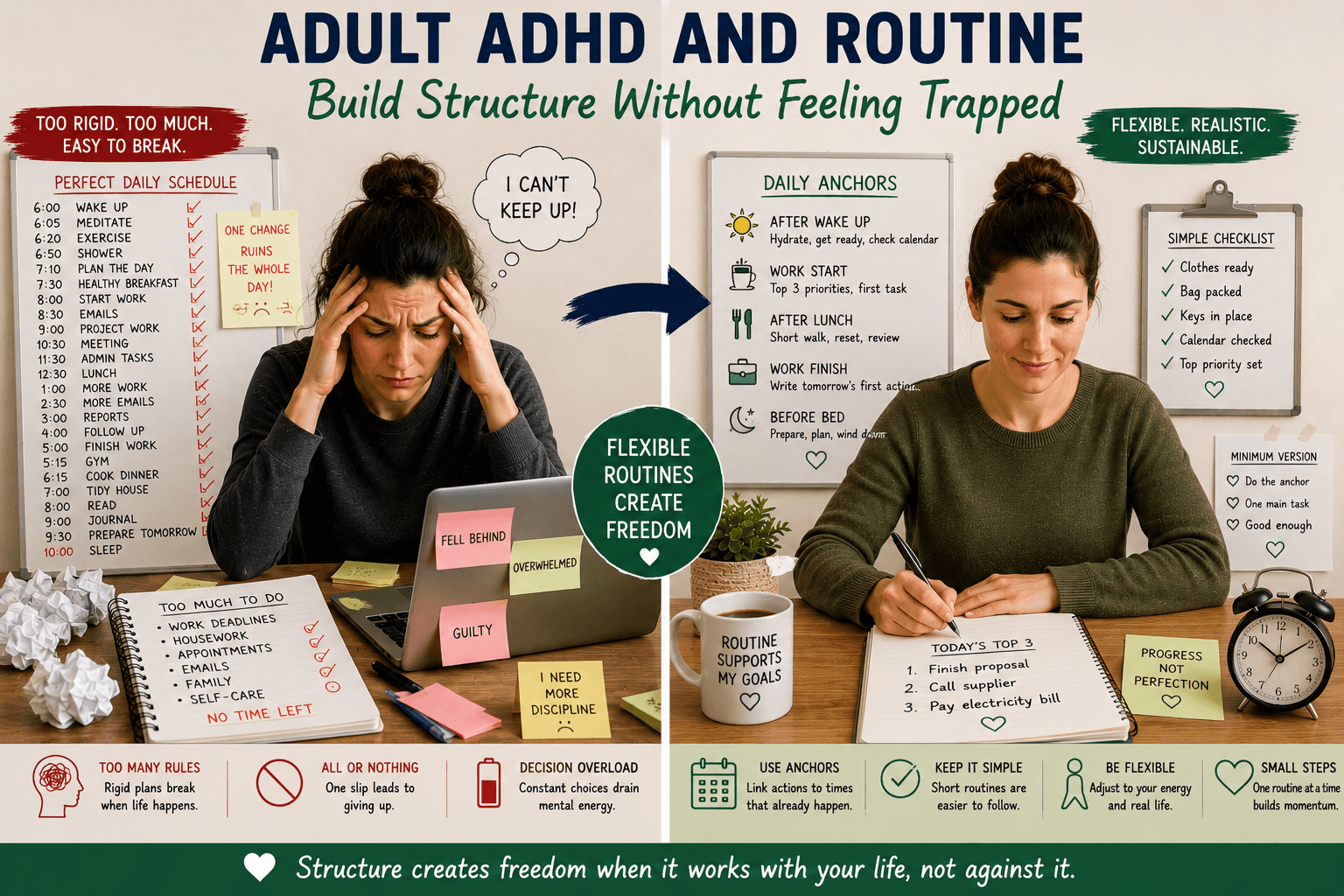
Adult ADHD and Routine: How to Build Structure Without Feeling Trapped
Adult ADHD and routine can seem like an awkward combination. For the wider library covering everyday systems, motivation, overwhelm, emotions and work, see our Adult ADHD practical guide.
On one hand, routine can make everyday life easier. For example, it can reduce repeated decisions, help you remember what comes next and make mornings, workdays and evenings more predictable.
However, too much structure can begin to feel restrictive.
A rigid schedule may work well for a few days. Then, one unexpected change happens. Perhaps an appointment moves, you sleep badly or somebody suddenly needs your attention.
As a result, the plan breaks.
At that point, it can be tempting to believe that the whole routine has failed.
However, one disrupted day does not mean the system is useless.
Instead, the goal is to create flexible structure.
That means having enough repetition to support you while leaving enough room to adapt when real life changes.
Therefore, a useful routine should create direction without making you feel trapped by the clock.
Why Adult ADHD and Routine Can Work Well Together
Every repeated decision uses some mental energy.
What should I do first?
When should I exercise?
When should I check email?
What happens after lunch?
When should I deal with paperwork?
Therefore, routines can reduce the need to answer the same questions again and again. This is one reason flexible routines can help reduce recurring decision fatigue and preserve attention for higher-value choices.
For example:
After breakfast → check calendar.
After work → complete a short reset.
Before bed → prepare tomorrow.
These patterns give the day direction. As a result, fewer decisions need to be made in the moment.
However, routine should support your life rather than control it.
The aim is not to follow every step perfectly. Instead, it is to make familiar parts of the day easier to navigate.
Routine Is Not the Same as Rigidity
This distinction matters.
A rigid system might say:
“This must happen at exactly 7:30 every day.”
A flexible routine might say:
“This usually happens after breakfast.”
The second version can be easier to maintain because real life changes.
Therefore, linking an action to an event can sometimes work better than linking everything to an exact time.
For example:
After waking → drink water.
After lunch → short walk.
After finishing work → review tomorrow.
Before bed → prepare clothes.
In this way, everyday events become anchors rather than strict rules.
Consequently, if one part of the schedule moves slightly, the whole routine does not necessarily collapse.
Adult ADHD and Routine: Use Anchors
An anchor is something that already happens regularly.
For example, you may wake up, eat breakfast, have lunch, finish work, eat dinner and go to bed at roughly familiar points in the day.
You can attach a useful action to one of those existing events.
After Breakfast
Check the calendar.
After Lunch
Review priorities.
After Work
Clear the desk and write tomorrow’s first task.
Before Bed
Prepare clothes and important items.
As a result, the existing event helps remind you what comes next.
Furthermore, you do not have to create an entirely new habit from nothing. You are simply attaching one useful action to something that already happens.
Start With One Routine
A common mistake is trying to rebuild the entire day at once.
You create a new morning routine, exercise routine, meal routine, work routine and bedtime routine.
However, this quickly becomes a large project.
Therefore, start with one repeated problem.
Perhaps mornings feel chaotic. If so, focus there first.
Maybe evenings are more difficult. In that case, begin with the evening.
Once one routine becomes useful, you can add another.
As a result, the system develops gradually instead of becoming another source of pressure.
Build a Simple Morning Routine
Mornings often contain many small decisions.
What should I wear?
What do I need today?
What should I eat?
What is the first task?
Therefore, a short morning routine can reduce friction.
For example:
- Get dressed.
- Eat breakfast.
- Check the calendar.
- Collect your bag and keys.
- Begin the first priority.
That may be enough.
Importantly, the routine does not need ten or fifteen steps.
In fact, the simpler the routine is, the easier it may be to follow consistently.
Prepare the Morning the Night Before
A smoother morning often begins the previous evening.
For example, you could choose clothes, charge devices, prepare your bag and put keys in their usual place.
In addition, check tomorrow’s calendar and decide what the first important task will be.
As a result, the morning contains fewer open decisions.
You are not trying to decide everything while also getting ready.
Therefore, a few minutes of preparation the night before may reduce much more friction the following morning.
Adult ADHD and Routine at Work
Workdays can easily become fragmented by email, calls, meetings, messages and competing projects.
Therefore, a few predictable work anchors can help.
Start of Work
Check priorities.
Mid-Morning
Complete a focused work block.
After Lunch
Review the remaining tasks.
End of Work
Write tomorrow’s first action.
These anchors create structure without requiring every minute to be planned.
As a result, the day has clear reference points even when the exact workload changes.
Create a Start-Up Routine
Starting work can become easier when the first steps are predictable.
For example:
Put the phone away.
Open the calendar.
Check today’s top three.
Open the first task.
Begin.
Because the sequence is already known, there are fewer decisions before work starts.
Therefore, a simple start-up routine can support both focus and task initiation.
Most importantly, keep the routine short enough that preparation does not replace the work itself.
Create a Shutdown Routine
Finishing work is just as important as starting.
A simple shutdown routine might be:
Save the current work.
Write the next action.
Check tomorrow’s calendar.
Close unnecessary tabs.
Clear one small surface.
Then stop.
As a result, the working day has a clearer ending.
Furthermore, tomorrow begins with a visible starting point rather than an unfinished mental question.
This can also make the transition into rest or personal time easier.
Use Routines to Support Task Switching
Earlier in this series, we discussed adult ADHD and task switching.
Routine can help transitions because it provides a repeated bridge between activities.
For example:
Meeting ends → write actions → close notes → short walk → next task.
Work ends → save → prepare tomorrow → close laptop → leave the desk.
Therefore, the routine helps explain how to move from one mode to another.
As a result, the transition itself requires less decision-making.
Adult ADHD and Routine at Home
Home life can feel less structured than work.
Cleaning, laundry, food, paperwork and appointments may all compete for attention.
Therefore, repeated patterns can reduce uncertainty.
For example:
Monday → laundry.
Tuesday → paperwork.
Wednesday → shopping.
Friday → household reset.
These themes do not need to be followed perfectly.
However, they give the week a general direction.
As a result, you do not need to decide from scratch when every household job should happen.
Use Theme Days
Theme days can be useful when detailed daily routines feel too repetitive.
For example:
Monday
Admin.
Tuesday
Exercise and errands.
Wednesday
Household tasks.
Thursday
Planning.
Friday
Reset.
The exact themes will depend on your life.
However, the advantage is that each day has a broad purpose.
Consequently, the week can feel more organised without becoming rigidly scheduled.
Do Not Overload the Routine
A routine should make life easier.
However, if it contains too many steps, it becomes another task to manage.
For example, a morning routine might include meditation, journalling, exercise, reading, stretching, cooking, planning and cleaning before the working day even begins.
That may suit some people.
However, for others, it creates immediate pressure.
Therefore, ask:
“What is the minimum useful routine?”
Start there.
Then, only add another step if it genuinely improves the routine.
Use Minimum Versions
Every routine can benefit from a smaller version.
For example:
Normal Morning
Breakfast, calendar, exercise, shower and work start.
Low-Energy Morning
Breakfast, calendar, get dressed and start one priority.
Likewise:
Normal Evening Reset
Clear kitchen, prepare bag, check tomorrow and tidy desk.
Minimum Evening Reset
Put keys in place and check tomorrow’s first appointment.
Therefore, the routine can survive difficult days instead of disappearing completely.
Adult ADHD and Routine on Low-Energy Days
Low-energy days are where flexible routines can become especially useful.
A rigid routine says:
“Do everything exactly as planned.”
A flexible routine says:
“Keep the important anchors and reduce the rest.”
Therefore, on a difficult day, you might keep only one morning anchor, one work anchor and one evening anchor.
That may be enough.
As a result, the routine remains alive without demanding full performance.
Use Defaults
Routine and defaults work well together.
For example, you might have a default breakfast, exercise period, paperwork day, shopping day and place for your keys.
As a result, fewer choices need to be made repeatedly.
This connects directly with the earlier article on adult ADHD and decision fatigue.
Therefore, a good routine does not simply organise time. It also reduces unnecessary decision-making.
Build Routine Around Your Natural Energy
Article 7 explored adult ADHD and energy management.
Routine often works better when it fits your natural rhythm.
For example, if you think clearly in the morning, use part of that period for important work.
Conversely, if your energy drops after lunch, simpler tasks may fit better there.
Therefore, routine should follow your energy where possible.
It should not force every type of task into the same kind of hour.
Use External Memory to Support Routine
Article 8 explored adult ADHD and external memory.
Routine becomes easier when reminders support it.
For example:
Use a calendar reminder for weekly admin.
Set an alarm for the shutdown routine.
Keep a checklist beside the door.
Use a whiteboard for morning priorities.
As a result, you do not need to remember every routine internally.
Instead, the environment and your tools help carry part of the load.
Reduce Decision Fatigue Through Routine
Article 9 explored adult ADHD and decision fatigue.
Routine can remove repeated low-value decisions.
For example:
What should I eat?
Use a default breakfast.
When should I check email?
Use set periods.
When should I do paperwork?
Use Tuesday evening.
Therefore, routine creates pre-made decisions.
Consequently, more attention remains available for choices that genuinely require thought.
Use Time Visibility
Article 10 explored adult ADHD and time blindness.
Routine becomes more useful when time is visible.
For example, use a clock during the morning, set an alarm before leaving or use a timer for a household reset.
Therefore, the routine has both sequence and time cues.
As a result, transitions may become easier to notice and act upon.
Routine Can Reduce Procrastination
Article 11 explored adult ADHD and procrastination.
Starting can become easier when the starting sequence is already known.
For example:
Sit at the desk.
Open the document.
Set the timer.
Begin.
Because there is less planning at the starting point, the gap between intention and action may become smaller.
Therefore, routine can make beginning feel more familiar.
Routine Can Reduce Overwhelm
Article 12 explored adult ADHD and overwhelm.
When everything seems to need attention, routine can provide a stable base.
For example:
Morning → top three.
Afternoon → review.
Evening → reset.
Therefore, there is always a familiar point to return to.
As a result, you do not need to rebuild the entire day every time something changes.
Routine Can Support Prioritisation
Article 13 explored adult ADHD and prioritisation.
A routine can protect important work.
For example:
First work block → main priority.
Later block → admin.
End of day → prepare tomorrow.
As a result, lower-value tasks are less likely to take over every strong period.
Therefore, routine can help turn priorities into repeated actions rather than intentions that disappear during the day.
Avoid Building Routines Around Motivation
Motivation changes.
Therefore, a useful routine should not depend entirely on feeling enthusiastic.
For example, you may not feel like checking the calendar.
However, if checking the calendar happens after breakfast every day, the action becomes less dependent on motivation.
Instead, the routine is connected to a familiar cue.
That is why building routines around events can be more reliable than waiting to feel ready.
Make the Cue Obvious
A good routine needs a clear trigger.
For example:
Coffee machine starts → check calendar.
Laptop closes → write tomorrow’s first task.
Dinner finishes → prepare bag.
Phone goes on charge → begin bedtime routine.
The cue should be easy to recognise.
As a result, the next action requires less thought.
Over time, the sequence may also begin to feel more familiar.
Adult ADHD and Routine: Keep It Visible
A routine hidden inside an app may be easy to forget.
Therefore, visible support can be useful.
For example:
Morning checklist on fridge.
Work routine on desk.
Evening reset on whiteboard.
Leaving-home list beside the door.
However, keep the list short.
Too many visible instructions can become another form of clutter.
Therefore, show the information that is useful now rather than everything at once.
Use Checklists for Repeated Sequences
Checklists are particularly useful for routines that repeat.
For example:
Leaving Home
- phone;
- keys;
- wallet;
- glasses;
- bag.
End of Work
- save;
- write next action;
- check calendar;
- close tabs;
- stop.
Therefore, you do not need to remember the whole sequence each time.
Instead, you follow the checklist.
This can make routine actions simpler and more consistent.
Do Not Restart From Zero After One Bad Day
One missed routine does not mean the system has failed.
Perhaps you slept late.
As a result, the morning disappeared.
Maybe the evening reset did not happen either.
That is normal.
Instead of thinking:
“I ruined the routine.”
ask:
“What is the next anchor?”
Perhaps it is lunch.
Perhaps finishing work.
Perhaps bedtime.
Then, resume there.
Use the “Next Anchor” Rule
The next anchor rule is a simple way to recover after disruption.
If the routine breaks, do not necessarily wait until tomorrow.
Instead, move to the next familiar anchor.
For example:
Missed morning planning → review at lunch.
Missed exercise → use an evening walk.
Missed shutdown → prepare tomorrow before bed.
As a result, one disruption does not need to destroy the entire day.
Build Flexibility Into the Routine
A useful routine can have more than one version.
For example:
Exercise
Normal → gym.
Alternative → walk.
Minimum → ten minutes of movement.
Work Planning
Normal → full review.
Alternative → top three.
Minimum → one priority.
Therefore, the purpose stays the same even when the method changes.
As a result, the routine adapts to real life rather than breaking whenever circumstances change.
Avoid All-or-Nothing Thinking
A routine does not need to be completed perfectly to help.
For example, if you complete four out of five steps, the routine still provided structure.
Likewise, if you follow it three days this week rather than seven, it may still have been useful.
Therefore, measure usefulness rather than perfection.
Ask:
Did it make the day easier?
Did it reduce decisions?
Did it help me remember?
Did it make starting easier?
Those questions are more useful than:
“Did I follow every step perfectly?”
Adult ADHD and Routine After a Late Diagnosis
After a late ADHD diagnosis, you may recognise why certain periods of life felt easier.
Perhaps school provided structure.
Maybe a particular job offered predictable routines.
Alternatively, holidays or unstructured weekends may have felt more difficult.
Understanding adult ADHD and routine can help explain why external structure sometimes feels supportive.
However, the goal is not to recreate an inflexible timetable.
Instead, it is to build enough predictable structure that everyday life requires less constant decision-making.
Build a Personal Routine Toolkit
Your toolkit might include:
Anchors
Link useful actions to events that already happen.
Checklists
Support repeated sequences.
Defaults
Reduce repeated decisions.
Minimum Versions
Keep routines usable on difficult days.
Theme Days
Give the week a general direction.
Start-Up Routine
Make beginning easier.
Shutdown Routine
Create a clearer finish.
Next Anchor Rule
Help you recover after disruption.
You do not need to use everything.
Instead, choose the tools that solve your actual problems.
A Simple Daily Routine Framework
If you want a starting point, try this:
Morning
Check the calendar.
Choose the top priority.
Prepare what you need.
Midday
Check the time.
Review priorities.
Adjust if necessary.
End of Work
Write tomorrow’s first task.
Close work.
Evening
Prepare important items.
Check tomorrow.
Reset one small area.
In this way, the day gains structure without requiring every minute to be scheduled.
As a result, you have clear reference points while keeping flexibility.
Start With One Anchor
If building a routine feels overwhelming, choose just one anchor.
For example:
After breakfast → check calendar.
Use it for one week.
Then, if it helps, add another.
Perhaps:
Before bed → prepare tomorrow.
Over time, a few simple anchors can create surprisingly strong structure.
Therefore, you do not need to redesign your whole life in one weekend.
Reflection Questions
- Which part of your day currently feels most unstructured?
- Which regular event could become a useful anchor?
- What repeated decision could become a default?
- Is your current routine too complicated?
- What would the minimum version of that routine look like?
- Which routine could support your strongest energy period?
- Would a checklist help with a repeated sequence?
- What is your next anchor after a disrupted day?
- Which routine could reduce morning friction?
- What one anchor could you start using today?
Conclusion
Adult ADHD and routine can provide useful structure when the routine is flexible enough to work with real life.
However, routine should not become another source of pressure.
Instead, use simple anchors, create defaults and build short checklists.
In addition, prepare important things in advance and use minimum versions on difficult days.
The method can change while the purpose remains the same.
Most importantly, do not treat one disrupted day as failure.
Instead, return to the next anchor and continue from there.
Therefore, rather than asking:
“How do I create the perfect routine?”
ask:
“What small pattern would make this part of my day easier?”
Over time, adult ADHD and routine may work best when structure feels supportive, flexible and realistic rather than rigid.