
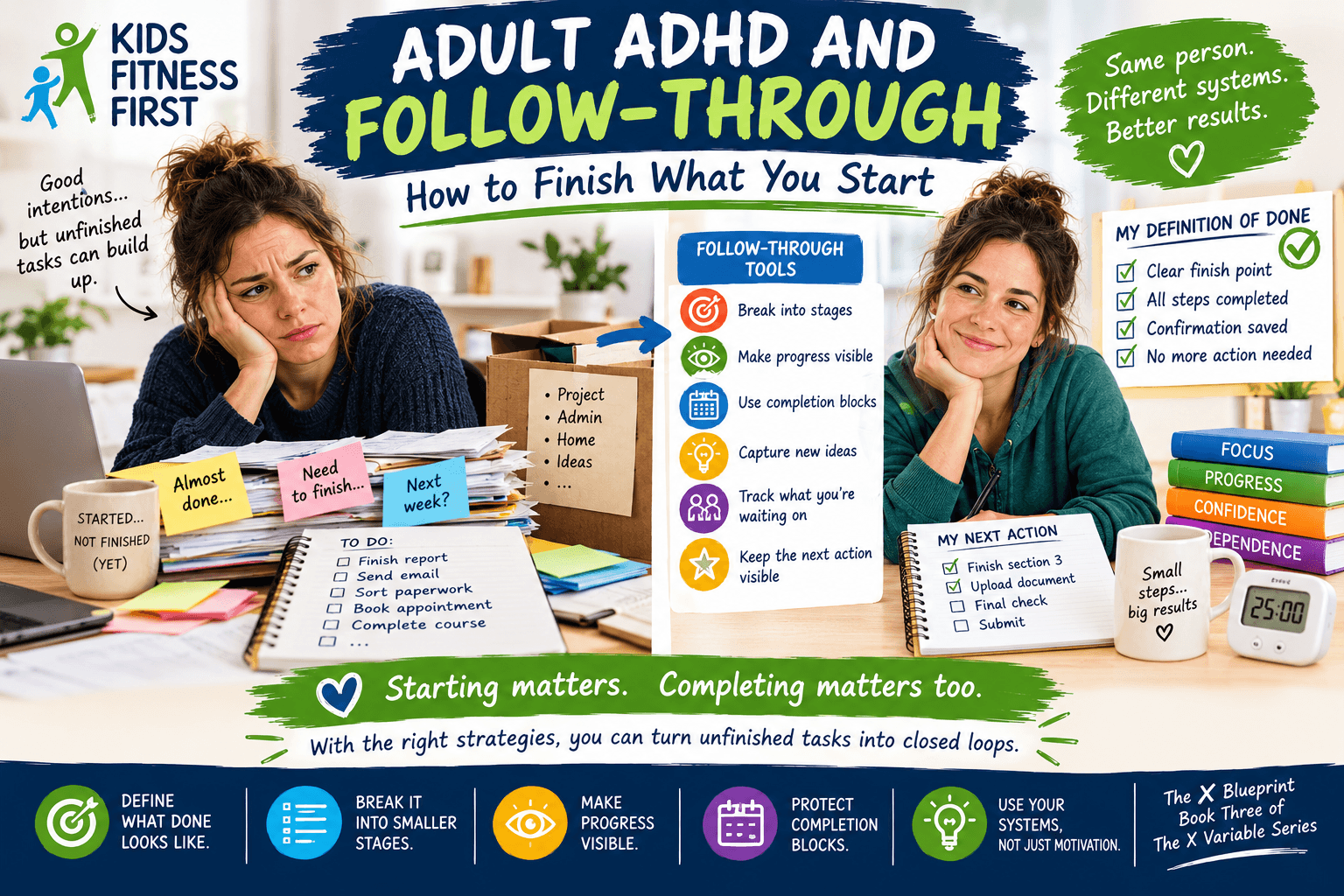
Adult ADHD and Follow-Through: How to Finish What You Start
Adult ADHD and follow-through can become frustrating when starting is not the main problem.
You may begin with good intentions.
You open the document.
You start the project.
You buy the materials.
You create the plan.
At first, progress feels positive.
However, somewhere in the middle, momentum begins to fade.
Another task appears.
A new idea becomes more interesting.
You get interrupted.
Meanwhile, the original project remains unfinished.
Days pass.
Then weeks.
Eventually, you notice several half-completed tasks and wonder:
“Why do I start things but struggle to finish them?”
The answer is not always lack of commitment.
Instead, unfinished work can build when the middle of a task becomes unclear, repetitive, distracting or difficult to re-enter.
Therefore, improving follow-through often means designing support for the whole journey, not just the beginning.
What Does Follow-Through Mean?
Follow-through means continuing an activity until the intended endpoint is reached.
That could mean:
- completing a report;
- finishing paperwork;
- returning a parcel;
- completing a household job;
- sending the final email;
- finishing a course;
- submitting an application.
Starting matters.
However, completing the task matters too.
Sometimes the first step is exciting because it feels new.
Later, the task may become repetitive or less stimulating.
As a result, the challenge shifts.
You are no longer asking:
“How do I begin?”
You are asking:
“How do I keep going?”
Why Adult ADHD and Follow-Through Can Be Difficult
A task often changes as you move through it.
At the beginning, the goal may feel clear.
For example:
“Create a presentation.”
However, after the first few slides, new questions appear.
What information is missing?
Which graphics are needed?
How should the ending work?
What still needs checking?
As a result, the task becomes less defined.
This is where adult ADHD and follow-through can become difficult.
The starting point may have been obvious.
The middle may not be.
Therefore, one useful strategy is to keep defining the next action as the task develops.
Define What “Finished” Actually Means
A surprisingly common problem is that a task has no clear finish point.
For example:
“Sort the office.”
When is that finished?
Every drawer?
Every document?
Every cable?
That can become endless.
Instead, define a practical finish.
For example:
Finished = desk clear, paperwork filed and floor usable.
Now the task has a boundary.
Likewise:
“Improve website” is vague.
“Finished = update homepage text and replace three images” is clearer.
Therefore, before starting a larger task, ask:
“What does done look like?”
Use a Definition of Done
A simple Definition of Done can help.
For example:
Task: Submit Application
Done means:
- form completed;
- documents attached;
- final check completed;
- application submitted;
- confirmation saved.
Now there is no confusion about whether the task is finished.
As a result, you are less likely to stop at “almost done.”
Adult ADHD and Follow-Through: Break the Middle Into Stages
Large tasks often feel manageable at the beginning and overwhelming in the middle.
Therefore, break them into stages.
For example:
Stage 1
Gather information.
Stage 2
Create first draft.
Stage 3
Review.
Stage 4
Make corrections.
Stage 5
Submit.
Each stage has its own endpoint.
Consequently, you can see progress rather than experiencing the entire task as one long unfinished block.
Make Progress Visible
Unfinished work can feel discouraging when progress is difficult to see.
Therefore, use a visible progress system.
For example:
Application
☑ Find documents
☑ Complete personal details
☑ Write supporting statement
☐ Upload evidence
☐ Final check
☐ Submit
Now you can see that three parts are already complete.
That matters.
As a result, the remaining work may feel smaller.
Use Percentage Progress Carefully
Some people find percentages motivating.
For example:
25% complete.
50% complete.
75% complete.
However, use realistic milestones.
Do not spend more time measuring progress than doing the task.
Therefore, simple checkboxes are often enough.
Keep the Next Action Visible
A project can stall because you return to it and cannot remember where you stopped.
Therefore, before leaving the task, write the next action.
For example:
Next: check figures on page 4.
Or:
Next: upload passport copy.
Later, when you return, you immediately know where to begin.
As a result, re-entry becomes easier.
Use Re-Entry Notes
Re-entry notes are particularly useful after interruptions.
Before stepping away, write:
Where I stopped: section 3.
What is finished: first two examples.
What comes next: add third example and conclusion.
This takes less than a minute.
However, it can save several minutes of trying to reconstruct your thinking later.
Adult ADHD and Follow-Through at Work
Work often creates interruptions.
Calls.
Emails.
Meetings.
Messages.
New priorities.
Therefore, follow-through can become difficult even when the original task matters.
One useful approach is to protect completion blocks.
For example:
10:00–10:45 — finish report section.
During that period:
close email;
silence non-essential notifications;
keep only necessary materials visible.
As a result, there are fewer opportunities for the task to fragment.
Use Completion Blocks
A completion block is slightly different from a general work block.
Its purpose is not to start something new.
Its purpose is to finish an existing piece of work.
For example:
Friday 3:00–3:30 → close open admin tasks.
Thursday 11:00–12:00 → finish current report.
Monday 4:00–4:30 → submit outstanding forms.
Therefore, completion becomes a planned activity rather than something you hope will happen naturally.
Stop Starting New Things Too Early
New ideas can be attractive.
A new project may feel more interesting than finishing an older one.
Therefore, create a rule:
Before starting a new major task, check whether one current task can be completed first.
This does not mean suppressing new ideas.
Instead, capture them on an ideas list.
Then return to the existing priority.
Use an Ideas Parking List
If a new idea appears, write it down.
For example:
- new course idea;
- website change;
- book topic;
- business idea;
- household project.
Now the idea is safe.
As a result, you do not need to begin it immediately.
This protects current work without losing creativity.
Adult ADHD and Follow-Through With Boring Middles
Some tasks become boring after the interesting part is over.
The planning was enjoyable.
The execution becomes repetitive.
The final checking feels dull.
However, these stages are often necessary.
Therefore, make the middle easier.
For example:
Use a timer.
Work alongside someone.
Play suitable background music.
Break the stage into short sections.
Reward completion of the block.
The task may still be boring.
Nevertheless, the environment can make persistence easier.
Use Short Finish Sprints
A finish sprint is a short period focused only on moving a task towards completion.
For example:
15 minutes — finish filing
20 minutes — final checks
25 minutes — complete remaining slides
The aim is not necessarily to finish the entire project.
Instead, it is to reduce the unfinished portion.
This can create momentum.
Use the Last 10% Rule
Many tasks stall near completion.
The hard thinking is finished.
However, small finishing jobs remain.
Upload file.
Check spelling.
Send email.
Save confirmation.
Therefore, create a rule:
When something reaches 90%, identify the final 10% immediately.
Write down the remaining actions.
Then schedule them.
This prevents “almost finished” tasks from remaining open for weeks.
Adult ADHD and Follow-Through With Admin
Admin tasks are especially likely to stop before completion.
You fill in the form.
Then it needs printing.
Or scanning.
Or attaching.
Or posting.
The form feels done.
However, the real task is not finished.
Therefore, define the full endpoint.
For example:
Form complete → evidence attached → submitted → confirmation stored.
That is the actual finish.
Close the Loop
A closed loop means the task no longer requires attention.
For example:
Pay bill → payment made → confirmation saved.
Book appointment → appointment confirmed → calendar updated.
Send document → recipient receives it → copy stored.
Therefore, ask:
“Is this task actually closed, or have I simply completed one stage?”
That question can prevent unfinished admin from returning later.
Use External Memory to Support Follow-Through
Earlier in this series, we discussed adult ADHD and external memory.
External memory is useful because follow-through often fails when the task disappears from awareness.
Therefore:
keep unfinished tasks visible in one trusted system;
record the next action;
use reminders for deadlines;
store supporting documents together.
As a result, the system remembers the task even when your attention moves elsewhere.
Prioritisation Helps Follow-Through
Article 13 explored adult ADHD and prioritisation.
If priorities change constantly, follow-through becomes difficult.
Therefore, once you choose a meaningful priority, protect it long enough to make progress.
Do not change direction simply because a new task appears.
Instead, capture the new task and review it later.
This protects continuity.
Routine Helps Follow-Through
Article 14 explored adult ADHD and routine.
Routine can create predictable completion points.
For example:
End of work → review unfinished tasks.
Friday afternoon → completion block.
Evening → close household loops.
Therefore, follow-through becomes part of a repeated routine rather than something that depends entirely on motivation.
Adult ADHD and Follow-Through at Home
Household tasks also need clear finish points.
For example:
Laundry is not:
Put washing machine on.
The loop may include:
wash;
dry;
fold;
put away.
If the process stops after drying, the task remains open.
Therefore, break household jobs into full sequences.
Use Complete Household Sequences
For example:
Laundry
- Sort.
- Wash.
- Dry.
- Fold.
- Put away.
Dishes
- Wash.
- Dry.
- Put away.
- Clear sink.
Paperwork
- Open.
- Act.
- File.
- Recycle.
As a result, you can see where the task actually ends.
Do Not Leave Everything at 80%
Some people accumulate many partly completed tasks.
Half-clean room.
Half-written report.
Half-packed bag.
Half-finished application.
Each one remains mentally active.
Therefore, periodically ask:
“Which existing task is closest to completion?”
Finish one.
That can create more relief than starting something new.
Use the Closest-to-Done Rule
When overwhelmed by many open tasks, choose one that is near completion.
For example:
Report 90% done.
Application 80% done.
Laundry 70% done.
New project 0% done.
Finish the report first.
Then the application.
As a result, the number of open loops decreases quickly.
Adult ADHD and Follow-Through on Low-Energy Days
Low-energy days may make long tasks difficult.
Therefore, reduce the target.
For example:
Normal goal → finish whole section.
Low-energy goal → complete one subsection.
Normal admin → clear whole tray.
Low-energy admin → close two open items.
The objective is to preserve forward movement.
Importantly, reduced progress is still progress.
Create a Minimum Completion Step
Ask:
“What is the smallest action that moves this task closer to done?”
For example:
Upload one file.
Check one paragraph.
Put one load away.
Send one confirmation email.
This prevents all-or-nothing thinking.
Stop Replanning the Same Task
Repeatedly planning without acting can create the illusion of progress.
You rewrite the list.
Move the task to tomorrow.
Change the colour.
Reschedule it.
However, the task itself has not moved.
Therefore, if the same item has been rescheduled several times, ask:
“What is blocking completion?”
Then solve that barrier.
Find the Sticking Point
A stalled task usually has a sticking point.
Perhaps:
you need information;
you need a decision;
you are waiting for someone;
the final step is unclear;
you are worried about making a mistake.
Once the sticking point is visible, the solution becomes easier to identify.
Therefore, do not simply label the task “unfinished.”
Ask why it is unfinished.
Use a Waiting-For List
Sometimes follow-through depends on another person.
For example:
Waiting for supplier quote.
Waiting for email response.
Waiting for approval.
Waiting for document.
These tasks should not remain mixed with things you can act on now.
Instead, create a Waiting For list.
For example:
Waiting For
- John — quote;
- Sarah — signed document;
- clinic — appointment date.
Then set a follow-up date.
This prevents the task from disappearing.
Schedule Follow-Ups
If you are waiting for someone, decide when you will check again.
For example:
No reply by Thursday → follow up.
Now the responsibility returns to your system at the right time.
As a result, you do not need to keep thinking about it every day.
Adult ADHD and Follow-Through With Long Projects
Long projects need more than one deadline.
A single final deadline may be too distant to support consistent progress.
Therefore, create stages.
For example:
Week 1 → research.
Week 2 → outline.
Week 3 → draft.
Week 4 → review.
Week 5 → submit.
Each stage creates a nearer finish point.
Consequently, progress stays visible.
Use Milestones
A milestone marks meaningful progress.
For example:
First chapter complete.
First room finished.
First module complete.
Application drafted.
Presentation ready.
Milestones help because they create completion experiences inside a larger project.
As a result, you do not have to wait until the entire project is finished before recognising progress.
Avoid Perfectionism at the Finish Line
Sometimes tasks remain unfinished because the final version never feels good enough.
You keep editing.
Keep checking.
Keep changing.
Eventually, finishing becomes difficult.
Therefore, define a reasonable standard before reaching the end.
Ask:
“What standard does this task actually require?”
Not every task needs perfection.
Many need:
accurate;
clear;
complete;
submitted.
That is enough.
Use a Final Check Limit
For example:
One content check.
One spelling check.
Then submit.
This creates a boundary.
Otherwise, checking can continue indefinitely.
Adult ADHD and Follow-Through After a Late Diagnosis
After a late ADHD diagnosis, unfinished tasks may begin to look different.
Perhaps you were very good at starting new projects.
Maybe enthusiasm carried you through the beginning.
Then interest dropped.
You may also have relied on deadlines or external pressure to finish.
Understanding adult ADHD and follow-through can provide another way to examine these patterns.
The goal is not to become someone who finishes everything perfectly.
Instead, it is to create systems that make continuation and completion easier.
Build a Personal Follow-Through Toolkit
Your toolkit might include:
Definition of Done
Know what finished means.
Next Action Note
Make re-entry easier.
Completion Block
Schedule time specifically for finishing.
Finish Sprint
Use short periods to reduce unfinished work.
Ideas Parking List
Protect current work from new ideas.
Waiting-For List
Track tasks that depend on others.
Milestones
Create completion points inside large projects.
Final Check Limit
Prevent perfectionism from delaying submission.
Use the tools that match the problem.
A Simple Follow-Through Routine
When adult ADHD and follow-through become difficult, try this:
First: identify the unfinished task.
Next: define what “done” means.
Then: identify the exact remaining steps.
After that: choose the next physical action.
Next: create a short completion block.
Finally: close the loop completely where possible.
If you need to stop before finishing, write a re-entry note.
That way, the next session already has a starting point.
Start With One Unfinished Task
Look around your current task list.
Which task is closest to finished?
Choose one.
Then ask:
What exactly remains?
Do you need to:
send it;
upload it;
check it;
put it away;
confirm it;
follow up?
Write the remaining actions.
Then complete the first one.
Afterwards, continue until the loop is closed or until you reach a genuine waiting point.
Reflection Questions
- Which tasks do you regularly start but not finish?
- Do those tasks have a clear definition of done?
- Where do they usually stall?
- Could you break the middle into smaller stages?
- Would a visible progress list help?
- Do you write down the next action before stopping?
- Which task is currently closest to completion?
- Are you starting new things before finishing existing priorities?
- Which task belongs on a waiting-for list?
- What one open loop could you close today?
Conclusion
Adult ADHD and follow-through can become difficult when a task loses clarity, interest or momentum after the starting point.
However, finishing does not have to depend on motivation alone.
Instead, define what done means.
Break the middle into visible stages.
Write down the next action.
Use completion blocks and short finish sprints.
In addition, capture new ideas without abandoning current priorities.
Track anything that depends on someone else.
Most importantly, close the final loop.
A task is not always finished when the main work is complete.
Sometimes the last email, final upload, confirmation or tidy-up is what turns an open task into a closed one.
Therefore, instead of asking:
“Why can I never finish things?”
try asking:
“What exactly is preventing this task from becoming complete?”
Over time, adult ADHD and follow-through may become easier when progress is visible, finish points are clear and every unfinished task has an obvious next action.
SUGGESTED INTERNAL LINKS
- Adult ADHD and Routine: How to Build Structure Without Feeling Trapped
- Adult ADHD and Prioritisation: How to Decide What Matters First
DISCLAIMER
This article is provided for general educational and informational purposes only. It does not provide medical, psychological, diagnostic or therapeutic advice and should not be used as a substitute for individual guidance from an appropriately qualified healthcare professional.
Difficulties with task completion, concentration and organisation can have many causes, and ADHD experiences vary considerably between individuals. Therefore, if these difficulties are significantly affecting your wellbeing or daily life, or if you have concerns about ADHD, mental health, diagnosis, medication or treatment, please speak with an appropriately qualified healthcare professional