
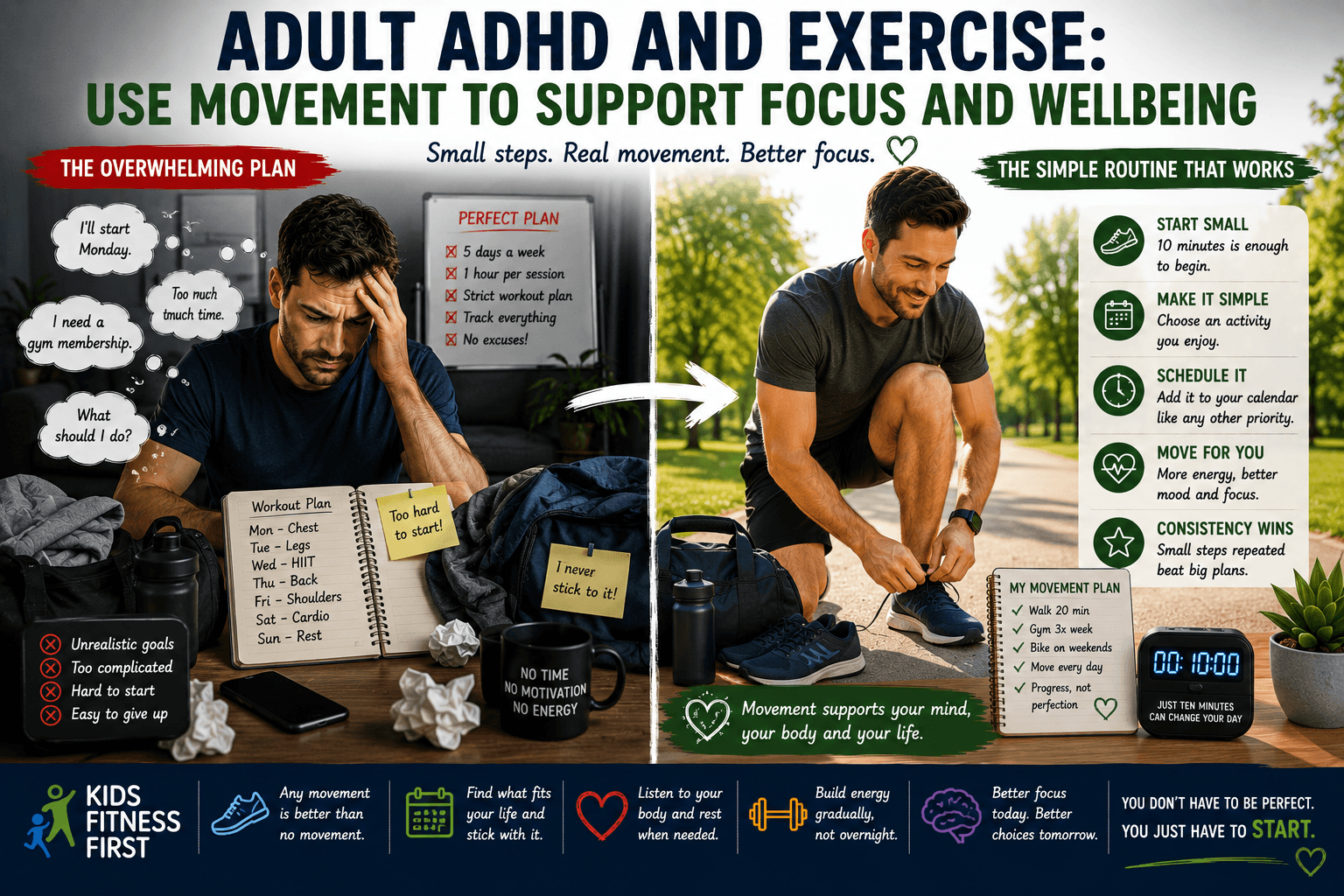
Adult ADHD and Exercise: How Movement Can Support Focus, Energy and Wellbeing
Adult ADHD and exercise can be easier to think about when the goal is not perfection.
You do not need to become a gym enthusiast.
You do not need a complicated training plan.
You do not need to exercise for an hour every day.
Instead, movement can simply become one practical part of the day.
A short walk.
A swim.
A bike ride.
Ten minutes of stretching.
A gym session.
A game of football.
Importantly, the best form of movement is often the one you are actually willing to repeat.
That matters because consistency is usually more useful than an ambitious plan that disappears after a week.
Therefore, rather than asking:
“What is the perfect exercise routine?”
a better question may be:
“What kind of movement fits my life well enough to keep doing?”
Why Adult ADHD and Exercise Can Work Well Together
Movement can provide structure.
It can also create a break between tasks.
For example, a walk after work can mark the transition from work mode into personal time.
Likewise, a short period of movement before starting a difficult task may help create a clearer mental reset.
In addition, regular physical activity supports general health and wellbeing.
However, this article does not claim that exercise treats or cures ADHD.
Instead, the focus is practical: movement can be one useful part of a broader routine.
Start With the Smallest Useful Version
One common mistake is starting too large.
You decide:
“From Monday, I will go to the gym five days a week.”
Then life becomes busy.
One session is missed.
Then another.
Eventually, the whole routine disappears.
Therefore, start smaller.
For example:
10-minute walk after lunch.
Or:
20 minutes of movement three times this week.
The smaller version may feel less impressive.
However, it is often easier to maintain.
Adult ADHD and Exercise: Reduce the Starting Friction
Starting is often harder when too many steps are involved.
Imagine wanting to exercise, but:
your shoes are upstairs;
your clothes are in another room;
your gym bag is empty;
you do not know what session to do;
you need to drive somewhere first.
That is a lot of preparation.
Therefore, reduce the friction.
Put the shoes near the door.
Prepare the clothes.
Keep the gym bag ready.
Choose the session beforehand.
As a result, movement becomes easier to begin.
Make the First Step Obvious
Instead of:
“Exercise today.”
write:
“Put trainers on and walk for ten minutes.”
That is clearer.
Likewise:
“Go to the gym”
can become:
“Leave home at 6 pm with gym bag already packed.”
Therefore, the first action should be physical and specific.
That helps turn intention into movement.
Choose Enjoyment Over Obligation Where Possible
Exercise is easier to repeat when you enjoy at least some part of it.
For example:
Some people prefer walking.
Others enjoy swimming.
Some prefer weight training.
Others like cycling, football or classes.
Therefore, there is no single correct format.
A routine that suits your personality and environment may be more sustainable than one chosen because it looks ideal on paper.
Adult ADHD and Exercise Does Not Have to Mean the Gym
Movement can happen in many places.
At home.
Outside.
At work.
In a pool.
In a park.
With friends.
Alone.
For example:
walk while making a phone call;
cycle to a nearby destination;
use resistance bands at home;
take stairs where suitable;
play a sport;
go for a short evening walk.
As a result, movement becomes part of everyday life rather than a separate project.
Use Movement as a Transition
Earlier in this series, we discussed adult ADHD and task switching.
Movement can support transitions.
For example:
Work ends → ten-minute walk.
Meeting ends → stretch and get water.
Long task ends → move to another room.
Therefore, physical movement can signal:
“That part is finished. Something new begins now.”
This can make transitions feel more deliberate.
Use Movement as a Reset
A difficult period of concentration can leave you mentally stuck.
Instead of immediately opening another screen, try movement.
For example:
stand up;
walk around the room;
go outside briefly;
stretch;
climb stairs if appropriate.
As a result, the next task begins from a slightly different physical state.
The goal is not to “fix” attention instantly.
Rather, movement creates a break in the pattern.
Adult ADHD and Exercise During the Workday
Long periods of sitting can make the day feel flat.
Therefore, short movement breaks may be useful.
For example:
10:30 — five-minute walk
1:00 — lunch and movement
3:30 — stretch and reset
These breaks do not need to become full workouts.
Instead, they create movement inside the working day.
Use Movement Breaks Intentionally
A movement break should have a purpose.
For example:
“I will walk for five minutes, then return to the report.”
Otherwise, a break can expand into distraction.
Therefore, define the break.
Movement.
Water.
Return.
That simple structure can help.
Match Exercise to Your Energy
Article 7 explored adult ADHD and energy management.
The same principle applies here.
On a high-energy day, a full gym session may feel realistic.
On a lower-energy day, a short walk may be enough.
Therefore, create different versions.
High-Energy Option
Gym session or sport.
Medium-Energy Option
20-minute walk or home session.
Low-Energy Option
Five to ten minutes of gentle movement.
As a result, movement can continue without becoming all-or-nothing.
Create a Minimum Movement Rule
A minimum rule might be:
“If I cannot do the full session, I will do ten minutes.”
This keeps the habit alive.
Sometimes ten minutes becomes more.
Sometimes it stays ten.
Both outcomes are acceptable.
Importantly, the point is consistency rather than perfection.
Adult ADHD and Exercise With Time Blindness
Article 10 explored adult ADHD and time blindness.
Exercise can be affected in two directions.
You may think:
“I do not have time.”
However, you may have twenty minutes.
Alternatively, you may start something and lose track of time.
Therefore, use visible time.
Set a timer.
Schedule the session.
Put it in the calendar.
As a result, movement becomes a real block rather than a vague intention.
Use a Fixed Start Cue
A start cue can make exercise easier to remember.
For example:
After breakfast → short walk.
After work → gym.
After lunch → ten-minute movement break.
Therefore, exercise becomes attached to something that already happens.
This connects directly with the earlier article on adult ADHD and routine.
Adult ADHD and Exercise With Procrastination
Article 11 explored adult ADHD and procrastination.
Exercise is easy to postpone.
You think:
“I will go later.”
Then later becomes tomorrow.
Therefore, reduce the first step.
Do not ask:
“Can I complete a full workout?”
Ask:
“Can I put my shoes on?”
Then:
“Can I move for five minutes?”
As a result, the task becomes easier to enter.
Use the Five-Minute Start
This is especially useful when motivation is low.
Set a timer for five minutes.
Begin moving.
When the timer ends, choose whether to continue.
If you continue, good.
If you stop, you still moved.
Therefore, the five-minute start creates a lower threshold.
Adult ADHD and Exercise With Overwhelm
Article 12 explored adult ADHD and overwhelm.
A complicated fitness plan can become another source of pressure.
Workout programme.
Nutrition plan.
Tracking app.
Steps target.
Gym schedule.
Measurements.
Eventually, the system becomes larger than the movement itself.
Therefore, simplify.
Choose:
one main activity;
one fallback activity;
one minimum version.
That is enough to start.
Use One Main Activity
For example:
Main
Walk 30 minutes.
Fallback
Walk 10 minutes.
Minimum
Move for five minutes.
This removes repeated decision-making.
As a result, you are less likely to spend more time planning movement than doing it.
Decision Fatigue Can Affect Exercise
Article 9 explored adult ADHD and decision fatigue.
If every session requires deciding:
what workout;
where;
how long;
what equipment;
when;
you may avoid starting.
Therefore, create defaults.
For example:
Monday → walk.
Wednesday → gym.
Saturday → swim.
As a result, the basic decision is already made.
Adult ADHD and Exercise With Routine
Article 14 explored adult ADHD and routine.
Exercise becomes easier to repeat when attached to a familiar pattern.
For example:
Tuesday after work → gym.
Thursday after dinner → walk.
Saturday morning → swim.
The schedule does not need to be rigid.
However, predictable anchors reduce uncertainty.
Use Flexible Routine, Not Punishment
If Tuesday’s session is missed, do not conclude:
“The week is ruined.”
Instead, use the next anchor.
Move it to Wednesday if practical.
Or use the minimum version.
Therefore, one disruption does not destroy the whole routine.
Adult ADHD and Exercise With Boundaries
Article 20 explored adult ADHD and boundaries.
Movement often disappears when everyone else’s requests come first.
Therefore, some exercise time may need protection.
For example:
“6:00–6:30 is my walk.”
Or:
“Saturday morning is my gym time.”
This is not selfish.
Instead, it is a planned commitment to your own health and wellbeing.
Protect the Session Before the Day Fills Up
If exercise matters to you, place it somewhere visible.
Calendar.
Reminder.
Routine.
Otherwise, it can easily become the task that gets pushed aside.
Therefore, treat movement as something real rather than optional leftover time.
Adult ADHD and Exercise With Sleep
Article 21 explored adult ADHD and sleep.
Movement and sleep both benefit from realistic routines.
However, individual responses differ.
Some people find vigorous exercise close to bedtime stimulating.
Others do not.
Therefore, observe your own pattern rather than assuming one timing works for everyone.
If a late session appears to make sleep harder, experiment with moving it earlier.
Exercise Should Not Become Another Source of Self-Criticism
Article 18 explored adult ADHD and self-criticism.
A missed session does not mean:
“I have failed.”
It means:
“I missed one session.”
Therefore, keep the language specific.
Ask:
What happened?
Was the session too ambitious?
Was the timing unrealistic?
Did something else need priority?
Then, adjust.
That is more useful than punishment.
Self-Trust Can Support Exercise
Article 19 explored adult ADHD and self-trust.
Small repeated commitments can strengthen confidence.
For example:
“I will walk ten minutes after lunch.”
Then you do it.
The next day, repeat it.
Over time, the message becomes:
“When I make a realistic commitment, I can follow through.”
That matters beyond exercise.
Make Exercise Easy to See
Visual cues can help.
For example:
trainers beside the door;
gym bag visible;
resistance bands near the desk;
bike ready;
calendar reminder.
As a result, the environment helps remember the activity.
This connects with adult ADHD and external memory from Article 8.
Prepare in Advance
Preparation reduces friction.
For example:
Fill water bottle.
Pack clothes.
Choose route.
Charge headphones.
Prepare equipment.
Therefore, when the time arrives, fewer steps remain.
The less preparation required in the moment, the easier movement may be to start.
Adult ADHD and Exercise With Other People
Some people find movement easier with company.
For example:
walking with a friend;
joining a class;
playing football;
training with a partner.
The social commitment may create useful accountability.
However, others prefer exercising alone.
Therefore, choose the format that supports you rather than assuming one approach is better.
Use Accountability Without Pressure
A simple accountability system might be:
“Message me when you have finished your walk.”
Or:
“We meet every Saturday morning.”
The aim is support.
Not guilt.
Therefore, choose people who encourage consistency rather than turning exercise into another source of judgement.
Adult ADHD and Exercise After a Late Diagnosis
After a late ADHD diagnosis, you may recognise patterns in your relationship with exercise.
Perhaps you enjoyed intense activities but struggled with routine ones.
Maybe you joined gyms repeatedly and stopped going when novelty faded.
Alternatively, you may have always found movement helpful without understanding why.
Understanding adult ADHD and exercise can help you design a routine around your actual behaviour.
The aim is not to force yourself into somebody else’s ideal plan.
Instead, build movement around what you enjoy, what fits your energy and what you can realistically repeat.
Use Novelty Without Rebuilding Everything
Variety can help keep movement interesting.
However, constantly changing everything can make routines harder.
Therefore, keep the structure stable while changing some content.
For example:
Tuesday = movement session.
One week → walk.
Next week → cycle.
Another week → swim.
The anchor stays.
The activity changes.
As a result, you keep both structure and variety.
Create a Movement Menu
A movement menu can reduce decision-making.
For example:
5 Minutes
Stretch.
Walk outside.
Simple mobility.
15 Minutes
Brisk walk.
Resistance bands.
Short home session.
30+ Minutes
Gym.
Swim.
Bike ride.
Sport.
Then choose based on available time and energy.
Adult ADHD and Exercise: Track Only What Helps
Tracking can motivate some people.
Steps.
Sessions.
Distance.
Weights.
However, tracking can also become another complicated task.
Therefore, keep only information that helps you continue.
For example:
Did I move today? Yes/No
Or:
Sessions this week: 2/3
That may be enough.
Do Not Let the Tracker Become the Goal
The goal is not to create a perfect record.
The goal is movement.
Therefore, if tracking starts creating guilt or taking too much attention, simplify it.
The system should serve the activity.
Not the other way around.
Use Movement to Break Long Sitting Periods
If your day involves long periods at a desk, consider simple movement interruptions.
For example:
stand during a call;
walk while thinking;
stretch between tasks;
take a short walk after lunch.
As a result, movement becomes part of the day rather than waiting for one large exercise session.
Create a Movement Trigger
For example:
After every long meeting → stand and stretch.
After lunch → walk.
After finishing one major work block → refill water and move.
This makes movement more automatic.
Adult ADHD and Exercise on Difficult Days
Some days will not support the full routine.
That is normal.
Therefore, use the question:
“What is the smallest useful movement I can do today?”
Maybe it is five minutes.
Perhaps it is a short walk.
That still counts.
Importantly, the purpose is to keep movement available rather than turning it into another all-or-nothing test.
Build a Personal Movement Toolkit
Your toolkit might include:
Minimum Version
Have a five- or ten-minute fallback.
Fixed Anchor
Link movement to a regular part of the day.
Visible Cue
Keep equipment where you can see it.
Prepared Kit
Reduce starting friction.
Movement Menu
Choose based on energy and time.
Accountability
Use supportive company where helpful.
Timer
Make the session visible.
Flexible Variety
Keep the routine but vary the activity.
Use the tools that solve your actual barriers.
A Simple Movement Routine
When adult ADHD and exercise feel difficult, try this:
First: Choose one form of movement you genuinely tolerate or enjoy.
Next: decide the minimum version.
Then: attach it to a regular anchor.
After that: prepare what you need in advance.
Next: use a timer or calendar reminder.
Finally: record completion simply, then move on.
Do not build a large system before testing whether the basic routine works.
Start With One Change
If movement is currently inconsistent, choose one experiment.
For example:
After lunch, I will walk for ten minutes three times this week.
That is specific.
It is measurable.
It is small enough to test.
Afterwards, ask:
Was the time realistic?
Did I enjoy it enough?
Was the starting friction low?
Would another activity suit me better?
Then adjust.
Reflection Questions
- Which forms of movement do you genuinely enjoy?
- What usually stops you from starting?
- Could you reduce the first step?
- What would your minimum movement version look like?
- Which part of the day has the best energy for movement?
- Could a regular anchor help?
- Would visible equipment make starting easier?
- Does exercising with someone help or distract you?
- Are you making the routine too complicated?
- What one realistic movement commitment could you test this week?
Conclusion
Adult ADHD and exercise can work well together when movement is simple, flexible and realistic.
However, the goal does not need to be an elaborate fitness programme.
Instead, reduce the starting friction.
Choose movement you can repeat.
Use anchors.
Prepare equipment.
Create a minimum version.
In addition, match movement to your available energy and protect some time for it before the day fills with other demands.
Most importantly, do not turn exercise into another test of perfection.
One missed session is one missed session.
It does not erase the rest.
Therefore, instead of asking:
“How do I become perfectly consistent with exercise?”
try asking:
“How can I make movement easy enough to return to?”
Over time, adult ADHD and exercise may become easier to maintain when the activity fits your life, the starting point is obvious and small amounts of movement are allowed to count.
SUGGESTED INTERNAL LINKS
- Adult ADHD and Boundaries: How to Protect Your Time, Energy and Attention
- Adult ADHD and Sleep: How to Build a Better Night-Time Routine
DISCLAIMER
This article is provided for general educational and informational purposes only. It does not provide medical, psychological, diagnostic, fitness or therapeutic advice and should not be used as a substitute for individual guidance from an appropriately qualified healthcare or fitness professional.
Exercise needs and physical capabilities vary considerably between individuals. Health conditions, injuries, medication and other factors may affect what type or amount of physical activity is appropriate. Therefore, if you have health concerns, have been inactive for a long period, are unsure whether exercise is suitable for you, or experience symptoms during activity, please seek appropriate professional advice.