
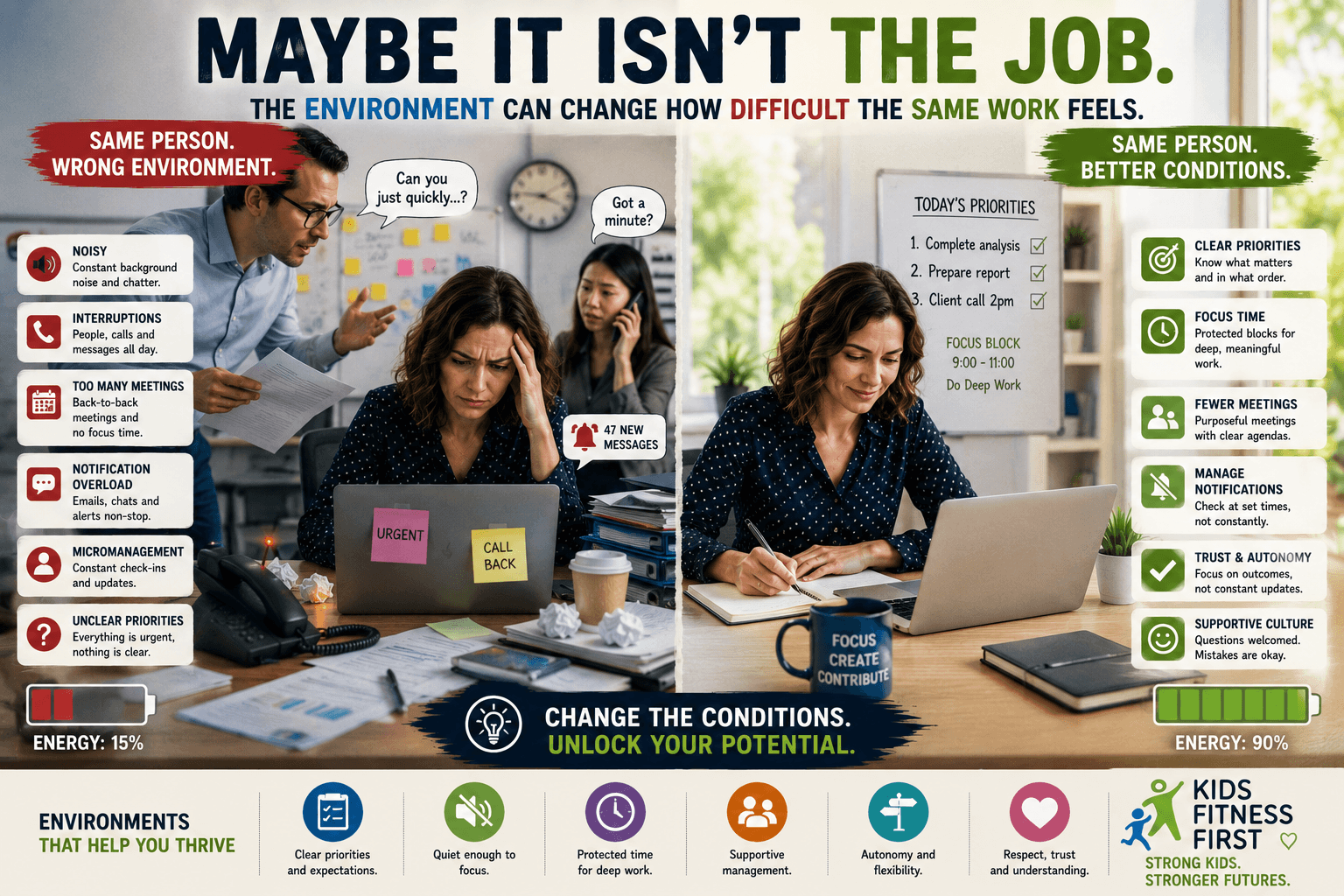
Adult ADHD and the Wrong Work Environment: When the Job Is Right but the Workplace Is Wrong
You may enjoy the actual work.
However, you may hate the way you are expected to do it.
Perhaps you enjoy solving problems.
Yet, you may struggle to concentrate in a noisy open-plan office.
Likewise, you may enjoy working with clients.
However, a calendar filled with back-to-back meetings may leave you exhausted.
Maybe you are excellent at completing projects independently.
However, your manager may want constant updates and interrupt you throughout the day.
As a result, you may eventually conclude:
“I must be in the wrong career.”
But that conclusion may be wrong.
Instead, the problem may not be what you do.
It may be where, when and how you are expected to do it.
Therefore, before abandoning a career that may actually suit you, it is worth examining the environment around the work. Our broader guide to Adult ADHD and Work Environment helps identify which conditions support or disrupt performance; if the core work itself feels wrong, compare this with Adult ADHD and the Wrong Job.
The Job and the Environment Are Different
Article 6 explored adult ADHD and the wrong job.
That article asked whether the core work itself fits.
By contrast, Article 7 asks:
“Would I enjoy this work if I could do it under different conditions?”
For example, imagine you enjoy analysing financial information.
However, you are expected to do that work in an office where phones constantly ring, colleagues interrupt, meetings break up the day and messages appear every few minutes.
The analytical work may suit you extremely well.
Nevertheless, the environment may make performing it unnecessarily difficult.
Therefore, job fit and environment fit should be assessed separately.
Adult ADHD and the Wrong Work Environment: The Same Person Can Perform Very Differently
Imagine the same employee in two workplaces.
Workplace A
They sit in an open-plan office.
People constantly walk past.
Messages arrive throughout the day.
Their manager frequently asks:
“How are you getting on?”
Meetings appear without warning.
Priorities change repeatedly.
Consequently, by 5 pm, they are exhausted and behind.
Now place the same person in another environment.
Workplace B
They have clear priorities.
Important instructions are written down.
They can protect periods of uninterrupted work.
Meetings have agendas.
Their manager focuses mainly on results.
As a result, the same person may perform extremely well.
Therefore, when performance changes dramatically between environments, that difference is valuable information.
Environment Can Change the Difficulty of the Same Task
A task does not have one fixed level of difficulty.
Context changes it.
For example, writing a report in a quiet room may feel manageable.
However, writing the same report while people talk nearby, emails arrive, your phone rings, a colleague asks questions and a meeting begins in twenty minutes may feel completely different.
Therefore, when something feels difficult, do not ask only:
“Why can’t I do this?”
Instead, ask:
“What is happening around me while I am trying to do this?”
That question can reveal environmental problems that are easy to overlook.
Adult ADHD and the Wrong Work Environment: Interruptions Matter
Interruptions can be one of the largest hidden workplace costs.
You begin a task.
Then an email appears.
You check it.
Afterwards, somebody asks a question.
You respond.
Then your phone rings.
Eventually, you return to the original task.
However, you now need to remember where you were, what you were thinking and what you were about to do.
Consequently, one interruption may cost much more than the few minutes it visibly occupies.
The real cost may be rebuilding attention afterwards.
The Restart Cost
Think of every interruption as potentially creating a restart cost.
Suppose a colleague interrupts you for three minutes.
The interruption lasts three minutes.
However, if it takes another ten minutes to regain your previous level of concentration, the real cost was closer to thirteen minutes.
Now repeat that throughout the day.
As a result, you may reach the evening feeling as though you worked constantly while completing surprisingly little.
Therefore, protecting concentration can sometimes be more valuable than trying to work faster.
Adult ADHD and the Wrong Work Environment: Open-Plan Offices
Open-plan offices work well for some people.
They can encourage communication and make collaboration easier.
However, they can also create continuous stimulation.
For example:
conversations;
movement;
telephones;
doors;
printers;
people approaching your desk.
None of these distractions may seem especially serious by themselves.
Nevertheless, together they can create substantial cognitive load.
Therefore, if you consistently perform better in quieter conditions, that pattern should be treated as useful information rather than a personal failing.
Sensory Load Is Part of Workload
Workload is usually measured through tasks.
How many reports?
How many customers?
How many deadlines?
However, the environment itself can also create workload.
For example:
bright lighting;
noise;
temperature;
movement;
crowded spaces;
constant notifications.
Individually, each may appear minor.
However, when they continue for eight hours, their combined effect can be considerable.
Therefore, sensory load belongs inside your assessment of work sustainability.
Adult ADHD and the Wrong Work Environment: Meeting Culture
Some organisations appear to solve every problem by creating another meeting.
A project starts.
Meeting.
Something changes.
Meeting.
Somebody needs an update.
Another meeting.
Consequently, a calendar can become fragmented into small pieces.
This creates a problem.
You may technically have two free hours during the day.
However, if those hours are divided into four separate thirty-minute blocks, they may not provide enough uninterrupted time for deeper work.
Therefore, do not measure available time only by quantity.
Also consider its shape.
Fragmented Time Is Different From Protected Time
Compare:
Option A
Four separate 30-minute periods between meetings.
Option B
One uninterrupted two-hour block.
Both contain exactly two hours.
However, they may not provide the same working value.
Option B may allow you to settle, focus, think deeply and complete something meaningful.
Therefore, when assessing your environment, ask:
“Do I have enough usable blocks of time?”
Adult ADHD and the Wrong Work Environment: Unclear Priorities
Imagine your manager gives you ten tasks.
Then says:
“They’re all important.”
Technically, you have been given information.
However, practically, you have not been given a priority.
As a result, you may spend significant mental energy deciding what comes first, what can wait and what will create trouble if it is late.
Therefore, unclear prioritisation can create unnecessary cognitive load.
A clearer instruction might be:
“Today, complete A first. Then B. If there is time, start C.”
Suddenly, the same workload may feel more manageable.
Moving Priorities Can Create Constant Restarting
Priorities sometimes genuinely need to change.
Businesses are not perfectly predictable.
However, constant unnecessary reprioritisation can make sustained work extremely difficult.
You begin Task A.
Then Task B becomes urgent.
You switch.
Later, Task C suddenly becomes the priority.
Eventually, somebody asks why Task A is unfinished.
Consequently, the problem may not be your ability to complete work.
Instead, it may be the environment’s inability to protect priorities long enough for work to be completed.
Adult ADHD and the Wrong Work Environment: Micromanagement
Some managers provide useful structure.
Clear deadlines and regular communication can be extremely helpful.
However, structure and micromanagement are not the same thing.
Micromanagement may involve constant checking, unnecessary approval, frequent progress requests, control over minor methods and interruptions to ask for updates.
As a result, you may spend substantial time reporting on work rather than doing it.
Therefore, ask:
“Does my manager’s involvement make the work clearer, or does it repeatedly break my concentration?”
Autonomy Can Change Performance
Some people work much better when they understand the required outcome but have flexibility over how to reach it.
For example:
“I need this completed by Thursday at 3 pm.”
may work better than:
“Do this at 9:00, then this at 9:30, update me at 10:00 and check with me before the next step.”
The destination is clear in both cases.
However, the second approach provides much less autonomy.
Therefore, if autonomy repeatedly improves your performance, record that as part of your Working Self Portrait.
Adult ADHD and the Wrong Work Environment: Communication Style
Communication can also affect environment fit.
Perhaps important instructions are given verbally while somebody is walking past your desk.
Later, you remember only part of them.
Consequently, you may spend the next hour trying to reconstruct what was requested.
A written follow-up could remove much of that uncertainty.
Therefore, notice which communication formats help you perform accurately.
Perhaps you prefer written priorities, meeting notes, clear deadlines, visual project boards or short summaries.
Those are useful pieces of career information.
Asking for Clarity Can Improve Performance
Instead of pretending an instruction was clear, you might ask:
“What is the most important outcome you need from this?”
Likewise, you could ask:
“Which of these should I prioritise first?”
Or:
“Could you send me the three actions from that meeting?”
These questions do not automatically signal weakness.
Instead, they can reduce mistakes and unnecessary effort.
Adult ADHD and the Wrong Work Environment: Notification Culture
Modern work can involve constant digital interruption.
Email.
Teams.
Slack.
WhatsApp.
Project-management alerts.
Calendar notifications.
Each one appears briefly.
However, together they can turn the day into continuous reaction.
Therefore, where your role allows it, consider whether every notification genuinely needs immediate attention.
Perhaps some communication can be checked at planned intervals instead.
Availability Is Not the Same as Productivity
Some workplaces value visible availability.
The employee who replies instantly may appear highly engaged.
However, instant response can conflict with deeper concentration.
Therefore, organisations need both communication and protected production time.
Likewise, individuals may need to distinguish between:
being reachable
and
being constantly interruptible.
They are not the same thing.
Adult ADHD and the Wrong Work Environment: Working From Home
Remote work can dramatically improve conditions for some people.
For example, it may reduce commuting, office noise, unplanned interruptions and social monitoring.
However, working from home is not automatically easier.
It may also introduce household distraction, isolation, lack of structure and difficulty separating work from personal life.
Therefore, the question is not:
“Is remote work better?”
Instead, ask:
“Under which environment do I personally perform and recover better?”
Hybrid Working Can Offer Useful Clues
Hybrid working can provide an interesting comparison.
Perhaps you notice that office days are better for collaboration.
Meanwhile, home days are better for deep work.
If so, that distinction can help you design work more intelligently.
For example:
Office
Meetings, collaboration and relationship-building.
Home
Analysis, writing, planning and focused production.
Therefore, different environments may suit different types of work.
Adult ADHD and the Wrong Work Environment: The Commute Matters Too
The environment begins before you reach your desk.
A long commute may involve traffic, crowded transport, noise, time pressure and unpredictability.
As a result, you may arrive at work already using significant energy.
Likewise, the journey home may delay recovery.
Therefore, when comparing roles, include commuting inside the energy calculation.
The Manager Can Be Part of the Environment
You may love the job but struggle under one particular management style.
Perhaps the manager is unclear, unpredictable, over-controlling, constantly changing priorities or poor at communication.
Then you move teams.
Suddenly, the same type of work feels much easier.
Therefore, before abandoning the profession, ask whether the manager is a significant part of the problem.
Adult ADHD and the Wrong Work Environment: Psychological Safety
A good working environment is not only physically comfortable.
It also needs enough psychological safety for people to ask questions, acknowledge mistakes and seek clarification.
Imagine you are afraid to say:
“I don’t understand.”
As a result, you pretend to understand.
Then you spend significant energy trying to work it out alone.
Therefore, environments where questions are treated reasonably may reduce both errors and unnecessary masking.
Workplace Culture Can Increase the Masking Tax
Article 4 explored the Masking Tax.
Some cultures make that tax much larger.
For example, an environment may reward constant visible enthusiasm, social performance, instant responses, long working hours and continuous availability.
Consequently, employees may spend significant energy appearing to meet cultural expectations in addition to performing their actual jobs.
Therefore, culture belongs inside your environment-fit assessment.
Adult ADHD and the Wrong Work Environment: The Body Matters
Work is not performed by a brain floating above a desk.
Your body is involved too.
Perhaps sitting still for long periods makes concentration harder.
Maybe short movement breaks improve attention.
Likewise, perhaps standing during telephone calls helps you think.
Therefore, notice whether your environment allows reasonable movement.
Small physical changes can sometimes make cognitive work easier.
Movement Does Not Have to Mean Exercise
You do not necessarily need a gym session during the working day.
Movement may simply mean walking while making a call, standing for part of a meeting, using stairs, taking a brief outside break or changing working position.
As a result, the day becomes less physically static.
For some people, that may also support attention and energy.
Adult ADHD and the Wrong Work Environment: The Best-Environment Test
Think about the best working environment you have experienced.
It may have been a previous job, a temporary project, working from home, a library, a quiet office or a busy collaborative space.
Then ask:
“What exactly made it work?”
Do not simply write:
“It was better.”
Instead, identify specific conditions.
For example:
clear priorities;
quiet;
autonomy;
short meetings;
good manager;
meaningful deadlines;
variety;
movement.
Those conditions become evidence.
Now Use the Worst-Environment Test
Next, think about the workplace where you struggled most.
What was present?
Perhaps:
constant interruption;
noise;
unclear expectations;
conflict;
micromanagement;
long commute;
excessive meetings.
Then, compare the two environments.
As a result, patterns may begin to emerge.
Adult ADHD and the Wrong Work Environment: Build Your Environmental Profile
Create three columns.
I Work Better With
Examples:
clear priorities;
written instructions;
protected focus time;
some autonomy.
I Can Tolerate
Examples:
occasional meetings;
moderate background noise;
some routine administration.
I Struggle With
Examples:
constant interruption;
unclear deadlines;
continuous task switching;
heavy micromanagement.
This becomes your Environmental Profile.
Therefore, when considering future roles, you can assess more than salary and job title.
Do Not Search Only by Job Title
Imagine you are offered two jobs with identical titles.
The salary is similar.
The responsibilities are similar.
However:
Company A
Five office days.
Open-plan desk.
Frequent meetings.
Highly supervised.
Company B
Hybrid.
Protected focus periods.
Clear written priorities.
Outcome-focused management.
The title may be identical.
However, your experience could be completely different.
Therefore, environment should form part of future job selection.
Adult ADHD and the Wrong Work Environment: Interview the Employer Too
A job interview should not only determine whether the employer wants you.
It should also help determine whether the environment fits you.
Useful questions may include:
“How are priorities normally communicated?”
“How many meetings would someone in this role typically attend?”
“How much autonomy does the role have?”
“What does a normal working day look like?”
“How does the team handle changing priorities?”
“Is there flexibility around where focused work is completed?”
The answers can reveal a great deal.
Listen to Vague Answers
Suppose you ask:
“What does a normal day look like?”
The answer is:
“Every day is crazy here!”
Perhaps that genuinely suits you.
However, if you need some predictability and protected focus, treat that answer as useful information.
Likewise:
“We all wear lots of hats.”
may mean variety.
Alternatively, it may mean unclear responsibilities.
Therefore, ask follow-up questions.
Adult ADHD and the Wrong Work Environment: Do Not Assume You Must Adapt to Everything
Professional flexibility matters.
Every workplace requires some adaptation.
However, adaptation should not become an endless attempt to force yourself into conditions that repeatedly undermine performance.
Sometimes the employee can change.
Sometimes the system can change.
Often, the best solution involves both.
Change the Environment Before Changing Your Career
If you enjoy the core work, test environmental changes before assuming you need an entirely different career.
For example:
protect one focus block;
reduce unnecessary notifications;
request clearer priorities;
change workspace;
cluster meetings;
use written follow-ups;
adjust working location where possible.
Then observe what happens.
If the work becomes substantially easier, you have learned something important.
Therefore, test the environment before making a larger conclusion about the career.
Adult ADHD and the Wrong Work Environment: The 10% Environment Experiment
Choose one thing that would make your working day approximately 10% easier.
For example:
one hour without interruptions;
a quieter desk;
written priorities each morning;
fewer notifications;
a proper lunch break.
Try it where practical.
Then, ask:
Did I complete more?
Did I feel less exhausted?
Was restarting easier?
Did I need less evening recovery?
Therefore, small experiments can provide better evidence than assumptions.
Your 7-Day Environment Audit
For seven working days, record:
1. Where Did I Work?
Office, home, shared space or elsewhere.
2. Biggest Environmental Drain
Noise?
Meetings?
Interruptions?
Management?
Unclear priorities?
3. Best Environmental Condition
What made work easier?
4. Energy After Work
Rate 1–10.
5. Productivity
Rate 1–10.
At the end of the week, compare the results.
As a result, you may discover that certain conditions consistently change both productivity and energy.
The Green, Amber and Red Environment Test
GREEN
The environment generally helps you work.
You have enough clarity, focus, autonomy and recovery.
Therefore, environmental fit appears reasonably strong.
AMBER
Some conditions work well.
However, repeated problems create unnecessary effort.
Therefore, targeted changes may help.
RED
The environment consistently disrupts concentration, increases masking, creates excessive exhaustion or prevents you from doing your best work.
Therefore, significant environmental change may need consideration.
This is not a diagnostic test.
Instead, it is a practical reflection tool.
Reflection Questions
- Do you enjoy the core work in your current role?
- Would you enjoy it more under different conditions?
- What interrupts you most frequently?
- How much restart cost do those interruptions create?
- Does your workplace provide usable blocks of focus time?
- Are priorities clear or constantly moving?
- Does your manager provide useful structure or unnecessary micromanagement?
- Which communication format helps you perform accurately?
- Where have you previously done your best work?
- What one environmental change could make your current working day 10% easier?
Conclusion: Do Not Abandon the Right Work Because of the Wrong Environment
Adult ADHD and the wrong work environment can make suitable work feel impossible.
You may begin believing that you chose the wrong career.
However, the actual problem may be the noise, the interruptions, the meeting culture, the management, the communication, the lack of autonomy or the constant switching.
Therefore, before making a major career decision, separate two questions:
“Does the work fit me?”
and:
“Does this environment allow me to do that work well?”
The answers may be very different.
Perhaps you need a different career.
However, perhaps you need the same career in a different organisation.
Likewise, you may need the same organisation but a different team.
Alternatively, relatively small changes to your current working environment may make a significant difference.
That is why environment fit matters.
Because the same person can look overwhelmed in one workplace and highly capable in another.
The person did not suddenly become more intelligent.
Their abilities did not magically change.
Instead, the conditions changed.
Therefore, sometimes the most effective career change is not changing careers at all.
Sometimes, it is changing the conditions around the work.
SUGGESTED INTERNAL LINKS
- Adult ADHD and Workplace Masking: The Hidden Energy Cost of Looking Fine at Work
- Adult ADHD and the Wrong Job: How to Know When the Work Itself Does Not Fit
DISCLAIMER
This article is provided for general educational and informational purposes only. It does not provide medical, psychological, diagnostic, employment, occupational-health or legal advice.
ADHD and neurodivergent experiences vary considerably between individuals. The workplace conditions discussed here will not affect everyone in the same way.
Furthermore, difficulties with concentration, fatigue or work performance can have many causes and should not automatically be attributed to ADHD. If difficulties are persistent or significantly affecting health, wellbeing or daily functioning, consider seeking appropriate professional guidance.
Workplace rights, reasonable adjustments and employment protections also vary according to individual circumstances and jurisdiction. Therefore, obtain appropriate professional advice where necessary before making significant employment decisions.