
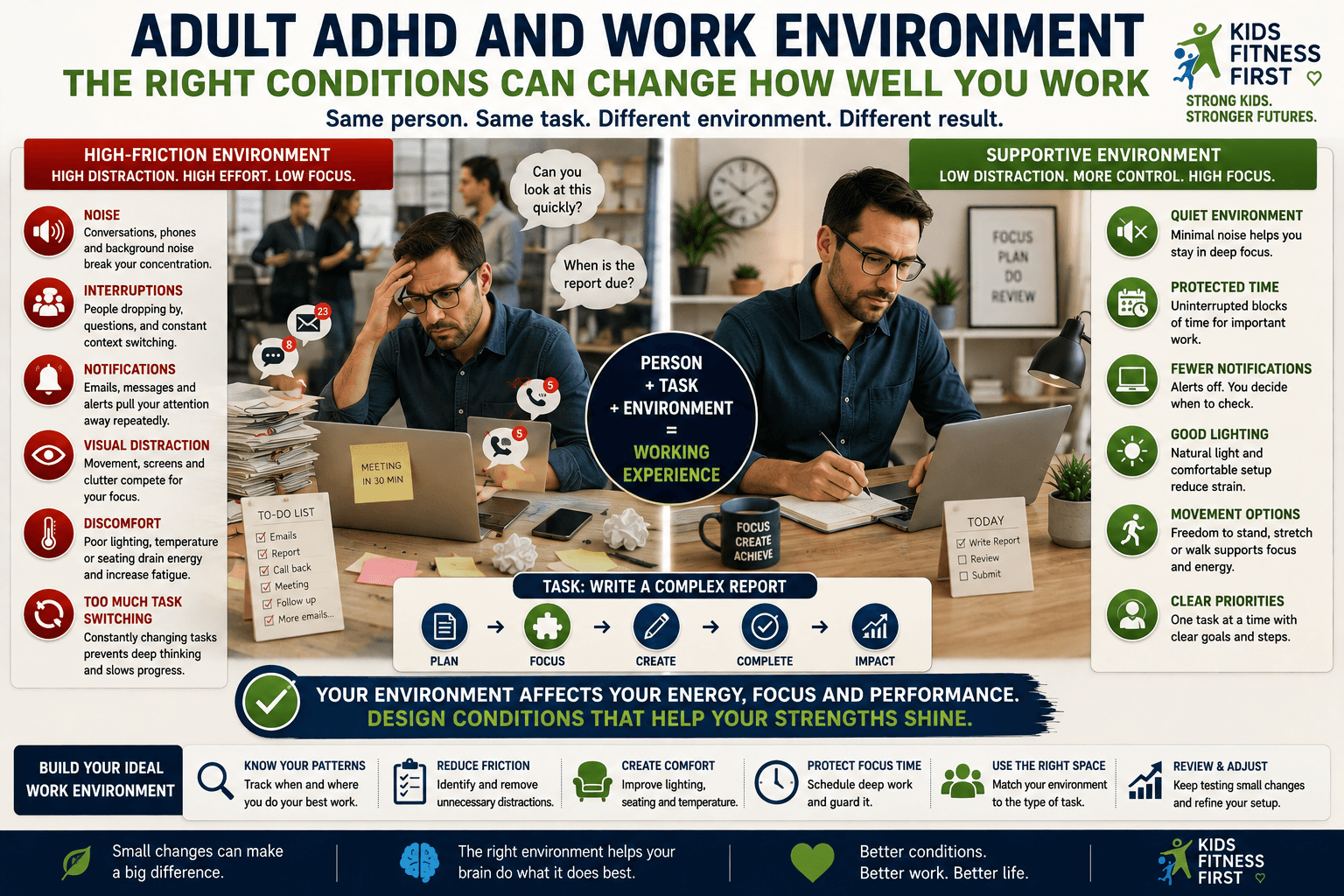
Adult ADHD and Work Environment: Why the Right Conditions Can Change How Well You Work
Adult ADHD and work environment can be easy to overlook. This is the main hub for our ADHD-at-work material; for the broader Adult ADHD library covering diagnosis, everyday systems, emotions and burnout as well as work, use our Adult ADHD practical guide.
When work becomes difficult, people often look first at themselves.
For example, they may think:
“I need more discipline.”
Or:
“I need to concentrate harder.”
However, concentration does not happen in isolation.
Instead, you are always concentrating somewhere.
Perhaps conversations are taking place around you.
Likewise, your phone may be ringing while notifications appear on your screen.
Meanwhile, people may be walking past your desk.
Perhaps the room is too warm.
Alternatively, the lighting may be uncomfortable.
Therefore, before deciding that the entire problem is inside you, examine what is happening around you.
A more useful question may be:
“What changes when I do the same work in a different environment?”
As a result, you may begin noticing patterns that were previously hidden.
This page is the starting point for our ADHD-at-work guidance. If a particular barrier stands out, explore the more specific guides on open-plan offices and distraction, autonomy at work, and workplace accommodations. If the work itself may be the problem rather than the setting, see ADHD and the wrong job.
The Environment Is Part of the Work
Imagine trying to write a complicated report.
In one situation, you have:
a quiet room;
a comfortable desk;
clear priorities;
ninety uninterrupted minutes.
In another situation, however, you have:
several conversations nearby;
messages appearing;
people interrupting;
a meeting beginning in thirty minutes.
The task itself has not changed.
Likewise, your knowledge has not changed.
However, the conditions have changed considerably.
Therefore, comparing your performance across environments can help you understand what supports or disrupts your work.
In other words, the environment is not separate from the task.
Instead, it becomes part of the working experience.
Adult ADHD and Work Environment: There Is No Universal Perfect Workspace
Some people need silence.
However, others prefer background sound.
Likewise, one person may love working from home.
Meanwhile, another may find home highly distracting.
Some people enjoy busy offices.
By contrast, others perform much better in quieter surroundings.
Therefore, this article is not trying to create one universal ADHD-friendly workplace.
Instead, the aim is to identify your environmental pattern.
That distinction matters because ADHD experiences can vary considerably between individuals.
As a result, the same environment can help one person while making work harder for another.
Stop Asking Whether an Environment Is Good or Bad
A better question is:
“Good or bad for what?”
For example, a busy office may be excellent for:
brainstorming;
quick conversations;
collaboration;
social connection.
However, the same office may be poor for:
detailed analysis;
writing;
complex calculations;
deep concentration.
Therefore, your ideal environment may change according to the task.
Instead of searching for one perfect location, you may need to match task to environment.
As a result, workplace design becomes more practical and more personal.
Adult ADHD and Work Environment: Noise
Noise is one of the most obvious environmental factors.
However, not all noise is equal.
For example, you may tolerate:
air-conditioning;
instrumental music;
traffic in the distance.
Yet, nearby conversation may repeatedly pull your attention away.
Why?
Because speech contains information.
As a result, your brain may notice words even when you are trying not to listen.
Therefore, record which types of sound affect you.
Instead of simply writing:
“Noise distracts me,”
try to identify:
“Nearby speech distracts me, but low-level background music does not.”
That level of specificity makes the problem easier to address.
Background Sound May Sometimes Help
Interestingly, complete silence is not ideal for everyone.
For example, some people prefer:
quiet music;
white noise;
a café atmosphere;
low-level background sound.
Therefore, experiment rather than assume.
First, try the same type of task in silence.
Then, try it with instrumental music.
Afterwards, try low-level background sound.
Finally, rate your concentration.
As a result, you begin building evidence about what actually works for you.
Adult ADHD and Work Environment: Conversations Can Be Particularly Distracting
Imagine working beside two colleagues discussing a project.
You are not part of the conversation.
However, you hear:
a name;
a problem;
a deadline;
a question.
Suddenly, part of your attention follows their discussion.
Then you return to your own work.
A few minutes later, another sentence attracts your attention.
Consequently, your concentration becomes repeatedly fragmented.
Therefore, nearby speech may deserve separate consideration from general background noise.
In other words, “noise” may be too broad a category.
Instead, identify the specific kind of sound that creates the greatest interruption.
Visual Distraction
Sound is not the only environmental demand.
Likewise, movement can attract attention.
For example:
people walking past;
screens changing;
doors opening;
phones flashing;
colleagues moving around.
Individually, each event may seem insignificant.
However, together they can create substantial visual activity.
Therefore, if concentration improves when you face a wall, use a quieter corner or reduce movement in your visual field, that is useful evidence.
As a result, visual positioning may become part of your workplace design.
Adult ADHD and Work Environment: Desk Position Can Matter
Sometimes a very small environmental change makes a noticeable difference.
For example, compare:
a desk facing a busy walkway
with:
a desk facing away from the walkway.
The office is the same.
Likewise, the job is the same.
However, the amount of visual information entering your attention may be very different.
Therefore, before assuming that you need an entirely different workplace, test smaller changes.
A different desk position may not solve everything.
Nevertheless, it may reduce unnecessary visual interruption.
Clutter and Visual Load
Some people work comfortably with many objects around them.
However, others find visible clutter distracting.
For example:
papers;
cups;
equipment;
notes;
boxes;
open browser tabs.
Each object can become another piece of information competing for attention.
Therefore, consider whether reducing visible clutter improves concentration.
On the other hand, avoid assuming that a completely empty desk is automatically better.
Instead, identify the level of visual simplicity that works for you.
Adult ADHD and Work Environment: Lighting
Lighting can affect comfort.
For example, some people find bright overhead lighting unpleasant.
Meanwhile, others may struggle in spaces that are too dark.
Likewise, screen glare can increase discomfort during long periods of computer work.
Therefore, consider:
natural light;
screen position;
brightness;
glare;
overhead lighting.
Again, the goal is not to diagnose a sensory issue.
Instead, notice whether environmental changes affect your comfort and concentration.
As a result, lighting becomes another variable you can test rather than simply tolerate.
Temperature Matters Too
A room that is too warm may make you feel tired.
Meanwhile, a very cold environment may become distracting.
Therefore, temperature can be another important variable.
Ask:
“When I struggle to concentrate, am I physically comfortable?”
This question sounds simple.
However, basic physical conditions can easily be overlooked when people focus only on productivity.
As a result, discomfort may be misinterpreted as poor motivation.
Adult ADHD and Work Environment: Your Chair, Desk and Body
Your body is part of your working environment.
For example, discomfort may increase if you spend several hours:
sitting in one position;
using an unsuitable chair;
looking down at a laptop;
working without movement.
Therefore, workplace fit should include physical comfort.
You do not need an elaborate setup.
However, you may benefit from considering:
chair position;
screen height;
desk height;
movement opportunities;
posture changes.
As a result, small physical adjustments may make long work periods easier to sustain.
Movement Can Support Some Working Styles
Some people prefer to think while moving.
For example, they may:
walk during telephone calls;
stand while reading;
pace while considering a problem;
take short movement breaks.
Therefore, a workplace that requires complete physical stillness for long periods may feel more demanding for some individuals.
If movement helps, record it as part of your Work Environment Profile.
Likewise, notice whether movement restores attention after periods of concentration.
Adult ADHD and Work Environment: Movement Is Not Wasted Time
Suppose you walk for five minutes and return with a clearer solution.
Was that five minutes unproductive?
Not necessarily.
Instead, the movement may have supported the thinking process.
Therefore, evaluate movement by its effect rather than by whether you remained at your desk.
As a result, a brief walk may become part of your work strategy rather than something you feel guilty about.
Interruptions Are Environmental Too
Article 12 explored interruptions as a collapse condition.
However, interruptions are also part of workplace design.
For example, compare:
an office where colleagues constantly approach your desk
with:
a system where non-urgent questions are collected and discussed at set times.
The people have not changed.
However, the communication environment has.
Therefore, interruption is not always simply an individual concentration problem.
Instead, the workflow itself may create fragmentation.
As a result, changing the system may help more than simply trying harder to ignore interruptions.
Adult ADHD and Work Environment: Digital Environments Matter
Your workplace is not only physical.
Your computer is also an environment.
For example, consider:
email alerts;
chat notifications;
calendar reminders;
news tabs;
multiple applications;
phone messages.
Therefore, somebody working alone in a quiet room may still experience constant interruption.
As a result, digital environment design can be just as important as physical workspace design.
Notification Overload
A notification creates a choice.
Do I look?
Do I ignore it?
Is it urgent?
Should I reply?
Even when you ignore it, the alert may still interrupt your thought.
Therefore, reducing non-essential notifications may help protect attention.
For example, you could test:
email alerts off;
phone face down;
chat notifications paused during focus periods.
Then compare your performance.
As a result, you may discover that some interruptions were avoidable.
Adult ADHD and Work Environment: The Open-Tab Effect
Imagine having twenty browser tabs open.
Each tab represents unfinished information.
You may not consciously think about every one.
However, they remain visually available.
Therefore, experiment with reducing open digital material during complex tasks.
For example, keep only the documents needed for the current task visible.
Afterwards, reopen other material when required.
As a result, you may reduce unnecessary visual and cognitive competition.
Home Working
Working from home can create significant benefits for some people.
For example:
less commuting;
more control over noise;
greater flexibility;
more control over lighting;
fewer spontaneous interruptions.
However, home working can also create difficulties.
For example:
household distractions;
lack of separation between work and rest;
isolation;
difficulty starting;
too little external structure.
Therefore, home working should not automatically be treated as better or worse.
Instead, ask whether it fits your working pattern.
Adult ADHD and Work Environment: Office Working
Office environments can provide:
structure;
social connection;
clear separation between work and home;
access to colleagues;
shared routines.
However, they may also contain:
noise;
movement;
interruptions;
commuting;
meeting overload.
Therefore, the office itself is not necessarily the issue.
Instead, ask:
“Which features of the office help me, and which make my work harder?”
As a result, you can separate useful structure from unnecessary friction.
Hybrid Working
For some people, hybrid working may provide useful flexibility.
For example:
Office Days
meetings;
collaboration;
relationship-building;
team planning.
Home Days
analysis;
writing;
deep work;
complex tasks.
Therefore, hybrid working can allow different environments to serve different functions.
However, this only works when the arrangement fits the role and employer.
As a result, hybrid working should be treated as one possible design option rather than a universal solution.
Adult ADHD and Work Environment: Match Location to Task
Instead of asking:
“Where should I work?”
ask:
“Where should I do this particular kind of work?”
For example:
Deep Analysis
Quiet environment.
Brainstorming
Collaborative environment.
Routine Administration
Flexible location.
Difficult Conversation
Private setting.
Therefore, workplace design becomes more sophisticated.
Instead of choosing one environment for everything, you are matching environments to cognitive demands.
As a result, the same person may use several different working conditions across one week.
Social Energy Is Part of the Environment
A workplace can be physically quiet but socially demanding.
For example:
constant availability;
frequent conversation;
customer interaction;
team communication.
Therefore, environmental fit includes social intensity.
Ask:
“How much interaction helps me, and when does it begin to reduce my available energy?”
This connects directly to Article 12’s discussion of social load.
As a result, social demands should be considered alongside noise and visual distraction.
Adult ADHD and Work Environment: Privacy
Privacy can matter for some types of work.
For example, you may concentrate better when you do not feel watched.
Likewise, sensitive conversations require private spaces.
Therefore, consider whether your workspace provides enough privacy for the tasks you perform.
This may be especially relevant if your role involves:
confidential information;
difficult conversations;
deep thinking;
creative experimentation.
As a result, privacy may become part of your ideal environment for certain tasks.
Autonomy Over the Environment
Two people can work in the same office but experience it differently.
Why?
One may have control over:
headphones;
desk location;
break timing;
focus periods.
Meanwhile, the other may have very little flexibility.
Therefore, environmental autonomy can matter alongside the environment itself.
Sometimes the important question is not:
“Is this office noisy?”
Instead, ask:
“Can I do anything about the noise when I need to concentrate?”
That difference can change how manageable the same workplace feels.
Adult ADHD and Work Environment: Predictability
Predictability can reduce unnecessary mental load.
For example, knowing:
when meetings happen;
when colleagues are available;
when interruptions are likely;
where you will work
may make planning easier.
However, complete predictability may also become monotonous for some people.
Therefore, the useful balance may be:
stable structure + enough variety.
As a result, structure and flexibility do not necessarily have to compete.
The Environment Can Change Across the Day
Your ideal environment at 9:00 may not be your ideal environment at 3:00.
For example, you may need quiet during your strongest cognitive period.
Later, however, you may enjoy collaborative work.
Therefore, do not assume your environmental needs remain identical throughout the day.
Instead, examine the interaction between:
environment;
task;
energy;
time.
As a result, you may discover that environment fit is partly about timing.
Adult ADHD and Work Environment: Build an Environment Map
Divide your working day into sections.
For example:
| Time | Task | Environment | Performance |
|---|---|---|---|
| 9–11 | Analysis | Quiet home office | Excellent |
| 11–12 | Calls | Home office | Good |
| 1–3 | Meetings | Busy office | Good |
| 3–4 | Detailed report | Busy office | Poor |
Then ask:
“Is the problem the task, the time, the environment or a combination?”
Therefore, the Environment Map helps you avoid oversimplifying the problem.
As a result, you can identify whether changing location, timing or task order may help.
One Variable at a Time
If possible, test environmental changes individually.
For example:
Week 1 — reduce notifications.
Week 2 — change desk position.
Week 3 — add a protected focus period.
Why?
Because if you change ten things at once, you may not know what actually helped.
Therefore, treat workplace design as an experiment.
First, change one variable.
Then observe the result.
Afterwards, decide whether to keep it.
Adult ADHD and Work Environment: The 10% Better Workspace Test
Do not begin by trying to create the perfect environment.
Instead, ask:
“What would make this environment 10% easier to work in?”
Perhaps:
headphones;
fewer notifications;
a clearer desk;
one uninterrupted hour;
better lighting;
a movement break;
a different desk position.
Therefore, small changes can be easier to test and maintain.
As a result, improvement becomes more practical.
The Environmental Friction Test
For each factor, score from 1 to 5.
| Environmental Factor | Friction Score |
|---|---|
| Noise | /5 |
| Visual distraction | /5 |
| Interruptions | /5 |
| Lighting | /5 |
| Temperature | /5 |
| Physical comfort | /5 |
| Digital notifications | /5 |
| Social demands | /5 |
| Lack of privacy | /5 |
| Lack of movement | /5 |
1 = little difficulty
5 = major difficulty
Then identify your three highest scores.
Therefore, these are the environmental factors worth investigating first.
Adult ADHD and Work Environment: The Environment Support Score
Now score what helps you.
| Supportive Condition | Importance |
|---|---|
| Quiet | /5 |
| Natural light | /5 |
| Movement | /5 |
| Privacy | /5 |
| Autonomy | /5 |
| Predictability | /5 |
| Social connection | /5 |
| Background sound | /5 |
| Clear workspace | /5 |
| Flexible location | /5 |
Therefore, your profile includes both sides of the picture:
what creates friction
and:
what provides support.
As a result, you avoid building a profile based only on problems.
Build Your Work Environment Profile
Complete these statements.
I CONCENTRATE BEST WHEN…
THE SOUNDS THAT DISTRACT ME MOST ARE…
VISUAL DISTRACTIONS THAT AFFECT ME ARE…
I THINK BETTER WHEN I CAN…
MY IDEAL LEVEL OF SOCIAL CONTACT IS…
I NEED MORE PRIVACY WHEN…
DIGITAL DISTRACTIONS THAT AFFECT ME ARE…
MY BEST ENVIRONMENT FOR DEEP WORK IS…
MY BEST ENVIRONMENT FOR COLLABORATION IS…
THREE ENVIRONMENTAL CHANGES I WOULD TEST ARE…
Therefore, you now have your Work Environment Profile.
Adult ADHD and Work Environment: Your 7-Day Environment Audit
For seven working days, record five things.
1. Where Did You Work?
Home?
Office?
Shared space?
Other?
2. What Were You Doing?
Name the task.
3. What Environmental Conditions Were Present?
Noise?
Movement?
Interruptions?
Lighting?
Social demands?
4. How Well Did You Work?
Rate from 1–10.
5. What One Change Might Have Helped?
Be specific.
At the end of the week, compare your strongest and weakest periods.
Then look for repeated conditions.
As a result, patterns may begin to emerge.
Green, Amber and Red Work Environments
GREEN — SUPPORTIVE
The environment generally helps you work.
Likewise, you have enough:
focus;
comfort;
control;
appropriate stimulation.
Therefore, protect these conditions where possible.
AMBER — WORKABLE BUT COSTLY
You can perform.
However, the environment creates additional effort.
For example, noise or interruptions may gradually drain your energy.
Therefore, look for practical adjustments.
RED — HIGH FRICTION
The environment repeatedly prevents concentration or creates substantial exhaustion.
Therefore, this condition deserves closer attention.
Instead of simply pushing harder, identify what can realistically change.
Adult ADHD and Work Environment: Workplace Adjustments
If environmental conditions are significantly affecting your work, practical workplace adjustments may sometimes help.
Depending on the individual, role, employer and circumstances, examples could include:
a quieter workspace;
different desk positioning;
noise reduction;
written priorities;
protected concentration periods;
adjusted communication methods;
flexible or hybrid working arrangements.
However, employment rights and reasonable-adjustment requirements vary according to individual circumstances and jurisdiction.
Therefore, where formal workplace accommodations are being considered, obtain appropriate guidance rather than relying only on general online information.
Functional Language Can Help
You do not always need to begin by saying:
“I need a completely different environment.”
Instead, explain the functional issue.
For example:
“I produce more accurate detailed work when I have an uninterrupted period.”
Likewise:
“Nearby conversations make detailed concentration more difficult, so I would like to explore whether I can use a quieter area for this type of work.”
Therefore, focus on three things:
condition;
impact;
possible solution.
As a result, the conversation becomes more practical.
Adult ADHD and Work Environment: Connect the Framework
By Article 16, your Work That Fits framework is becoming increasingly detailed.
Cognitive Signature
What you naturally tend to do well.
Peak Performance Formula
Conditions that help those abilities appear.
Collapse Conditions
Conditions that make performance harder.
Strength Portfolio
Where your abilities create value.
Depth Portfolio
Where your deeper thinking creates distinctive contribution.
Automation Boundary
What AI can support and what should remain human-led.
Work Environment Profile
The physical, digital and social conditions that support your work.
Therefore, career fit becomes much more than choosing a job title.
Instead, it becomes an interaction between:
person;
task;
environment;
energy;
value.
The Same Job Can Feel Completely Different
Imagine two identical roles.
The first provides:
clear priorities;
quiet focus time;
reasonable autonomy;
appropriate social contact.
Meanwhile, the second provides:
constant interruption;
heavy noise;
no control over task timing;
continuous meetings.
The job title is identical.
However, the lived experience may be completely different.
Therefore, when considering a career move, investigate the environment as carefully as the role itself.
Adult ADHD and Work Environment: Better Interview Questions
During an interview, consider asking:
“What does a typical working day look like?”
“How much of the role is meeting-based?”
“How is focused individual work normally handled?”
“Is the team office-based, remote or hybrid?”
“How frequently do priorities change?”
“How do team members usually communicate during the day?”
Therefore, interviews can reveal more than responsibilities and salary.
As a result, you may understand the real working environment before accepting the role.
Do Not Wait Until the First Day
People often investigate:
salary;
job title;
benefits;
promotion opportunities.
However, they may know very little about:
noise;
meeting culture;
interruptions;
communication;
autonomy;
workspace.
Therefore, workplace-environment questions should form part of career research.
The environment is not a minor detail.
Instead, it is where the job actually happens.
Adult ADHD and Work Environment: You May Not Need a New Career
Sometimes a person concludes:
“This career does not suit me.”
However, the same work in a different environment may feel dramatically different.
Therefore, before making a major career change, ask:
“Have I tested whether the environment is the real problem?”
Perhaps you do not need a different profession.
Instead, you may need:
fewer interruptions;
more control;
a quieter location;
better task-environment matching.
That possibility is worth investigating.
However, Environment Cannot Fix Everything
The opposite is also true.
A perfect workspace cannot make every role suitable.
If the work consistently conflicts with your:
interests;
values;
strengths;
energy;
long-term goals,
then environmental changes may not solve the underlying mismatch.
Therefore, use the Work Environment Profile as one part of the wider framework.
It is important.
However, it is not the entire answer.
Reflection Questions
- Where do you currently perform your best work?
- What type of noise affects you most?
- Does nearby conversation interrupt your concentration?
- Does visual movement affect detailed work?
- How does lighting influence your comfort?
- Do you benefit from movement while working?
- Which digital notifications interrupt you most?
- Do you perform differently at home and in an office?
- Which tasks benefit from collaboration?
- Which tasks require privacy or quiet?
- How much environmental control do you currently have?
- What three small changes would you test first?
Conclusion: Design the Conditions, Not Just the Career
Adult ADHD and work environment should not be treated as a minor issue.
Your workplace surrounds every task you perform.
Noise matters.
Likewise, interruptions matter.
Digital notifications, lighting, movement, privacy and social demands can all influence the experience of working.
However, there is no universal ADHD-friendly environment.
Therefore, the goal is not to copy somebody else’s perfect workspace.
Instead, investigate your own evidence.
First, notice where your strongest work happens.
Then identify what those environments have in common.
Afterwards, identify the conditions that create friction.
Finally, test small changes.
Perhaps you need quieter periods.
Alternatively, you may need more movement or social contact.
Perhaps hybrid working allows you to separate collaborative tasks from deep work.
Therefore, do not ask only:
“What job should I do?”
Also ask:
“Under what conditions can I do my best work?”
Because the right career in the wrong environment can still become exhausting.
Meanwhile, a better-designed environment may allow strengths that were previously hidden to become much easier to access.
Sometimes better work begins not by changing who you are, but by changing the conditions in which you are asking yourself to perform.
SUGGESTED INTERNAL LINKS
- Adult ADHD and AI at Work: Why Human Depth May Become More Valuable as Routine Work Is Automated
- Adult ADHD and the Depth Economy: Why Deep Thinking May Matter More Than Busy Work
DISCLAIMER
This article is provided for general educational and informational purposes only. It does not provide medical, psychological, diagnostic, employment, financial, technology or career advice.
The future impact of artificial intelligence and automation is uncertain and will vary considerably across industries, employers, occupations and jurisdictions.
Likewise, ADHD and other neurodivergent experiences vary considerably between individuals. Therefore, the possible working patterns and strengths discussed here should not be assumed to apply universally.
AI-generated information can also be inaccurate, incomplete or inappropriate for a particular context. Therefore, important professional decisions should involve appropriate human verification, specialist expertise and accountability.
Where significant career, financial, employment or professional decisions are involved, consider obtaining appropriate qualified advice.