
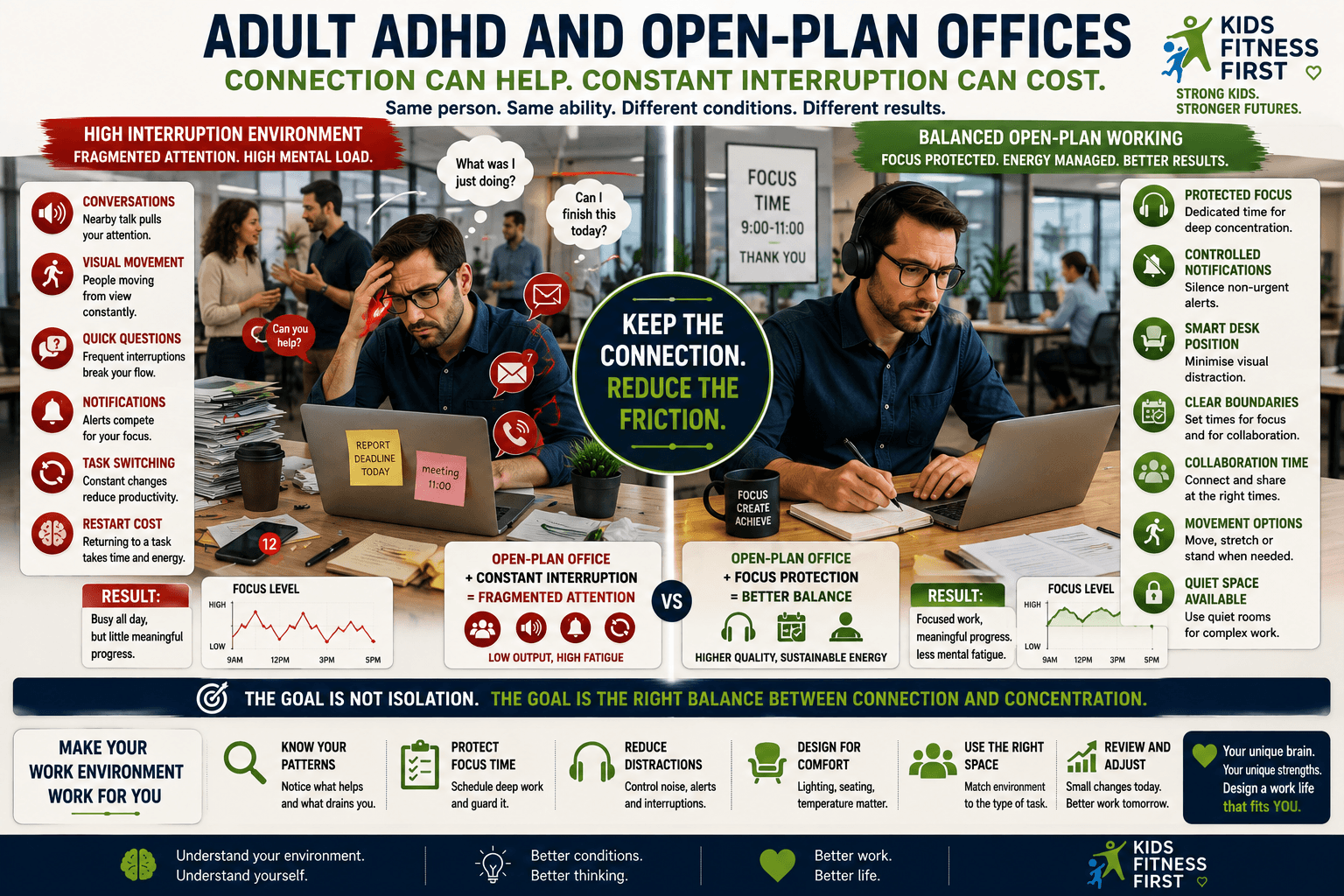
Adult ADHD and Open-Plan Offices: Why Noise, Movement and Interruptions Can Make Concentration Harder
Adult ADHD and open-plan offices can sometimes create a difficult working combination.
You may arrive at work intending to concentrate.
However, before you have properly started, somebody walks past your desk.
Then a telephone rings.
Meanwhile, two colleagues begin discussing a project nearby.
A few minutes later, somebody asks:
“Have you got a minute?”
Afterwards, an email notification appears.
None of these events seems particularly serious.
However, together they can create a working day filled with hundreds of small demands on attention.
Therefore, the problem may not simply be that you cannot concentrate.
Instead, your concentration may be repeatedly asked to compete with the environment.
That distinction matters. Open-plan offices are one specific part of the wider question of ADHD and work environment. If noise, movement or interruptions are the main barrier, practical changes may also be explored through our guide to ADHD workplace accommodations.
What Is an Open-Plan Office?
An open-plan office generally places multiple employees within a shared working area rather than separating everyone into individual rooms.
Therefore, it may provide:
easier communication;
greater collaboration;
more social contact;
faster access to colleagues;
flexible use of space.
However, the same design can also introduce:
background conversations;
visual movement;
telephone calls;
unexpected interruptions;
limited privacy.
As a result, an open-plan office may support some types of work while making others more demanding.
Adult ADHD and Open-Plan Offices: The Office Is Not Automatically the Problem
It would be too simplistic to say:
“Open-plan offices are bad for ADHD.”
That is not the argument.
Instead, people differ.
For example, one person may enjoy the energy of a busy workplace.
Meanwhile, another may find the same environment exhausting.
Likewise, the same person may enjoy an open-plan environment during collaborative work but struggle with it while writing a detailed report.
Therefore, the useful question is not:
“Are open-plan offices good or bad?”
Instead, ask:
“Which parts of this environment help me, and which parts make particular tasks harder?”
Why Nearby Conversation Can Be Difficult to Ignore
Imagine trying to read a complicated document while two people talk beside you.
You are not trying to listen.
However, suddenly you hear your name.
Then you hear a familiar company.
Afterwards, somebody mentions a problem you know something about.
Your attention moves towards the conversation.
Then you return to the document.
Consequently, your reading has been interrupted even though nobody directly spoke to you.
Therefore, nearby speech can create a particular form of distraction.
Adult ADHD and Open-Plan Offices: Speech Contains Meaning
A humming air conditioner is relatively predictable.
By contrast, human conversation contains constantly changing information.
There are:
names;
questions;
emotions;
problems;
jokes;
changes in tone.
Therefore, speech may repeatedly invite attention.
Even when you resist listening, part of your mental effort may be spent ignoring it.
As a result, concentration can become more effortful.
The Attention Competition Problem
Think of attention as something several things are competing to receive.
Your report wants attention.
However, so does:
the conversation beside you;
the person walking past;
the ringing telephone;
the notification on your screen.
Therefore, you are not simply performing the task.
Instead, you may also be repeatedly deciding:
“Does that matter?”
“Should I look?”
“Was that person speaking to me?”
“Do I need to respond?”
As a result, the environment itself can create additional cognitive work.
Adult ADHD and Open-Plan Offices: Visual Movement
Open-plan offices do not only contain sound.
They also contain movement.
For example:
somebody stands up;
another person walks past;
a meeting begins nearby;
a delivery arrives;
a door opens;
a colleague waves.
Each event may last only seconds.
However, together they can create continuous visual activity.
Therefore, where your desk is positioned can sometimes matter more than expected.
Desk Position Can Change the Experience
Imagine two desks in the same office.
Desk A faces the main walkway.
Meanwhile, Desk B faces a wall with the walkway behind it.
The workplace has not changed.
Likewise, the job has not changed.
However, the amount of movement visible to the employee may be substantially different.
Therefore, before deciding that the entire office is unsuitable, test whether a smaller environmental change helps.
Adult ADHD and Open-Plan Offices: The “Quick Question”
Open-plan workplaces can make people highly accessible.
That can be useful.
For example, instead of arranging a meeting, a colleague can simply ask:
“Can I quickly check something?”
However, quick questions can accumulate.
One question may take two minutes.
Another takes five.
Then somebody else needs help.
As a result, a morning intended for focused work becomes fragmented.
Therefore, accessibility has both benefits and costs.
The Real Cost of an Interruption
Suppose somebody interrupts you for three minutes.
It may appear that you lost only three minutes.
However, the real cost may be larger.
First, you stop the original task.
Then you process the interruption.
Afterwards, you return to the task.
Finally, you reconstruct where your thinking had reached.
Therefore, an interruption includes both the interruption itself and the restart.
This is especially important during complex work.
Adult ADHD and Open-Plan Offices: Restart Cost
Article 12 introduced the idea of restart cost.
Imagine you are developing an argument.
Several ideas are connected in your mind.
Then somebody interrupts.
Afterwards, you return to the document.
However, the connections are no longer as clear.
Therefore, you reread the previous paragraph.
Then you check your notes.
Eventually, you rebuild the thought.
The interruption may have lasted two minutes.
Nevertheless, the restart may take considerably longer.
Small Interruptions Can Create a Fragmented Day
Consider this pattern:
9:00 — start report.
9:12 — colleague asks question.
9:25 — return to report.
9:38 — telephone call.
9:50 — return.
10:05 — somebody walks over.
10:20 — return.
10:30 — meeting.
By lunchtime, you may feel extremely busy.
However, the report has barely progressed.
Therefore, the problem is not necessarily lack of effort.
Instead, the day may contain too little uninterrupted time for the task.
Adult ADHD and Open-Plan Offices: Context Switching
Every interruption can also create a context switch.
For example:
report → colleague question → report → email → report → meeting.
Each activity requires a different mental context.
Therefore, the brain repeatedly moves between tasks.
As a result, some working days become dominated by switching rather than completing.
This is why Article 16 emphasised matching environment to task.
Collaboration and Concentration Need Different Conditions
Open-plan offices may work extremely well for collaboration.
For example:
brainstorming;
quick discussions;
team problem-solving;
relationship-building.
However, detailed individual work may need different conditions.
Therefore, the question should not necessarily be:
“Open office or private office?”
Instead, ask:
“Which parts of my job benefit from openness, and which parts require protection?”
This creates a more balanced approach.
Adult ADHD and Open-Plan Offices: The Collaboration Paradox
You may genuinely enjoy being around colleagues.
Perhaps conversations give you:
energy;
ideas;
connection;
motivation.
However, the same conversations may interrupt deep work.
Therefore, two things can be true at the same time:
You benefit from people.
and:
You sometimes need protection from interruption.
Recognising both sides prevents workplace design from becoming unnecessarily extreme.
The Solution Is Not Always Isolation
If open-plan working creates difficulty, the answer does not automatically have to be:
“Put me in a room alone all day.”
Instead, you may benefit from a combination.
For example:
collaborative periods;
quiet focus periods;
team meetings;
private workspaces;
movement breaks.
Therefore, the aim is not necessarily isolation.
Instead, the aim is appropriate access to different environments.
Adult ADHD and Open-Plan Offices: Quiet Zones
Some workplaces provide quieter areas for concentrated work.
If available, these spaces can be useful for tasks such as:
writing;
analysis;
financial work;
complex reading;
planning.
Meanwhile, the main office can remain available for collaboration.
Therefore, different spaces can support different cognitive demands.
As a result, employees do not have to choose between collaboration and concentration.
Headphones and Noise Reduction
For some people, headphones may reduce auditory distraction.
For example, they might use:
noise reduction;
quiet instrumental music;
white noise;
other non-distracting sound.
However, headphones may not be appropriate in every role.
For example, some employees need to hear:
customers;
telephones;
safety instructions;
colleagues.
Therefore, the suitability of headphones depends on the job.
Adult ADHD and Open-Plan Offices: Headphones Can Also Become a Signal
In some workplaces, headphones can communicate:
“I am concentrating unless something is urgent.”
Therefore, they may reduce both noise and interruption.
However, this only works when the team understands the meaning.
For example, a simple team agreement might be:
Headphones on
Please message unless urgent.
Headphones off
Available for normal conversation.
As a result, a physical object becomes part of the communication system.
Protected Focus Time
One of the simplest ideas is protected concentration time.
For example:
9:00–10:30 — focus work.
Afterwards, normal communication resumes.
Therefore, colleagues still have access to you.
However, they know there is a predictable period when non-urgent interruptions should be reduced.
This can benefit more than one employee.
In fact, whole teams may benefit from shared focus periods.
Adult ADHD and Open-Plan Offices: Predictability Can Reduce Interruption
Imagine colleagues know:
“Amanda reviews non-urgent questions at 11:00.”
Therefore, they may be less likely to interrupt at 9:30.
Likewise, if you know when questions will arrive, you can plan your concentration around them.
As a result, predictability can reduce the need for constant availability.
Communication Windows
Another option is creating communication windows.
For example:
9:00–10:30 — deep work.
10:30–11:00 — email and questions.
11:00–12:00 — collaborative work.
Therefore, communication is not eliminated.
Instead, it is organised.
This can reduce random interruption while maintaining accessibility.
Adult ADHD and Open-Plan Offices: Digital Interruption Still Matters
Moving to a quiet room does not solve everything if your laptop continues producing:
email alerts;
chat messages;
calendar notifications;
phone alerts.
Therefore, physical and digital environments should be considered together.
For example, during a focus period you might:
silence non-essential alerts;
close email;
pause chat notifications;
keep only relevant documents visible.
As a result, the quiet room becomes genuinely quieter cognitively as well as physically.
Meetings Can Fragment the Day Too
Suppose you have meetings at:
9:30;
11:00;
1:30;
3:00.
Technically, there are gaps between them.
However, each gap may feel too short for serious concentration.
Therefore, four meetings can influence much more than the four blocks shown on the calendar.
As a result, meeting distribution matters as well as meeting duration.
Adult ADHD and Open-Plan Offices: Cluster Meetings Where Possible
Where a role allows it, grouping meetings may create longer periods for uninterrupted work.
For example:
Morning
Individual concentration.
Afternoon
Meetings and collaboration.
Alternatively, the pattern may be reversed.
Therefore, the exact schedule matters less than protecting meaningful blocks.
The “Available All Day” Problem
Open-plan workplaces can create an expectation of constant accessibility.
You are visible.
Therefore, people assume you are available.
However, being physically present does not mean you are cognitively available.
You may be in the middle of:
analysis;
writing;
planning;
problem-solving.
Therefore, teams may benefit from distinguishing:
present
from:
available for interruption.
Adult ADHD and Open-Plan Offices: Create Visible Signals
A team can sometimes use simple signals.
For example:
calendar focus block;
status indicator;
headphones;
desk sign;
shared communication rule.
The purpose is not to prevent colleagues from speaking to each other.
Instead, it helps distinguish urgent from non-urgent interruption.
As a result, employees can protect concentration without appearing unapproachable.
Do You Need Silence or Control?
This is an important distinction.
Perhaps you believe:
“I need silence.”
However, what you may actually need is control.
For example, music you choose may be comfortable.
Meanwhile, an unpredictable conversation may be distracting.
Therefore, the problem may not be sound itself.
Instead, it may be uncontrollable and meaningful sound.
This is worth testing.
Adult ADHD and Open-Plan Offices: The Control Test
Compare three situations:
Situation A
Complete silence.
Situation B
Background sound you choose.
Situation C
Unpredictable nearby conversation.
Then rate concentration from 1–10.
If Situation B works well but Situation C does not, the issue may involve unpredictability or speech rather than noise generally.
Therefore, precise testing can lead to better solutions.
The Open-Plan Friction Score
Rate each factor from 1 to 5.
| Open-Plan Factor | Friction Score |
|---|---|
| Nearby conversation | /5 |
| Telephone noise | /5 |
| People walking past | /5 |
| Desk interruptions | /5 |
| Lack of privacy | /5 |
| Digital notifications | /5 |
| Meeting frequency | /5 |
| Task switching | /5 |
| Feeling watched | /5 |
| Lack of quiet space | /5 |
1 = little impact
5 = major impact
Then identify your three highest scores.
Therefore, you can focus on the conditions that matter most rather than trying to redesign everything.
Adult ADHD and Open-Plan Offices: Identify the Benefits Too
Do not assess only the negatives.
Rate the possible benefits.
| Open-Plan Benefit | Value Score |
|---|---|
| Social connection | /5 |
| Easy access to colleagues | /5 |
| Brainstorming | /5 |
| Team energy | /5 |
| Quick problem-solving | /5 |
| External structure | /5 |
| Reduced isolation | /5 |
| Informal learning | /5 |
Therefore, your goal is to preserve valuable benefits while reducing unnecessary friction.
The Open-Plan Balance Test
Now compare:
WHAT HELPS ME
WHAT DISTRACTS ME
WHAT I WANT TO KEEP
WHAT I WANT TO REDUCE
WHAT I WOULD TEST FIRST
As a result, your solution becomes more balanced.
Adult ADHD and Open-Plan Offices: Your 7-Day Office Audit
For seven working days, record:
1. What Task Were You Doing?
Writing?
Analysis?
Administration?
Collaboration?
2. What Was Happening Around You?
Conversation?
Movement?
Calls?
Interruptions?
3. Concentration Score
Rate 1–10.
4. Energy Cost
Low / Medium / High.
5. Number of Direct Interruptions
Estimate if necessary.
6. What Helped?
Quiet room?
Headphones?
Focus period?
7. What Would You Change?
Choose one thing.
At the end of the week, compare the results.
Therefore, you can begin separating assumptions from evidence.
Green, Amber and Red Open-Plan Conditions
GREEN — WORKS WELL
The environment supports the task.
For example, collaborative work may benefit from easy communication.
Therefore, continue using the environment for those activities.
AMBER — MANAGEABLE WITH SUPPORT
The environment creates some distraction.
However, headphones, quieter periods or desk positioning make it manageable.
Therefore, small adjustments may be enough.
RED — HIGH FRICTION
Concentration repeatedly breaks down.
Likewise, energy costs become unusually high.
Therefore, consider whether the task needs a different environment or stronger protection.
Adult ADHD and Open-Plan Offices: Use Functional Language
If you want to discuss the issue at work, focus on performance.
Instead of saying:
“I hate this office.”
you might say:
“I find detailed work significantly easier when I have a period with fewer conversational interruptions.”
Likewise:
“Could I use the quiet room for the two hours when I complete the weekly analysis?”
Therefore, you are connecting:
task;
difficulty;
solution.
This can make the request clearer.
Start With the Smallest Effective Change
Perhaps you do not need:
a permanent private office;
full-time home working;
a completely different job.
Instead, you may need:
one quiet hour;
a different desk position;
headphones;
notification control;
meeting clustering.
Therefore, begin with the smallest change likely to make a meaningful difference.
Then measure the result.
Adult ADHD and Open-Plan Offices: The 10% Better Office Question
Ask:
“What would make this office 10% easier for me to work in?”
Perhaps the answer is:
“Facing away from the walkway.”
Or:
“Using the quiet room for reports.”
Alternatively:
“Having one interruption-free period each morning.”
Therefore, improvement does not always require a dramatic change.
Small reductions in friction can accumulate.
Workplace Adjustments
For some employees, workplace adjustments may be appropriate.
Depending on individual circumstances, the role and applicable employment arrangements, possible examples may include:
access to quieter working areas;
changes to desk position;
agreed focus periods;
alternative communication methods;
noise reduction;
flexible working arrangements.
However, formal workplace rights depend on individual circumstances and applicable law.
Therefore, where formal accommodations are required, appropriate professional or workplace guidance should be obtained.
Adult ADHD and Open-Plan Offices: Connect Article 17 to Your Work Environment Profile
Article 16 asked you to build a Work Environment Profile.
Now add an open-plan section.
I WORK BEST IN AN OPEN OFFICE WHEN…
OPEN-PLAN CONDITIONS THAT HELP ME ARE…
MY BIGGEST OPEN-PLAN DISTRACTIONS ARE…
TASKS I CAN DO WELL IN THE MAIN OFFICE ARE…
TASKS I PREFER TO DO SOMEWHERE QUIETER ARE…
THE FIRST CHANGE I WOULD TEST IS…
Therefore, your Work Environment Profile becomes increasingly specific.
The Wider Work That Fits Framework
You now have:
Cognitive Signature
What you tend to do well.
Peak Performance Formula
Conditions that help those abilities appear.
Collapse Conditions
Conditions that make performance harder.
Strength Portfolio
Where your abilities create value.
Depth Portfolio
Where deeper thinking creates distinctive contribution.
Automation Boundary
Where AI can support your work.
Work Environment Profile
The physical, social and digital conditions that support performance.
Open-Plan Balance
How shared workplaces affect concentration and collaboration.
Therefore, you are no longer asking only:
“What career suits me?”
Instead, you are building a detailed picture of how work needs to function for you.
Reflection Questions
- Which sounds distract you most in an open-plan office?
- Does nearby conversation affect you more than general background noise?
- How much visual movement do you notice?
- How frequently are you directly interrupted?
- Which tasks suffer most from interruption?
- Which tasks benefit from being near colleagues?
- Do headphones improve concentration?
- Would a different desk position help?
- Do you have access to quieter working areas?
- Could meetings be clustered more effectively?
- Would protected focus periods help?
- What is the smallest environmental change you could test first?
Conclusion: Protect Concentration Without Losing Connection
Adult ADHD and open-plan offices should not be reduced to a simple argument that shared offices are either good or bad.
Open-plan workplaces can provide valuable benefits.
For example, they can support:
collaboration;
connection;
quick communication;
team problem-solving.
However, the same environment can also create:
noise;
movement;
interruptions;
privacy challenges;
context switching.
Therefore, the goal is not necessarily to escape the office.
Instead, identify which conditions create the greatest friction.
First, examine noise.
Then look at visual movement.
Afterwards, consider interruptions and digital notifications.
Meanwhile, identify what you actually value about being around colleagues.
Finally, test practical changes.
Perhaps you need a quiet room for one task.
Alternatively, a different desk position may help.
Likewise, protected focus time may reduce interruptions without removing collaboration.
Therefore, ask:
“How can I keep the benefits of connection while protecting the concentration my work requires?”
That is a more useful question than:
“Can I cope with an open-plan office?”
Because workplace fit does not have to mean choosing between total isolation and constant interruption.
Instead, better work may come from creating the right balance between connection and concentration.
SUGGESTED INTERNAL LINKS
- Adult ADHD and Work Environment: Why the Right Conditions Can Change How Well You Work
- Adult ADHD and AI at Work: Why Human Depth May Become More Valuable as Routine Work Is Automated
DISCLAIMER
This article is provided for general educational and informational purposes only. It does not provide medical, psychological, diagnostic, occupational-health, employment or legal advice.
ADHD experiences vary considerably between individuals. Therefore, open-plan working should not be assumed to create the same benefits or difficulties for every adult with ADHD.
Likewise, concentration can be affected by many factors, including sleep, workload, physical health, mental health, medication, stress and personal circumstances.
Furthermore, workplace adjustment rights depend on individual circumstances and applicable employment law.
Therefore, where significant health, employment or workplace concerns exist, appropriate qualified professional guidance should be considered.