Adult ADHD and Autonomy at Work: Why Having More Control Can Improve Focus, Motivation and Performance
Adult ADHD and autonomy at work can be easy to misunderstand.
Some people assume that autonomy means:
no rules;
no deadlines;
no accountability;
complete freedom.
However, useful autonomy is usually something very different.
Instead, it may mean:
a clear outcome;
a clear deadline;
a clear standard;
some flexibility over how the work is completed.
For example, compare these two instructions.
Option A
“Complete this report by Thursday afternoon. It needs to include the three recommendations we discussed.”
Option B
“Start at 9:00, use this exact template, send me an update at 10:00, then check with me before moving to the next section.”
Both instructions have structure.
However, Option A gives much more control over the route.
Therefore, the useful question is not:
“Do I need freedom?”
Instead, ask:
“How much control helps me perform well without losing the structure I need?”
That is the balance this article explores. Autonomy is one component of the broader ADHD work environment: the aim is not unlimited freedom, but identifying the amount of control and structure that supports effective work.
Autonomy Is Not the Same as Chaos
Autonomy and structure are often treated as opposites.
However, they can work together.
For example, you may benefit from knowing:
what needs to be done;
when it is due;
what good work looks like.
At the same time, you may perform better when you can decide:
what order to do the tasks in;
where to do the work;
when to take a short break;
which method to use.
Therefore, a useful model may be:
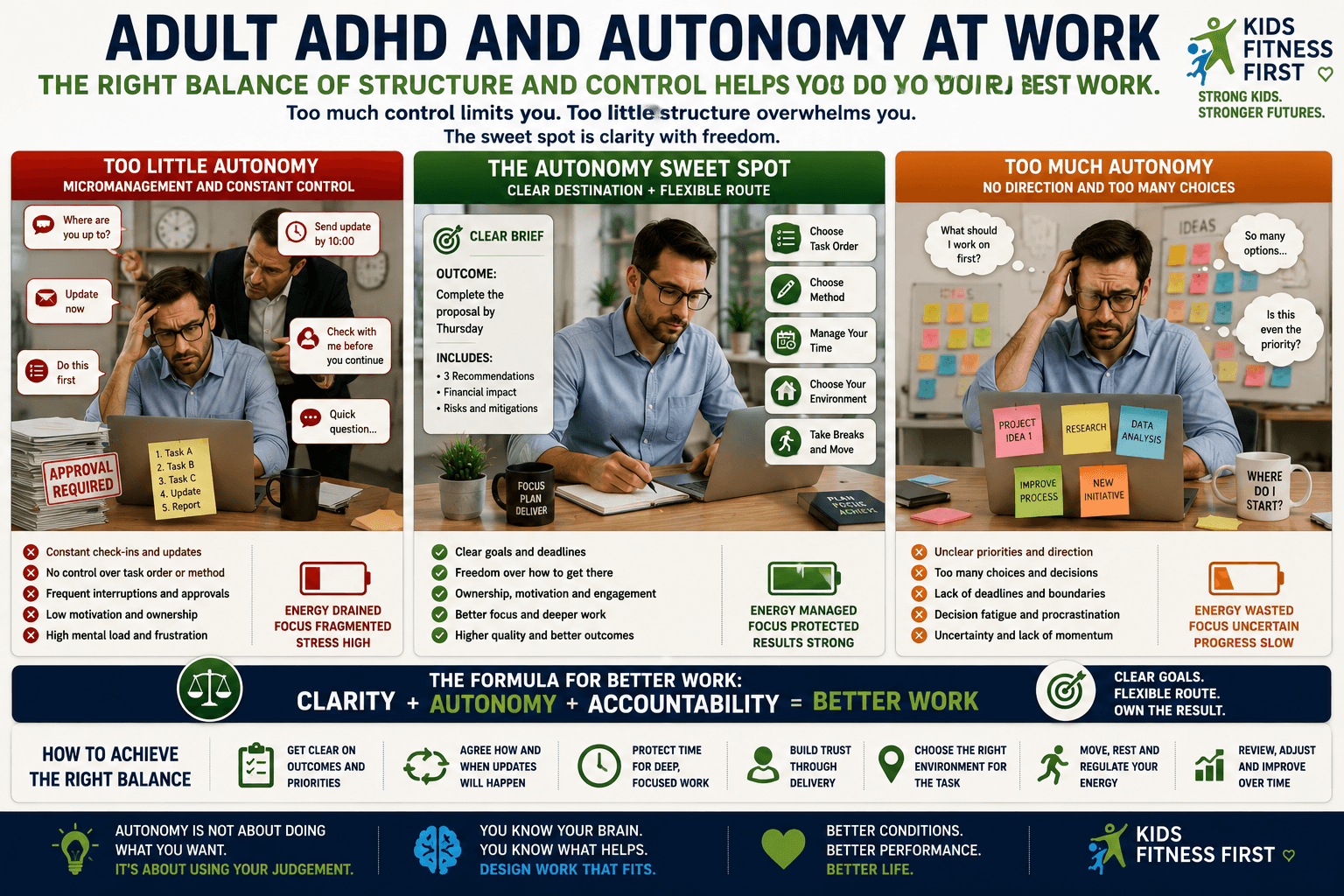
CLEAR DESTINATION + FLEXIBLE ROUTE
This gives enough structure to create direction.
Meanwhile, it also preserves enough autonomy to reduce unnecessary friction.
Adult ADHD and Autonomy at Work: Why Control Can Affect Motivation
Motivation can change when a task feels imposed in every detail.
For example, imagine you are told exactly:
when to start;
how to organise the task;
how long each stage should take;
when to report progress.
You may still complete the work.
However, the experience may feel much more effortful.
By contrast, if the outcome is clear but you can choose the route, the task may feel more engaging.
Therefore, control can influence not only comfort but also motivation.
The Difference Between Responsibility and Control
A job can give you responsibility without giving you much control.
For example:
you are responsible for delivering the result;
however, you cannot choose the method;
you cannot move the deadline;
you cannot control the interruptions;
you cannot adjust the sequence.
As a result, you carry accountability while having limited influence over how the work happens.
Therefore, when assessing autonomy, ask both:
“What am I responsible for?”
and:
“What can I actually control?”
That distinction can be revealing.
Adult ADHD and Autonomy at Work: Micromanagement
Micromanagement can create a particular kind of workplace friction.
For example:
constant progress checks;
unnecessary approvals;
frequent updates;
detailed control over minor methods;
interruptions to ask where you are up to.
Each action may seem small.
However, together they can make the work feel fragmented.
As a result, you may spend part of your attention managing the manager rather than completing the task.
Therefore, the question becomes:
“Does this level of oversight improve the work, or does it repeatedly interrupt it?”
Structure Can Still Be Helpful
It is important not to swing too far in the opposite direction.
Some people benefit from:
clear priorities;
visible deadlines;
regular check-ins;
written instructions;
external accountability.
Therefore, the goal is not to remove all structure.
Instead, it is to identify which structure supports you and which structure becomes excessive control.
That difference matters.
Adult ADHD and Autonomy at Work: Supportive Structure Versus Micromanagement
Compare these two approaches.
SUPPORTIVE STRUCTURE
“Here are the top three priorities for today. Let me know if you get blocked.”
MICROMANAGEMENT
“Do Task A now. Send me an update in thirty minutes. Then start Task B exactly this way.”
The first approach creates clarity.
Meanwhile, the second controls both the outcome and the route.
Therefore, autonomy is not about having no expectations.
It is about having enough room to use your own judgement.
Task Order Can Matter
Some people find it easier to work when they can choose the sequence.
For example, perhaps you prefer to:
complete the hardest task first;
clear one small task to create momentum;
do analytical work during your best energy period;
leave routine administration until later.
Therefore, control over task order can affect how manageable the day feels.
If somebody else constantly determines the sequence, you may lose that advantage.
Adult ADHD and Autonomy at Work: Time Autonomy
Time autonomy means having some influence over when particular work happens.
For example, you may know that your strongest focus period is:
9:00–11:00.
Therefore, you may prefer to protect that period for:
analysis;
writing;
problem-solving.
Then you can move:
email;
routine updates;
administration
to a lower-energy part of the day.
As a result, the same workload may feel more manageable.
Flexible Timing Is Not Always Possible
Some roles require fixed timing.
For example:
customer service;
manufacturing;
healthcare;
teaching;
transport.
Therefore, time autonomy depends heavily on the job.
However, even in fixed roles, smaller choices may still exist.
For example:
task order;
break timing;
how preparation is organised;
when paperwork is completed.
Therefore, autonomy is not always all-or-nothing.
Adult ADHD and Autonomy at Work: Method Autonomy
Method autonomy means having some choice over how you reach the result.
For example:
you may prefer a checklist;
a visual board;
a written plan;
a digital system;
a handwritten notebook.
If the outcome is correct, the exact method may not matter.
Therefore, forcing one universal working style can sometimes create unnecessary friction.
Instead, allowing different methods can help people use systems that genuinely support them.
Outcome-Based Management
One useful management approach is to focus heavily on the result.
For example:
“The client needs the final proposal by Friday, and it must include these five items.”
Then the employee has reasonable flexibility over how to get there.
Therefore, outcome-based management can support autonomy while preserving accountability.
This is different from abandoning oversight.
Instead, the expectations remain clear.
Adult ADHD and Autonomy at Work: Decision Autonomy
Some roles also provide more freedom over decisions.
For example:
which problem to solve first;
which option to recommend;
which process to change.
Decision autonomy can be energising for some people.
However, it can also become overwhelming when expectations are vague.
Therefore, enough context and boundaries still matter.
A useful formula may be:
DECISION SPACE + CLEAR BOUNDARIES
That combination can support both confidence and judgement.
Too Much Choice Can Become Another Problem
Autonomy can be helpful.
However, unlimited choice can also create decision fatigue.
Imagine being told:
“Do whatever you think is best.”
That may sound empowering.
However, if you do not know:
the priority;
the deadline;
the budget;
the expected outcome,
the freedom may actually create uncertainty.
Therefore, autonomy works best when the boundaries are clear.
Adult ADHD and Autonomy at Work: The Choice Overload Problem
Suppose you have ten possible tasks.
Nobody tells you which one matters most.
You can choose anything.
Technically, you have high autonomy.
However, you may spend a large amount of time deciding.
Therefore, autonomy without prioritisation can become another form of cognitive load.
This is why clear priorities remain essential.
The Best Autonomy May Be Bounded Autonomy
Bounded autonomy means:
clear goals;
clear constraints;
clear responsibilities;
flexibility inside those boundaries.
For example:
“Complete these three priorities today. You can decide the order and method.”
That creates enough structure to reduce uncertainty.
At the same time, it provides enough control to support individual working style.
Therefore, bounded autonomy may be more useful than either total control or total freedom.
Adult ADHD and Autonomy at Work: Location Autonomy
Location can also be part of autonomy.
For example, some tasks may be easier:
at home;
in a quiet room;
in the main office;
in a collaborative space.
Therefore, if a role allows some location flexibility, you may be able to match environment to task.
This connects directly to Article 16 on work environment.
Use the Right Environment for the Right Work
Imagine:
deep analysis → quiet space.
team planning → shared office.
client conversation → private room.
routine admin → flexible location.
Therefore, location autonomy can support task-environment matching.
However, this only works where the role and employer allow it.
Adult ADHD and Autonomy at Work: Break Autonomy
Some people benefit from taking short breaks when their concentration begins to fall.
For example:
stand up;
walk briefly;
get water;
change position.
Then return to the task.
Therefore, a workplace that allows reasonable flexibility around short breaks may help some people regulate attention and energy.
Again, this depends on the role.
Being Watched Can Change Performance
Some people work comfortably when others are nearby.
However, others may become more self-conscious when they feel constantly observed.
As a result, part of their attention moves towards:
how they appear;
whether they are moving enough;
whether they look busy;
whether somebody is judging the process.
Therefore, perceived surveillance can reduce the psychological benefit of autonomy even when formal freedom exists.
Adult ADHD and Autonomy at Work: Visible Busyness
Some workplaces reward visible activity.
For example:
always online;
instant replies;
constant availability;
frequent status updates.
However, Article 14 explored why visible busyness does not always equal value.
Therefore, autonomy can also involve being trusted to focus on outcomes rather than constantly proving activity.
This can be especially important for deep work.
Trust Is Part of Autonomy
Autonomy depends heavily on trust.
A manager who trusts the employee may say:
“You understand the goal. Let me know if you need support.”
By contrast, low trust may create:
constant checking;
unnecessary updates;
duplicated approvals.
Therefore, the quality of the manager-employee relationship can directly influence the level of usable autonomy.
Adult ADHD and Autonomy at Work: Accountability Still Matters
Autonomy does not remove accountability.
If anything, greater autonomy may require stronger responsibility.
For example:
you choose the route;
however, you still deliver the outcome.
You manage your time;
however, you still meet the deadline.
You choose the method;
however, the work must still meet the required standard.
Therefore, autonomy and accountability should reinforce each other.
The Autonomy–Accountability Balance
Think of two extremes.
LOW AUTONOMY + HIGH CONTROL
The employee is closely directed.
HIGH AUTONOMY + NO ACCOUNTABILITY
The employee has little guidance or responsibility.
Neither extreme may work well.
Instead, a stronger model may be:
HIGH CLARITY + APPROPRIATE AUTONOMY + CLEAR ACCOUNTABILITY
This creates freedom within responsibility.
Adult ADHD and Autonomy at Work: Ask What You Actually Need Control Over
You may not need control over everything.
Therefore, identify which parts matter most.
Perhaps you care most about:
task order;
focus time;
workspace;
method;
communication style.
Meanwhile, other areas may matter less.
Therefore, specific autonomy requests are usually more realistic than asking for complete freedom.
The Five Types of Autonomy
Rate how important each form is to you.
| Type of Autonomy | Importance |
|---|---|
| Task order | /5 |
| Timing | /5 |
| Method | /5 |
| Location | /5 |
| Breaks / movement | /5 |
Then ask:
“Which two matter most?”
As a result, your autonomy profile becomes more specific.
Adult ADHD and Autonomy at Work: The Autonomy Friction Test
Now rate the current job.
| Area | Current Control |
|---|---|
| Task order | /5 |
| Timing | /5 |
| Method | /5 |
| Location | /5 |
| Breaks / movement | /5 |
Compare:
importance
with:
current control.
For example:
Timing importance = 5/5
Current timing control = 1/5
That gap may be significant.
Therefore, focus first on the largest gaps.
Build Your Autonomy Profile
Complete these statements.
I WORK BEST WHEN I CAN CHOOSE…
I NEED CLEAR STRUCTURE AROUND…
I BECOME FRUSTRATED WHEN…
I NEED MORE CONTROL OVER…
I DO NOT NEED MUCH CONTROL OVER…
THE TYPE OF CHECK-IN THAT HELPS ME MOST IS…
THE TYPE OF OVERSIGHT THAT DISTRACTS ME MOST IS…
MY IDEAL AUTONOMY LEVEL IS…
You now have your Autonomy Profile.
Adult ADHD and Autonomy at Work: The 7-Day Autonomy Audit
For seven working days, record:
1. What Was the Task?
Be specific.
2. How Much Control Did You Have?
Rate 1–10.
3. Was the Outcome Clear?
Yes / No.
4. How Motivated Did You Feel?
Rate 1–10.
5. How Well Did You Perform?
Rate 1–10.
6. What Level of Oversight Was Present?
Low / Medium / High.
7. What Would Have Helped?
More structure?
More freedom?
Clearer priorities?
At the end of the week, compare the pattern.
As a result, you may begin seeing whether autonomy genuinely affects performance.
Green, Amber and Red Autonomy
GREEN — SUPPORTIVE AUTONOMY
The outcome is clear.
Likewise, you have enough flexibility over the route.
Therefore, motivation and performance are easier to sustain.
AMBER — TOO LITTLE OR TOO MUCH
You either feel over-controlled or under-directed.
Therefore, the balance needs adjustment.
RED — HIGH FRICTION
You carry responsibility but have very little useful control.
Alternatively, the job provides so little structure that you repeatedly become stuck.
Therefore, this area deserves closer attention.
Adult ADHD and Autonomy at Work: Functional Workplace Language
If you want more autonomy, avoid making the request sound like:
“I don’t want anyone telling me what to do.”
Instead, connect autonomy to output.
For example:
“I work most efficiently when the outcome and deadline are clear and I have some flexibility over the order I complete the tasks.”
Likewise:
“Could we agree the priority and deadline, then let me organise the work sequence?”
Therefore, the request becomes practical rather than personal.
Ask for Less Interruption, Not Less Management
A good manager can be extremely valuable.
Therefore, the goal is not necessarily less management.
Instead, you may need:
clearer management;
less fragmented management;
more predictable check-ins.
For example:
one planned 15-minute review
may be more helpful than:
six unexpected progress questions.
Therefore, consider the form of management, not only the amount.
Adult ADHD and Autonomy at Work: Predictable Check-Ins
Regular check-ins can provide:
accountability;
clarity;
support;
feedback.
However, if they happen unpredictably, they may become another interruption.
Therefore, scheduled check-ins may provide both structure and autonomy.
For example:
Monday — priorities
Wednesday — progress
Friday — review
As a result, both manager and employee know when communication will happen.
Autonomy Can Support Deep Work
Article 14 explored the Depth Economy.
Deep work often requires:
time;
focus;
judgement;
freedom to explore.
Therefore, excessive micromanagement can interfere with depth.
However, complete lack of direction can also waste time.
Therefore, deep work often benefits from:
clear problem;
clear outcome;
protected attention;
enough autonomy to think.
Adult ADHD and Autonomy at Work: AI Makes Judgement More Important
Article 15 explored AI at work.
As more routine output becomes easier to automate, human judgement may become increasingly important.
However, judgement requires some freedom to:
question;
interpret;
challenge;
choose.
Therefore, highly controlled work may leave less room for the very human contribution that organisations increasingly value.
Autonomy Is Also Part of Career Fit
When comparing future roles, investigate:
how closely the role is supervised;
how priorities are set;
how much control employees have over methods;
how flexible the working environment is;
how often managers check progress.
Therefore, autonomy should be part of career research.
Two jobs with the same title may provide completely different levels of control.
Adult ADHD and Autonomy at Work: Better Interview Questions
During an interview, consider asking:
“How much autonomy does someone in this role have over how work is completed?”
“How are priorities normally set?”
“How frequently does the manager check in?”
“How much flexibility is there over task order?”
“Is performance judged mainly on outcomes or on process?”
“How does the team balance independent work and collaboration?”
Therefore, you can learn about the management culture before accepting the job.
Watch for Certain Phrases
Interview answers can reveal useful clues.
For example:
“We trust people to get the work done.”
may indicate autonomy.
However:
“We like to know where everyone is at all times.”
may suggest close oversight.
Likewise:
“Priorities change constantly.”
could mean exciting flexibility.
Alternatively, it could mean unclear direction.
Therefore, ask follow-up questions rather than relying on slogans.
Adult ADHD and Autonomy at Work: The 10% More Control Test
Do not begin by trying to redesign your entire role.
Instead, ask:
“What would 10% more useful control look like?”
Perhaps:
choosing task order;
one protected focus block;
fewer unscheduled check-ins;
choosing where to complete one type of task;
moving routine admin to a different time.
Then test it.
As a result, you can determine whether autonomy genuinely changes performance.
More Autonomy Is Not Always Better
This point is crucial.
The goal is not maximum autonomy.
Instead, the goal is appropriate autonomy.
Too little control may create frustration.
However, too much freedom without enough clarity may create uncertainty.
Therefore, the right amount depends on:
the person;
the role;
the task;
the environment;
the level of experience.
Adult ADHD and Autonomy at Work: The Autonomy Sweet Spot
Imagine autonomy on a line.
Too Little
Controlled, interrupted, little ownership.
Sweet Spot
Clear goals, useful boundaries, freedom over method.
Too Much
Vague expectations, too many choices, weak support.
Therefore, your goal is to identify your personal sweet spot.
Connect Your Autonomy Profile to the Work That Fits Framework
By Article 18, you now have:
Cognitive Signature
What you do well.
Peak Performance Formula
Conditions that help your strengths appear.
Collapse Conditions
Conditions that make performance harder.
Strength Portfolio
Where your strengths create value.
Depth Portfolio
Where deeper thinking creates distinctive contribution.
Automation Boundary
What AI can support.
Work Environment Profile
Where and how you work best.
Open-Plan Balance
How you balance collaboration with concentration.
Autonomy Profile
How much control and structure help you perform well.
Therefore, your picture of career fit is becoming increasingly practical.
Reflection Questions
- How much autonomy do you currently have?
- Which type of autonomy matters most to you?
- Do you work better when you control task order?
- Does flexible timing improve your performance?
- Do you prefer choosing your own methods?
- How much structure do you still need?
- What type of manager helps you perform best?
- Do frequent progress checks improve or interrupt your work?
- Does unclear freedom create decision fatigue?
- What would your autonomy sweet spot look like?
- What is one area where 10% more control might help?
- What is one area where more structure might actually help?
Conclusion: The Best Autonomy Is Freedom With Direction
Adult ADHD and autonomy at work should not be reduced to a desire for complete freedom.
Instead, useful autonomy often contains both direction and choice.
You may need:
clear priorities;
clear deadlines;
clear expectations.
However, within those boundaries, you may perform better when you can choose:
the task order;
the method;
the environment;
the timing of some work.
Therefore, the goal is not:
“Leave me alone.”
Instead, it is:
“Give me enough clarity to know what success looks like and enough control to find the best route there.”
First, identify where autonomy helps.
Then identify where structure helps.
Afterwards, look at your current balance.
Finally, test small changes.
Perhaps one planned check-in works better than repeated interruptions.
Likewise, choosing your own task order may reduce friction.
Alternatively, clearer priorities may make autonomy easier to use.
Therefore, ask:
“What combination of structure and control allows me to do my best work?”
That is the real autonomy question.
Because the right workplace does not simply give you freedom.
It gives you enough freedom to use your judgement — and enough structure to know where you are going.
SUGGESTED INTERNAL LINKS
- Adult ADHD and AI at Work: Why Human Depth May Become More Valuable as Routine Work Is Automated
- Adult ADHD and Open-Plan Offices: Why Noise, Movement and Interruptions Can Make Concentration Harder
DISCLAIMER
This article is provided for general educational and informational purposes only. It does not provide medical, psychological, diagnostic, occupational-health, employment, management or legal advice.
ADHD experiences and preferences vary considerably between individuals. Therefore, autonomy should not be assumed to improve work for every adult with ADHD.
Likewise, the amount of autonomy appropriate for a particular job depends on the role, level of experience, safety requirements, employer responsibilities and many other circumstances.
Workplace rights and adjustment requirements also depend on individual circumstances and applicable law.
Therefore, where significant health, management, employment or workplace concerns exist, consider appropriate professional guidance.