Adult ADHD and Workplace Accommodations: Practical Changes That May Help You Work More Effectively
Adult ADHD and workplace accommodations can sometimes be misunderstood.
For example, some people hear the word accommodation and imagine that expectations are being lowered.
However, that is not necessarily the purpose.
Instead, a workplace accommodation may involve changing how work is organised so that the essential work can be completed more effectively.
For example, the expected outcome may remain exactly the same.
However, the employee may benefit from:
clearer written priorities;
a quieter place for detailed work;
more predictable check-ins;
fewer unnecessary interruptions;
a different way of receiving instructions.
Therefore, a useful question is not:
“How can the job be made easier?”
Instead, ask:
“Which unnecessary barriers are making good performance harder than it needs to be?”
That distinction is central to this article. If you have not yet identified the barrier, start with our broader guide to Adult ADHD and Work Environment. For a common specific example, see ADHD and open-plan offices. This page then focuses on translating an identified barrier into a practical workplace adjustment.
Workplace Accommodations Are Not One Universal List
There is no single set of accommodations that suits every adult with ADHD.
For example, one person may benefit from a quieter workspace.
Meanwhile, another may find silence unhelpful and prefer moderate background sound.
Likewise, one employee may benefit from written instructions.
However, another may prefer a short verbal discussion followed by a written summary.
Therefore, accommodations should be based on the individual, the task and the workplace.
Instead of copying somebody else’s adjustments, examine your own evidence.
Adult ADHD and Workplace Accommodations: Start With the Barrier
Before asking for a change, identify the actual barrier.
For example:
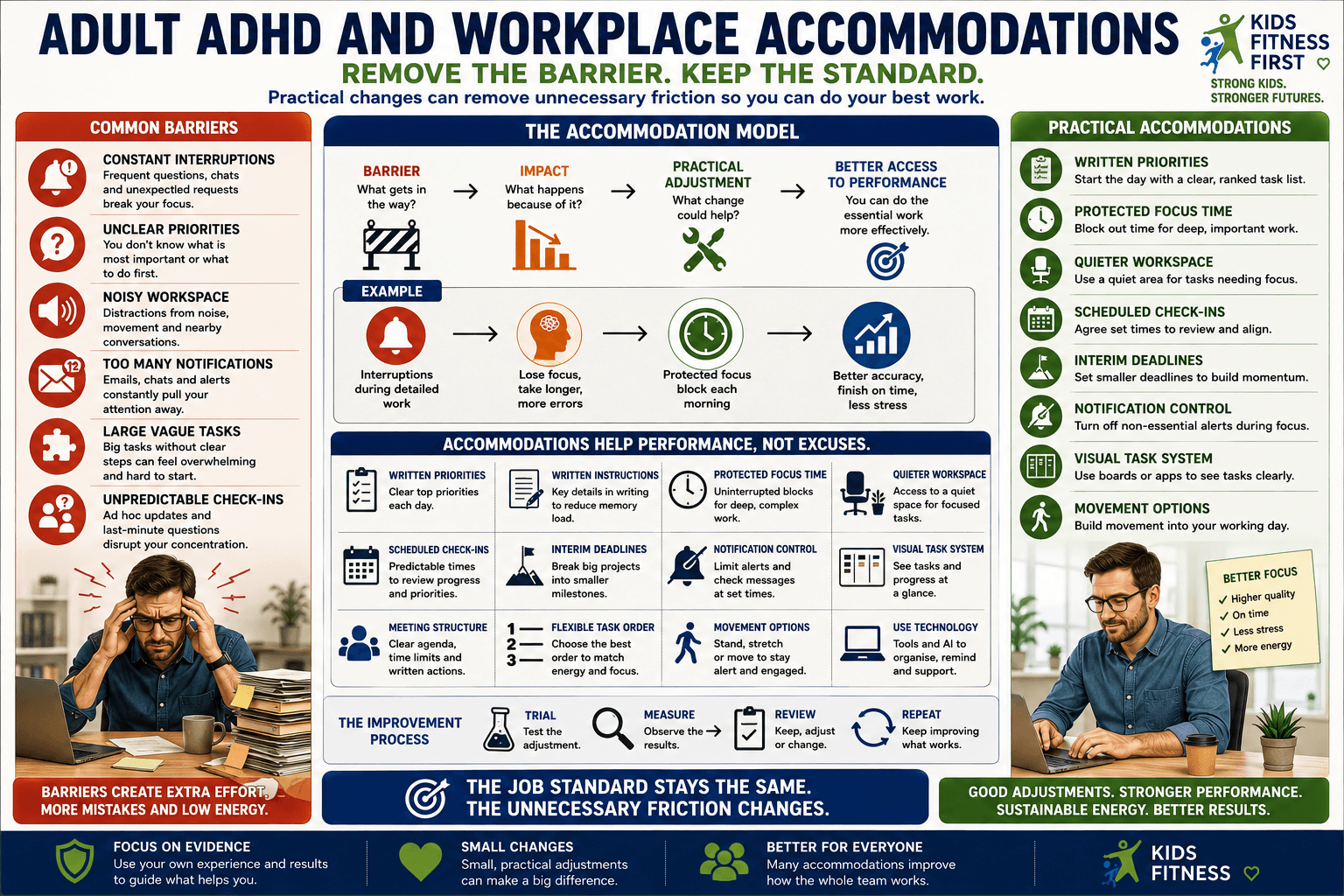
Barrier
Frequent interruptions during detailed work.
Effect
You repeatedly lose your place and need extra time to restart.
Possible Accommodation
A protected focus period.
Therefore, the accommodation should connect directly to the difficulty.
As a result, the conversation becomes much clearer. If requesting an adjustment may involve sharing personal information, the separate question of ADHD disclosure at work deserves its own decision process. If you are currently compensating so successfully that others cannot see the cost, also consider our guide to workplace masking.
The Barrier–Impact–Adjustment Model
Use this simple structure:
BARRIER
What is making the work harder?
IMPACT
What happens because of it?
ADJUSTMENT
What realistic change could help?
For example:
Barrier: verbal instructions containing several steps.
Impact: important details are sometimes forgotten.
Adjustment: written follow-up containing key actions.
Therefore, workplace accommodations become easier to discuss when they are connected to a specific function.
Adult ADHD and Workplace Accommodations: Clear Written Priorities
Unclear priorities can create significant cognitive load.
For example, imagine being given six tasks and being told:
“They’re all urgent.”
Technically, you have work to do.
However, you have not been given a usable priority.
Therefore, one practical adjustment may be:
a clearly ranked task list.
For example:
- Complete Client A report.
- Resolve Supplier B issue.
- Start presentation if time allows.
As a result, less energy is spent deciding what matters most.
Written Instructions Can Reduce Memory Load
Some tasks involve several steps.
For example:
call the customer;
update the system;
email finance;
send a copy to the manager.
If those instructions are given quickly in conversation, details may be forgotten.
Therefore, a short written summary can reduce the need to hold every instruction in memory.
This does not remove responsibility.
Instead, it creates a more reliable reference point.
Adult ADHD and Workplace Accommodations: Written Does Not Have to Mean Complicated
A useful written instruction does not need to become a long document.
For example:
Today:
- finish the report;
- email Sarah;
- update the spreadsheet.
That may be enough.
Therefore, the goal is clarity rather than bureaucracy.
In fact, overly complicated systems can create a new barrier.
Protected Focus Time
Article 17 explored open-plan offices and interruption.
If detailed work is repeatedly disrupted, a protected focus period may help.
For example:
9:00–10:30 — detailed report work
During that period:
non-urgent messages wait;
unexpected meetings are avoided where possible;
routine questions are saved until later.
Therefore, communication continues.
However, it becomes more predictable.
As a result, focused work has enough time to develop.
Adult ADHD and Workplace Accommodations: Focus Time Should Have a Purpose
Do not ask only for:
“More uninterrupted time.”
Instead, connect the request to a particular task.
For example:
“I would like to use 9:00–10:30 for the weekly analysis because that work requires sustained concentration.”
Therefore, the request becomes measurable.
Likewise, the employer can review whether it improves the result.
Quieter Workspaces
For some employees, nearby conversation or movement may make detailed concentration harder.
Therefore, access to a quieter workspace may sometimes help.
For example, a quieter space might be used for:
complex reports;
financial work;
analysis;
writing;
planning.
However, that does not necessarily mean working alone all day.
Instead, the quiet space can be matched to the task.
Adult ADHD and Workplace Accommodations: A Different Desk Position
Sometimes the useful adjustment is surprisingly small.
For example:
moving away from the main walkway;
facing away from constant movement;
sitting farther from ringing telephones.
The office remains the same.
However, the level of visual or auditory distraction may change.
Therefore, smaller environmental changes are often worth testing before assuming that a large redesign is necessary.
Noise Reduction
Depending on the job, noise reduction may be another practical option.
For example:
headphones;
ear defenders in appropriate environments;
quiet zones;
different desk location.
However, safety and communication requirements matter.
Therefore, anything that reduces environmental awareness needs to be appropriate for the role.
Adult ADHD and Workplace Accommodations: Digital Notification Control
A quiet physical workspace can still be highly distracting if the digital environment is constantly interrupting you.
For example:
email notifications;
chat messages;
calendar pop-ups;
phone alerts.
Therefore, a practical adjustment may involve reducing non-essential notifications during specific work periods.
For example:
pause chat alerts during deep work;
check email at planned intervals;
turn off unnecessary desktop notifications.
As a result, attention is interrupted less frequently.
Meeting Structure
Meetings can create difficulty when they are:
frequent;
unstructured;
long;
unclear.
Therefore, accommodations may sometimes focus on meeting design.
For example:
clear agenda;
defined start and finish;
written actions afterwards;
fewer unnecessary attendees;
scheduled breaks between meetings.
As a result, the meeting creates less uncertainty and less recovery cost.
Adult ADHD and Workplace Accommodations: Written Actions After Meetings
A meeting may cover many ideas.
However, afterwards, people may remember different things.
Therefore, a short action summary can help.
For example:
Amanda — complete draft by Tuesday.
John — obtain supplier price.
Sarah — arrange follow-up meeting.
This supports everyone, not only employees with ADHD.
Therefore, some accommodations can improve the wider team’s working system.
Predictable Check-Ins
Article 18 explored autonomy and management.
Some employees benefit from regular check-ins.
However, frequent unexpected progress questions can become distracting.
Therefore, scheduled check-ins may provide a better balance.
For example:
Monday — agree priorities.
Wednesday — progress review.
Friday — results and next steps.
As a result, the employee receives structure without continuous interruption.
Adult ADHD and Workplace Accommodations: External Deadlines
Large projects can sometimes feel too distant.
For example, a task due in six weeks may remain abstract for much of that time.
Therefore, intermediate milestones may help.
For example:
Week 1 — research complete.
Week 2 — outline complete.
Week 3 — first draft.
Week 4 — review.
As a result, progress becomes more visible.
Likewise, problems can be identified earlier.
Break Large Tasks Into Smaller Outputs
A task such as:
“Complete the strategy.”
can feel vague.
Instead, break it into:
collect information;
identify key issues;
create outline;
draft recommendations;
review final version.
Therefore, large work becomes a sequence of defined outputs.
As a result, starting may become easier.
Adult ADHD and Workplace Accommodations: Visual Task Systems
Some people benefit from being able to see work status visually.
For example:
To Do;
In Progress;
Waiting;
Complete.
A board may be:
physical;
digital;
on a whiteboard;
inside project-management software.
Therefore, the specific tool matters less than whether it makes priorities and progress visible.
Timers and Time Blocks
Time can sometimes feel abstract during long tasks.
Therefore, some people may benefit from time blocks.
For example:
45 minutes focused work;
10-minute break;
another 45-minute block.
However, fixed timing methods do not suit everyone.
Therefore, treat timers as an experiment rather than a rule.
Adult ADHD and Workplace Accommodations: Flexibility Around Task Order
Suppose three tasks must be completed today.
If all three have similar urgency, allowing the employee to choose the order may support performance.
For example, they may complete analytical work during their strongest energy period.
Then, routine administration can happen later.
Therefore, small amounts of task-order autonomy may be useful.
This connects directly to Article 18.
Flexible Working Hours
In some jobs, timing flexibility may be possible.
For example, an employee may work better slightly earlier or later than standard hours.
However, not every role can support this.
Customer-facing work, manufacturing, healthcare and other roles may require fixed coverage.
Therefore, flexibility should be considered within the realities of the job.
Adult ADHD and Workplace Accommodations: Hybrid or Remote Working
Some people perform better when part of their work can be completed remotely.
For example, remote work may reduce:
commuting;
office noise;
visual distraction;
unexpected interruption.
However, remote work can also create:
isolation;
weaker external structure;
home distractions.
Therefore, hybrid or remote working should be considered based on the individual’s actual performance pattern, not as a universal ADHD accommodation.
Use Location Strategically
A hybrid arrangement may work best when location matches task.
For example:
Office
meetings;
teamwork;
relationship-building.
Home
writing;
analysis;
deep work.
Therefore, location flexibility can become a task-management tool.
Adult ADHD and Workplace Accommodations: Movement
For some people, movement can support concentration or energy.
For example:
walking during a telephone call;
standing during part of a meeting;
taking a short movement break;
using a sit-stand workspace where available.
Therefore, reasonable movement opportunities may form part of a supportive environment.
However, the exact arrangement must still fit the role and workplace.
Break Flexibility
Some employees may benefit from shorter, more deliberate breaks.
For example, after ninety minutes of intense concentration, a brief break may help restore attention.
Therefore, break flexibility can sometimes improve sustainability.
However, again, operational needs matter.
The goal is not unrestricted breaks.
Instead, it is a workable arrangement that supports both performance and responsibility.
Adult ADHD and Workplace Accommodations: Reduce Unnecessary Multitasking
Some workplaces expect employees to handle several demands simultaneously.
For example:
answer telephone;
reply to messages;
complete report;
monitor customer requests.
However, constant switching can reduce efficiency for complex tasks.
Therefore, one adjustment may be to reduce simultaneous demands during specific work periods.
For example:
one person covers urgent calls while another completes the monthly analysis.
Then roles can rotate.
As a result, complex work receives enough concentration.
Clarify What Is Truly Urgent
Many workplace interruptions begin with:
“Quick question.”
However, not every quick question is urgent.
Therefore, teams may benefit from agreed categories.
For example:
URGENT
Needs action now.
TODAY
Can wait until communication window.
ROUTINE
Can be handled later.
As a result, fewer issues automatically become interruptions.
Adult ADHD and Workplace Accommodations: Reduce Administrative Duplication
Sometimes employees are required to enter the same information into several systems.
This may be necessary.
However, sometimes duplication exists simply because the process has never been reviewed.
Therefore, where possible, removing unnecessary duplication can reduce cognitive load.
Importantly, this is not an ADHD-specific idea.
Instead, it is good process design.
Some Accommodations Help Everyone
Clear priorities help many employees.
Likewise, meeting agendas, written actions and sensible notification rules can improve whole teams.
Therefore, a useful accommodation may sometimes reveal a poorly designed system.
As a result, improving one person’s working conditions may benefit others too.
Adult ADHD and Workplace Accommodations: Assistive Technology
Technology may also support certain workplace needs.
For example:
task-management systems;
calendar reminders;
speech-to-text tools;
text-to-speech tools;
digital note systems;
AI-assisted organisation.
However, workplace security, privacy and employer policies matter.
Therefore, employees should use only tools that are appropriate and permitted within their organisation.
AI as an Organisational Support Tool
Article 15 explored AI at work.
For example, where appropriate and permitted, AI may help:
organise notes;
create a draft task list;
summarise information;
break a project into steps.
However, confidential or sensitive workplace information should not be placed into tools without appropriate permission and safeguards.
Therefore, technology use needs both usefulness and responsible boundaries.
Adult ADHD and Workplace Accommodations: Memory Supports
A memory support can be very simple.
For example:
written checklist;
calendar reminder;
shared project board;
meeting notes.
The goal is not to avoid remembering anything.
Instead, it reduces unnecessary reliance on memory for information that can easily be stored externally.
Therefore, external systems can become part of reliable performance.
Use One System Where Possible
Too many organisational systems can create their own problem.
For example:
one task in email;
another in chat;
another in notebook;
another in project software;
another in calendar.
As a result, information becomes scattered.
Therefore, where possible, simplify.
One primary task system may be easier to maintain than five competing systems.
Adult ADHD and Workplace Accommodations: Communication Preferences
People differ in how they process information.
For example, some may prefer:
written instructions;
short verbal briefings;
visual examples;
one-to-one discussion.
Therefore, where reasonable, communication methods can sometimes be adapted.
However, the important point is not preference alone.
Instead, ask which method leads to the most reliable performance.
The Accommodation Should Solve a Real Problem
An accommodation should not simply be something that sounds appealing.
Instead, ask:
“What evidence do I have that this change will help?”
For example, perhaps you already know that:
quiet mornings improve report accuracy;
written priorities reduce missed tasks;
scheduled check-ins reduce interruptions.
Therefore, use evidence from your own work history.
This connects directly to Article 19’s Career Evidence File.
Adult ADHD and Workplace Accommodations: Use Your Existing Framework
You already have several tools from Book Four.
Use them.
From Article 11
Peak Performance Formula
What conditions help you work well?
From Article 12
Collapse Conditions
What repeatedly makes performance harder?
From Article 16
Work Environment Profile
Which environmental factors matter most?
From Article 18
Autonomy Profile
How much structure and control help?
From Article 19
Career Evidence File
What evidence exists from past roles?
From Article 20
Disclosure Planning Sheet
What information needs to be communicated?
Therefore, an accommodation request can be based on a substantial body of personal evidence.
Adult ADHD and Workplace Accommodations: The Accommodation Gap Test
Create two columns.
| Current Barrier | Possible Adjustment |
|---|---|
| Constant interruption | Protected focus time |
| Unclear verbal instructions | Written summary |
| Heavy office noise | Quieter workspace for deep work |
| Too many unexpected check-ins | Scheduled check-ins |
| Large vague projects | Interim milestones |
| Digital alerts | Notification control |
Then ask:
“Which one gap creates the largest performance cost?”
Start there.
Do Not Ask for Ten Changes at Once
If several things are difficult, it may be tempting to request everything.
However, that can make it harder to identify which adjustment actually helps.
Therefore, where appropriate, prioritise.
For example:
First Change
Protected focus block.
Then measure the effect.
Afterwards, consider whether another adjustment is still necessary.
Adult ADHD and Workplace Accommodations: The 10% Improvement Test
Ask:
“What one practical adjustment could make this task 10% easier to perform accurately?”
For example:
written priorities;
quiet space;
one fewer meeting;
scheduled check-in;
shorter task stages.
Therefore, improvement can begin with something small and measurable.
Trial, Measure, Review
A useful approach is:
TRIAL
Test the adjustment.
MEASURE
Observe what changes.
REVIEW
Decide whether to keep, modify or remove it.
For example:
Trial: quiet room for weekly report.
Measure: completion time and errors.
Review: after three weeks.
Therefore, workplace accommodations can be treated as practical experiments.
Adult ADHD and Workplace Accommodations: Measure the Right Outcome
Do not measure only whether you liked the adjustment.
Also consider:
accuracy;
completion time;
missed deadlines;
energy cost;
number of interruptions;
quality of output.
Therefore, effectiveness becomes more objective.
Accommodation Does Not Mean Zero Difficulty
No workplace can remove every difficult task.
There will still be:
deadlines;
routine work;
meetings;
unexpected problems.
Therefore, the goal is not eliminating all discomfort.
Instead, accommodations aim to reduce unnecessary barriers that materially affect performance.
Adult ADHD and Workplace Accommodations: Essential Job Requirements Still Matter
A workplace adjustment cannot always change the fundamental nature of the role.
For example, if a job genuinely requires:
constant customer interaction;
fixed shift coverage;
immediate emergency response,
those requirements may remain central.
Therefore, accommodation discussions need to consider the essential demands of the role.
If the core job itself is a poor fit, Article 6’s question about the wrong job may become relevant again.
Formal and Informal Changes Are Different
Some workplace changes may happen informally.
For example:
manager agrees to send priorities in writing.
However, other adjustments may involve:
HR;
occupational health;
formal workplace procedures.
Therefore, the appropriate route depends on the situation.
Where legal rights or formal disability accommodations are involved, authoritative local guidance or qualified advice may be important.
Adult ADHD and Workplace Accommodations: Keep Privacy in Mind
Article 20 explored disclosure.
You may not want every colleague to know personal medical information.
Often, they only need to know the working arrangement.
For example:
“Barry uses 9:00–10:30 for focus work.”
They may not need to know why.
Therefore, separate the practical accommodation from the personal information behind it.
Use Functional Language
A useful request may sound like:
“I produce my most accurate analytical work when I have an uninterrupted block. Could we trial a ninety-minute focus period each morning and review the results after three weeks?”
This statement contains:
the issue;
the benefit;
the change;
the review point.
Therefore, it is much clearer than:
“I need special treatment because I have ADHD.”
Adult ADHD and Workplace Accommodations: The Accommodation Planning Sheet
Complete this before a workplace conversation.
THE TASK I AM TRYING TO IMPROVE IS…
THE BARRIER IS…
THE IMPACT ON MY WORK IS…
THE ADJUSTMENT I WOULD LIKE TO TEST IS…
I BELIEVE IT WILL HELP BECAUSE…
THE RESULT WE CAN MEASURE IS…
THE TRIAL PERIOD WILL BE…
THE REVIEW DATE WILL BE…
You now have an Accommodation Planning Sheet.
The Accommodation Priority Score
Score each possible adjustment from 1–5.
| Question | Score |
|---|---|
| How large is the current problem? | /5 |
| How likely is this adjustment to help? | /5 |
| How easy is it to implement? | /5 |
| How easy is it to measure? | /5 |
| How sustainable is it? | /5 |
Then prioritise adjustments with the strongest overall case.
Therefore, you avoid trying to change everything at once.
Adult ADHD and Workplace Accommodations: Green, Amber and Red Adjustments
GREEN — PRACTICAL AND EVIDENCE-BASED
The barrier is clear.
Likewise, the adjustment is realistic and measurable.
Therefore, it may be worth testing.
AMBER — POSSIBLY USEFUL
The adjustment may help.
However, the barrier or expected result is still unclear.
Therefore, gather more evidence.
RED — POORLY MATCHED
The adjustment does not address the actual problem.
Alternatively, it conflicts heavily with essential role requirements.
Therefore, reconsider the approach.
Your 7-Day Accommodation Audit
For seven working days, record:
1. Biggest Barrier
What made work harder today?
2. Task Affected
What were you trying to do?
3. Performance Impact
What happened?
4. Existing Support
Did anything help?
5. Possible Adjustment
What realistic change could help?
6. Expected Benefit
What would improve?
At the end of the week, identify the most repeated barrier.
Then choose one practical adjustment to investigate.
Adult ADHD and Workplace Accommodations: Avoid Building a Perfect-System Fantasy
It is easy to imagine:
perfect lighting;
zero interruptions;
complete flexibility;
ideal management;
no boring tasks.
However, real workplaces involve compromise.
Therefore, focus on high-impact barriers.
Ask:
“Which three conditions matter most?”
Then prioritise them.
That approach is much more realistic.
Better Systems Can Reduce the Need for Constant Compensation
Without supportive systems, you may compensate by:
working later;
checking everything repeatedly;
using excessive mental effort;
taking work home.
As a result, performance may look fine while the personal cost becomes very high.
Therefore, a good accommodation may reduce the amount of hidden compensation required.
Adult ADHD and Workplace Accommodations: Sustainability Matters
An adjustment should not only help you finish today’s task.
Ideally, it should also make the working pattern more sustainable.
Therefore, consider:
performance;
energy;
recovery;
consistency.
For example, a working method that produces excellent output but leaves you exhausted every evening may still need attention.
Accommodations Can Evolve
What helps today may not be what helps in five years.
For example:
the role may change;
management may change;
technology may change;
your responsibilities may change.
Therefore, workplace accommodations should be reviewed rather than assumed to remain perfect forever.
Adult ADHD and Workplace Accommodations: Better Questions for Managers
Useful questions may include:
“Which part of this role absolutely has to stay the same?”
“Where is there flexibility in how the work is completed?”
“Could we trial this adjustment?”
“How will we measure whether it is working?”
“When should we review it?”
Therefore, the conversation becomes collaborative rather than vague.
Connect Article 21 to the Work That Fits Framework
By Article 21, the framework now includes:
Cognitive Signature
What you do well.
Peak Performance Formula
What conditions help.
Collapse Conditions
What gets in the way.
Strength Portfolio
Where you create value.
Depth Portfolio
Where deeper contribution matters.
Automation Boundary
Where technology can support you.
Work Environment Profile
Which surroundings support performance.
Open-Plan Balance
How you balance connection and concentration.
Autonomy Profile
How much control and structure help.
Career Evidence File
What your work history shows.
Disclosure Planning Sheet
What you may need to communicate.
Accommodation Planning Sheet
What practical change you want to test and why.
Therefore, the framework is moving from self-understanding towards practical workplace design.
Reflection Questions
- What is the biggest workplace barrier you experience?
- Which task does it affect most?
- What happens to your performance because of it?
- What practical change could reduce that barrier?
- Do you have evidence that the change would help?
- Could the adjustment be tested temporarily?
- What result would show that it worked?
- Which accommodations would be easy to implement?
- Which changes require formal workplace involvement?
- Which personal information actually needs to be shared?
- Are you compensating for poor conditions by working longer?
- What is the smallest useful adjustment you could test first?
Conclusion: Remove the Barrier, Keep the Standard
Adult ADHD and workplace accommodations should not be about removing responsibility.
Instead, the aim is to identify barriers that make good performance unnecessarily difficult.
Perhaps the barrier is constant interruption.
Therefore, protected focus time may help.
Perhaps verbal instructions are easily lost.
Then a written summary may help.
Likewise, perhaps detailed work becomes much harder in a noisy environment.
In that case, access to a quieter workspace may be worth testing.
However, the important principle remains the same:
IDENTIFY THE BARRIER.
CONNECT IT TO PERFORMANCE.
TEST A PRACTICAL CHANGE.
MEASURE THE RESULT.
First, understand what is making the task difficult.
Then identify the smallest useful adjustment.
Afterwards, trial it.
Finally, review the evidence.
Therefore, workplace accommodations should not be viewed as a collection of special privileges.
Instead, they can be understood as practical workplace design.
Most importantly:
The goal is not to remove the standard.
The goal is to remove unnecessary barriers that stop someone from reaching that standard effectively and sustainably.
SUGGESTED INTERNAL LINKS
- Adult ADHD and Disclosure at Work: How to Decide Whether to Tell Your Employer
- Adult ADHD and Career Archaeology: What Your Past Jobs Can Teach You About the Work That Fits
DISCLAIMER
This article is provided for general educational and informational purposes only. It does not provide medical, psychological, diagnostic, occupational-health, employment or legal advice.
ADHD experiences vary considerably between individuals. Therefore, no single workplace accommodation should be assumed to help every person with ADHD.
Likewise, what is practical or appropriate depends on the individual’s role, workplace, employer, responsibilities and circumstances.
Formal workplace accommodation or reasonable-adjustment rights also depend on applicable law and individual circumstances.
Therefore, where formal rights, disability protections, employment disputes or medical documentation are involved, seek authoritative local guidance or appropriate qualified professional advice.