
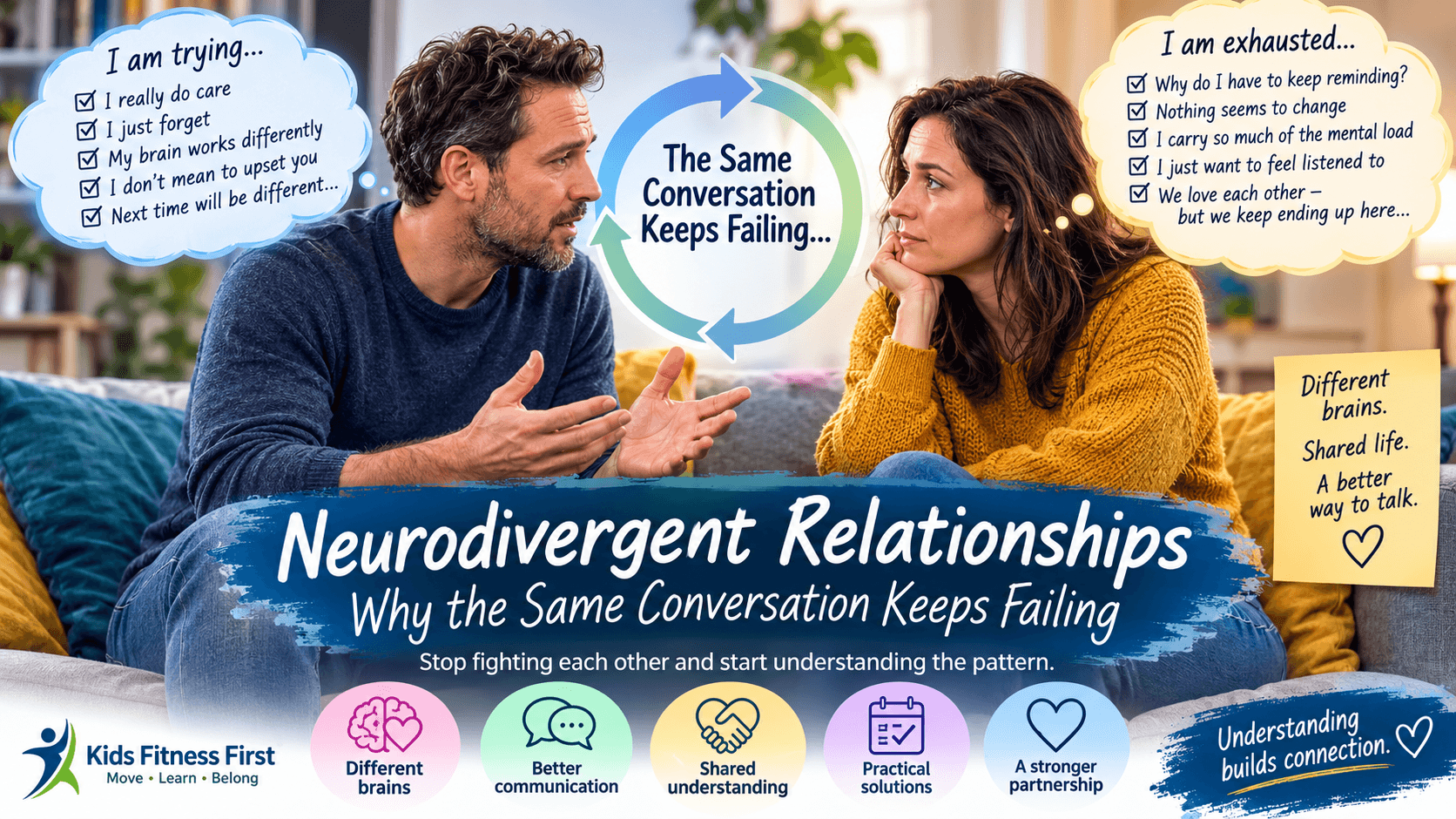
Neurodivergent Relationships: Why the Same Conversation Keeps Failing
One of the hardest parts of neurodivergent relationships is not necessarily the dramatic argument.
More often, it is the ordinary conversation that keeps coming back.
The forgotten appointment.
The household job that still has not been done.
The message that was never answered.
The plan that one person thought had been agreed.
The paperwork that one person keeps having to manage.
At first, each incident may appear small. However, when the same pattern repeats, the conversation gradually stops being about that single forgotten task.
Instead, it begins to carry the weight of everything that came before it.
One partner may be thinking:
Why do I have to keep reminding you?
Meanwhile, the other may be thinking:
Why does everything I get wrong become evidence that I do not care?
Consequently, two people who may genuinely love one another can find themselves having almost exactly the same argument again and again.
The subject changes.
The pattern does not.
That distinction matters.
Because, once you recognise that the pattern itself may be the problem, you can begin to stop treating each other as the problem.
When an Argument Becomes a Loop
Think about a difficult conversation you have had with someone close to you.
Now ask yourself a question:
Have we had this conversation before?
Not simply a conversation on the same subject.
Almost the same conversation.
Perhaps you already know how it develops.
First, one person raises an issue.
Then, the other explains what happened.
Afterwards, the first person says that they have heard the explanation before.
The second person becomes defensive.
As a result, the first person feels unheard.
Then somebody becomes angry, withdraws, shuts down or gives up.
Finally, the original issue remains unresolved.
A week later, something similar happens.
Therefore, the entire sequence begins again.
Once a conversation becomes this predictable, it is no longer simply an argument.
It has become a relationship loop.
Importantly, recognising that loop does not mean deciding who is right or wrong. Instead, it means noticing that the current way of discussing the problem is no longer capable of producing a new result.
The Small Issue Is Often Carrying a Much Bigger Meaning
Consider a missed appointment.
For one person, the conversation may genuinely be about one forgotten appointment.
They may think:
I forgot. I apologised. I will sort it tomorrow.
However, their partner may not be experiencing the incident in isolation.
For them, the forgotten appointment may sit beside ten other things:
- the bill they had to chase;
- the school form they completed;
- the insurance they remembered;
- the birthday present they organised;
- the phone call they made;
- the family calendar they maintain;
- and all the reminders they gave along the way.
Therefore, one partner sees one incident.
The other sees a pattern.
Neither experience is necessarily false.
However, if neither person realises that they are discussing two different things, communication becomes extremely difficult.
One person may feel unfairly judged for everything that has ever happened.
Meanwhile, the other may feel that the history of the problem is being erased every time it occurs.
That is one reason repeated arguments can become so emotionally powerful.
Good Intentions Do Not Always Produce Visible Outcomes
A particularly painful issue in neurodivergent relationships is the difference between effort and outcome.
Someone may genuinely be trying.
For example, they might:
- set reminders;
- create a new calendar;
- buy a whiteboard;
- download an organisation app;
- listen to podcasts;
- read about ADHD or autism;
- promise themselves that next time will be different.
Internally, considerable effort may be taking place.
However, their partner usually experiences the relationship through what actually happens.
Did the appointment get made?
Was the bill paid?
Was the conversation remembered?
Did the agreed task happen?
Consequently, one person may say:
“I am trying.”
The other may answer:
“But nothing is changing.”
Both statements can be true at exactly the same time.
That is important because treating one statement as proof that the other must be false usually makes the relationship worse.
Instead, the useful question becomes:
How do we turn genuine effort into an outcome that both people can actually see and rely upon?
The Explanation Trap
Receiving a diagnosis or finally understanding your neurodivergence can be enormously important.
Suddenly, years of behaviour may begin to make sense.
You may learn about executive functioning, working memory, sensory processing, emotional regulation, attention, autistic communication styles or dyslexia.
As a result, you finally have language for experiences that previously felt confusing.
That language can be liberating.
However, there is a potential relationship trap.
When something goes wrong, explanation can begin replacing change.
For example:
“I forgot because of my ADHD.”
“I shut down because I was overloaded.”
“I struggle with written instructions because I am dyslexic.”
“I didn’t understand what you meant because I took the words literally.”
These explanations may be completely genuine.
Nevertheless, imagine how they may sound to a partner who has experienced the same difficulty repeatedly.
They may hear:
“This will always happen, so you will simply have to accept it.”
That may not be what was meant.
Yet communication is affected not only by what somebody intends to say, but also by what the other person receives.
Therefore, one of the most useful principles for neurodivergent relationships is:
Explanation helps us understand the problem. A plan helps us change what happens next.
Both matter.
But they are not the same thing.
Explanation Is Not the Same as an Excuse
This distinction deserves care.
Understanding why somebody struggles is valuable.
In fact, without understanding, partners can wrongly interpret neurological differences as laziness, selfishness, indifference or a lack of love.
However, understanding neurodivergence should not require either person to pretend that difficult consequences do not matter.
A useful relationship can hold two truths at once:
“I understand that you did not do this deliberately.”
and
“We still need a system that prevents me carrying this alone.”
Likewise:
“I understand why this behaviour has hurt you.”
and
“I need you to understand that my difficulty is real rather than assuming I simply do not care.”
The goal, therefore, is neither blame nor unlimited excuse-making.
Instead, it is translation followed by practical change.
When One Partner Becomes the Household Manager
Another pattern can develop gradually.
One person forgets something, so the other takes responsibility for it.
Initially, this solves the immediate problem.
Then another task moves across.
And another.
Eventually, one partner may become responsible for much of the invisible organisation of family life.
They know:
- when appointments are;
- which forms need completing;
- what food is needed;
- whose birthday is approaching;
- when the car needs servicing;
- what the school requires;
- which bill needs renewing;
- and what everyone is doing next weekend.
Meanwhile, the other person may gradually become less involved in those areas.
Nobody necessarily planned this arrangement.
Nevertheless, resentment can develop on both sides.
One partner feels overworked and unsupported.
The other feels managed, criticised or treated like a child.
Consequently, the relationship can slip away from a partnership and towards a parent-and-child style dynamic.
This is damaging for both people.
The answer, however, is rarely for the overloaded partner simply to drop everything overnight.
Instead, responsibility usually needs to be rebuilt deliberately, visibly and realistically.
Different Brains May Experience the Same Conversation Differently
Neurodivergence is not one experience.
Therefore, we should not assume that every ADHD, autistic or dyslexic person experiences relationships in the same way.
Nevertheless, different neurological profiles can create recurring areas of misunderstanding.
ADHD
In some ADHD relationships, repeated conversations may centre on:
- remembering commitments;
- starting tasks;
- finishing tasks;
- time management;
- household administration;
- inconsistency;
- attention during conversations.
Therefore, the partner may experience unreliability even when there is no intention to be unreliable.
Meanwhile, the ADHD person may experience repeated reminders as criticism or evidence that their efforts are invisible.
Dyslexia
For a dyslexic person, difficulty may sometimes appear around:
- written instructions;
- forms;
- documents;
- lengthy emails;
- administrative tasks;
- spelling or written communication.
Consequently, a partner may mistakenly interpret avoidance of paperwork as lack of effort.
However, the task may simply carry a much higher cognitive cost for the dyslexic person.
Autism
Some autistic people may need:
- more direct communication;
- fewer implied meanings;
- greater predictability;
- recovery time following social activity;
- clear expectations;
- reduced sensory overload.
Meanwhile, a partner may expect emotional information to be understood from tone, facial expression or hints.
Therefore, one person believes they communicated clearly while the other genuinely did not receive the intended message.
Again, neither person necessarily lacks care.
The difficulty may be occurring in the translation.
Two Neurodivergent Partners Can Have Opposite Needs
There is another important possibility.
Both people in the relationship may be neurodivergent.
However, their needs may be very different.
For example, one person may strongly need routine and predictability.
Meanwhile, the other may function best with novelty, flexibility and spontaneous decisions.
One person may need silence after a demanding day.
The other may regulate through conversation and connection.
One may want plans made several days in advance.
The other may struggle to engage with something until it becomes immediate.
Therefore, simply saying that both people are neurodivergent does not automatically solve the communication problem.
In fact, two people can understand neurodivergence very well and still have genuinely conflicting nervous-system needs.
The important step is identifying those needs without turning them into character judgements.
Instead of:
“You are controlling.”
it may become:
“You need predictability.”
Instead of:
“You are chaotic.”
it may become:
“You need more flexibility than I do.”
That change in language does not automatically solve the disagreement.
However, it changes what the disagreement is about.
The Most Important Shift: Make the Pattern the Problem
Suppose a familiar argument begins.
Normally, each person immediately becomes the problem in the other’s story.
“You never remember.”
“You always criticise me.”
“You don’t listen.”
“You are overreacting.”
“You don’t care.”
“You are controlling.”
However, there is another possibility.
Imagine that, halfway through the conversation, one of you says:
“We are in that same loop again.”
Suddenly, something changes.
The problem is no longer entirely you or me.
Instead, there is something sitting between us:
the pattern.
Once a pattern becomes visible, both people can begin looking at it together.
That does not mean the practical problem disappears.
The appointment still needs booking.
The workload still needs sharing.
The hurt still needs acknowledging.
However, the relationship has moved from:
me versus you
towards:
us versus the pattern.
That is a very different starting point.
Try This: Name Your Conversation
Take a piece of paper and think of one relationship that matters to you.
Then identify the conversation that keeps returning.
Do not begin by deciding who is responsible.
Instead, complete these five prompts.
| Question | Your Answer |
|---|---|
| What does the argument appear to be about? | |
| How many times have we had a similar conversation? | |
| What larger pattern might sit underneath it? | |
| At what exact point does the conversation usually go wrong? | |
| What do I think the other person is actually afraid of, tired of or needing? |
Afterwards, add one final sentence:
“Our recurring conversation is not really about __________. Underneath, it may be about __________.”
For example:
“Our recurring conversation is not really about the dishwasher. Underneath, it may be about whether household responsibility feels equally shared.”
Or:
“Our recurring conversation is not really about cancelling Saturday’s plans. Underneath, it may be about one person’s need for predictability and the other person’s need for flexibility.”
This exercise is not designed to prove that your interpretation is correct.
Instead, it helps you begin looking underneath the surface subject.
If You Are the Neurodivergent Person
Consider what you normally do when the difficult conversation begins.
Do you immediately explain?
Do you withdraw?
Do you become defensive?
Do you apologise quickly because you want the conversation to stop?
Do you promise something without building a practical way to make it happen?
If so, try replacing the automatic response with four steps:
First: acknowledge the outcome.
“I can see that this did not get done.”
Then: acknowledge the effect.
“I can understand why that leaves you feeling you have to carry it.”
Next: explain only what is useful.
“My ADHD makes this type of future task difficult for me to hold reliably.”
Finally: create a concrete next step.
“I am booking it now and putting the confirmation into our shared calendar.”
The explanation is still present.
However, it is now connected to action.
If You Are the Partner or Loved One
Your exhaustion also matters.
Understanding somebody’s neurodivergence does not mean that you must absorb unlimited responsibility.
However, repeated criticism can sometimes make practical improvement harder rather than easier.
Therefore, where possible, separate the person from the behaviour.
Instead of:
“You are completely unreliable.”
try:
“We need a more reliable way of making sure appointments are booked.”
Instead of:
“I have to do everything.”
try:
“I am currently carrying these six responsibilities, and I cannot sustainably continue carrying all six.”
This does not weaken the message.
In fact, it often makes the real issue clearer.
The goal is not to avoid difficult conversations.
It is to make those conversations capable of producing something new.
A Simple Conversation Reset
When you recognise the familiar loop beginning, try this short reset:
1. Name it.
“We have reached our usual conversation again.”
2. Slow it down.
“Can we deal with one issue rather than five at once?”
3. Separate intention from impact.
“I know this may not have been intentional. However, this is how it affected me.”
4. Replace explanation with planning.
“What will actually be different next time?”
5. Agree one visible action.
Choose something concrete, small and measurable.
For example:
- book the appointment now;
- put it into a shared calendar;
- divide three household tasks explicitly;
- agree a quiet recovery period after social events;
- send important arrangements in both spoken and written form;
- schedule a ten-minute weekly household check-in.
Small practical changes are often more powerful than another hour of arguing about intentions.
Love and Compatibility Are Not the Same as Automatic Understanding
Two people can love each other deeply and still misunderstand each other’s brains.
One can be trying incredibly hard while the other remains exhausted.
One can feel criticised while the other feels abandoned.
One can need more support while the other needs less responsibility.
These experiences can exist together.
Therefore, the goal of understanding neurodivergent relationships should not be to decide which side deserves sympathy.
Both may deserve it.
Instead, the task is to make the invisible structure of the relationship visible enough that both people can work with it.
That begins with a deceptively simple idea:
The same conversation keeps failing because the same pattern keeps entering the conversation.
Until the pattern changes, changing the words alone may not be enough.
Conclusion: Stop Fighting Each Other and Start Studying the Loop
A recurring argument does not automatically mean that a relationship is broken.
However, it does provide information.
It tells you that something important has not yet found a workable solution.
Therefore, rather than asking only:
“Who is right?”
try asking:
“What keeps happening between us?”
Then ask:
“What would have to change for this conversation to produce a different ending?”
That is the beginning of a different type of relationship conversation.
Not one where neurodivergence excuses everything.
Not one where neurodivergence is blamed for everything.
Instead, it is a conversation in which two people become curious about the pattern sitting between them.
Once the loop has a name, you can begin to notice when it appears.
Once you notice it, you can interrupt it.
And once you can interrupt it, you have something you did not have before:
the possibility of a different ending.
Suggested Internal Links
Where relevant, link this article to earlier articles covering:
- Adult ADHD and Meaningful Work: Building a Career That Fits Your Strengths, Values and Life
- Adult ADHD and Portfolio Careers: Could a Mix of Roles, Projects and Income Streams Fit You Better?
Disclaimer
This article is provided for general educational and informational purposes only. It is not medical, psychological, relationship or therapeutic advice and should not be used as a substitute for support from a suitably qualified professional.
Neurodivergent people are individuals. ADHD, autism, dyslexia and other forms of neurodivergence can affect people differently, and no single relationship pattern applies to everyone. Examples and frameworks should therefore be used as tools for reflection rather than assumptions about any individual.
If relationship difficulties involve abuse, coercion, threats or concerns about safety, they should not be treated simply as communication differences or neurodivergence.