What Does Meaningful Work Actually Mean?
Adult ADHD and meaningful work can easily become confused with the idea of finding one perfect career.
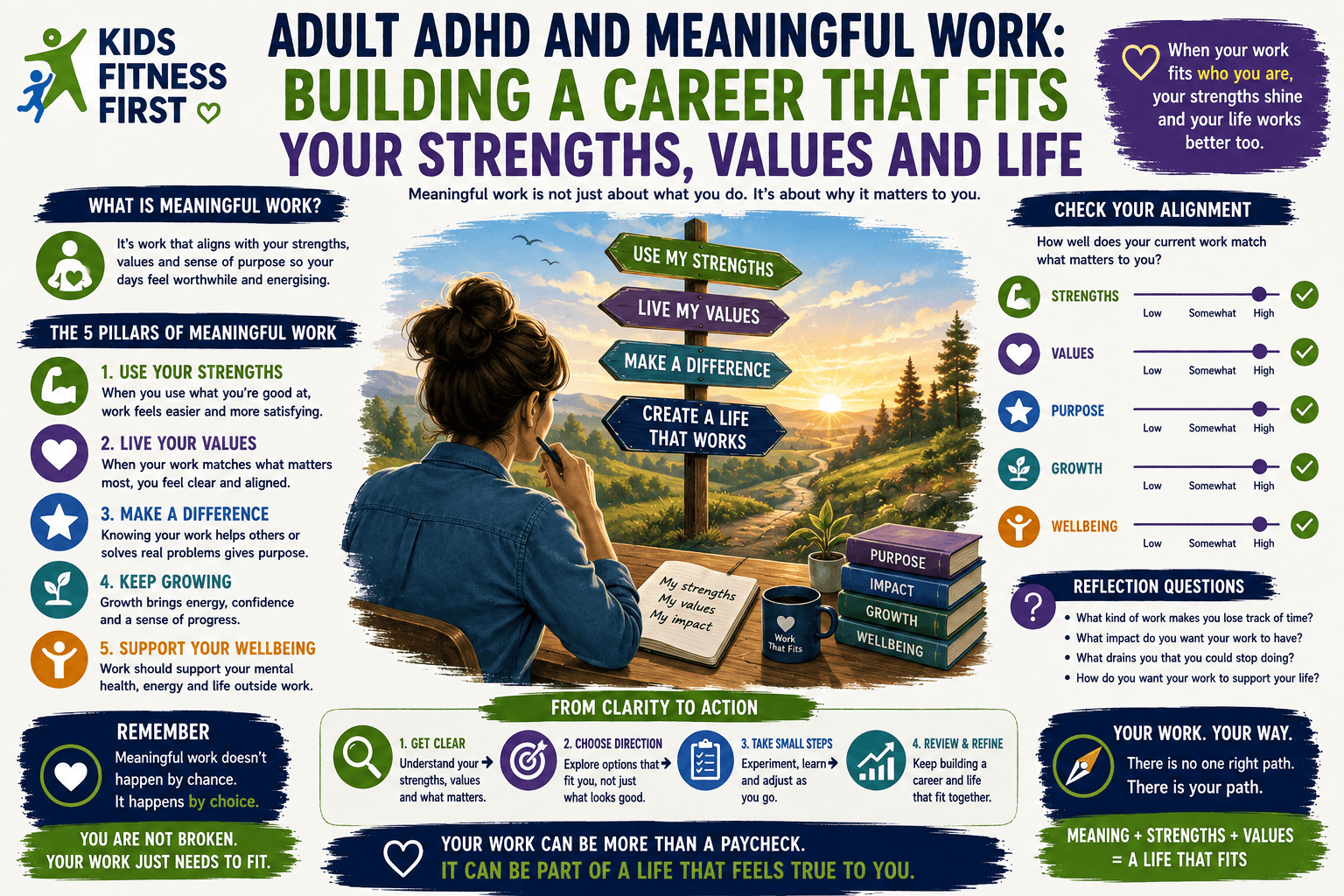
However, meaningful work does not necessarily mean discovering a magical job that feels exciting every day. It is the broader destination in this career-fit cluster: after examining ADHD strengths at work and using career archaeology to identify recurring patterns, meaningful work asks how strengths, values, practical needs and sustainability can fit together.
Instead, meaningful work may involve finding a reasonable combination of:
purpose;
strengths;
interest;
income;
autonomy;
belonging;
growth;
stability;
and sustainability.
Therefore, the question is not simply:
“What job would make me happy?”
Instead, a stronger question may be:
“What kind of working life allows me to contribute, develop and remain well enough to keep doing it?”
That distinction matters.
Meaningful Work Does Not Need to Be Extraordinary
Many people assume meaningful work must involve changing the world.
However, meaning can come from much smaller things.
For example, you may find meaning in solving problems.
Alternatively, you may value helping customers, building things, teaching others or improving systems.
Likewise, somebody else may find meaning in providing financial security for their family.
Therefore, meaningful work is personal.
It does not need to look impressive from the outside.
Instead, it needs to matter to the person doing it.
Adult ADHD and Meaningful Work: Start With Your Strengths
Throughout Book Four, we have repeatedly returned to strengths.
That is because career fit becomes difficult when your strongest abilities are rarely required.
For example, perhaps you are particularly strong at:
pattern recognition;
creative problem-solving;
explaining complicated ideas;
strategic thinking;
connecting information;
responding to unusual challenges.
However, perhaps your current role mainly requires repetitive administration.
As a result, the problem may not be a lack of ability.
Instead, there may be a mismatch between your strongest abilities and the work you are being asked to perform.
Therefore, meaningful work should give at least some of your strongest abilities somewhere to go.
Revisit Your Cognitive Signature
Earlier in Book Four, you developed your Cognitive Signature.
Now bring it back.
Ask:
“What does my mind repeatedly seem to do well?”
For example:
Do you spot patterns?
Do you generate ideas?
Do you solve unusual problems?
Do you communicate?
Do you organise complexity?
Do you understand people?
Do you build things?
Do you analyse information?
Therefore, before choosing a career direction, identify the abilities that repeatedly appear across your life.
Then ask:
“Where would these abilities genuinely create value?”
Adult ADHD and Meaningful Work: Strength Is Not Enough
A job can use your strengths and still be wrong for you.
For example, you may be excellent at crisis management.
However, living in permanent crisis may eventually exhaust you.
Likewise, you may perform exceptionally under intense deadlines.
Nevertheless, constant deadline pressure may become unsustainable.
Therefore, career design cannot be based only on:
“What am I good at?”
Instead, it must also consider:
“What can I do well without repeatedly damaging my wellbeing?”
That is a crucial distinction.
Your Peak Performance Formula Matters
Earlier, we explored your Peak Performance Formula.
Perhaps you perform best when you have:
clear goals;
interesting problems;
some autonomy;
limited interruption;
visible outcomes;
enough challenge.
Therefore, the environment surrounding the job matters almost as much as the job title itself.
For example, the same profession could feel completely different in two organisations.
One workplace may provide autonomy and trust.
Meanwhile, another may provide constant interruption and excessive supervision.
As a result, career fit depends partly on conditions.
Adult ADHD and Meaningful Work: Remember Your Collapse Conditions
Book Four also introduced Collapse Conditions.
These are the conditions that repeatedly make good performance harder to sustain.
For example:
constant interruption;
unclear priorities;
excessive meetings;
micromanagement;
sensory overload;
repetitive work;
unmanageable workload;
no recovery time.
Therefore, meaningful work is not simply about adding positive conditions.
It is also about reducing predictable sources of friction.
In other words, knowing what repeatedly does not work can be just as useful as knowing what does.
Values Give Work Direction
Strengths tell you what you may do well.
However, values help explain what matters to you.
For example, you may value:
freedom;
security;
creativity;
service;
learning;
family;
achievement;
fairness;
community;
independence.
Therefore, two people with similar abilities may choose completely different careers because their values differ.
One person may prioritise stability.
Meanwhile, another may prioritise autonomy.
Neither choice is automatically better.
Instead, the important question is whether your working life reflects what genuinely matters to you.
Adult ADHD and Meaningful Work: The Values Test
Choose your five most important work-related values.
VALUE 1
VALUE 2
VALUE 3
VALUE 4
VALUE 5
Then, ask:
Does my current work support these values?
Does it conflict with them?
Which values are missing?
As a result, vague dissatisfaction can sometimes become easier to understand.
Do Not Confuse Excitement With Meaning
Excitement can feel powerful.
However, excitement and meaning are not the same thing.
A new opportunity may feel stimulating because it is unfamiliar.
Nevertheless, novelty may eventually disappear.
Therefore, ask a deeper question:
“Would this still matter to me after the novelty has faded?”
For example, learning a new field may initially feel exciting.
However, if the underlying work does not fit your strengths or values, interest may decline.
Consequently, meaningful career decisions should not depend on novelty alone.
Adult ADHD and Meaningful Work: Purpose Can Be Quiet
Purpose does not always arrive as a dramatic revelation.
Instead, it may emerge gradually.
For example, perhaps you repeatedly enjoy helping people understand difficult information.
Over time, that pattern may lead towards teaching, training, writing or advisory work.
Alternatively, perhaps you repeatedly enjoy improving inefficient systems.
That pattern may point towards operations, engineering, technology or consultancy.
Therefore, purpose may be discovered through repeated evidence rather than one life-changing moment.
Follow the Evidence From Your Own Career
Article 19 introduced Career Archaeology.
Now use it one final time.
Look back across your working life.
First, identify moments when you performed particularly well.
Then, identify moments when you felt genuinely useful.
Afterwards, identify work you wanted to continue even after the initial excitement disappeared.
Finally, identify the environments in which those moments occurred.
Therefore, your career history becomes evidence.
Instead of asking only:
“What should I become?”
ask:
“What patterns have already been trying to tell me something?”
Adult ADHD and Meaningful Work: Follow the Problem Thread
Your Problem Thread can also reveal meaning.
Perhaps across different jobs you repeatedly gravitate towards the same kind of problem.
For example, you may repeatedly:
fix broken systems;
help confused people;
build new things;
analyse difficult information;
organise chaos;
improve inefficient processes.
Therefore, the meaningful part of your career may not be an industry.
Instead, it may be the type of problem you enjoy solving.
As a result, several different career paths may potentially fit the same underlying strength.
Meaning Does Not Need to Come Entirely From Work
This is especially important.
Your job does not have to provide your entire sense of identity or purpose.
For example, meaning may also come from:
family;
friendships;
volunteering;
community;
creative interests;
learning;
sport;
personal projects.
Therefore, expecting one job to provide income, identity, excitement, friendship, purpose and personal fulfilment may place unrealistic pressure on work.
Instead, consider the whole life.
Adult ADHD and Meaningful Work: Think in Terms of a Life Portfolio
Article 24 explored portfolio careers.
However, the same principle can be applied more broadly.
Imagine your life as a portfolio containing:
WORK
Contribution and income.
RELATIONSHIPS
Connection and belonging.
HEALTH
Energy and capacity.
LEARNING
Growth and curiosity.
COMMUNITY
Contribution beyond yourself.
RECOVERY
Rest and restoration.
Therefore, a successful career should support the wider portfolio rather than consume it.
The Career-Life Fit Test
Ask yourself:
“Does this career support the life I want outside work?”
For example, a prestigious role may provide excellent income.
However, it may require constant travel.
If family presence is one of your strongest values, that trade-off matters.
Likewise, another job may pay slightly less.
Nevertheless, it may provide autonomy, flexibility and time.
Therefore, career success should be measured against your own priorities rather than somebody else’s definition of achievement.
Adult ADHD and Meaningful Work: Money Still Matters
Meaningful work does not mean ignoring money.
Financial stability matters.
After all, persistent financial pressure can create its own stress.
Therefore, career decisions should consider:
income;
security;
benefits;
future earning potential;
financial obligations.
However, income is one part of career fit rather than the only part.
A high salary may not compensate indefinitely for severe burnout.
Likewise, deeply meaningful work may become difficult to sustain if it cannot support basic financial needs.
Therefore, the goal is balance.
Build Your Personal Definition of Enough
Ask:
How much income do I realistically need?
How much time do I want outside work?
How much responsibility do I want?
How much growth matters to me?
How much uncertainty can I tolerate?
Therefore, define your own version of enough.
Otherwise, career ambition can become an endless moving target.
Adult ADHD and Meaningful Work: Status Can Distort Career Decisions
Job titles can influence how we see ourselves.
Likewise, salary, prestige and external recognition can become powerful signals.
However, status does not necessarily equal fit.
For example, a promotion may provide more money and recognition.
Nevertheless, it may also replace technical work you love with management responsibilities you dislike.
Therefore, before pursuing the next level, ask:
“Do I actually want the work attached to this status?”
That question can prevent achievement from becoming a trap.
Success Should Be Defined Functionally
Instead of defining success only as:
promotion;
salary;
title;
company size;
consider a broader definition.
For example, success might mean:
using your strongest abilities;
earning enough;
having reasonable autonomy;
continuing to learn;
protecting your health;
having time for important relationships;
doing work that creates visible value.
Therefore, success can be both ambitious and sustainable.
Adult ADHD and Meaningful Work: Create Your Career Fit Scorecard
Score each area from 1 to 10.
| Career Area | Score |
|---|---|
| Uses my strengths | /10 |
| Matches my values | /10 |
| Provides enough income | /10 |
| Supports my energy | /10 |
| Gives appropriate autonomy | /10 |
| Provides useful challenge | /10 |
| Supports learning | /10 |
| Fits my preferred environment | /10 |
| Leaves enough recovery | /10 |
| Supports the life I want | /10 |
Then, look at the pattern.
Do not focus only on the total.
Instead, identify the lowest scores.
Therefore, you can see which areas most need attention.
You May Not Need a Completely New Career
A poor score does not automatically mean:
“Quit.”
Instead, ask whether the existing situation could be redesigned.
For example, perhaps the profession fits but the employer does not.
Alternatively, perhaps the employer fits but your responsibilities do not.
Likewise, perhaps flexible working, different responsibilities or better boundaries would materially improve the situation.
Therefore, career change exists on a spectrum.
Adult ADHD and Meaningful Work: The Career Change Ladder
Consider these levels:
LEVEL 1 — ADJUST THE CURRENT ROLE
Change routines, boundaries or working methods.
LEVEL 2 — CHANGE RESPONSIBILITIES
Move towards tasks that use more of your strengths.
LEVEL 3 — CHANGE TEAM OR MANAGER
Keep the profession but change the immediate environment.
LEVEL 4 — CHANGE EMPLOYER
Keep your expertise but move to a better organisation.
LEVEL 5 — CHANGE ROLE
Use transferable strengths in a different job.
LEVEL 6 — CHANGE CAREER DIRECTION
Move into a substantially different field.
LEVEL 7 — BUILD A PORTFOLIO CAREER
Combine several types of work.
Therefore, you do not always need to make the largest possible change.
Instead, begin with the smallest change capable of solving the actual problem.
Do Not Destroy What Already Works
Career reinvention can sound exciting.
However, starting again has costs.
For example, you may lose:
income;
expertise;
professional relationships;
credibility;
industry knowledge.
Therefore, before abandoning an established path, identify what is already valuable.
Then ask:
“How can I carry this forward?”
As a result, career change can become evolution rather than destruction.
Adult ADHD and Meaningful Work: Transfer Your Career Capital
Career capital includes:
skills;
knowledge;
experience;
relationships;
reputation;
qualifications;
evidence of results.
Therefore, when changing direction, try to transfer as much career capital as possible.
For example, an experienced manager moving into consultancy is not beginning from zero.
Likewise, a technical specialist moving into training can carry years of expertise into the new role.
As a result, previous experience becomes an asset rather than something to escape.
Experiment Before You Leap
Throughout Book Four, experimentation has been a recurring principle.
Therefore, before making a major career change, test the idea where possible.
For example:
shadow somebody;
volunteer;
take a short project;
complete a small freelance assignment;
attend industry events;
speak to people already doing the work.
Then, compare the imagined career with the real experience.
As a result, your decision becomes grounded in evidence.
Adult ADHD and Meaningful Work: Build a 90-Day Career Experiment
Choose one area you want to investigate.
MY EXPERIMENT
WHY IT INTERESTS ME
STRENGTHS IT MAY USE
WHAT I WILL TEST
HOW LONG I WILL TEST IT
WHAT SUCCESS WOULD LOOK LIKE
Then, review the experiment after 90 days.
Therefore, career exploration becomes manageable rather than overwhelming.
Your Environment Still Matters
Do not forget Article 16.
You may find meaningful work and still struggle if the environment is wrong.
For example, meaningful analytical work may become exhausting in a constantly interrupted office.
Likewise, rewarding client work may become unsustainable under extreme caseloads.
Therefore, meaningful work requires both:
MEANINGFUL TASKS
and
WORKABLE CONDITIONS
Without both, fit may remain incomplete.
Adult ADHD and Meaningful Work: Autonomy Still Matters
Article 18 explored your Autonomy Profile.
Some people need substantial freedom.
Meanwhile, others perform better with more structure.
Therefore, do not assume maximum autonomy is always best.
Instead, identify the level of autonomy that allows you to perform reliably.
For example, you may want control over task order while still benefiting from clear deadlines.
As a result, structure and autonomy can work together.
Technology Should Support the Career, Not Replace It
Earlier in Book Four, we explored automation and AI.
Technology can support:
planning;
organisation;
drafting;
research;
routine administration.
However, it should not automatically replace the human strengths that create your distinctive value.
Therefore, automate friction where appropriate.
Meanwhile, protect the abilities that matter most.
For example, technology may help organise information.
However, your judgement may determine what the information means.
Adult ADHD and Meaningful Work: Protect Your Depth
Modern work can become fragmented.
Messages, notifications, meetings and interruptions can consume the day.
Therefore, if your strongest work requires depth, protect it.
For example:
schedule focus blocks;
reduce unnecessary notifications;
group meetings;
define communication windows.
As a result, your working environment gives your deeper abilities a chance to appear.
Burnout Is Not a Career Strategy
Article 22 explored burnout.
Meaningful work can still become too much.
In fact, meaningful work can sometimes make boundaries harder because you care deeply about the outcome.
Therefore, commitment should not become unlimited availability.
Likewise, passion should not become permanent overwork.
Instead, sustainability should be treated as part of performance.
Adult ADHD and Meaningful Work: Build a Sustainability Floor
Identify the minimum conditions required for you to remain functional.
For example:
adequate sleep;
protected recovery;
reasonable workload;
financial stability;
some autonomy;
manageable commuting;
time outside work.
Therefore, treat these conditions as infrastructure rather than luxuries.
If a career repeatedly destroys the infrastructure supporting your performance, something needs attention.
The Meaningful Work Equation
A useful way to think about career fit is:
STRENGTHS
What do I do well?
VALUES
What matters to me?
ENVIRONMENT
Where do I work best?
ENERGY
What can I sustain?
VALUE
What useful outcome do I create?
LIFE
What kind of life does this work support?
Therefore:
STRENGTHS + VALUES + ENVIRONMENT + ENERGY + VALUE + LIFE FIT = WORK THAT FITS
This is not a scientific formula.
Instead, it is a practical framework for thinking about career decisions.
Adult ADHD and Meaningful Work: Your Work That Fits Blueprint
Now complete the final Book Four exercise.
MY COGNITIVE SIGNATURE
I am particularly strong at:
MY PEAK PERFORMANCE CONDITIONS
I work best when:
MY COLLAPSE CONDITIONS
I struggle most when:
MY CORE STRENGTHS
MY DEPTH DOMAINS
MY PROBLEM THREAD
I repeatedly enjoy solving:
MY CORE VALUES
MY IDEAL WORK ENVIRONMENT
MY AUTONOMY PROFILE
MY INCOME FLOOR
MY RECOVERY REQUIREMENTS
MY CAREER CAPITAL
THE VALUE I CREATE
THE LIFE I WANT WORK TO SUPPORT
Turn the Blueprint Into a Career Statement
Now complete:
“I do my strongest work when I use __________ to solve __________ in an environment that provides __________. I create value by __________, while protecting __________ because I want my work to support __________.”
Therefore, instead of defining yourself only through a job title, you begin defining the conditions under which you create your best work.
Adult ADHD and Meaningful Work: Green, Amber and Red Career Fit
GREEN — STRONG FIT
The work uses your strengths.
Moreover, it aligns reasonably well with your values.
The environment supports performance.
Likewise, the workload is sustainable.
Therefore, the opportunity may deserve serious consideration.
AMBER — POSSIBLE FIT
Some important elements work.
However, there are unresolved questions around environment, management, workload, income or autonomy.
Therefore, investigate before making a major commitment.
RED — POOR FIT
The work repeatedly conflicts with your Collapse Conditions.
Likewise, it may undermine important values or require unsustainable effort.
Therefore, do not ignore the evidence simply because the opportunity appears prestigious or exciting.
Stop Asking Only “What Job Should I Do?”
That question is often too narrow.
Instead, ask:
What problems do I enjoy solving?
What strengths do I want to use?
What environment helps me perform?
What values matter?
How much autonomy do I need?
What income do I require?
What life do I want outside work?
Therefore, career planning becomes less about selecting a title and more about designing fit.
Adult ADHD and Meaningful Work: You Are Allowed to Change
What fits at 25 may not fit at 35.
Likewise, what fits at 35 may not fit at 50.
Your priorities may change.
Your family circumstances may change.
Your financial needs may change.
Moreover, your strengths may deepen.
Therefore, Work That Fits is not a one-time decision.
Instead, it is an ongoing process of adjustment.
Review Your Career Annually
Once a year, ask:
What is working?
What is becoming harder?
Which strengths am I using?
Which strengths are disappearing from my work?
What am I learning?
What is draining me?
What has changed in my life?
Then, make small adjustments where possible.
As a result, career problems may be addressed before they become crises.
Adult ADHD and Meaningful Work: The Final 12 Questions
- What are my strongest recurring abilities?
- Which problems do I genuinely enjoy solving?
- What type of environment helps me perform?
- Which conditions repeatedly cause difficulties?
- What level of autonomy works best?
- Which values must my working life respect?
- What income do I realistically need?
- What career capital have I already built?
- Which abilities do I want to deepen?
- What does sustainable performance look like for me?
- What kind of life do I want outside work?
- What is the smallest useful change I could make next?
Therefore, you do not need to solve your entire career today.
Instead, you need enough clarity to make the next useful decision.
Bringing Book Four Together
Throughout Work That Fits, we have moved away from one question:
“What is wrong with me at work?”
Instead, we have explored a different set of questions.
What are your strengths?
Where do they appear?
Which environments help them emerge?
Which environments suppress them?
What work uses them?
What kind of management supports them?
What accommodations may help?
How can technology reduce unnecessary friction?
How can burnout be prevented?
Could a portfolio career provide a better combination?
Most importantly:
What kind of working life actually fits the person you are?
Therefore, the goal has never been to create one universal ADHD career formula.
Instead, the goal is to develop enough self-knowledge to make better individual decisions.
Conclusion: Build Work Around the Person, Not the Person Around the Work
Adult ADHD and meaningful work is ultimately about fit.
A career may look successful from the outside.
However, if maintaining it requires constant masking, exhaustion or working against your strongest abilities, the cost may eventually become too high.
On the other hand, meaningful work does not need to be perfect.
There will still be boring tasks.
Likewise, there will still be difficult days.
However, the overall pattern matters.
Therefore, look for work where your strengths have somewhere useful to go.
At the same time, protect the conditions that help those strengths appear.
Moreover, build around your values rather than somebody else’s definition of success.
Then protect your energy.
Likewise, preserve the career capital you have already earned.
Finally, remember that work is part of life rather than the whole of it.
The central question of Book Four is not:
“What job should somebody with ADHD do?”
Instead, it is:
“WHAT KIND OF WORK ALLOWS THIS PARTICULAR PERSON TO CREATE VALUE, USE THEIR STRENGTHS AND BUILD A LIFE THEY CAN ACTUALLY SUSTAIN?”
Therefore, the destination is not the perfect job title.
It is something much more personal:
WORK THAT FITS.
Suggested Internal Links
- Adult ADHD and Portfolio Careers: Could a Mix of Roles, Projects and Income Streams Fit You Better?
- Adult ADHD and Job Interviews: How to Present Your Strengths Without Pretending to Be Someone Else
Disclaimer
This article is provided for general educational and informational purposes only. It does not provide medical, psychological, diagnostic, financial, legal, employment or professional career advice.
ADHD experiences vary considerably between individuals. Therefore, no particular career, working arrangement or strategy should be assumed to suit every adult with ADHD.
Likewise, major employment, financial or career decisions should be considered in light of individual circumstances and, where appropriate, with relevant qualified professional guidance.