Adult ADHD and Portfolio Careers: Could a Mix of Roles, Projects and Income Streams Fit You Better?
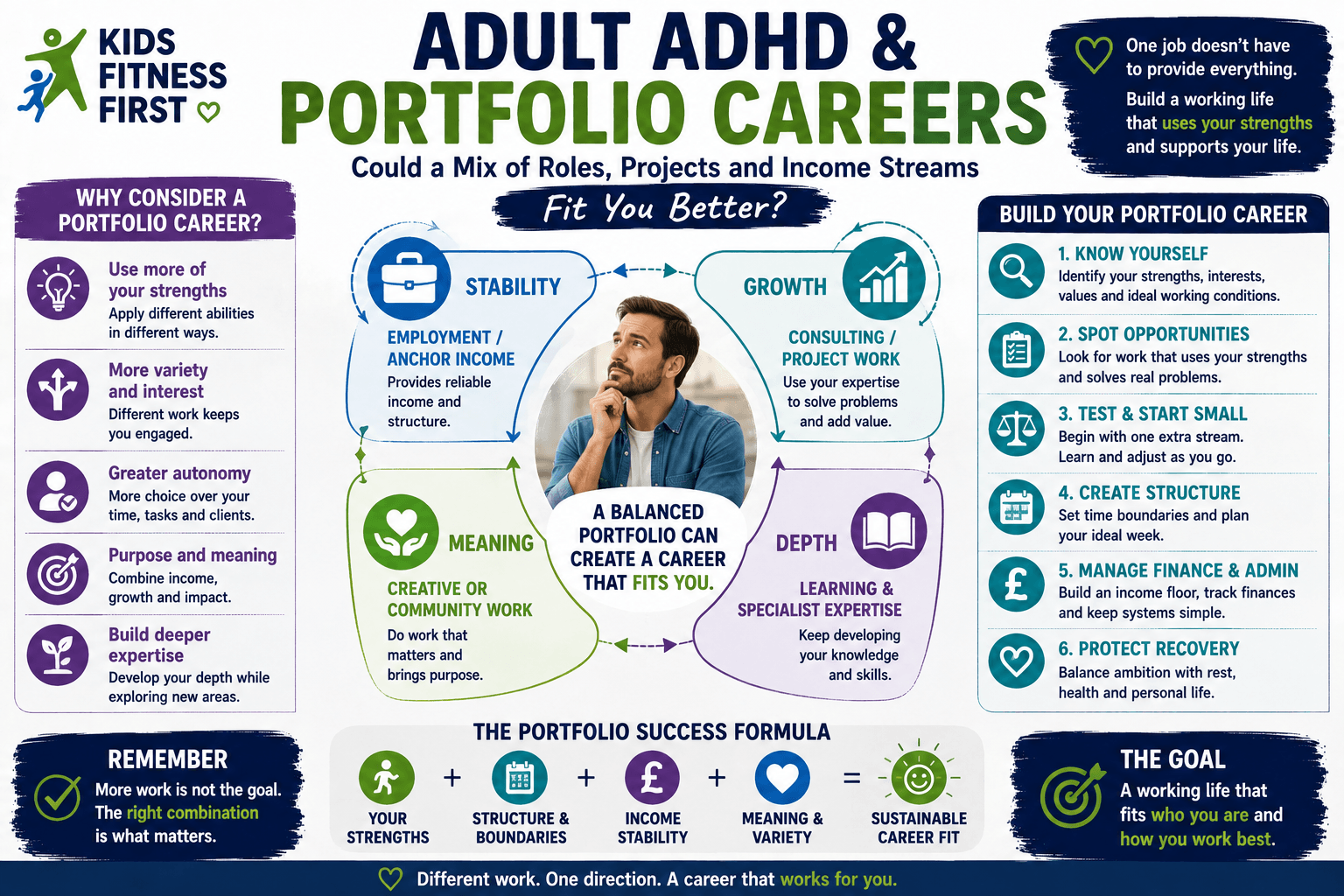
Adult ADHD and portfolio careers can become an interesting question when one traditional job seems unable to provide everything you need.
For example, perhaps you want variety, autonomy, interesting problems, different people and space for deeper work.
However, one conventional role may provide only some of those things.
Therefore, you may begin wondering:
“Do I actually need one job to provide my whole working identity?”
For some people, the answer may be yes.
On the other hand, others may benefit from combining several types of work.
For example, that combination might include part-time employment, freelance work, consulting, teaching, creative projects or specialist project work.
Therefore, a portfolio career is not automatically better.
Instead, it is simply another possible way of organising your working life.
What Is a Portfolio Career?
A portfolio career involves combining more than one kind of work.
For example, somebody may work three days in employment, one day consulting and one day developing a personal project.
Alternatively, another person may combine freelance contracts, teaching, advisory work and creative projects.
As a result, several activities contribute to income, professional identity and career development.
However, greater variety can also create greater complexity.
Therefore, the quality of the structure matters just as much as the number of activities.
Adult ADHD and Portfolio Careers: Variety Can Be Attractive
Some people enjoy moving between different forms of work.
For example, Monday may involve client work.
Then, Tuesday may involve research.
Meanwhile, Wednesday may involve teaching.
As a result, the working week contains natural variety.
Therefore, a portfolio career may feel more engaging for somebody who performs well across several different challenges.
However, variety alone is not enough.
Instead, the real question is whether that variety remains organised, financially realistic and sustainable.
Variety Is Not the Same as Chaos
A varied career may involve different projects, clients and working environments.
However, chaos may involve unclear deadlines, competing commitments, constant switching and no recovery time.
Therefore, a good portfolio career needs structure around the variety.
Otherwise, freedom can quickly become overload.
In addition, poor financial visibility can make an exciting portfolio feel stressful.
Therefore, variety should be designed rather than simply accumulated.
Adult ADHD and Portfolio Careers: Why One Job May Feel Too Narrow
Perhaps your strongest abilities include strategic thinking, communication, problem-solving and creative work.
However, your current role may only use one or two of them.
As a result, some of your abilities may remain underused.
Therefore, a portfolio career may create more space for several strengths.
For example, consulting may use strategic thinking.
Meanwhile, training may use communication.
Likewise, project work may use problem-solving.
Consequently, the combination may feel more complete than one narrow role.
Use Your Strength Portfolio
Article 13 introduced your Strength Portfolio.
First, ask which strengths you currently use.
Then, identify which strengths are underused.
Afterwards, ask which of those strengths could create value somewhere else.
Therefore, do not begin with:
“What extra job could I do?”
Instead, begin with:
“Which part of my capability is currently unused?”
As a result, the portfolio begins with strengths rather than random opportunities.
Adult ADHD and Portfolio Careers: Use Your Depth Portfolio
Article 14 introduced your Depth Portfolio.
Perhaps you have developed deep expertise in one area.
However, you may enjoy applying that expertise in several different ways.
For example, you might use the same expertise through consulting, training, writing, advisory work or project delivery.
Therefore, one Depth Domain can potentially create several different forms of value.
As a result, you keep the expertise while changing the type of activity.
One Expertise, Several Outputs
Imagine your Depth Domain is construction.
For example, your portfolio might include project consultancy, technical training, content creation and supplier advisory work.
The subject stays consistent.
However, the type of work changes.
As a result, you can maintain depth while still gaining variety.
Therefore, variety does not always require repeatedly starting from zero.
Adult ADHD and Portfolio Careers: Follow the Problem Thread
Article 19 introduced the Problem Thread.
Perhaps you repeatedly enjoy solving difficult operational problems across several roles.
Therefore, your portfolio career may not need to be built around one single industry.
Instead, it could be built around one type of problem.
For example, that problem might involve business improvement, process design, technical explanation or problem-solving.
As a result, career continuity can exist beneath surface-level variety.
Portfolio Careers Can Increase Autonomy
Article 18 explored autonomy.
A portfolio career may provide more control over clients, projects, working hours, location and task types.
Therefore, this structure may suit people who perform better when they have more control.
However, autonomy also creates responsibility.
For example, you may need to manage income, contracts, marketing, deadlines and administration.
Therefore, increased freedom should always be weighed against the operational demands it creates.
Adult ADHD and Portfolio Careers: Freedom Creates Administration
A common mistake is imagining only the interesting parts.
For example, you may picture creative projects, client conversations and specialist work.
However, a portfolio career may also involve invoicing, accounting, scheduling, contracts, marketing and follow-up.
Therefore, ask:
“Am I prepared to manage the business side too?”
In addition, consider whether some of that administration can be simplified or delegated.
As a result, you can judge the whole portfolio rather than only its most attractive parts.
The Admin Reality Test
List every activity needed to support the portfolio.
For example, include client delivery, business development, invoicing, planning, accounting, email and learning.
Then, ask which activities you enjoy.
Next, identify which activities could be systemised.
Finally, decide which ones might eventually be delegated.
Therefore, the portfolio is designed around the entire workload rather than only the enjoyable elements.
Adult ADHD and Portfolio Careers: Income Stability Matters
One traditional job may provide a predictable salary, benefits and regular hours.
By contrast, portfolio income may fluctuate.
For example, one month may be strong.
Meanwhile, another month may be quieter.
Therefore, income stability deserves serious consideration.
Instead of assuming flexibility automatically outweighs uncertainty, ask how much predictable income you personally need.
The Income Floor
A useful question is:
“What is the minimum reliable monthly income I need?”
Then, ask what part of the portfolio could provide that floor.
For example, part-time employment may cover essential costs.
Meanwhile, freelance or project work may provide additional upside.
Therefore, one possible model is:
STABILITY + FLEXIBILITY
rather than:
TOTAL UNCERTAINTY
Adult ADHD and Portfolio Careers: The Anchor Income Model
An Anchor Income is the predictable part of the portfolio.
For example, it could come from three days of employment, one retained client or one regular teaching contract.
Then, additional work can provide variety, growth, extra income and experimentation.
Therefore, the anchor can reduce financial pressure while preserving flexibility.
As a result, the overall portfolio may feel more sustainable.
Do Not Build Five Jobs at Once
Portfolio careers can become overloaded quickly.
For example, consulting, writing, teaching, coaching and e-commerce may all sound interesting.
However, each stream may require separate systems, marketing and administration.
Therefore, begin smaller.
First, establish one core role.
Then, add one secondary stream.
Afterwards, review the result before adding anything else.
As a result, you learn before complexity grows.
Adult ADHD and Portfolio Careers: The Two-Stream Test
Start with:
STREAM 1
Reliable core work.
STREAM 2
One additional project or income source.
Then, after three months, ask:
Does it add energy?
Does it create useful income?
Does it use an underused strength?
Does it increase stress?
Therefore, the second stream becomes an experiment rather than a permanent commitment.
Portfolio Careers Can Reduce Boredom
If your work becomes difficult once novelty disappears, changing projects may help maintain engagement.
However, constantly chasing novelty can prevent depth.
Therefore, the goal should not be:
“Always do something new.”
Instead, aim to:
“Create enough variation while allowing expertise to compound.”
As a result, the portfolio can provide stimulation without sacrificing long-term development.
Adult ADHD and Portfolio Careers: Breadth and Depth Together
A good portfolio may contain one deep area of expertise and several ways of applying it.
For example, your Depth Domain might be education.
Meanwhile, the applications could include training, consulting, writing and programme design.
Therefore, breadth and depth can coexist.
As a result, the portfolio can feel varied without becoming shallow.
Use the T-Shaped Career Model
Article 14 introduced the T-shaped career.
The horizontal line represents breadth.
Meanwhile, the vertical line represents depth.
A portfolio career can expand the horizontal line while preserving the vertical one.
Therefore, you can explore variety without repeatedly abandoning accumulated expertise.
Adult ADHD and Portfolio Careers: Energy Matters
Different forms of work can have different energy costs.
For example, client meetings may be socially demanding.
Meanwhile, writing may be mentally demanding.
Likewise, administration may feel repetitive.
Therefore, do not build a portfolio containing only high-energy activities.
Instead, balance the week.
As a result, the portfolio may become easier to sustain.
Create an Energy-Balanced Portfolio
Score each activity by energy cost.
| Activity | Energy Cost |
|---|---|
| Client meetings | High |
| Writing | Medium |
| Administration | Low/Medium |
| Training | High |
| Research | Medium |
Then, ask:
“Have I scheduled too many high-cost activities together?”
Therefore, portfolio design should consider energy as well as time.
Adult ADHD and Portfolio Careers: Recovery Still Matters
Article 22 explored burnout recovery.
A portfolio career can become dangerous if every free hour becomes another project.
For example, you may work in employment during the day, freelance at night and develop business opportunities at weekends.
However, that is not necessarily freedom.
Instead, it may simply be overwork organised differently.
Therefore, protect recovery time deliberately.
The Anti-Overload Rule
A useful rule is:
EVERY NEW STREAM REQUIRES A CAPACITY CHECK
Before adding something, ask:
What will I reduce?
Where will this fit?
What recovery remains?
Therefore, addition should not happen automatically.
Instead, each new commitment should fit within genuine capacity.
Adult ADHD and Portfolio Careers: Use Boundaries
Different roles can easily blur together.
For example, client messages may arrive during family time.
Meanwhile, freelance work may interrupt employment tasks.
Likewise, weekends may gradually become administration days.
Therefore, create boundaries.
For example:
Monday–Wednesday — employed role.
Thursday — consultancy.
Friday morning — administration.
Friday afternoon — development.
As a result, the portfolio becomes easier to manage.
Create Role Containers
Each role should have defined time, responsibilities and communication channels.
For example:
CONSULTING
Tuesday afternoon.
Email checked at 12:00 and 16:00.
WRITING
Thursday morning.
No client calls.
Therefore, each activity occupies a defined container rather than spreading across the entire week.
Adult ADHD and Portfolio Careers: Task Switching Can Become Expensive
Several roles naturally create switching.
For example, you may move between consulting, teaching, writing and business administration.
However, constant switching can increase cognitive load.
Therefore, group similar work.
For example, schedule all client calls on one day.
Likewise, schedule all administration in one block.
As a result, the week contains variety without constant fragmentation.
Theme Your Days
A simple model might be:
MONDAY — CLIENT WORK
TUESDAY — DELIVERY
WEDNESDAY — EMPLOYMENT
THURSDAY — CREATIVE / DEVELOPMENT
FRIDAY — ADMIN / REVIEW
Therefore, each day has a primary identity.
As a result, decision fatigue may reduce.
Adult ADHD and Portfolio Careers: Self-Employment Is Not Required
A portfolio career does not automatically mean starting a business.
For example, you could combine two part-time roles.
Alternatively, you could combine employment with teaching, volunteering or creative work.
Therefore, portfolio thinking is broader than entrepreneurship.
Portfolio Careers Can Be Transitional
Perhaps you do not want a permanent portfolio.
Instead, it may become a bridge.
For example, you might work three days in employment and spend two days developing a new field.
Then, over time, the balance may change.
Therefore, a portfolio career can support gradual transition rather than one dramatic career leap.
Adult ADHD and Portfolio Careers: The Bridge Model
STAGE 1
Full-time job + small side project.
STAGE 2
Reduced employment + larger side project.
STAGE 3
Two balanced income streams.
STAGE 4
Choose whether to specialise or continue portfolio working.
Therefore, change can happen gradually.
As a result, risk may be easier to manage.
Use Experiments, Not Fantasy
Before leaving a stable role, test the new activity.
For example, try one freelance project, one workshop or one consulting assignment.
Then, ask:
Did I enjoy the actual work?
Was I good at it?
Did the administration feel manageable?
Was there real demand?
Therefore, test reality before building major plans around an imagined version of the work.
Adult ADHD and Portfolio Careers: Market Demand Matters
A portfolio should not be based only on what you enjoy.
Instead, it also needs to create value.
Ask:
Who would pay for this?
What problem does it solve?
Why would someone choose me?
Therefore, connect strengths to real demand.
As a result, your portfolio becomes commercially realistic as well as personally interesting.
The Portfolio Value Test
For each possible stream, ask:
AM I GOOD AT IT?
Yes / No
DO I ENJOY IT?
Yes / No
DOES SOMEONE VALUE IT?
Yes / No
IS THERE REAL DEMAND?
Yes / No
CAN I DELIVER IT SUSTAINABLY?
Yes / No
Therefore, avoid building income streams simply because they sound interesting.
Adult ADHD and Portfolio Careers: Avoid the Hobby-to-Business Trap
You may love an activity.
However, turning it into paid work changes the experience.
For example, a hobby may suddenly include deadlines, customers, pricing and administration.
Therefore, before monetising something meaningful, ask:
“Do I want this to remain enjoyable, or do I genuinely want to professionalise it?”
That distinction matters.
One Stream Can Be Non-Financial
Not every part of your portfolio needs to earn money.
For example, employment may provide income.
Meanwhile, volunteering may provide meaning.
Likewise, creative work may provide expression and learning may provide growth.
Therefore, consider a life portfolio, not only an income portfolio.
Adult ADHD and Portfolio Careers: Meaning Can Be Distributed
One job may not need to provide income, purpose, creativity, community, growth and autonomy all at once.
Instead, those needs can be distributed across several activities.
As a result, one role does not carry the pressure of providing everything.
Therefore, portfolio thinking can also become a way of designing a broader working life.
The Four-Part Portfolio
Consider four categories.
INCOME
What pays reliably?
GROWTH
What develops expertise?
MEANING
What feels worthwhile?
VARIETY
What provides stimulation?
Therefore, a balanced portfolio may contain different roles serving different purposes.
Adult ADHD and Portfolio Careers: Avoid Identity Fragmentation
Having several roles can create a new question:
“What do I actually do?”
Therefore, look for an underlying professional thread.
For example:
“I help organisations solve operational problems through consulting, training and project work.”
As a result, several activities become connected by one professional identity.
Build Your Portfolio Career Statement
Use this template:
“I use __________ across __________ to help __________ achieve __________.”
For example:
“I use strategic thinking and communication across consulting, training and project work to help organisations improve complex systems.”
Therefore, the career can have one underlying identity even though the activities vary.
Adult ADHD and Portfolio Careers: Your Portfolio Map
| Work Stream | Purpose | Income | Energy |
|---|---|---|---|
| Employment | Stability | High | Medium |
| Consulting | Growth | Medium | High |
| Writing | Meaning | Low | Medium |
| Training | Variety | Medium | High |
Then, ask:
What is missing?
What is overloaded?
What could be simplified?
Therefore, the whole working life becomes visible.
The Portfolio Risk Test
Score each risk from 1–5.
| Risk | Score |
|---|---|
| Income instability | /5 |
| Admin burden | /5 |
| Too much switching | /5 |
| Lack of recovery | /5 |
| Client dependency | /5 |
| Unclear priorities | /5 |
| Too many systems | /5 |
Then, identify the three highest risks.
Therefore, portfolio planning includes risk as well as opportunity.
Adult ADHD and Portfolio Careers: Your 30-Day Experiment
Before making a major change, test one portfolio element for thirty days.
For example, try one consulting project, one weekly teaching session or one small paid service.
During the experiment, track enjoyment, income potential, energy cost, administration and demand.
Finally, ask:
“Do I want more of this?”
Therefore, the decision becomes evidence-based rather than theoretical.
Green, Amber and Red Portfolio Streams
GREEN — GOOD FIT
The stream uses strengths and creates value.
In addition, the energy cost is manageable.
Therefore, consider developing it.
AMBER — INTERESTING BUT UNCLEAR
Potential exists.
However, demand, income or sustainability remains uncertain.
Therefore, continue testing.
RED — HIGH FRICTION
The stream consumes substantial energy and creates little value.
Moreover, it may add unnecessary administrative complexity.
Therefore, reconsider whether it belongs in the portfolio.
Adult ADHD and Portfolio Careers: Keep the Portfolio Simple
A mature portfolio career does not need ten components.
In fact, two or three well-designed streams may be enough.
Therefore, prioritise quality over quantity.
The goal is not to prove you can do everything.
Instead, it is to create a working life that combines the right things.
What Would a Good Week Look Like?
Design the week before designing the career.
For example, ask:
How many meetings?
How much deep work?
How much social interaction?
How much administration?
How much recovery?
Therefore, begin with the lived experience.
After all, a portfolio that looks impressive on paper but creates an exhausting week is not automatically a good fit.
Adult ADHD and Portfolio Careers: The Ideal Week Exercise
Write:
MONDAY
TUESDAY
WEDNESDAY
THURSDAY
FRIDAY
Then, ask:
Does this week contain enough variety?
Does it contain enough depth?
Does it provide enough income?
Does it protect enough recovery?
Therefore, career design becomes tangible.
Connect Article 24 to the Work That Fits Framework
By Article 24, almost every tool in Book Four can inform your portfolio career.
Cognitive Signature
Which abilities should appear repeatedly?
Peak Performance Formula
Which conditions should each stream support?
Collapse Conditions
Which conditions must the portfolio avoid?
Strength Portfolio
Which strengths can different streams use?
Depth Portfolio
Which expertise should continue compounding?
Automation Boundary
Which routine tasks can technology support?
Work Environment Profile
Where should each activity happen?
Autonomy Profile
How much control do you want?
Career Evidence File
Which patterns from your history support the idea?
Burnout Prevention Plan
How will you prevent the portfolio becoming overwork?
Interview Framework
If employment remains part of the portfolio, does the role fit the wider design?
Portfolio Map
How do all the pieces work together?
Therefore, portfolio career design becomes much more deliberate than simply collecting several jobs.
Reflection Questions
- Does one job currently use enough of your strongest abilities?
- Which strengths are underused?
- Would more variety improve your working life?
- How much financial stability do you need?
- What could provide Anchor Income?
- Which second work stream would you test first?
- Which administrative tasks would the portfolio create?
- How would you protect recovery?
- Which activities could share one Depth Domain?
- What type of task switching would you need to manage?
- What would your ideal working week look like?
- Would a portfolio career genuinely improve fit, or simply give you more work?
Conclusion: More Work Is Not the Goal — Better Combination Is
Adult ADHD and portfolio careers is not an argument that everybody should have several jobs.
For some people, one well-designed role may be ideal.
However, others may discover that a combination of roles provides a better balance of stability, variety, meaning, autonomy and depth.
Therefore, do not begin by asking:
“How many income streams can I create?”
Instead, ask:
“What combination of work would allow me to use my strengths without creating an unsustainable life?”
First, identify your strongest abilities.
Then, identify the work that uses them.
Afterwards, protect financial stability.
Meanwhile, account for administration and energy.
Finally, design the week you actually want to live.
As a result, a good portfolio career should not feel like several jobs fighting for your attention.
Instead, it should feel like several carefully chosen pieces supporting one coherent working life.
Most importantly:
THE GOAL IS NOT TO DO MORE THINGS.
THE GOAL IS TO COMBINE THE RIGHT THINGS.
Therefore, work that fits may not always arrive in the form of one perfect job.
Sometimes, instead, it may come from designing the right portfolio.
SUGGESTED INTERNAL LINKS
- Adult ADHD and Workplace Accommodations: Practical Changes That May Help You Work More Effectively
- Adult ADHD and Job Interviews: How to Present Your Strengths Without Pretending to Be Someone Else
DISCLAIMER
This article is provided for general educational and informational purposes only. It does not provide financial, tax, legal, employment, business, medical, psychological or career advice.
Portfolio careers may involve financial uncertainty, administrative responsibilities, tax obligations, contractual issues and changing employment arrangements.
Therefore, major career or business changes should be considered carefully in light of individual financial circumstances, contractual obligations, applicable law and professional advice where appropriate.
Likewise, ADHD experiences vary considerably between individuals. Therefore, a portfolio career should not be assumed to suit every adult with ADHD.