
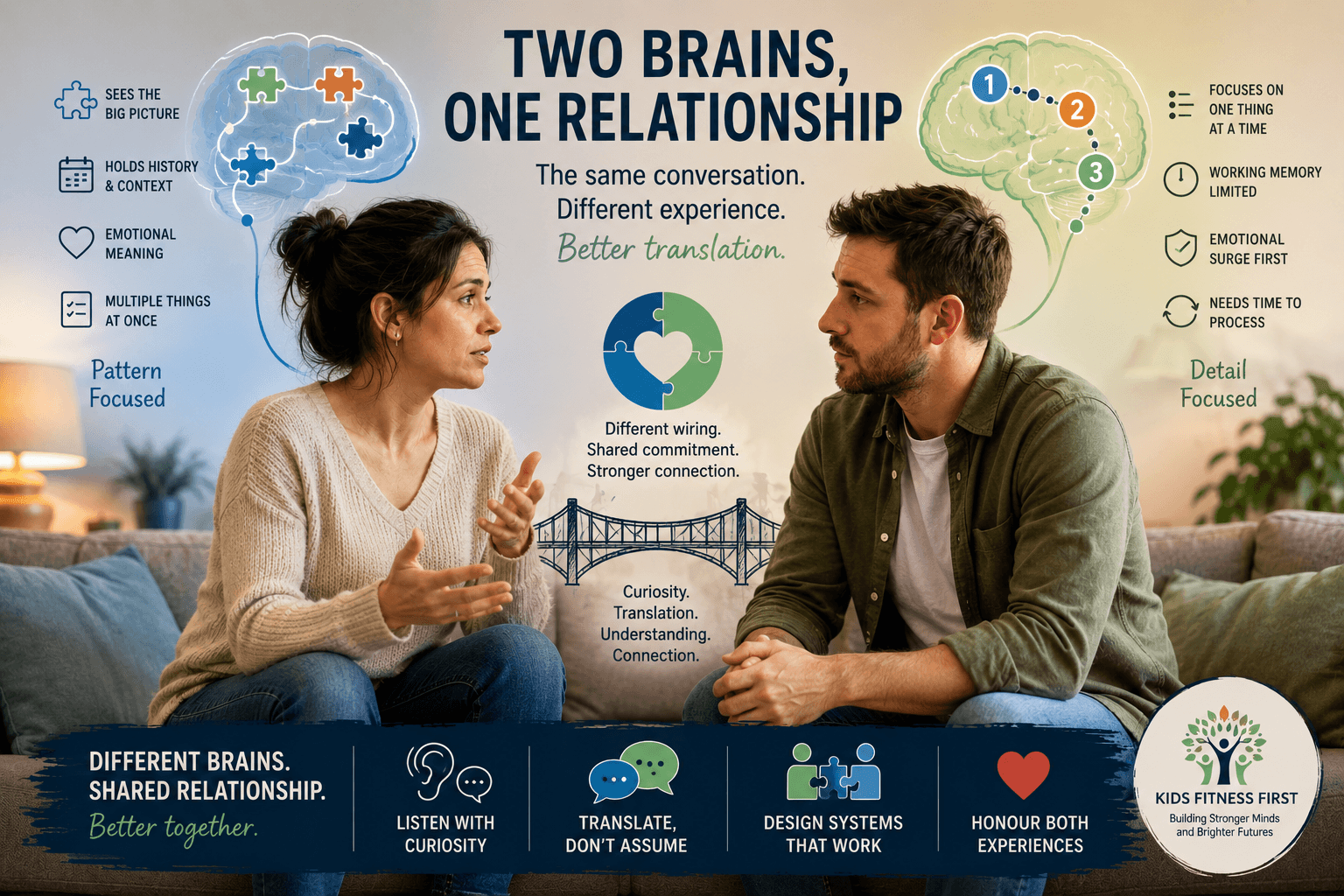
Neurodivergent Relationship Communication: Two Brains, One Relationship
Neurodivergent relationship communication can become difficult for a surprisingly simple reason: two people can hear the same words while their brains experience completely different events.
One person may be trying to explain a pattern.
Meanwhile, the other may be trying desperately to process one detail at a time.
One partner may believe they are calmly describing several examples.
However, the other may experience those examples as information arriving too quickly, all at once.
As a result, the conversation can move from useful discussion to defensiveness before either person understands what happened.
This does not automatically mean that somebody is uncaring.
It does not automatically mean that somebody is unreasonable.
Instead, sometimes two differently wired nervous systems are trying to process the same moment using different equipment.
Understanding that difference can change everything.
Why Neurodivergent Relationship Communication Can Feel So Different
Imagine that your partner says:
“You forgot the dentist appointment, you still haven’t called the electrician, and you never replied to the school message.”
For one brain, those three examples may form one clear pattern.
The speaker is not necessarily trying to produce a list of accusations. Instead, they may be saying:
“I need you to see the bigger pattern that I have been carrying.”
However, the listener may experience something entirely different.
First comes the dentist.
Then comes the electrician.
Before that thought is processed, the school message arrives.
Consequently, the brain is no longer dealing with one conversation. It is trying to hold several pieces of information at the same time while also processing emotion.
That difference is central to neurodivergent relationship communication.
The problem is not simply what was said.
The problem may also be how much arrived, how quickly it arrived and how each nervous system processed it.
1. Working Memory Can Change the Conversation
Working memory is the mental space we use to temporarily hold information while doing something with it.
For example, imagine trying to remember three instructions while someone continues talking to you.
Some people can hold those instructions together quite comfortably.
Others may lose the first item as the third one arrives.
In ADHD, working-memory difficulties can make this particularly noticeable.
Therefore, a partner who lists five related problems may believe they are giving useful context.
Meanwhile, the ADHD partner may experience the same list as a flood.
They may start responding to the first point.
Then the second arrives.
Consequently, the first point disappears.
Afterwards, the third arrives.
Now the person may feel overwhelmed before they have even formed a complete answer.
From outside, this can look like avoidance.
However, inside the conversation, something different may be happening.
The brain may simply be overloaded.
A practical change
Instead of:
“You forgot this, this, this, this and this.”
try:
“There are several things I want us to discuss, but let’s take them one at a time.”
That small sentence can completely change the amount of information the other brain is being asked to process.
2. Emotional Reactions Can Arrive Before Words
Working memory is only one part of the problem.
Emotion also matters.
For some neurodivergent people, particularly some people with ADHD, emotional responses can arrive very quickly.
A comment may therefore produce a physical reaction before the person has consciously decided what the comment means.
Their chest tightens.
Their face changes.
Their body becomes defensive.
Their thoughts accelerate.
Meanwhile, their partner notices that change immediately.
The partner then thinks:
“Here we go again. I can’t even raise something calmly without you becoming defensive.”
Consequently, the first person now feels criticised for a defensive response that they barely had time to understand themselves.
The conversation escalates.
Importantly, understanding this process does not mean that harmful behaviour should simply be accepted.
Instead, understanding creates an earlier intervention point.
If someone learns to recognise their own emotional surge, they can say:
“I can feel myself reacting very strongly. Give me a moment so I can actually hear what you’re saying.”
That is very different from walking away without explanation.
Likewise, it is different from immediately arguing back.
3. Two People May Be Living on Different Time-Frames
Another major issue in neurodivergent relationship communication is how each person experiences the past.
Suppose an argument happened three weeks ago.
One partner may feel:
“We discussed that. I apologised. We moved on.”
However, the other person may still see the incident as part of an unresolved pattern.
Therefore, when something similar happens again, they mention the earlier event.
The first partner may respond:
“Why are you bringing that up again?”
Meanwhile, the other thinks:
“Because it keeps happening.”
Neither person necessarily intends to invalidate the other.
They may simply be using different time-frames.
One brain experiences the old incident as a closed event.
The other experiences it as evidence in a continuing pattern.
Consequently, the argument becomes about whether the past is relevant instead of about the problem that both people are actually trying to solve.
Try changing the language
Instead of:
“You always bring up old things.”
try:
“I think this feels finished to me but still connected for you. Can you explain what pattern you are seeing?”
Likewise, instead of:
“You never understand the pattern.”
try:
“I am mentioning the earlier example because, to me, it connects directly to what happened today.”
Now both people know why the past entered the room.
4. One Brain May Process One Channel While Another Processes Several
Some people communicate while simultaneously processing:
- the words being spoken;
- facial expression;
- tone of voice;
- earlier context;
- body language;
- what was not said;
- and the likely emotional meaning underneath everything.
Other people may process communication more effectively one channel at a time.
For example, an autistic person may focus strongly on the literal wording of what was said.
Their partner, however, may expect them to recognise what the tone, silence or facial expression implied.
As a result, one person says:
“I told you I was upset.”
The other genuinely believes:
“You didn’t actually say that.”
Both may be describing their own experience accurately.
This is why assumptions can be particularly dangerous in neurodivergent couples.
One person believes the message was obvious.
The other never received the hidden part of the message.
Therefore, direct communication is often kinder than expecting someone to decode the emotional subtext.
Instead of:
“You should know what’s wrong.”
try:
“I am upset because I felt left out when the decision was made without me.”
Clarity is not less romantic.
In fact, clarity can be an act of care.
5. Different Brains Can Have Different Recovery Clocks
Arguments do not end when the talking stops.
This is another place where couples frequently misunderstand each other.
One person may recover quickly.
After thirty minutes, they are ready to talk normally.
Meanwhile, the other person’s nervous system may still be activated several hours later.
Sometimes the effect can continue into the following day.
Consequently, the faster-recovering partner may believe:
“We sorted this out. Why are you still being distant?”
The slower-recovering partner may think:
“How can you act as though nothing happened?”
Again, both experiences can be real.
The problem is that neither person knows the other’s recovery clock.
Make recovery visible
After a difficult conversation, try saying:
“I need some time to settle. I am not withdrawing from you. I would like to come back to this at nine tomorrow morning.”
That sentence provides two important things.
First, it creates space.
Secondly, it provides reassurance that the relationship has not disappeared during the space.
6. End-of-Day Depletion Can Make Everything Harder
Timing matters enormously.
Consider what happens after a long day.
One partner may have spent hours masking, concentrating, managing sensory demands, reading difficult material, switching tasks or regulating attention.
By the time they arrive home, very little capacity remains.
Unfortunately, home is often exactly where the most important conversations happen.
Therefore, a partner who has been waiting all day may begin an important discussion at precisely the moment the other person’s nervous system has the least ability to handle it.
Neither person is wrong.
One needs the conversation.
The other does not currently have the capacity for it.
The better question becomes:
Is this the right conversation at the wrong time?
Sometimes thirty minutes of quiet changes everything.
A useful sentence might be:
“I want to talk about this properly, but I have nothing left right now. Can I have half an hour to reset and then give you my full attention?”
However, that only works if the conversation actually happens afterwards.
Otherwise, recovery time becomes avoidance.
ADHD Relationship Communication Is Not About Lowering Expectations
This distinction is crucial.
Understanding an ADHD brain does not mean saying:
“They have ADHD, so nothing can change.”
Likewise, understanding autism or dyslexia does not mean accepting every difficult outcome indefinitely.
Neurodiversity explains differences.
However, relationships still require responsibility.
Therefore, understanding should lead to better systems.
For example:
If working memory is difficult, create external reminders.
If verbal instructions disappear, write important information down.
If several problems at once create overload, discuss one at a time.
If spontaneous changes create stress, give advance notice wherever possible.
If emotional processing requires more time, build a return time into difficult conversations.
The goal is not to demand that one brain become another brain.
Instead, the goal is to design communication that works for both.
When Both Partners Are Neurodivergent
Not every neurodivergent relationship includes one neurodivergent person and one neurotypical person.
Sometimes both partners are neurodivergent.
Moreover, they may be neurodivergent in very different ways.
For example, one partner may be autistic and need predictability.
The other may have ADHD and thrive on novelty.
One wants the weekend planned on Tuesday.
The other does not know what they want to do until Saturday morning.
Neither preference is automatically wrong.
However, the combination can create repeated friction.
Likewise, one partner may need quiet after social contact.
Meanwhile, the other may regulate through talking.
Therefore, the solution cannot simply be:
“Understand neurodivergence.”
Both people are already neurodivergent.
Instead, the couple must understand their specific combination of nervous systems.
That is much more useful.
The Five-Mechanism Conversation Check
The next time a difficult conversation begins, stop and ask which mechanism may be active.
| Mechanism | What It Can Feel Like | Useful Response |
|---|---|---|
| Working-memory overload | “Too much is coming at me.” | Take one issue at a time. |
| Emotional surge | “I feel attacked before I know why.” | Pause before responding. |
| Time-frame mismatch | “Why are we discussing old things?” | Explain how past and present connect. |
| Channel mismatch | “I thought it was obvious.” | Say the meaning directly. |
| Recovery-clock difference | “Why aren’t you over this yet?” | Agree when to reconnect. |
This table is not a diagnostic tool.
Instead, it is a translation tool.
It helps replace:
“What is wrong with you?”
with:
“What is happening between our two nervous systems right now?”
That is a much more useful question.
Try This: The Two-Brain Translation Exercise
Think about one recent argument.
Then write down what happened in four stages.
Stage One: What was actually said?
Keep this factual.
Avoid interpretation.
For example:
“I mentioned three jobs that had not been completed.”
Stage Two: What did I mean?
Perhaps:
“I was trying to explain that I feel responsible for remembering everything.”
Stage Three: What might my partner have heard?
Perhaps:
“You fail at everything.”
Stage Four: What could I say differently next time?
For example:
“I am not trying to list your failures. I am trying to explain that I feel overloaded. Can we discuss one responsibility first?”
Then reverse the exercise.
Ask what your partner might have intended, what you heard and where the translation failed.
The purpose is not to decide whose interpretation was correct.
Instead, the purpose is to identify the gap.
Replace Assumption With Translation
Many relationship conflicts rely on assumed meanings.
“You forgot, therefore you don’t care.”
“You mentioned it again, therefore you are attacking me.”
“You need space, therefore you are rejecting me.”
“You need reassurance, therefore you are demanding.”
“You want plans, therefore you are controlling.”
“You want flexibility, therefore you are inconsiderate.”
However, those interpretations may not be accurate.
Therefore, before reacting to the assumed meaning, translate it.
Ask:
“What does this behaviour mean inside your brain?”
Then ask:
“What does the same behaviour mean when I experience it?”
Those answers may be very different.
That difference is where communication begins.
Five Better Phrases for Neurodivergent Couples
Try replacing familiar conflict language with language that gives both brains more room.
Instead of:
“You never listen.”
Try:
“I don’t think what I meant has landed yet. Can I say it differently?”
Instead of:
“You’re attacking me.”
Try:
“I can feel myself becoming defensive. Can we slow this down?”
Instead of:
“Why are you bringing that up again?”
Try:
“Can you explain how that earlier event connects to this one for you?”
Instead of:
“You should know how I feel.”
Try:
“I need to say clearly what I am feeling rather than expecting you to guess.”
Instead of:
“Why are you still upset?”
Try:
“Are you still processing what happened? When would feel right to reconnect?”
None of these sentences guarantees agreement.
However, each one reduces the chance that neurological difference will automatically be interpreted as bad character.
The Goal Is Fluency, Not Perfect Communication
No couple communicates perfectly.
Neurodivergent couples should not be expected to do so either.
The goal is not to remove every misunderstanding.
Instead, the goal is to recognise misunderstandings earlier.
Over time, couples can develop their own vocabulary.
They may say:
“Too many things at once.”
“I’m in the emotional surge.”
“We are on different time-frames.”
“I need you to say that directly.”
“My recovery clock is slower today.”
“I have no capacity left tonight.”
Those phrases may sound simple.
Nevertheless, they can prevent an enormous amount of unnecessary interpretation.
Most importantly, both partners stop treating every difference as evidence about love.
Instead, they begin treating differences as information.
Conclusion: The Fight May Not Be Between You
A difficult relationship conversation can feel deeply personal.
However, sometimes the most painful part is not what either person intends.
It is the collision between two different ways of processing information, emotion, time and attention.
One brain sees the pattern.
Another sees the individual details.
One recovers quickly.
Another needs time.
One expects emotional subtext to be understood.
Another needs the meaning stated clearly.
Therefore, better neurodivergent relationship communication begins when both people stop assuming that their own nervous system represents the only normal way to experience the moment.
Instead, ask:
What is my brain doing right now?
Then ask:
What might your brain be doing differently?
Finally, ask:
How do we build a bridge between the two?
Because the aim is not for one person to win the translation.
The aim is for both people to understand what crossed the gap.
Two brains do not need to work the same way to build one relationship. They need a shared language for the ways they differ.
SUGGESTED INTERNAL LINKS
Link back to Book Five Article 1:
Neurodivergent Relationships: Why the Same Conversation Keeps Failing
Suggested anchor text:
- Neurodivergent Relationships: Why the Same Conversation Keeps Failing
- Adult ADHD and Meaningful Work: Building a Career That Fits Your Strengths, Values and Life
DISCLAIMER
This article is provided for general educational and informational purposes only. It is not medical, psychological, therapeutic or relationship advice and should not replace assessment or support from a suitably qualified professional.
Neurodivergent people are individuals. ADHD, autism, dyslexia and other forms of neurodivergence can affect communication differently, and the patterns discussed here should not be assumed to apply to every person or every relationship.
Relationship difficulties involving abuse, intimidation, coercive control, threats or safety concerns should not be explained simply as neurodivergent communication differences.