
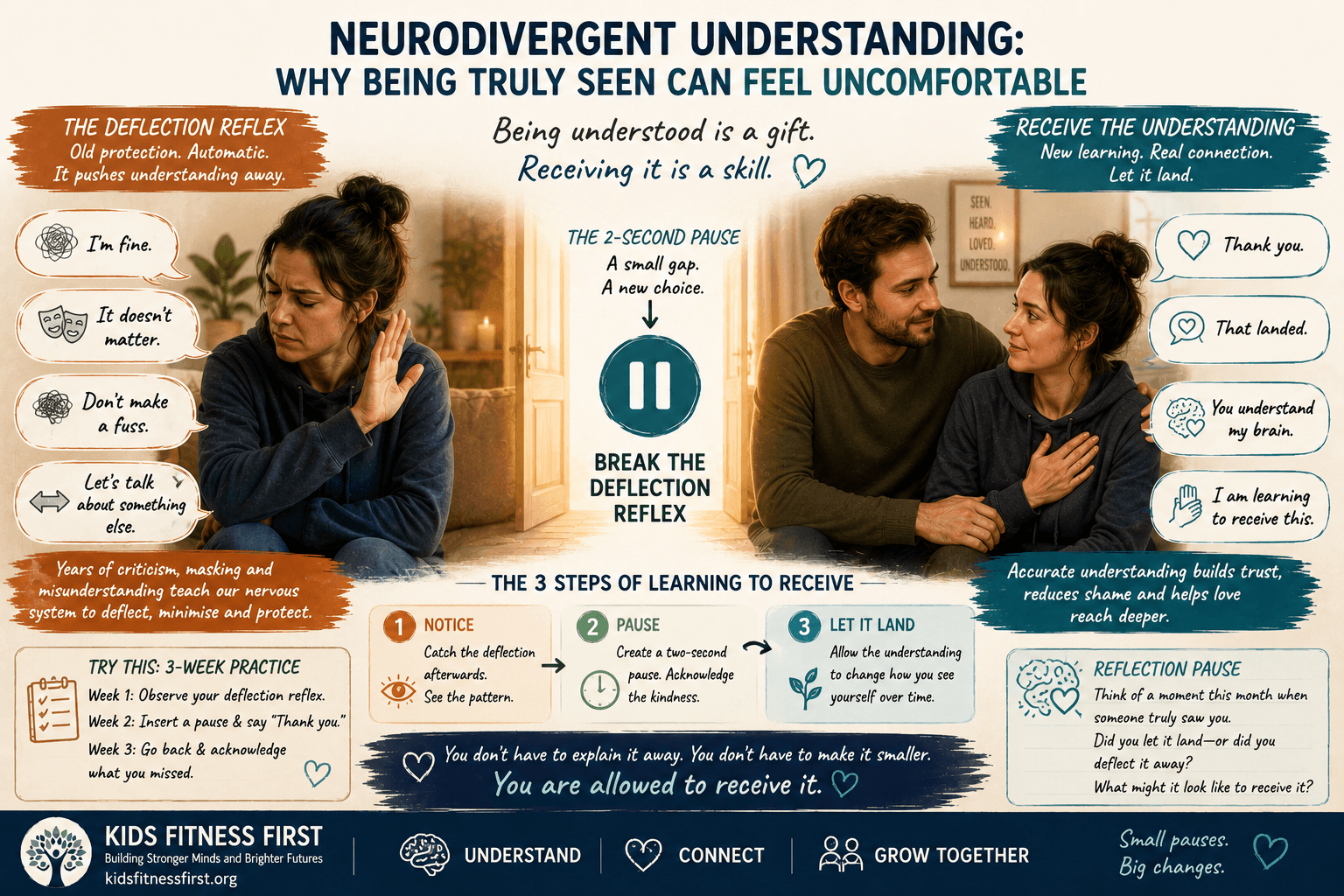
Neurodivergent Understanding: Why Being Truly Seen Can Feel Uncomfortable
Neurodivergent understanding sounds like something everybody would want.
After all, if you have spent years being misunderstood, criticised or repeatedly told that your natural reactions were somehow wrong, surely being accurately seen should feel like relief.
Sometimes it does.
However, sometimes something stranger happens.
Your partner understands you correctly.
They notice that you are overloaded.
They recognise that you need a moment.
Likewise, they understand that a forgotten detail may be a working-memory problem rather than a sign that you do not care.
Then, instead of feeling relieved, you become uncomfortable.
Perhaps you laugh it off.
Alternatively, you change the subject.
Maybe you say:
“I’m fine.”
Or:
“It doesn’t matter.”
Perhaps you even become slightly irritated by the person who has just offered you exactly the understanding you always said you wanted.
Why?
Because being understood is not only about finding someone who understands you.
Sometimes it is also about learning how to receive that understanding.
When Accurate Kindness Feels Unfamiliar
Imagine a familiar situation.
You forget something.
Perhaps you miss a message or go quiet in a social situation.
Immediately, the old response begins.
You prepare to apologise.
You begin explaining.
You expect the disappointed look.
However, your partner says:
“Was that a working-memory moment?”
Or:
“Do you need a minute?”
Perhaps they simply put a hand on your arm and give you a look that says:
“I understand what happened. This is not a crisis.”
For some people, the body relaxes immediately.
However, for others, that moment can feel surprisingly destabilising.
The apology was ready.
The defence was ready.
The explanation was ready.
Yet suddenly none of them is required.
Therefore, the nervous system is left with something it has not practised very often:
being seen without being judged.
That can feel beautiful.
Nevertheless, it can also feel deeply unfamiliar.
What Is the Deflection Reflex?
Book Five names this response the Deflection Reflex.
The Deflection Reflex happens when accurate understanding arrives and the person automatically redirects it before it can land.
For example, the person may:
- change the subject;
- make a joke;
- minimise what they feel;
- insist they are fine;
- dismiss the kindness;
- explain away another person’s bad behaviour;
- or create emotional distance.
Importantly, this is not usually a deliberate rejection of love.
Instead, it may be an old protective habit.
The person has learned that being closely seen can be dangerous.
Therefore, when somebody looks closely now — even kindly — the old system still prepares for the old outcome.
That is why a generous moment can produce a strange reaction.
Where the Deflection Reflex May Begin
Many neurodivergent adults grew up before anybody had useful language for what they were experiencing.
Therefore, when adults looked closely, they often saw behaviour rather than neurology.
For example:
A child with ADHD might be described as careless.
A dyslexic child might be called slow or lazy.
An autistic child might be described as difficult, antisocial or rude.
Consequently, being noticed was not always safe.
Being noticed could mean being corrected.
Being noticed could mean being compared.
Likewise, being noticed could mean being asked why you could not behave more like everyone else.
Over time, the nervous system may learn:
Do not let people look too closely.
Therefore, the child learns to:
- joke;
- mask;
- become quiet;
- change the subject;
- perform competence;
- minimise difficulties;
- or present a safer version of themselves.
At the time, these responses may be intelligent adaptations.
However, years later, the same adaptations can get in the way when somebody finally sees you accurately and kindly.
Masking Can Make Being Seen Feel Risky
Masking can become especially important here.
For years, a neurodivergent person may learn to edit themselves.
For example, they may hide:
- sensory discomfort;
- confusion;
- overwhelm;
- executive-function problems;
- the need for more processing time;
- specialist interests;
- emotional intensity;
- or social uncertainty.
Therefore, relationships can sometimes develop around the version of the person who appears easiest to understand.
However, once diagnosis, self-awareness or trust allows more of the real person to appear, another challenge arrives.
You may finally be visible.
Yet visibility itself feels dangerous.
That is the contradiction.
You want somebody to know you.
Meanwhile, part of you has spent years learning how not to be known too accurately.
Why Late Diagnosis Can Intensify This
Late diagnosis can make the experience particularly complicated.
For decades, you may have carried one explanation for yourself.
Perhaps:
“I am disorganised.”
“I am too sensitive.”
“I am difficult.”
“I am bad at people.”
“I just need to try harder.”
Then a diagnosis changes the story.
Suddenly, there is another interpretation.
However, understanding intellectually is not the same as believing emotionally.
Therefore, when a partner begins speaking to the newer, kinder explanation, an older part of you may still resist.
They say:
“That wasn’t laziness. You were overloaded.”
Yet something inside replies:
“Don’t let yourself off that easily.”
They say:
“I know you care.”
However, your inner voice says:
“If they really knew you, they would not say that.”
Consequently, being understood can feel almost suspicious.
The Difference Between a Compliment and Recognition
An important distinction in this chapter is the difference between ordinary praise and accurate recognition.
A compliment might be:
“You’re brilliant.”
Recognition is more specific.
For example:
“I noticed that when the room became noisy, you stopped being able to follow the conversation.”
Or:
“I know you weren’t ignoring me. You were trying to process too many things at once.”
Likewise:
“I can see you’re starting to get overloaded. You don’t have to explain it.”
Recognition can feel more powerful because it proves that somebody has actually been paying attention.
However, that is also why it can feel more exposing.
A compliment can bounce off the surface.
Accurate recognition reaches deeper.
Therefore, accepting it may require more vulnerability.
Neurodivergent Understanding Is Not Excusing Everything
There is an important boundary here.
Being understood does not mean being excused from responsibility.
For example, a partner may understand why you forgot something.
However, the forgotten responsibility may still need to be completed.
Likewise, somebody can understand emotional dysregulation without accepting hurtful behaviour.
Therefore, genuine neurodivergent understanding holds two truths:
“I understand why this happened.”
and:
“We still need to deal with what happened.”
That balance matters.
Without understanding, behaviour can become character judgement.
However, without responsibility, understanding can become avoidance.
Healthy relationships need both.
Three Stages of Learning to Receive Understanding
Book Five describes receiving understanding as a slow practice rather than a single decision.
The practice develops in three stages.
Stage 1: Notice the Deflection Afterwards
At first, you may not catch the reflex in real time.
Instead, you notice it later.
Perhaps your partner says something kind.
Then you make a joke.
An hour later, you realise:
“They were actually trying to understand me, and I changed the subject.”
That retrospective noticing matters.
In fact, it is the beginning of the process.
Therefore, do not criticise yourself because you noticed too late.
The aim at this stage is simply:
See the pattern.
For example, you might write:
Situation: Partner recognised I was overloaded.
Deflection: I laughed and said I was fine.
What I could have done: Said thank you and paused.
That is enough.
Stage 2: Create the Two-Second Pause
After you begin recognising the reflex afterwards, you may eventually notice it while it is happening.
Your partner says something accurate.
Immediately, you feel the joke forming.
Or the minimising sentence.
Or the urge to change the subject.
However, now there is a tiny gap.
Perhaps only two seconds.
That gap matters.
Instead of automatically deflecting, take one breath.
Then respond simply.
For example:
“Thank you.”
Or:
“That helped.”
Or:
“I am trying to let that land.”
Sometimes a quiet nod is enough.
The goal is not to produce a perfect emotional response.
Instead, the goal is simply to stop the kindness disappearing.
Stage 3: Let the New Message Become Part of You
The third stage takes longer.
Eventually, repeated experiences of being accurately understood may begin changing how you understand yourself.
For example, perhaps your partner repeatedly notices that you become overloaded in certain situations.
At first, you dismiss them.
Then you begin accepting their observation.
Later, you may notice the pattern yourself.
Finally, one day, instead of thinking:
“Why am I useless today?”
you think:
“I have had too much sensory and social input. I need recovery time.”
That shift is significant.
The understanding that once came from outside has gradually become part of your own inner voice.
Therefore, receiving kindness is not simply about making your partner feel appreciated.
Over time, it can help reshape the way you speak to yourself.
From Old Inner Voice to New Inner Voice
Consider the difference.
| Old Internal Message | More Accurate Message |
|---|---|
| “I’m lazy.” | “I am struggling to initiate this task.” |
| “I’m useless socially.” | “I need more time to process social information.” |
| “I’m too sensitive.” | “My nervous system reacts strongly to certain environments.” |
| “I always mess things up.” | “I made a mistake that needs repair.” |
| “I shouldn’t need help.” | “Support can help me function more effectively.” |
The second column is not automatically kinder because it avoids responsibility.
Instead, it is more specific.
Therefore, it gives you something useful to work with.
What Being Understood Can Give a Relationship
When understanding actually lands, several things can change.
Less unnecessary defence
First, you may spend less energy proving that you are not bad.
Therefore, conversations become more practical.
More accurate support
Secondly, your partner can respond to what you genuinely need rather than guessing.
For example, they may offer space rather than demanding an immediate answer.
Greater trust
Meanwhile, you begin to learn that being seen does not automatically lead to punishment.
That changes the emotional atmosphere of the relationship.
Less masking
In addition, you may gradually feel safer being more authentic.
Consequently, the relationship becomes less exhausting.
Better repair
Finally, accurate understanding makes responsibility clearer.
Instead of collapsing into shame, you can say:
“Yes. That is what happened. Now let’s repair it.”
Try This: Practising Receipt for Three Weeks
Book Five includes a three-week practice designed to make the Deflection Reflex visible and gradually replace it.
Week One: Observation
For seven days, record moments when you notice that you deflected kindness or understanding.
Write down:
- what happened;
- what the other person said;
- how you deflected;
- and what you wish you had done instead.
Do not try to change the behaviour yet.
Instead, simply observe it.
Week Two: The Pause
During the second week, try to catch the reflex earlier.
When you notice the deflection forming, pause for two seconds.
Then, if possible, replace it with one simple acknowledgement.
For example:
“Thank you.”
“That landed.”
“That was helpful.”
Or simply nod.
Again, simplicity matters.
Week Three: The Return
During the third week, choose one specific moment when somebody understood you and you did not fully receive it.
Then return to that person.
You might say:
“When you said that the other day, I deflected it. I wanted you to know it actually meant a lot.”
That sentence does something important.
It tells the other person:
Your understanding reached me.
Therefore, it encourages the relationship to keep moving towards accurate seeing rather than back towards old assumptions.
Reflection: Can You Let Understanding Land?
Pause here.
Think about the last month.
Now identify one moment when somebody saw you accurately.
Not a general compliment.
Instead, choose a moment when somebody recognised something real.
Perhaps they noticed that:
- you were overloaded;
- you needed more time;
- you were trying even though the outcome was imperfect;
- you were hurt despite pretending otherwise;
- you needed quiet;
- you had reached your limit;
- or a behaviour had a neurological explanation rather than a character one.
Now ask yourself:
1. What did they actually say or do?
Write the moment as clearly as possible.
2. What happened inside you immediately?
Did you feel:
- relief;
- embarrassment;
- irritation;
- vulnerability;
- suspicion;
- sadness;
- or discomfort?
3. Did you deflect?
Did you:
- laugh;
- change the subject;
- minimise;
- say you were fine;
- explain the other person away;
- or emotionally pull back?
4. What were you protecting yourself from?
Perhaps:
- being vulnerable;
- believing something kind and later losing it;
- being seen too clearly;
- feeling dependent;
- or discovering how long you had gone without being understood.
5. What would receiving the moment have looked like?
Perhaps simply:
“Thank you.”
Or:
“You understood that correctly.”
Or:
“That is difficult for me to hear because it is kind, but I appreciate it.”
6. What old belief did the understanding challenge?
Complete:
“I have spent years believing I am __________.”
Then:
“This person was showing me that perhaps I am actually __________.”
7. Can you go back?
If the moment has already passed, consider returning to it.
You could say:
“I did not know how to receive what you said earlier. However, I want you to know that it mattered.”
Reflection Takeaway
Being understood is not only something another person gives you.
Sometimes it is something you have to learn how to receive.
Therefore, if kindness feels uncomfortable, do not automatically reject it.
Pause.
Notice the reflex.
Then ask:
“What if this person is seeing me more accurately than my old shame does?”
That possibility deserves room.
For the Partner: Accurate Understanding Must Stay Accurate
There is also responsibility on the other side.
If you are the person offering understanding, avoid turning neurological language into permanent labels.
For example:
“You’re doing your ADHD thing again.”
may not feel understanding at all.
Likewise, saying:
“You’re autistic, so obviously you don’t understand emotions”
turns a useful framework into stereotyping.
Instead, accurate understanding is specific.
For example:
“There seems to be a lot coming at you at once. Do you need a minute?”
Or:
“Was the written instruction difficult to process?”
Or:
“Would it help if I said exactly what I mean?”
Understanding should increase dignity.
Therefore, if the language makes somebody feel reduced to a diagnosis, the translation needs improving.
Receiving Understanding Does Not Mean Becoming Dependent
Another fear may appear.
You may think:
“If I need somebody else to understand me, am I becoming dependent on them?”
Not necessarily.
A healthy relationship involves mutual recognition.
We all partly learn who we are through being seen accurately by other people.
However, the aim is not to make your partner your only source of self-understanding.
Instead, the long-term goal is internalisation.
The external message:
“You are overloaded.”
gradually becomes your own:
“I am overloaded, and I know what I need.”
Therefore, being understood can support self-knowledge rather than replace it.
Why This Matters After Article 5
Article 5 focused on stopping unnecessary apologies.
That was about laying down an old protective habit.
However, once you stop apologising constantly, a new space opens.
What fills it?
Ideally, clearer communication.
Greater self-respect.
Specific accountability.
And, importantly, the ability to receive care without immediately shrinking away from it.
Therefore, Article 6 is the natural next step.
First, stop treating your existence as something that needs apology.
Then learn to stay present when somebody treats your existence as something worth understanding.
Conclusion: Let the Kindness Reach You
Neurodivergent understanding can feel strange because your nervous system may have spent years preparing for misunderstanding.
Therefore, when somebody sees you accurately and responds with patience, your first reaction may not be relief.
It may be deflection.
However, the Deflection Reflex is not proof that you do not want love.
Instead, it may be evidence of how long you have been protecting yourself.
First, notice when the reflex appears.
Then create the pause.
Afterwards, let a simple acknowledgement replace the joke, minimising or subject change.
Finally, over time, let repeated accurate understanding begin reshaping your own internal language.
Most importantly, remember this:
Being understood is only half of the gift.
The other half is learning to believe that you are allowed to receive it.
You do not have to explain it away.
You do not have to make it smaller.
You do not have to earn it again.
Sometimes somebody has simply seen you clearly.
And sometimes the bravest response is simply:
“Thank you. That landed.”
SUGGESTED INTERNAL LINKS
Article 1: Stop Apologising for Your Brain: Neurodivergence, Shame and Better Repair
Article 2: ADHD Love Language: 6 Ways Neurodivergent People Show Love
DISCLAIMER
This article is provided for general educational and informational purposes only. It is not medical, psychological, diagnostic or therapeutic advice and should not replace individual support from a suitably qualified professional.
Neurodivergent people are individuals. Therefore, ADHD, autism, dyslexia and other neurodivergent experiences should not be assumed to produce identical emotional or relationship patterns.
Understanding neurodivergence should not be used to excuse harmful behaviour, abuse, intimidation, coercion or refusal to take responsibility.