
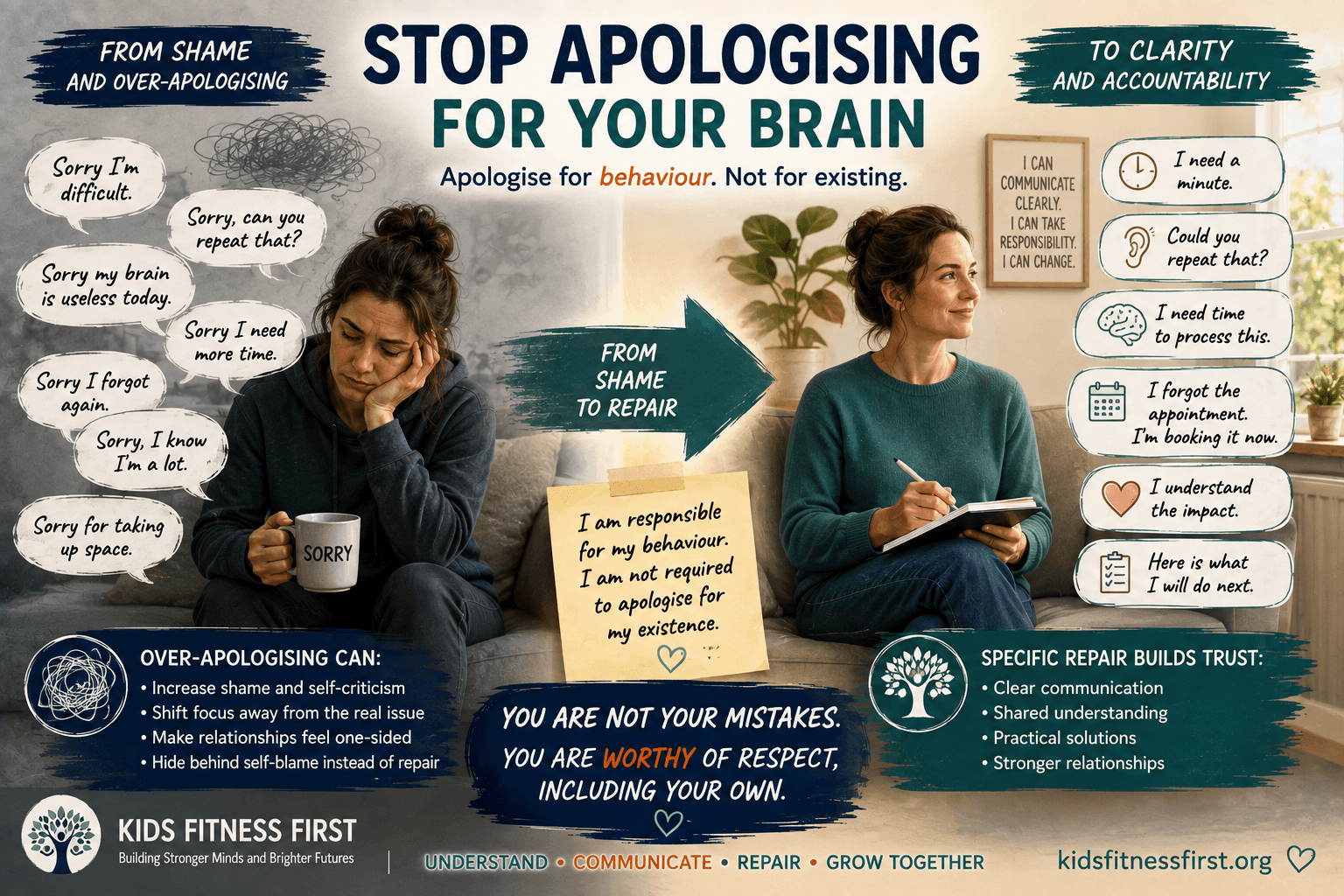
Stop Apologising for Your Brain: Neurodivergence, Shame and Better Repair
Stop apologising for your brain.
That sentence sounds simple.
However, for many neurodivergent adults, it can feel surprisingly difficult.
You may apologise when you need a question repeated.
You may say sorry before asking for help.
Likewise, you may apologise for taking longer to read something, needing time to process, forgetting a small detail or becoming overwhelmed.
Sometimes you may even apologise before anything has actually gone wrong.
As a result, “sorry” can become less of an apology and more of a background noise running through everyday life.
Yet there is an important distinction.
You should still apologise when your behaviour genuinely hurts somebody.
However, you do not need to apologise for having the brain you have.
That difference sits at the heart of this article. When an apology is genuinely needed after hurt, our separate guide to neurodivergent relationship repair focuses on accountability without collapsing into shame. For communication problems that occur before harm is done, see neurodivergent relationship communication.
When “Sorry” Becomes Automatic
A genuine apology has a purpose.
For example:
“I forgot the appointment, and that created extra work for you. I am sorry.”
That apology is connected to a specific event.
However, over-apologising works differently.
For example:
“Sorry, can you repeat that?”
“Sorry, I just need a minute.”
“Sorry, I know I’m difficult.”
“Sorry, my brain isn’t working.”
“Sorry, I know I’m a lot.”
“Sorry, I probably explained that badly.”
At first, these phrases may seem polite.
However, when they happen repeatedly, they can reveal something deeper.
Instead of saying:
“I did something that needs repair,”
the hidden message can become:
“My presence needs apologising for.”
That is a very different belief.
Therefore, the first step is simply noticing how often the apology appears.
Why Neurodivergent People May Over-Apologise
Over-apologising does not appear from nowhere.
Instead, it often develops gradually.
Many neurodivergent adults have spent years being corrected.
For example, they may have been told:
- to pay more attention;
- to stop interrupting;
- to work faster;
- to sit still;
- to remember things;
- to read more carefully;
- to speak differently;
- to stop being too sensitive;
- or to behave more normally.
Consequently, some people begin trying to prevent criticism before it arrives.
An apology becomes a form of insurance.
If you apologise first, perhaps nobody else will need to point out the mistake.
If you criticise yourself first, perhaps another person’s criticism will hurt less.
If you say:
“Sorry, I’m useless with this stuff,”
then perhaps you can control the embarrassment before someone else does.
However, the cost of that strategy can become very high.
Over-Apologising and ADHD
For some people with ADHD, unnecessary apologising may be closely connected to reliability.
For example, you may know that you sometimes:
- forget arrangements;
- lose track of time;
- miss messages;
- interrupt;
- struggle with organisation;
- or start things without finishing them.
Therefore, you may begin apologising in advance.
You might say:
“Sorry, I know I’ll probably forget.”
Or:
“Sorry, I’m terrible at this.”
At first, this may feel like honesty.
However, over time, it can reinforce the idea that you are fundamentally unreliable.
Moreover, it can make it harder to distinguish between something that genuinely needs repair and something that simply reflects a difference in how your brain functions.
Over-Apologising and Dyslexia
For some dyslexic adults, the pattern may centre more strongly on competence.
For example, reading a long document may take extra time.
Likewise, written instructions, forms or detail-heavy tasks may create additional effort.
Therefore, the apology can become:
“Sorry, I’m slow.”
“Sorry, I need to read that again.”
“Sorry, I’m rubbish with paperwork.”
However, needing more processing time is not a moral failure.
Likewise, asking for information in a format that works better for you is not something that automatically requires an apology.
Instead, a clearer response might be:
“I need a little longer to process that.”
That sentence gives information without self-attack.
Over-Apologising and Autism
For some autistic people, the apology may appear after social interactions.
Perhaps you leave a conversation and begin replaying it.
Did your tone sound wrong?
Did you speak too much?
Did you miss a signal?
Did somebody’s expression change?
As a result, you may apologise even though nobody has said that anything went wrong.
For example:
“Sorry if I was weird.”
“Sorry if that came across badly.”
“Sorry, I never know if I’m saying the right thing.”
However, constantly apologising for uncertainty can reinforce the belief that your natural communication style is unacceptable.
Therefore, instead of automatically apologising, you might ask:
“Did that make sense?”
Or:
“I want to check that I communicated that clearly.”
Again, the difference is small in wording but large in meaning.
The Real Problem With Constant Apologising
Over-apologising can hurt the person doing it.
However, it can also affect the relationship.
Imagine this situation.
A partner says:
“The school form wasn’t sent.”
The neurodivergent partner immediately replies:
“I’m so sorry. I’m useless. I know I always let you down. You must be sick of me.”
Now notice what happens.
The original issue was the school form.
However, the conversation has suddenly become about the apologising person’s pain.
As a result, the partner may feel compelled to respond:
“No, you’re not useless.”
“I don’t think you’re terrible.”
“I’m not leaving you.”
Consequently, the person who originally raised a reasonable concern may now be comforting the person who forgot the task.
This may happen without intention.
Nevertheless, over time it can become exhausting.
Therefore, constant self-criticism is not necessarily the same as accountability.
Sometimes it can actually move the conversation away from accountability.
Apologise for Behaviour, Not for Existing
This is the central shift.
Do not stop apologising completely.
Instead, make your apologies more specific.
Ask:
Am I apologising for what I did, or for who I am?
Compare these examples.
Instead of:
“I’m so sorry. I’m such a mess.”
Try:
“I didn’t book the appointment. I am doing it now.”
Instead of:
“Sorry, my brain is useless today.”
Try:
“I need fifteen minutes to reset before I answer properly.”
Instead of:
“I’m sorry you have to put up with me.”
Try:
“I know missing the message caused a problem. Therefore, I’m setting a reminder so I don’t miss the next one.”
Instead of:
“Sorry, I know I’m a lot.”
Sometimes the replacement is simply:
Nothing.
You do not have to apologise for taking up space.
Shame Language Versus Repair Language
The difference can be understood very simply.
Shame language focuses on identity.
Repair language focuses on behaviour.
For example:
| Shame Language | Repair Language |
|---|---|
| “I’m useless.” | “I forgot the appointment.” |
| “I’m a nightmare.” | “I interrupted you. Please finish.” |
| “I’m terrible at everything.” | “I missed the message.” |
| “Sorry I’m so difficult.” | “I need more time to process this.” |
| “You shouldn’t have to deal with me.” | “I understand the impact, and here is what I will do next.” |
The second column may sound less emotional.
However, it is actually more responsible.
Why?
Because it identifies what happened.
Then it gives the relationship something practical to work with.
A Better Apology Has Three Parts
A useful apology does not need to be long.
Instead, try three parts.
1. Name what happened
For example:
“I forgot the appointment.”
2. Acknowledge the impact
Then say:
“I know that meant you had to deal with it.”
3. Name the next action
Finally:
“I am booking it now and putting it into the shared calendar.”
That is enough.
You do not need to add:
“I am terrible.”
“I ruin everything.”
“You deserve better than me.”
Those sentences may express real emotion.
However, they do not necessarily repair the situation.
The action does.
Why Stopping Can Feel Uncomfortable
If you have apologised automatically for years, stopping may feel surprisingly exposed.
At first, you may worry that you sound rude.
Likewise, you may feel that people are noticing you more.
Perhaps you ask someone to repeat themselves without saying sorry first.
For example:
“Could you repeat the last part?”
That sentence is perfectly reasonable.
However, if you have spent years saying:
“Sorry, I’m really bad at this, could you repeat it?”
the shorter version may feel almost arrogant.
Nevertheless, it is not arrogance.
It is simply communication without unnecessary self-punishment.
Therefore, expect discomfort.
The discomfort does not necessarily mean you are doing something wrong.
Sometimes it means an old protective habit is no longer doing all the talking.
The Two-Week Apology Experiment
The Book Five manuscript suggests a simple two-week exercise.
The purpose is not to eliminate apologies overnight.
Instead, the first goal is awareness.
Week One: Count
For seven days, notice every unnecessary “sorry.”
Each time one appears, write a mark in your phone or notebook.
Do not stop yourself.
Do not judge yourself.
Instead, simply count.
At the end of each day, record the total.
Then, at the end of the week, look for patterns.
Ask:
- Which situations produce the most apologies?
- Which people?
- Which tasks?
- What time of day?
- Do apologies increase when you are tired?
- Do they increase at work?
- Do they appear around paperwork?
- Do they appear after social situations?
First, map the pattern.
Then change it.
Week Two: Substitute
During the second week, begin replacing unnecessary apologies.
For example:
Instead of:
“Sorry, I need a minute.”
try:
“I need a minute.”
Instead of:
“Sorry, can you repeat that?”
try:
“Could you repeat the last part?”
Instead of:
“Sorry, I haven’t finished yet.”
try:
“I will have it finished by this evening.”
Sometimes no replacement is needed at all.
Simply continue speaking.
Reflection: What Are You Actually Apologising For?
Pause here.
Think about the last seven days.
Now ask yourself:
What have I apologised for that was not actually wrong?
Do not rush.
Instead, consider the ordinary moments.
Perhaps you apologised for:
- asking somebody to repeat something;
- needing more time;
- being tired;
- needing quiet;
- asking a question;
- forgetting a minor detail;
- not understanding an unclear instruction;
- becoming excited;
- talking about something you enjoy;
- needing written information;
- taking up physical space;
- changing your mind;
- or saying no.
Now answer these questions.
1. When do I apologise most?
Is it:
- at work;
- at home;
- around authority figures;
- during conflict;
- during paperwork;
- after social events;
- or when you feel rushed?
2. What am I trying to prevent?
Perhaps the apology is trying to prevent:
- criticism;
- rejection;
- embarrassment;
- conflict;
- disappointment;
- or being seen as difficult.
3. What belief sits underneath the apology?
Complete the sentence:
“If I do not apologise, people might think I am…”
Perhaps:
lazy.
careless.
rude.
difficult.
slow.
selfish.
too much.
unreliable.
Now ask yourself:
Where did I learn that?
4. Which apologies are genuine?
Think about one situation in which you genuinely hurt somebody.
What behaviour actually requires repair?
Write it clearly.
For example:
“I forgot something important and left my partner to deal with it.”
Now remove every statement about your identity.
Do not write:
“I am awful.”
Instead, write:
“This is what happened.”
5. What action would repair it?
Complete this sentence:
“The practical next step is…”
That step may be:
- setting a reminder;
- completing the task;
- returning to the conversation;
- listening without defending;
- changing a system;
- or asking what repair would help.
6. What do I no longer want to apologise for?
Complete:
“I no longer need to apologise for needing…”
Perhaps:
time.
clarity.
quiet.
movement.
written instructions.
a break.
direct communication.
support.
space.
Reflection Takeaway
Finally, write this somewhere you can see it:
“I am responsible for my behaviour. I am not required to apologise for my existence.”
The aim is not to remove responsibility.
Instead, it is to make responsibility clearer.
Because once shame stops filling the entire room, genuine repair has more space to happen.
How to Know Whether an Apology Is Needed
When you feel “sorry” arriving, ask three questions.
Did I actually harm or inconvenience someone?
If yes, an apology may be appropriate.
Am I simply asking for something my brain needs?
If yes, a clear request may be better than an apology.
Is this about my behaviour or my identity?
If the apology sounds like:
“Sorry I’m me,”
stop.
If it sounds like:
“I did something that affected you,”
repair it.
That distinction can become a powerful filter.
What Your Partner May Notice
Interestingly, when you reduce blanket apologies, your relationships may become more straightforward.
At first, your partner may notice fewer emotional apologies.
However, they may also receive more specific responses.
Instead of:
“I feel terrible.”
they may hear:
“I understand what happened.”
Instead of:
“I hate that I’m like this.”
they may hear:
“Here is what I will change.”
Consequently, accountability may actually increase.
The relationship spends less time managing shame and more time solving the real problem.
Dignity and Accountability Can Coexist
Sometimes people fear that self-acceptance means lowering standards.
However, that is not the message here.
You can accept your brain and still work on your behaviour.
Likewise, you can understand ADHD and still use a calendar.
You can understand dyslexia and still create systems for important paperwork.
You can understand autism and still repair a conversation when your words caused hurt.
Therefore, self-acceptance and accountability are not opposites.
In fact, they often work better together.
When you are no longer busy proving that you are terrible, you have more energy available to ask:
“What actually needs changing?”
That is a far more useful question.
Stop Making Your Brain the Crime
Your brain is not an offence that needs continuous mitigation.
You do not need to enter every room with an invisible disclaimer.
You do not need to say:
“Sorry for needing instructions clearly.”
“Sorry for thinking differently.”
“Sorry for asking.”
“Sorry for taking longer.”
“Sorry for needing quiet.”
Instead, describe what you need.
Ask clearly.
Then take responsibility when your actual behaviour affects another person.
The distinction is simple.
However, its effect can be profound.
Conclusion: Replace Blanket Shame With Specific Repair
To stop apologising for your brain does not mean becoming someone who never says sorry.
Instead, it means making your apologies matter again.
First, stop apologising for being neurodivergent.
Then, notice when a genuine behaviour needs repair.
Next, name exactly what happened.
Afterwards, acknowledge the impact.
Finally, take a visible next step.
That is accountability.
By contrast, repeating:
“I am awful.”
“I am useless.”
“I am a burden.”
may feel like responsibility, but it often leaves the practical problem exactly where it was.
Therefore, let the apology become smaller.
Let the repair become bigger.
Most importantly, remember:
You can take responsibility without attacking yourself.
You can change behaviour without treating your brain as a defect.
And you can take up space without apologising for having been in the room.
SUGGESTED INTERNAL LINKS
Article 1: ADHD Love Language: 6 Ways Neurodivergent People Show Love
Article 2: ADHD Shame Cycle: Why Small Criticism Can Feel So Big
DISCLAIMER
This article is provided for general educational and informational purposes only. It is not medical, psychological, diagnostic or therapeutic advice.
Neurodivergent people are individuals. Therefore, ADHD, autism, dyslexia and other neurodivergent experiences should not be assumed to produce the same patterns in everyone.
Reducing unnecessary apologies does not mean avoiding accountability. Genuine harm, repeated harmful behaviour, abuse, coercion or intimidation should never be dismissed as neurodivergence or communication differences.