
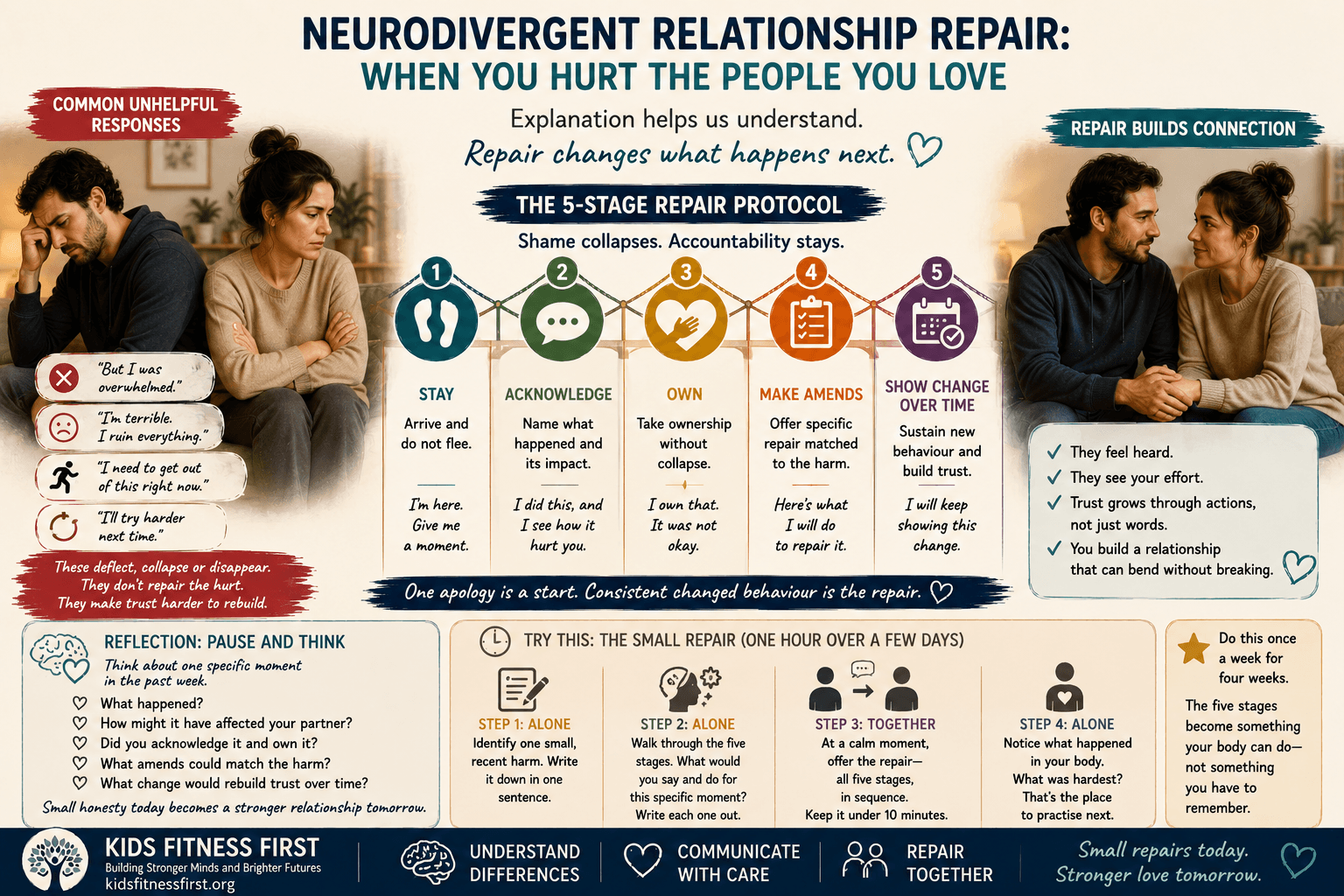
Neurodivergent Relationship Repair: When You Hurt the People You Love
Neurodivergent relationship repair begins with a difficult truth:
Sometimes we hurt the people we love.
Not deliberately.
Not because neurodivergent people are bad partners.
However, intention and impact are not always the same thing.
For example, executive-function difficulties may contribute to a forgotten anniversary.
Emotional overload may contribute to a sharp response during an argument.
Likewise, shame may contribute to withdrawal when a partner simply asks for something reasonable.
In each case, the neurological explanation matters.
However, the person who was hurt is still hurt.
That distinction is one of the most important ideas in Book Five.
Your neurology can help explain the behaviour.
Nevertheless, explanation alone does not repair the impact.
Therefore, this article is not about blame.
Instead, it is about a different skill:
adult accountability without shame.
Why Accountability Can Feel So Dangerous
For many neurodivergent adults, admitting that they hurt somebody can immediately activate an older emotional pattern.
A partner says:
“That really hurt me.”
Yet, instead of hearing only the behaviour, the person may hear:
“You are a terrible person.”
Consequently, the nervous system reacts.
Perhaps you defend yourself.
Alternatively, you explain.
Maybe you withdraw.
Or perhaps you collapse into:
“I’m awful. I ruin everything.”
At first, that collapse may look like accountability.
However, it often does something very different.
Suddenly, the person who was hurt may have to reassure you.
Therefore, the original harm disappears beneath your shame.
This is why Article 7 follows Articles 5 and 6.
First, Book Five asked you to reduce chronic over-apologising.
Then it asked you to practise receiving understanding.
Now there is enough emotional ground to do something harder:
look directly at harm without turning yourself into the harm.
Shame and Accountability Are Not the Same Thing
This distinction is central to neurodivergent relationship repair.
Shame says:
“I am bad.”
Accountability says:
“I did something that caused harm.”
Those sentences may feel almost identical when emotions are high.
However, they lead in completely different directions.
Shame collapses inward.
Therefore, attention moves towards your identity.
Accountability remains specific.
Consequently, attention stays on:
- what happened;
- how it affected the other person;
- what needs repairing;
- and what needs changing.
That difference creates a useful principle:
You do not need to hate yourself in order to take responsibility for yourself.
In fact, self-hatred can sometimes make responsibility harder.
The Explanation Trap Returns
Earlier in Book Five, we looked at the Explanation Trap.
A partner raises a problem.
Then the neurodivergent person explains:
“My ADHD makes working memory difficult.”
“I was overloaded.”
“I shut down because I’m autistic.”
“I struggle with paperwork because I’m dyslexic.”
These statements may be accurate.
However, during the repair itself, they can easily sound like:
“Here is why what happened should not count.”
That may not be what you mean.
Nevertheless, it can be what your partner hears.
Therefore, the Repair Protocol deliberately places acknowledgement before explanation.
First, recognise the harm.
Later, if the neurological explanation is useful for preventing recurrence, discuss it during the planning stage.
That order matters.
Explanation can help design the solution. It should not replace the acknowledgement.
The Five-Stage Repair Protocol
Book Five’s Repair Protocol gives neurodivergent adults a structured way to respond when they have caused harm.
The five stages are:
- Arrive and do not flee
- Acknowledge before explaining
- Take ownership without collapse
- Offer specific amends
- Sustain the change over time
Each stage has a different purpose.
Stage 1: Arrive and Do Not Flee
First, stay.
This sounds almost too simple.
However, for somebody whose nervous system responds to conflict through withdrawal, shutdown, defensiveness or escape, staying can be difficult.
The shame response may tell you:
Leave.
The emotional surge may tell you:
Defend yourself.
The old survival pattern may tell you:
End the conversation before it becomes unbearable.
Instead, the first repair move is presence.
You might say:
“I am here. I want to stay here. Give me a moment.”
That sentence communicates something powerful.
It says:
“I am not disappearing while you are trying to tell me that I hurt you.”
You do not need to solve everything immediately.
However, you do need to remain emotionally available enough for the conversation to continue.
Stage 2: Acknowledge Before Explaining
Next, acknowledge exactly what happened.
Not:
“I’m sorry, but I was overloaded.”
Not:
“I’m sorry you feel that way.”
Likewise, not:
“I’m sorry I’m such a nightmare.”
Instead, be specific.
For example:
“I snapped at you when you asked me a reasonable question. That was not okay.”
Or:
“I did not reply for three days, and I can understand why that hurt you.”
Or:
“I withdrew without explaining what was happening, and that left you feeling alone.”
Notice what these statements do.
They name:
- the behaviour;
- the impact;
- and the reality of the other person’s experience.
Most importantly, they do not contain a pivot.
There is no:
“but…”
The word “but” often cancels everything before it.
Therefore, keep the acknowledgement clean.
Stage 3: Take Ownership Without Collapse
This may be the hardest stage.
You have now heard the hurt.
You have acknowledged it.
Consequently, shame may surge.
The mind may say:
“See? You’re terrible.”
However, the Repair Protocol asks you to stay specific.
Instead of:
“I am a terrible partner.”
say:
“I did that. It was not okay. I own it.”
That is enough.
No dramatic confession is required.
Likewise, no long performance of guilt is needed.
The person who was hurt does not need to convince you that you are still a good person before they can finish explaining what happened.
Therefore, resist turning accountability into self-punishment.
A useful internal sentence is:
“I am a person who caused harm in this moment. That is different from being a harmful person in every moment.”
Specificity protects both people.
Stage 4: Offer Specific Amends
Words matter.
However, words alone usually do not complete repair.
If the harm was practical, the repair should also become practical.
For example:
Too vague:
“I’ll try harder.”
More useful:
“From tomorrow, I will set a reminder at 8pm to check tomorrow’s family commitments.”
Likewise:
Too vague:
“I’ll communicate better.”
More useful:
“If I need space after an argument, I will tell you when I plan to return to the conversation.”
Or:
Too vague:
“I won’t forget again.”
More useful:
“We will put the appointment directly into the shared calendar while we are talking.”
Specific amends should match the size of the harm.
Therefore, a small missed task usually needs a small practical repair.
Meanwhile, a larger repeated pattern may require a more substantial change.
Stage 5: Sustain Change Over Time
Finally, repair becomes evidence.
One clean apology matters.
However, if the same behaviour repeats unchanged for the next two years, trust may not return.
Therefore, the fifth stage is consistency.
This is where genuine neurodivergent relationship repair becomes visible.
Perhaps you:
- use the shared calendar consistently;
- return after taking space;
- stop raising your voice;
- complete the responsibility you took back;
- communicate overload earlier;
- or keep a commitment that used to be repeatedly missed.
At first, your partner may still be cautious.
That caution does not necessarily mean they reject your effort.
Instead, they may simply need enough new evidence to update an old expectation.
Trust usually changes through accumulation.
Therefore:
repair is not only what you say once. It is what you repeatedly do next.
The Repair Protocol at a Glance
| Stage | Core Question | Useful Response |
|---|---|---|
| 1. Stay | Can I remain present? | “I am here. Give me a moment.” |
| 2. Acknowledge | What actually happened? | “I did this, and I see the impact.” |
| 3. Own | Can I accept responsibility without self-attack? | “I own that. It was not okay.” |
| 4. Amend | What specific action repairs this? | “Here is what I will do next.” |
| 5. Sustain | What will prove the repair over time? | Consistent changed behaviour |
The structure is intentionally simple.
However, practising it can be emotionally demanding.
When Your Partner Does Not Immediately Trust the Repair
Suppose you use the Repair Protocol correctly.
You stay.
You acknowledge.
You take ownership.
Then you offer a specific change.
However, your partner remains cautious.
You may feel discouraged.
Perhaps you think:
“Nothing I do is ever enough.”
Nevertheless, remember what may have happened before.
Your partner may have seen:
- explanations;
- promises;
- emotional apologies;
- withdrawal;
- brief changes;
- and returns to the old pattern.
Therefore, one successful repair may not immediately replace years of evidence.
That does not make the repair pointless.
Instead, it means the fifth stage matters.
New behaviour needs time to become believable.
When One Repair Is Not Enough
Some harm is small.
Other harm has accumulated for years.
For example, one partner may have spent a decade carrying:
- family administration;
- emotional reassurance;
- household planning;
- appointments;
- financial organisation;
- social arrangements;
- and repeated recovery after conflict.
Therefore, one ten-minute repair conversation may not touch the full weight of what has built up.
That is not necessarily proof that repair has failed.
Instead, the situation may have exceeded what one person can repair alone.
At that point, relational support may be useful.
For example, couples therapy or another appropriately qualified professional may help both people work with the accumulated pattern.
The important point is this:
The limits of solo repair are real.
Recognising them is not failure.
Reflection: What Has Your Partner Been Carrying?
Pause here.
This reflection is not about creating a list of everything you have ever done wrong.
That would likely trigger shame rather than accountability.
Instead, choose one specific pattern.
Perhaps:
- forgetting responsibilities;
- becoming sharp during conflict;
- disappearing emotionally;
- leaving one partner to manage everything;
- failing to communicate plans;
- or repeatedly promising change without a system.
Now consider the following questions.
1. What actually happened?
Write the behaviour without explanation.
For example:
“I repeatedly left the school administration to my partner.”
Not:
“Because my ADHD…”
Not yet.
First, name the behaviour.
2. What might that have cost them?
Perhaps:
- time;
- energy;
- trust;
- rest;
- emotional safety;
- confidence in you;
- or a sense of partnership.
3. Have you been focusing more on your intention than their impact?
Complete:
“I wanted them to know that I did not mean to hurt them. However, they may have needed me to recognise that…”
Finish the sentence.
4. What happens inside you when they describe the hurt?
Do you:
- explain;
- defend;
- shut down;
- apologise excessively;
- attack yourself;
- change the subject;
- or leave?
5. Which part of the Repair Protocol is hardest for you?
Is it:
- staying;
- acknowledging;
- owning;
- making amends;
- or sustaining change?
6. What specific repair would match the harm?
Avoid:
“I’ll be better.”
Instead, write an action.
For example:
“From now on, I will take responsibility for the school calendar and check it every Sunday evening.”
7. What would your partner need to see over time?
Perhaps the real repair is not another conversation.
Instead, it may be three months of changed behaviour.
Reflection Takeaway
Complete this sentence:
“Understanding why I behaved this way matters. However, the person I love also deserves…”
Perhaps:
recognition.
repair.
reliability.
change.
space to be angry.
evidence.
The purpose is not to erase your neurodivergence.
Instead, it is to recognise that your partner’s experience also belongs inside the story.
Try This: The Small Repair
Choose one small, recent, specific moment from the last week or two.
Not the biggest problem in your relationship.
Instead, pick:
- a sharp tone;
- a forgotten thing;
- a missed message;
- a small withdrawal;
- or another manageable moment.
Step 1: Write the harm in one sentence
For example:
“I snapped at my partner when they reminded me about the appointment.”
Step 2: Prepare the five stages
Write down:
Stay:
How will you remain present?
Acknowledge:
What happened, without “but”?
Ownership:
What is yours to own?
Amends:
What specific action fits the harm?
Change:
What will you do differently over time?
Step 3: Offer the repair
At a calm moment, have the conversation.
Keep it short.
You do not need a one-hour emotional summit.
Instead, aim for clarity.
Step 4: Reflect afterwards
Ask yourself:
- Did shame arrive?
- Did I stay?
- Did I start explaining?
- Could I hear their response?
- Which stage was hardest?
Then practise that stage again.
The Book Five manuscript recommends repeating a small repair weekly for four weeks so that the five stages begin to feel more natural rather than remaining an intellectual checklist.
What a Clean Repair Can Sound Like
Here is a simple example:
“I want to come back to what happened yesterday. I spoke sharply when you asked me about the form. That was not okay, and I can see it upset you. I own that. I have completed the form now, and next time I feel overloaded I am going to tell you I need ten minutes rather than snapping. I know you may need to see that change more than once, and I understand that.”
Notice what is missing.
There is no:
“but my ADHD…”
There is no:
“I’m the worst partner in the world.”
There is no demand for reassurance.
Instead, there is presence, acknowledgement, ownership, repair and future evidence.
That is the structure.
Your Neurology Still Matters
None of this means pretending neurology is irrelevant.
In fact, neurological understanding is extremely important when designing prevention.
For example:
If working memory contributed to missed tasks, use external systems.
If sensory overload contributed to a sharp response, build recovery time.
Likewise, if transitions create difficulty, give earlier warnings.
If written information is easier than verbal information, change the communication channel.
Therefore, neurodivergence belongs strongly in the solution design.
However, during the initial acknowledgement, the person who was hurt may need the impact recognised before they are ready to discuss the mechanism.
That sequencing can protect the repair.
Accountability Does Not Cancel Self-Compassion
Some people fear that this kind of accountability will reopen years of shame.
However, accountability and self-compassion can coexist.
You can say:
“My brain was overloaded.”
and:
“I still hurt you.”
You can say:
“I did not intend that.”
and:
“I understand that intention does not remove the impact.”
Likewise, you can say:
“I deserve compassion.”
and:
“You deserve repair.”
Both sides matter.
That is what makes this adult accountability rather than punishment.
The Person You Love Should Not Have to Pay for Your Understanding
A diagnosis can transform your understanding of your life.
Suddenly, years of confusion make sense.
That can be deeply important.
However, there is a relational question alongside the personal one:
What happened to the people who were sharing the life while you were still figuring it out?
Perhaps they carried practical responsibilities.
Maybe they absorbed emotional storms.
Likewise, they may have waited through repeated apologies or repeated promises.
Therefore, understanding yourself is not the final stage.
At some point, self-understanding must meet relational responsibility.
That meeting point is repair.
Conclusion: Stay, See It, Own It, Repair It
Neurodivergent relationship repair is not about blame.
Likewise, it is not about pretending that neurodivergence has no effect on behaviour.
Instead, it asks for something more balanced.
First, stay.
Then acknowledge what happened.
Next, take ownership without turning yourself into a terrible person.
Afterwards, offer an amends that matches the harm.
Finally, let changed behaviour become the evidence.
That is the Repair Protocol.
Most importantly, remember:
Shame is a collapse. Accountability is a capacity.
You do not need to disappear into guilt.
You also do not need to explain the hurt away.
Instead, you can stand inside the uncomfortable middle and say:
“I did this. I can see what it cost you. I am here. And I am going to work on what happens next.”
That is not weakness.
It is one of the strongest things a person can bring into a relationship.
SUGGESTED INTERNAL LINKS
Article 1: Neurodivergent Understanding: Why Being Truly Seen Can Feel Uncomfortable
Article 2: Stop Apologising for Your Brain: Neurodivergence, Shame and Better Repair
DISCLAIMER
This article is provided for general educational and informational purposes only. It is not medical, psychological, diagnostic, couples-therapy or therapeutic advice and should not replace individual support from an appropriately qualified professional.
Neurodivergent people are individuals. Therefore, ADHD, autism, dyslexia and other neurodivergent experiences should not be assumed to produce the same relationship behaviours in every person.
Likewise, neurodivergence should never be used to excuse abuse, threats, intimidation, coercive control or ongoing harmful behaviour. In situations involving safety concerns or abuse, a general relationship-repair framework may not be appropriate.