
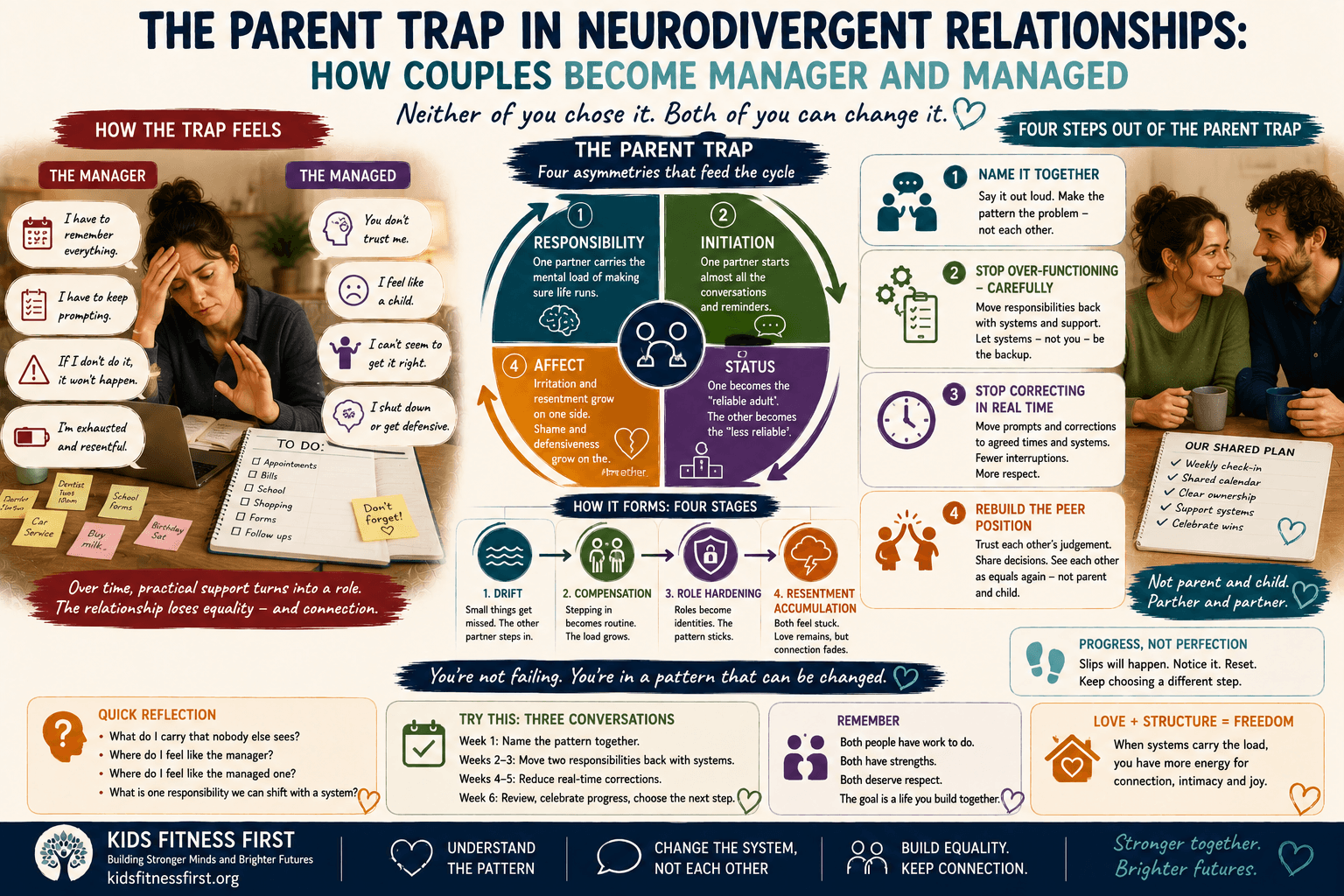
The Parent Trap in Neurodivergent Relationships: How Couples Become Manager and Managed
The Parent Trap in neurodivergent relationships rarely begins with somebody deciding:
“From now on, I will manage my partner.”
Likewise, the neurodivergent partner rarely decides:
“From now on, somebody else can take responsibility for my life.”
Instead, the pattern develops quietly.
Something gets forgotten.
Therefore, the other partner steps in.
Then something else gets missed.
Again, the partner takes over.
At first, this feels sensible.
In fact, it often solves a real problem.
However, years later, the relationship may look very different.
One person holds the calendar.
One person remembers the deadlines.
One person notices what needs doing.
One person reminds.
One person checks.
Meanwhile, the other partner becomes the person being reminded, checked and monitored.
Eventually, neither feels like an equal adult.
One feels exhausted.
The other feels diminished.
Both may feel resentful.
And yet both may still love each other deeply.
That is the Parent Trap.
What Is the Parent Trap?
The Parent Trap is a relationship pattern in which one partner gradually becomes the manager of the shared life while the other becomes the person being managed.
It is particularly recognisable in some ADHD relationships.
However, the Book Five framework also applies more broadly to relationships involving dyslexia and autism.
The exact responsibilities may differ.
Nevertheless, the underlying structure is similar.
One partner holds more responsibility.
Then they initiate more.
Consequently, their judgement begins carrying more authority.
Meanwhile, the other partner increasingly occupies the lower-status position.
Eventually, the emotional relationship changes too.
What began as practical support becomes a structural imbalance.
The Four Asymmetries of the Parent Trap
Book Five identifies four features that tend to reinforce one another.
They are:
- Asymmetric responsibility
- Asymmetric initiation
- Asymmetric status
- Asymmetric affect
Together, these create the architecture of the Parent Trap.
1. Asymmetric Responsibility
First, one partner becomes responsible for whether daily life actually functions.
They may hold:
- the family calendar;
- appointments;
- school responsibilities;
- household administration;
- insurance;
- bills;
- family commitments;
- maintenance;
- forms;
- follow-ups;
- and many of the invisible tasks discussed in Article 10.
At first, the arrangement may appear efficient.
However, responsibility means more than doing a task.
It also means feeling mentally responsible for whether that task happens.
Therefore, the same partner often becomes the household’s backup system.
If nobody else remembers, they will.
If nobody else acts, they will.
Consequently, the relationship begins leaning on one person’s nervous system.
2. Asymmetric Initiation
Next, one partner becomes the person who starts almost every practical conversation.
For example:
“Have you done the form?”
“Did you call the dentist?”
“Remember the MOT.”
“Can you please answer that email?”
“Have you booked it yet?”
This may happen several times every day.
Therefore, one person increasingly becomes the initiator, while the other becomes the recipient of prompting.
That distinction matters.
The problem is not simply who eventually completes the task.
The problem is also who had to notice that action was required.
Over time, the person doing the prompting feels they are carrying the entire forward motion of the household.
Meanwhile, the person being prompted begins experiencing daily life as a sequence of corrections.
Both people become frustrated.
3. Asymmetric Status
Eventually, something deeper changes.
One person becomes unconsciously positioned as the more reliable adult.
Their memory is trusted more.
Their judgement carries more weight.
Likewise, they may begin making decisions without consulting the other person because:
“It’s easier if I just deal with it.”
Meanwhile, the neurodivergent partner may gradually be treated as somebody whose judgement needs checking.
This is where practical imbalance becomes relationship hierarchy.
The couple are still technically equals.
However, emotionally, one may begin occupying the position of:
responsible adult
while the other occupies:
unreliable adult who needs supervision.
That is damaging to both.
The higher-status partner does not want to parent their spouse.
Likewise, the lower-status partner does not want to feel like a teenager being monitored in their own home.
Nevertheless, the pattern may have become so established that both struggle to imagine another arrangement.
4. Asymmetric Affect
Finally, the emotional consequences accumulate.
The managing partner increasingly feels:
- irritation;
- frustration;
- disappointment;
- exhaustion;
- resentment;
- and loneliness.
Meanwhile, the managed partner increasingly feels:
- shame;
- defensiveness;
- inadequacy;
- loss of autonomy;
- resentment;
- and humiliation.
Therefore, both people become emotionally primed before practical conversations even begin.
A simple question such as:
“Did you remember the appointment?”
may already contain years of emotional history.
The manager hears:
“I have to check again.”
The managed partner hears:
“You do not trust me again.”
Consequently, the Parent Trap begins generating its own fuel.
The Four Asymmetries at a Glance
| Asymmetry | Managing Partner | Managed Partner |
|---|---|---|
| Responsibility | Carries whether things happen | Depends increasingly on reminders/systems |
| Initiation | Notices and prompts | Is increasingly prompted |
| Status | Viewed as more reliable/competent | Viewed as less reliable |
| Affect | Irritation and resentment | Shame and defensiveness |
Most importantly, these are not four separate problems.
Instead, they form a loop.
More responsibility creates more prompting.
More prompting creates lower status.
Lower status creates shame and withdrawal.
Then lower initiative reinforces the manager’s belief that they must carry even more.
Round the cycle goes.
How the Parent Trap Forms
The Parent Trap usually develops gradually.
Book Five identifies four stages:
- Drift
- Compensation
- Role Hardening
- Resentment Accumulation
Understanding these stages matters because they show why blame is often the wrong starting point.
Stage 1: Drift
First, small difficulties appear.
Perhaps one person forgets appointments.
A bill is missed.
A form is not returned.
Therefore, the other partner steps in.
This is not controlling.
Instead, it is usually practical.
The cost of stepping in is smaller than the cost of allowing the task to fail.
So they help.
Then they help again.
At this point, neither person believes anything significant has changed.
However, responsibility has begun to drift.
Stage 2: Compensation
Next, stepping in becomes routine.
Now one partner automatically handles several areas.
Perhaps:
- all school administration;
- family appointments;
- financial paperwork;
- household scheduling;
- or social organisation.
The arrangement may even seem successful.
After all, things are getting done.
Therefore, both partners may conclude that the system works.
However, the hidden cost is growing.
One person’s competence is now compensating for the other’s difficulty across several domains.
The compensation solves today’s crisis.
Nevertheless, it may also prevent a more sustainable system from being built.
Stage 3: Role Hardening
Eventually, the practical arrangement becomes identity.
One partner is:
“the organised one.”
The other becomes:
“the forgetful one.”
One is:
“the responsible one.”
The other becomes:
“the one who needs reminding.”
This is the point where roles become dangerous.
Because people often behave according to the roles relationships repeatedly assign them.
If you are constantly treated as unreliable, you may gradually initiate less.
Likewise, if you believe your partner cannot be trusted, you may gradually hand over less.
Therefore, both people begin producing evidence that confirms the roles.
The system has become self-reinforcing.
Stage 4: Resentment Accumulation
Finally, years of small costs accumulate.
The managing partner has carried more without feeling adequately recognised.
Meanwhile, the managed partner has lived in a lower-status position without knowing how to escape it.
Therefore, affection may become more difficult.
Intimacy may decrease.
The relationship begins feeling functional rather than romantic.
You still love each other.
However, one person feels like a household manager.
The other feels like a difficult employee.
Neither position is good for partnership.
Why the Parent Trap Is Not One Person’s Fault
This is crucial.
It is tempting to blame the manager.
Perhaps they are too controlling.
Alternatively, it is tempting to blame the managed partner.
Perhaps they need to become more responsible.
However, the pattern usually developed because both people were solving real problems with the tools available at the time.
The managing partner stepped in because something genuinely needed doing.
Meanwhile, the neurodivergent partner accepted the support because the support genuinely helped.
Therefore, the trap often formed through a series of individually reasonable decisions.
The problem appears when those temporary solutions become the permanent architecture of the relationship.
That distinction is important.
Because a pattern can be changed more easily than a character judgement.
How the Parent Trap Can Look in ADHD Relationships
In ADHD relationships, the Parent Trap often centres on executive function.
For example, the non-ADHD partner may become responsible for:
- scheduling;
- remembering;
- reminders;
- deadlines;
- follow-through;
- and future planning.
Consequently, the ADHD partner is gradually treated as unreliable.
However, this may obscure substantial strengths and contributions elsewhere.
Therefore, the challenge is not simply:
“Make the ADHD partner remember everything naturally.”
Instead, it is:
“Build systems so adult responsibility does not depend on one partner acting as the other’s working memory.”
That is very different.
How the Parent Trap Can Look With Dyslexia
For dyslexic adults, the Parent Trap may develop around literacy-heavy administration.
For example, one partner becomes responsible for:
- official letters;
- contracts;
- forms;
- school communication;
- lengthy emails;
- and bureaucratic documents.
At first, this division may make sense.
However, over time, the dyslexic partner may quietly be treated as less capable overall.
That interpretation is inaccurate.
The specific task may simply require considerably more effort.
Therefore, the goal should be designing support around literacy-heavy work while preserving adult competence and responsibility in the wider relationship.
How the Parent Trap Can Look With Autism
In autistic relationships, the imbalance may appear more strongly around social and logistical navigation.
For example, the non-autistic partner may become responsible for:
- extended family communication;
- unexpected social situations;
- interpreting social nuance;
- arranging gatherings;
- and managing changes of plan.
Consequently, the autistic partner may be labelled rigid or difficult.
However, that interpretation can overlook the considerable sensory and social adjustment they may already be making.
Again, therefore, understanding the actual mechanism matters.
The relationship needs systems and negotiation.
It does not need one partner permanently cast as the difficult child.
Four Steps Out of the Parent Trap
The Parent Trap does not disappear through one emotional conversation.
Instead, Book Five proposes four moves carried out over time.
They are:
- Name It Together
- Stop Over-Functioning — Carefully
- Stop Correcting in Real Time
- Rebuild the Peer Position
Neither partner can do all four alone.
That is important.
The manager cannot stop parenting while the other person refuses adult responsibility.
Likewise, the managed partner cannot reclaim adult status while being continually monitored and corrected.
Both sides must move.
Step 1: Name It Together
First, stop arguing only about individual incidents.
Instead, name the larger pattern.
You might say:
“I think we have developed a manager-and-managed dynamic. I have been carrying too much responsibility, and you have been getting managed too much. I don’t think either of us wants this.”
Notice the language.
There is no:
“You made me become your parent.”
Likewise, there is no:
“You’re controlling.”
Instead, the pattern becomes the shared problem.
That is important because once the Parent Trap has a name, couples can recognise it while it is happening.
For example:
“We are slipping into the Parent Trap again.”
That sentence can interrupt an entire argument.
Step 2: Stop Over-Functioning — But Carefully
This step is difficult.
The managing partner must gradually stop carrying responsibilities that genuinely belong to the other adult.
However, simply allowing important things to collapse is not the answer.
For example, deliberately refusing to remind somebody about a critical bill so they “learn a lesson” may create real financial consequences.
Therefore, responsibilities should migrate back with systems.
Start with Article 10’s Invisible Labour Map.
Choose perhaps two responsibilities that:
- genuinely belong to your partner;
- have drifted to you;
- and can reasonably be transferred.
Then build external support.
For example:
- shared calendars;
- automatic reminders;
- recurring alarms;
- written ownership;
- a weekly fifteen-minute review;
- apps;
- automated payments;
- or another system that suits the person’s brain.
Then step back.
Most importantly:
let the system become the backup rather than your memory.
That is the key difference.
If something fails, redesign the system together.
Do not immediately conclude:
“See? I knew you couldn’t do it.”
Step 3: Stop Correcting in Real Time
This may be one of the most powerful changes.
Many couples inside the Parent Trap live inside constant micro-correction.
For example:
“Don’t forget.”
“You were supposed to…”
“Did you remember?”
“You always do this.”
Sometimes the words are not harsh.
However, the tone communicates continuous assessment.
Over time, this can become deeply shame-producing.
Therefore, move practical corrections out of the emotional relationship and into agreed systems.
For example:
Instead of mentioning a missed appointment over breakfast, record it for the weekly household review.
Likewise, instead of reminding repeatedly throughout the week, allow the external reminder system to do the work.
At first, this may feel like ignoring problems.
However, you are not ignoring them.
Instead, you are rerouting them.
That protects the relationship from becoming a permanent performance review.
Step 4: Rebuild the Peer Position
Finally, rebuild adult equality deliberately.
This is slower than transferring chores.
Because the Parent Trap changes how two people see each other.
Therefore, rebuilding peer status may include:
- asking for your partner’s opinion;
- allowing them to make decisions;
- trusting their judgement in areas of strength;
- accepting their “no”;
- not speaking for them;
- not finishing their sentences;
- not explaining them to other adults;
- and recognising contributions that the Parent Trap may have made invisible.
This does not mean pretending unreliability never happened.
Instead, it means refusing to let one difficulty define the whole person.
Your partner is not simply:
“the person with ADHD who forgets things.”
They are an adult with a full range of judgement, strengths, knowledge and contribution.
The relationship needs to make room for that adult again.
Four Steps Out at a Glance
| Step | Old Pattern | New Direction |
| 1. Name It Together | Fight about individual incidents | Identify the shared pattern |
| 2. Stop Over-Functioning Carefully | One brain acts as backup | External systems carry responsibility |
| 3. Stop Real-Time Correcting | Continuous reminders and assessment | Scheduled system-based review |
| 4. Rebuild Peer Position | Manager and managed | Adult and adult |
The goal is not perfection.
Instead, the goal is gradual structural change.
Reflection: Are You Partners or Manager and Managed?
Pause here.
Do not begin by deciding who is wrong.
Instead, consider the structure of your relationship.
1. Who carries responsibility?
Ask:
Who usually feels ultimately responsible for whether important things get done?
Is it mostly one person?
2. Who initiates?
Who usually says:
- “We need to…”
- “Have you…”
- “Remember…”
- “When are you going to…?”
If one person initiates most of the household’s movement, notice that.
3. Whose judgement carries more weight?
When you disagree, is one person’s opinion automatically treated as more reliable?
Why?
Is that true across every domain?
Or has reliability in one area quietly become higher status everywhere?
4. Who carries irritation and who carries shame?
Think about practical conversations.
Does one partner tend to feel:
“Why do I have to keep doing this?”
Meanwhile, does the other tend to feel:
“Why am I always getting things wrong?”
If so, the emotional asymmetry may already be established.
5. What role have you accidentally assigned each other?
Complete:
“In our relationship I have gradually become the __________ one.”
Then:
“My partner has gradually become the __________ one.”
Perhaps:
organised.
responsible.
forgetful.
difficult.
competent.
unreliable.
controlling.
dependent.
Now ask:
Are these descriptions of whole people — or roles our relationship has hardened around?
6. What do you miss about being peers?
Perhaps you miss:
- spontaneity;
- admiration;
- flirting;
- shared decision-making;
- trusting each other;
- asking instead of instructing;
- or simply feeling like two adults on the same side.
7. What is one adult responsibility that could move?
Choose something small enough to succeed.
Not everything.
Just one domain.
Reflection Takeaway
Complete this sentence:
“The goal is not for me to do less while everything collapses. The goal is for us to build a system in which…”
Finish it honestly.
Perhaps:
“…I am not responsible for another adult’s memory.”
Or:
“…we both have real ownership.”
Or:
“…neither of us has to be the parent.”
That is the direction of travel.
Try This: The Three Conversations
The Book Five manuscript recommends a six-week practice involving three conversations.
The aim is not to fix the relationship in six weeks.
Instead, it is to change the structure enough that both people begin seeing a different possibility.
Week 1 — Conversation One: Name the Pattern
Keep this conversation under thirty minutes.
Say, in your own words:
“I think we have slipped into a manager-and-managed relationship. I don’t want to manage you, and I don’t think you want to be managed. Can we look at this together?”
Do not immediately solve the chores.
Instead, agree that the pattern exists.
That is enough for the first conversation.
Weeks 2–3 — Conversation Two: Build the Systems
Return to the Invisible Labour Map from Article 10.
Choose two responsibilities that have drifted from your partner to you.
Then create a specific support system for each.
For example:
Responsibility: car servicing
Owner: partner
System: calendar reminder three weeks before due date + annual recurring reminder
Or:
Responsibility: school messages
Owner: partner
System: dedicated notification + ten-minute check every evening
Then review the systems after two weeks.
If they fail, redesign them.
Do not automatically take the responsibility back.
Weeks 4–5 — Conversation Three: Reduce the Corrections
Agree that the managing partner will practise reducing small real-time corrections for two weeks.
The managed partner can gently signal when the pattern appears.
For example:
“Parent Trap.”
Or:
“Can we put that into the system?”
The point is not to shame the correcting partner either.
After all, the correcting habit developed for understandable reasons.
Therefore, treat this as practice.
Not performance.
Slips will happen.
End of Week 6 — Review the Dynamic
Sit together and ask:
- Has anything become easier?
- Have reminders reduced?
- Has resentment reduced?
- Does one partner feel more trusted?
- Does the other feel less responsible for everything?
- What still feels stuck?
- What responsibility should move next?
- Where are we still speaking manager-to-managed rather than adult-to-adult?
Do not ask:
“Have we fixed it?”
Instead, ask:
“Has the direction changed?”
That is a better measure.
What Not to Do: Scorched-Earth Withdrawal
There is a tempting response once the managing partner understands how much they have been carrying.
They may think:
“Fine. I’m stopping all of it.”
However, sudden disengagement can create real damage.
Bills may go unpaid.
Children may miss commitments.
Important responsibilities may fail.
Therefore, stepping back should be deliberate.
You are not abandoning responsibility.
Instead, you are transferring ownership with support.
That distinction protects the relationship and the wider household.
What Not to Do: Use the Parent Trap as a New Insult
Once couples learn the term, another danger appears.
“You’re parenting me again.”
Or:
“You’re acting like a child.”
That will not help.
The framework should describe the relationship pattern.
It should not become ammunition.
Therefore, say:
“We are slipping into the Parent Trap.”
Not:
“You are being my parent.”
The word we matters.
It reminds both people that the pattern belongs between them rather than inside one person’s character.
The Neurodivergent Partner Has Work to Do Too
Stopping the Parent Trap cannot mean the managing partner simply stops managing while the other adult changes nothing.
That would be unsustainable.
Therefore, the neurodivergent partner must also participate.
That may include:
- taking ownership;
- using external systems;
- communicating before things fail;
- repairing missed commitments;
- asking clearly for support;
- and accepting responsibility without collapsing into shame.
Earlier Book Five articles have prepared exactly for this.
Article 5 addressed over-apologising.
Article 7 addressed real accountability.
Article 8 addressed self-advocacy.
Now those skills become essential.
Because adult status requires adult ownership.
The Managing Partner Also Has Work to Do
Likewise, the managing partner cannot demand adult behaviour while continuing to treat their partner as a child.
Therefore, they may need to:
- reduce monitoring;
- stop unnecessary correcting;
- surrender some control;
- tolerate systems that work differently from their own;
- allow small recoverable mistakes;
- ask rather than command;
- and genuinely recognise the other person’s competence.
This can feel risky.
After years of carrying everything, handing responsibility back can produce anxiety.
However, equality requires some uncertainty.
You cannot give someone adult ownership while checking every movement they make with it.
Reliability Without Willpower
A central principle here is that neurodivergent households often need external reliability.
Instead of saying:
“Just remember.”
use:
- automation;
- reminders;
- checklists;
- shared calendars;
- routines;
- visual systems;
- clear ownership;
- or scheduled planning.
This is not childish.
In fact, it is adult problem-solving.
Businesses use systems.
Hospitals use systems.
Airlines use systems.
Therefore, relationships can use systems too.
The important question is:
Does the system allow each adult to carry their own responsibility without requiring another adult to supervise them?
If yes, it is doing useful work.
What Rebuilding Equality Can Feel Like
The early signs may be surprisingly small.
Perhaps the managing partner asks:
“What do you think we should do?”
and genuinely waits for the answer.
Perhaps the neurodivergent partner independently handles a responsibility that previously required reminders.
Likewise, perhaps a missed task goes into the weekly review instead of becoming an immediate critical comment.
One evening, nobody checks whether something has been done.
Because the system has already handled it.
Then something subtle returns.
Respect.
Perhaps even attraction.
Because it is difficult to feel romantic towards someone you experience as your dependent.
Likewise, it is difficult to feel confident and intimate with somebody you experience as your supervisor.
Therefore, rebuilding peer status can affect far more than household efficiency.
It can begin changing the emotional relationship itself.
Progress Will Not Be Perfect
The Parent Trap may reappear during:
- stressful weeks;
- illness;
- major work pressure;
- family crises;
- or simple exhaustion.
That does not mean the work failed.
Instead, the important difference is recognition.
Before, the pattern ran automatically.
Now one person can say:
“We’re doing it again.”
Then both can change the next move.
That is progress.
Not transformation.
Not perfection.
Instead:
an accumulated series of different choices.
Conclusion: Stop Managing Each Other and Start Building Systems
The Parent Trap in neurodivergent relationships begins quietly.
First, responsibility drifts.
Then compensation becomes routine.
Afterwards, roles harden.
Finally, resentment accumulates.
At the same time, four asymmetries emerge:
responsibility, initiation, status and affect.
Therefore, escaping the trap requires more than dividing chores differently.
The relationship itself has to change.
First, name the dynamic together.
Then move responsibilities back carefully with external systems.
Next, reduce the continuous real-time correcting.
Finally, rebuild adult peer status deliberately.
Most importantly, remember:
Neither person wins by keeping the Parent Trap alive.
The manager becomes exhausted.
The managed partner becomes diminished.
Therefore, the goal is not for one partner to become more competent and the other less controlling.
The goal is bigger.
It is to build a relationship in which both adults have responsibility, autonomy, dignity and a genuine voice.
Because a partner should not have to become your parent.
And you should not have to become their child.
You are supposed to be standing beside each other.
SUGGESTED INTERNAL LINKS
Article 1: Invisible Labour in Neurodivergent Relationships: Why You Feel So
Article 3: Neurodivergent Relationships: Why the Same Conversation Keeps Failing
DISCLAIMER
This article is provided for general educational and informational purposes only. It is not medical, psychological, diagnostic, relationship or couples-therapy advice.
Neurodivergent people and relationships are individuals. Therefore, ADHD, autism, dyslexia and other neurodivergent experiences should not automatically be assumed to produce a manager-and-managed relationship.
Likewise, this framework should not be used to justify coercion, financial irresponsibility, abuse, intimidation or refusal to take adult responsibility. Where a relationship contains persistent serious conflict or safety concerns, appropriately qualified professional support may be necessary.