
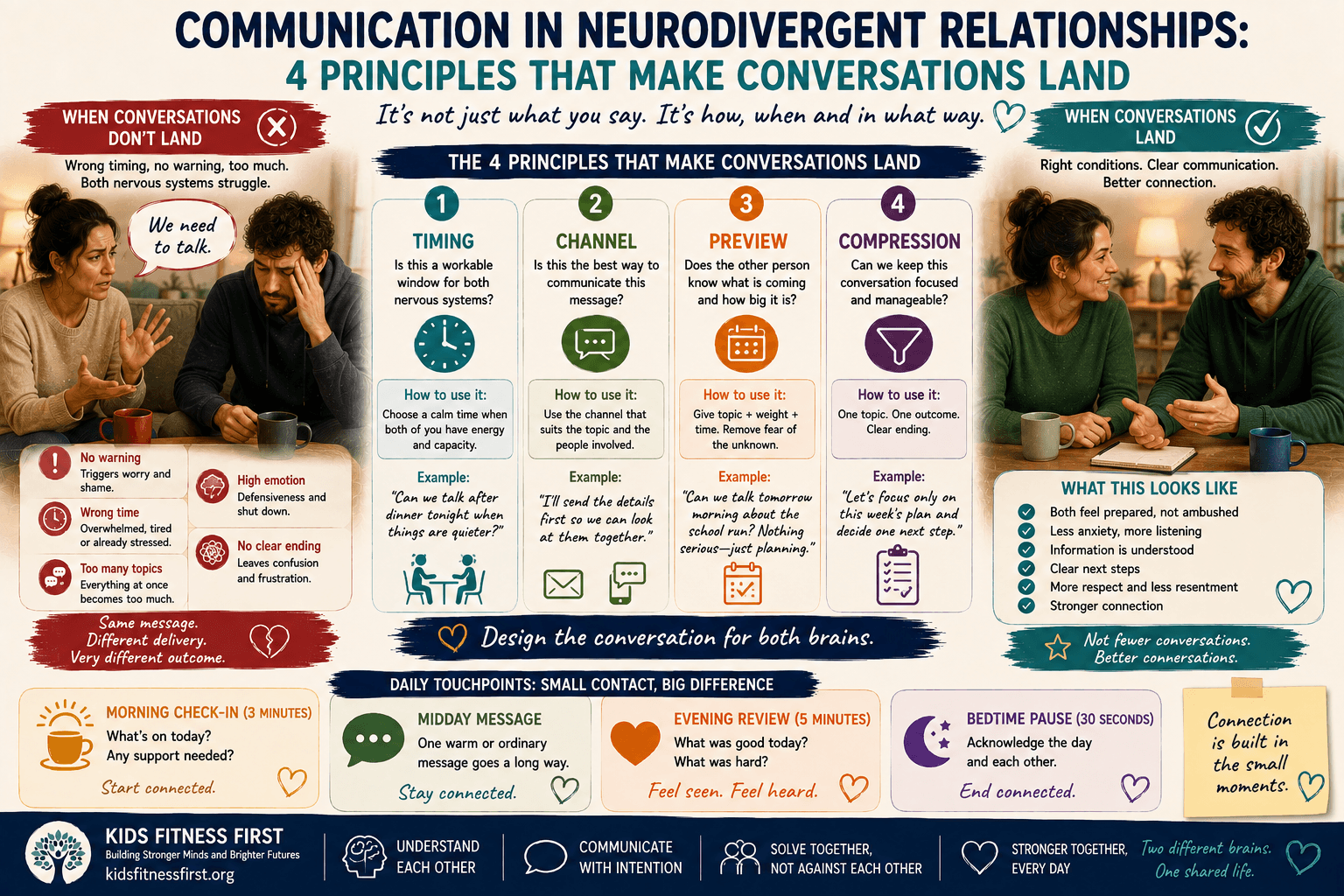
Communication in Neurodivergent Relationships: 4 Principles That Make Conversations Land
There are three words that can change the atmosphere of a relationship almost instantly:
“We need to talk.”
Perhaps you have said them gently.
Perhaps you meant:
“There is something important I would like us to discuss.”
However, the person hearing them may receive something completely different.
They may hear:
Something is wrong.
I have done something wrong.
The relationship is in trouble.
I am about to be criticised.
Consequently, several hours may pass before the actual conversation happens.
During that time, their mind may run through dozens of possible explanations.
Meanwhile, their nervous system is already preparing for danger.
By the time you finally sit down together, one person may have spent hours worrying about a conversation that has not even started.
Therefore, the problem is no longer simply what you wanted to discuss.
The way the conversation was delivered has already changed what is possible inside it.
That is one of the central ideas behind effective communication in neurodivergent relationships:
Sometimes the message is not wrong. The delivery system is.
When Care Is Not the Problem
Many couples eventually reach a painful conclusion:
“We just cannot communicate.”
However, that sentence can hide something more hopeful.
Perhaps you can communicate.
Perhaps you have simply been trying to communicate through a format that repeatedly works against one or both nervous systems.
The Book Five framework identifies four parts of that format:
- Timing
- Channel
- Preview
- Compression
Together, these are the Four Principles That Make Conversations Land.
They do not guarantee agreement.
Likewise, they do not remove accountability or difficult subjects.
Instead, they increase the likelihood that both people are actually capable of receiving the conversation when it happens.
That distinction matters.
Because there is little value in finding the perfect words if the other person’s nervous system cannot process them at that moment.
Why Good Communication Advice Can Still Fail
Most of us have heard familiar relationship advice:
- listen carefully;
- maintain eye contact;
- use “I” statements;
- do not interrupt;
- explain your feelings;
- repeat what the other person said;
- stay in the conversation until the issue is resolved.
None of these ideas is automatically wrong.
However, some may become difficult when they are treated as universal rules.
For example, sustained attention during a long emotional conversation may be difficult for some people with ADHD.
Likewise, some autistic people may find eye contact distracting, uncomfortable or actively overwhelming.
Meanwhile, somebody may understand their emotions perfectly well after twenty minutes of processing but struggle to name them immediately when asked:
“How do you feel right now?”
Therefore, good communication should not be measured by how closely two people follow a standard script.
Instead, it should be measured by whether useful information can move between them without unnecessarily overwhelming either person.
That changes the question.
Rather than asking:
“Why can’t you communicate normally?”
ask:
“What conditions help communication work for us?”
The Four Principles That Make Conversations Land
| Principle | The Question |
|---|---|
| Timing | Is this a workable moment for both nervous systems? |
| Channel | Is this the best way to communicate this particular message? |
| Preview | Does the other person know what is coming? |
| Compression | Can we keep this conversation focused and manageable? |
Individually, each principle can help.
However, when couples begin using all four together, conversations can feel very different.
Principle 1: Timing
The first principle is deceptively simple.
When you speak matters.
Sometimes it matters almost as much as what you say.
Consider two versions of exactly the same conversation.
In the first, your partner has just returned from work.
They are tired.
Their attention is depleted.
They are hungry.
Perhaps they have spent the entire day masking, concentrating, managing people or coping with noise.
Then you say:
“Can we talk about the problem with the school?”
Nothing about the question is unreasonable.
However, the nervous system receiving it may have almost no capacity left.
Now imagine the same subject on a calm morning.
There is no rush.
Both people have eaten.
Nobody is halfway through another task.
Suddenly, the conversation may be considerably easier.
The topic did not change.
The nervous-system conditions did.
Every Person Has Communication Windows
One of the most useful things a couple can learn is:
When does my partner have the greatest capacity for difficult conversation?
The answer will differ between people.
For one person, it may be a quiet Saturday morning.
For another, it may be during a walk.
For somebody else, talking while driving may feel easier because there is no pressure for continuous eye contact.
Meanwhile, another person may prefer a planned conversation at the kitchen table.
There is no universally correct window.
Therefore, the goal is not to memorise general rules about neurodivergence.
The goal is to learn your person’s windows.
Bad Timing Is Not Avoidance
This distinction is important.
Saying:
“I can’t have this conversation right now”
does not necessarily mean:
“I refuse to discuss this.”
Sometimes it means:
“If we discuss this now, I am unlikely to do it well.”
However, postponement only works when there is a genuine return point.
Therefore:
“Not now.”
should ideally become:
“Not now. Could we talk about it tomorrow morning?”
The first can feel like avoidance.
The second is regulation combined with responsibility.
Try This Right Now: Map Your Communication Windows
At a calm moment, ask each other two questions:
“When do difficult conversations usually feel easiest for you?”
Then ask:
“When is the worst time for me to raise something important?”
Write down both answers.
Do not debate them immediately.
Instead, treat the information as data.
You may discover that you have repeatedly been attempting important conversations in the exact windows when one or both of you have the least capacity.
That is useful information.
Principle 2: Channel
The second principle asks:
Does this conversation actually need to happen face-to-face?
Many people assume that serious relationship communication must happen verbally, in person and in real time.
However, different brains process information differently.
Therefore, different subjects may benefit from different communication channels.
Possible channels include:
- face-to-face conversation;
- text message;
- email;
- shared note;
- written list;
- voice note;
- telephone call;
- conversation while walking;
- or a combination of written and spoken communication.
The correct channel is the one that helps both people understand and respond.
Why Writing Can Sometimes Help
Written communication can provide several useful things.
First, it creates processing time.
Instead of needing an immediate answer, the reader can stop, think and return.
Second, it reduces the pressure to manage facial expression, tone and verbal response simultaneously.
Third, it creates a record.
Therefore, nobody has to remember every detail of the conversation afterwards.
This can be especially useful when the subject is practical.
For example:
- dates;
- appointments;
- household arrangements;
- travel;
- family plans;
- money administration;
- or agreed next steps.
Instead of discussing five arrangements verbally and later disagreeing about what was decided, you can write them down.
However, Writing Is Not Automatically Better
A dyslexic partner may find a long written emotional message considerably harder than a short spoken conversation.
Likewise, some people experience text messages as emotionally ambiguous because tone is difficult to read.
Therefore, the principle is not:
“Write instead of speaking.”
It is:
“Choose the channel deliberately.”
That distinction prevents one useful strategy from becoming another rigid rule.
A Simple Channel Guide
| Type of Conversation | Channel Worth Considering |
| Simple fact or arrangement | Text or shared note |
| Dates, tasks or responsibilities | Written/shared system |
| Sensitive emotional issue | Calm face-to-face conversation |
| Complex emotional issue | Written preview + scheduled conversation |
| Person needs processing time | Asynchronous message |
| Written language creates difficulty | Spoken conversation |
| Eye contact adds pressure | Walk, car journey or side-by-side conversation |
Again, these are starting points.
Your relationship may work differently.
Principle 3: Preview
This principle addresses the problem at the beginning of this article.
“We need to talk.”
The difficulty is not necessarily that a conversation has been announced.
In fact, advance notice can be very helpful.
The problem is that nothing has been said about what the conversation is actually about.
Consequently, the receiving brain has an information gap.
An anxious or shame-sensitive brain may fill that gap with the worst possibilities available.
Therefore, the better approach is not less warning.
It is more useful warning.
Replace the Ambush With an Appointment
Instead of:
“We need to talk later.”
try:
“I’d like us to talk tonight about Christmas plans with my family. Nothing dramatic — I just want us to agree what we’re doing.”
Now the person receiving the message knows three things:
1. The topic
Christmas plans.
2. The emotional weight
Nothing catastrophic is being announced.
3. The timescale
The conversation will happen tonight.
That is a preview.
The Book Five principle is simple:
A vague warning can feel like an ambush. A clear preview turns the conversation into an appointment.
Why Preview Matters So Much
Imagine receiving:
“Can we speak later?”
Your brain now has several hours to answer:
About what?
However, if you receive:
“Can we spend ten minutes tonight deciding who is taking the car in tomorrow? Nothing wrong — we just need a plan.”
there is very little mystery.
Therefore, the brain does not have to manufacture a story.
Preview reduces unnecessary uncertainty.
And when uncertainty decreases, people often arrive at the actual conversation with more capacity available.
The Three-Part Preview
Before an important conversation, give three pieces of information:
TOPIC + WEIGHT + TIME
For example:
Topic: “I want to discuss the school meeting.”
Weight: “Nothing has gone wrong. I just think we need a plan.”
Time: “Could we talk for fifteen minutes after breakfast tomorrow?”
That is enough.
A preview does not need to contain the entire conversation.
In fact, if you put every concern into the preview, you may accidentally start the discussion before the agreed time.
Therefore, keep it short.
Principle 4: Compression
The fourth principle asks something many couples rarely ask:
Does this conversation need to be this long?
Sometimes we assume important issues require long discussions.
Therefore, when a relationship problem appears, we attempt to cover:
- what happened today;
- what happened last month;
- what happened three years ago;
- why it keeps happening;
- how it makes us feel;
- what it says about the relationship;
- what needs to change;
- and everything else connected to it.
Unfortunately, the conversation may become too large for either person to manage.
The answer is compression.
One Conversation, One Topic
If there are three subjects to discuss, consider having three conversations.
That may feel inefficient.
However, it can be considerably more productive.
For example, do not begin with:
“We need to discuss the bills, your mother, the school messages and the fact that you never listen to me.”
Instead:
“Can we decide tonight who is responsible for checking the school messages?”
One topic.
One manageable piece.
One opportunity for an actual outcome.
Aim for a Next Step, Not Total Resolution
Another common mistake is expecting every difficult conversation to produce complete emotional understanding.
Sometimes that is impossible in one sitting.
Therefore, ask:
“What useful outcome can this conversation produce?”
Perhaps the outcome is:
- an appointment will be booked;
- a responsibility will change hands;
- you will revisit the issue tomorrow;
- you agree to try a new system;
- or you understand one specific thing better.
That is progress.
A successful conversation does not have to solve the entire relationship.
Give the Conversation an Ending
Some conversations become exhausting because nobody knows when they are finished.
Therefore, use an explicit ending.
For example:
“I think we’ve got what we needed from this.”
Or:
“We’ve agreed the next step. Let’s leave it there.”
Or:
“I need to think about this. Can we come back to it tomorrow?”
A clear ending creates psychological safety.
Both people know that difficult conversations have boundaries.
Consequently, they may become less frightening to begin.
The Four Principles Working Together
Imagine you need to discuss household spending.
The old version might be:
Wednesday evening.
Your partner has just finished work.
You begin suddenly:
“We need to talk about money.”
Then you discuss the credit card, shopping, holidays, savings, last year’s argument and why you feel unsupported.
An hour later, both people are overwhelmed.
Now apply the four principles.
Timing
Choose Saturday morning when both people generally have more capacity.
Channel
Send the figures beforehand so nobody has to process them for the first time during the conversation.
Preview
Say:
“Could we spend fifteen minutes Saturday morning looking at our monthly household spending? Nothing urgent. I just want us to agree one change for next month.”
Compression
Discuss one subject.
Agree one action.
Then stop.
Same relationship.
Same financial issue.
However, the architecture of the conversation is completely different.
Different Neurologies May Need Different Combinations
The four principles apply across neurodivergent relationships.
However, different people may benefit from different combinations.
ADHD: Preview and Compression May Matter Most
For some people with ADHD, a surprise serious topic creates an immediate attentional and emotional shift.
Likewise, a long conversation containing several different subjects can become increasingly difficult to track.
Therefore:
- preview the subject;
- keep the scope narrow;
- make the outcome concrete;
- and write down the decision afterwards.
However, individual ADHD experiences vary.
The aim is to observe what helps the actual person in front of you.
Dyslexia: Channel Matters
A person with dyslexia may not benefit from receiving a long written relationship message simply because writing allows processing time.
Instead, verbal communication may be easier for emotionally complex subjects.
Therefore, you might:
- send a very short written preview;
- have the main conversation verbally;
- then record only the practical outcome in writing.
Again, the goal is not to choose the supposedly “best” communication style.
It is to remove unnecessary processing cost.
Autism: Timing and Channel May Be Crucial
Some autistic people benefit significantly from knowing:
- what the conversation is about;
- when it will happen;
- how long it is likely to last;
- and whether they need to respond immediately.
Likewise, asynchronous written communication may create useful processing space.
However, another autistic person may prefer direct spoken language.
Therefore, individual agreement remains essential.
Daily Touchpoints: The Communication Between the Big Conversations
The four principles help difficult conversations land.
However, Book Five introduces another important practice:
Daily Touchpoints.
These are not relationship meetings.
They are not problem-solving sessions.
Instead, they are small moments that repeatedly communicate:
“We are still connected.”
What a Daily Touchpoint Can Look Like
It might be:
Morning: three minutes over coffee discussing what the day contains.
Lunchtime: a brief warm message.
Evening: five minutes asking what was good and what was difficult.
Bedtime: a short moment of connection before sleep.
None of these needs to become another chore.
Instead, the idea is to create small, predictable opportunities for warm contact.
Why Small Contact Matters
Without ordinary connection, every conversation can begin to feel practical.
Who is collecting the children?
Did you pay the bill?
When is the appointment?
Have you answered the message?
Over time, partners may communicate constantly while feeling emotionally disconnected.
Therefore, Daily Touchpoints create a different category of communication.
Not management.
Not correction.
Not problem-solving.
Just contact.
Consequently, when a difficult conversation eventually arrives, it enters a relationship that has already been communicating gently.
That changes the emotional background.
Reflection: What Helps Conversations Land in Your Relationship?
Take several minutes and answer these questions separately before discussing them together.
There are no correct answers.
The purpose is to discover the conditions your relationship actually needs.
1. When Do Conversations Work Best?
Think about conversations that have gone surprisingly well.
What time were they?
Where were you?
Were you walking?
Driving?
Sitting together?
Had you both eaten?
Were you tired?
Was there time pressure?
Now ask:
What conditions were present when communication worked?
2. When Do Conversations Usually Fail?
Notice the repeated pattern.
Do difficult conversations often begin:
- late at night;
- immediately after work;
- while leaving the house;
- during another task;
- when somebody is hungry;
- after social overload;
- or when one person is already emotionally activated?
Write down what you notice.
The pattern may be more useful than another attempt to find better words.
3. Which Channel Helps You Process Best?
Complete:
“For practical information, I prefer…”
Then:
“For emotional conversations, I prefer…”
Then:
“When I am overwhelmed, the easiest way to communicate with me is…”
Compare your answers.
Do not assume they will match.
4. How Do You Feel When You Hear “We Need to Talk”?
Notice your immediate reaction.
Do you become:
- anxious;
- defensive;
- curious;
- irritated;
- frightened;
- numb;
- or ready to solve the problem?
Now ask:
What information would make an advance warning feel safer?
Perhaps you need the subject.
Perhaps you need reassurance about its seriousness.
Perhaps you need a time.
That answer helps create your preview system.
5. Do You Bundle Too Much?
Think about your last difficult conversation.
How many separate subjects entered it?
One?
Three?
Seven?
Then ask:
What would have happened if we had discussed only the first issue?
6. Do Your Conversations Have Clear Endings?
How do you know a difficult conversation is finished?
Does it end with:
- an agreement;
- a next step;
- a scheduled return;
- silence;
- somebody walking away;
- or sheer exhaustion?
If there is no clear ending, consider creating one.
7. How Many Warm Touchpoints Did You Have Last Week?
Do not count:
- reminders;
- shopping lists;
- logistical messages;
- corrections;
- parenting administration;
- or household instructions.
Instead, count moments of uncomplicated connection.
A smile.
Coffee together.
A warm text.
A joke.
Five minutes talking without solving anything.
A hand on a shoulder.
A brief moment of:
“I see you.”
What do you notice?
Reflection Takeaway
Complete this sentence:
“Our conversations are most likely to work when…”
Then complete:
“Our conversations are most likely to fail when…”
Finally:
“One small change we could make this week is…”
That final sentence matters most.
You do not need to redesign every conversation at once.
Instead, change one condition.
Then observe what happens.
Try This: Redesign One Conversation
Choose one moderate issue you genuinely need to discuss.
Do not choose the biggest unresolved conflict in your relationship.
Start smaller.
Then apply all four principles.
Step 1 — Timing
Ask:
When are we both most likely to have capacity?
Choose that window deliberately.
Step 2 — Channel
Ask:
Should any information be written down first?
If so, send only what is useful.
Step 3 — Preview
Give:
the topic + emotional weight + time.
For example:
“Could we talk tomorrow morning about the school run next week? Nothing serious. I just want us to agree who is doing which days.”
Step 4 — Compression
Choose:
- one topic;
- one desired outcome;
- and a rough time boundary.
Step 5 — Have the Conversation
Notice not only what is said.
Also notice:
- attention;
- defensiveness;
- overwhelm;
- processing;
- and whether both people stay engaged.
Step 6 — End Clearly
State the outcome.
For example:
“So we’ve agreed Monday and Tuesday are mine, Wednesday and Thursday are yours, and we’ll confirm Friday tomorrow.”
Then finish.
Do not add another topic simply because this one went well.
Step 7 — Review Later
Ask:
“Did that conversation feel different?”
If yes, why?
If not, which condition should change next time?
That is how communication becomes something you design together rather than something you repeatedly survive.
Communication Is More Than Choosing Better Words
Couples often spend enormous energy trying to perfect phrasing.
They search for softer words.
Better sentences.
More careful explanations.
However, sometimes the sentence is not the main problem.
A perfectly phrased conversation delivered:
- at the wrong time;
- through the wrong channel;
- without warning;
- and for too long
may still fail.
Meanwhile, an imperfect sentence offered:
- at a regulated time;
- through a workable channel;
- with a clear preview;
- and inside a manageable conversation
may land beautifully.
Therefore, before rewriting the words, consider redesigning the conditions.
From the Parent Trap to Adult-to-Adult Communication
Article 11 examined the Parent Trap.
One partner may have become the manager.
Meanwhile, the other may have become the person being managed.
Article 12 now adds something essential.
Even after a couple begins restoring adult equality, they still need a way to discuss the relationship without immediately recreating the old dynamic.
Timing helps prevent exhausted correction.
Channel reduces unnecessary processing pressure.
Preview removes avoidable anxiety.
Compression stops a practical conversation becoming another relationship-wide indictment.
Therefore, these principles support the adult-to-adult position that Article 11 began rebuilding.
They help two people speak beside each other rather than down to each other.
Better Communication Does Not Mean No Conflict
You will still disagree.
Likewise, people will still forget things.
Some conversations will still go badly.
Sometimes the timing will look good and one person will unexpectedly have no capacity.
Sometimes a text will be misunderstood.
Sometimes a supposedly fifteen-minute conversation will expand.
That does not invalidate the framework.
Instead, ask:
“What did we learn about the conditions?”
Then adjust.
Communication is not a performance.
It is an evolving system between two nervous systems.
Conclusion: Change the Form and the Conversation May Change
Effective communication in neurodivergent relationships is not simply about speaking more carefully.
It is about understanding that every conversation arrives through a nervous system.
Therefore, four things matter:
Timing.
Choose a moment when both people have a reasonable chance of engaging.
Channel.
Choose the method that suits the subject and the people involved.
Preview.
Remove unnecessary uncertainty by explaining what the conversation is about.
Compression.
Keep important conversations focused, manageable and capable of producing one useful outcome.
Then, between those conversations, maintain the relationship through small Daily Touchpoints.
Not constant analysis.
Not endless problem-solving.
Just regular evidence that connection still exists.
Most importantly, remember:
The fact that a conversation keeps failing does not automatically mean the relationship has nothing left to say.
Perhaps the same important message has simply been delivered repeatedly in a form that one nervous system cannot receive.
Change the timing.
Change the channel.
Change the preview.
Change the size of the conversation.
Then try again.
Sometimes the words you have been searching for were never the missing piece.
The missing piece was creating the conditions in which those words could finally land.
SUGGESTED INTERNAL LINKS
Article 1: The Parent Trap in Neurodivergent Relationships: How Couples Become Manager and Managed
Invisible Labour in Neurodivergent Relationships: Why You Feel So
DISCLAIMER
This article is provided for general educational and informational purposes only. It is not medical, psychological, diagnostic, relationship or couples-therapy advice.
Neurodivergent people are individuals. Therefore, ADHD, autism, dyslexia and other neurodivergent experiences should not be assumed to create one universal communication style.
The principles in this article should be adapted to the people involved. They should not be used to avoid necessary conversations, dismiss another person’s concerns or excuse harmful behaviour.
Where communication difficulties involve persistent serious conflict, coercion, abuse or safety concerns, appropriately qualified professional support may be necessary.