
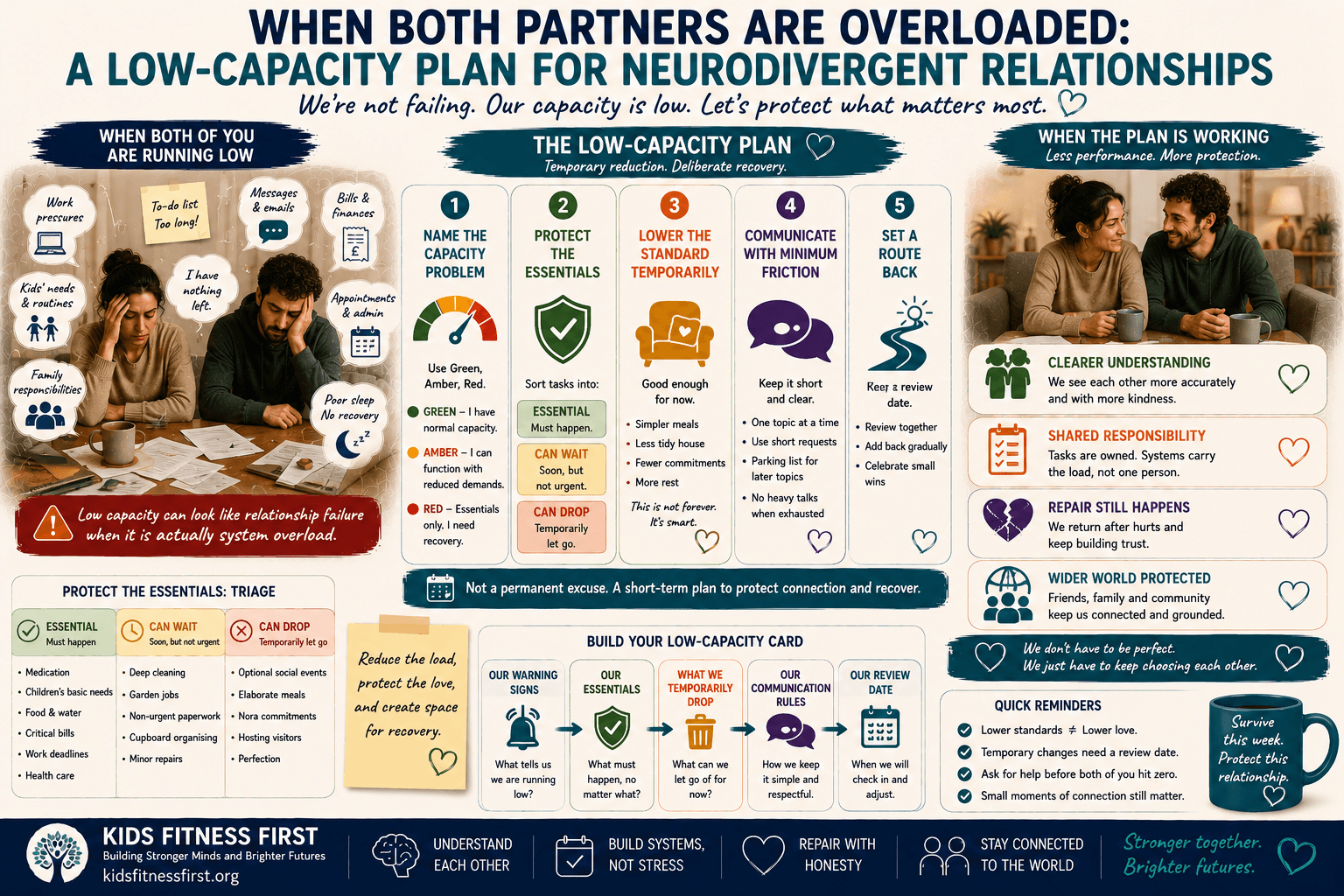
When Both Partners Are Overloaded: A Low-Capacity Plan for Neurodivergent Relationships
Neurodivergent relationship overload can become particularly difficult when both partners reach their limits at the same time.
Usually, couples compensate for each other.
One person has a difficult day, while the other has enough capacity to cook dinner.
Likewise, one partner becomes overloaded, while the other manages the children’s routine.
Perhaps one person forgets something, while the other remembers.
For much of adult life, this flexibility allows relationships to keep moving.
However, eventually there are periods when both people are tired.
Both are stressed.
Both need quiet.
Both have responsibilities they cannot postpone.
Meanwhile, the children still need feeding.
The bills still arrive.
Work continues.
Appointments remain in the calendar.
Consequently, the relationship reaches an uncomfortable point:
Nobody has spare capacity to compensate for anybody else.
At that moment, couples can easily misinterpret what is happening.
One partner thinks:
“You are not supporting me.”
Meanwhile, the other thinks:
“I have nothing left to give.”
Both statements may contain truth.
Therefore, the answer is not necessarily asking one person to try harder.
Instead, the couple may need to temporarily change how the entire household operates.
That is the purpose of a Low-Capacity Plan.
What Relationship Overload Actually Looks Like
Relationship overload does not always look dramatic.
Sometimes it looks like silence.
Perhaps both people sit on the sofa scrolling because conversation requires too much energy.
Alternatively, it may look like irritation.
Small household problems suddenly feel enormous.
A cup left on the table becomes:
“Why am I always the one who has to deal with everything?”
A forgotten message becomes:
“You don’t listen to me.”
Meanwhile, a simple question sounds like criticism.
A normal request feels like pressure.
As a result, both partners begin reacting to ordinary life as though it contains far more threat than usual.
This does not necessarily mean the relationship itself has suddenly deteriorated.
Instead, capacity may have deteriorated.
That distinction is extremely important.
Capacity Changes Behaviour
When capacity is high, a person may:
- tolerate noise;
- recover quickly;
- remember tasks;
- communicate patiently;
- manage disappointment;
- switch attention;
- and cope with changes of plan.
However, when capacity is low, the same person may struggle with several of those things.
Therefore, if both partners have reduced capacity simultaneously, the household may experience:
- more forgetting;
- more irritability;
- slower processing;
- stronger emotional responses;
- more withdrawal;
- less patience;
- less social energy;
- and reduced ability to repair quickly.
At first, this may look like a sudden increase in relationship problems.
However, some of those problems may actually be signs of nervous-system depletion.
Therefore, before diagnosing the entire relationship, ask:
“Are we currently trying to operate at normal expectations with abnormal capacity?”
That question can change the next step.
The Mistake of Expecting Normal Performance
Imagine both partners are exhausted.
One is dealing with a major work deadline.
Meanwhile, the other is sleeping badly and caring for an unwell parent.
The household still expects:
- normal meals;
- a clean home;
- full social commitments;
- perfect parenting;
- prompt responses;
- emotional availability;
- intimacy;
- household planning;
- exercise;
- and cheerful connection.
Eventually, something fails.
Then somebody says:
“We need to get more organised.”
Perhaps.
However, organisation may not be the central problem.
There may simply be too much demand for the available capacity.
Therefore, one of the most useful principles during overload is:
Do not keep normal expectations when capacity is temporarily abnormal.
Instead, reduce the load.
The Low-Capacity Plan
The Low-Capacity Plan has five steps:
- Name the Capacity Problem
- Protect the Essentials
- Lower the Standard Temporarily
- Communicate With Minimum Friction
- Set a Route Back
The plan is temporary.
Therefore, it is not a permanent excuse for avoiding responsibility.
Instead, it is a short-term operating mode for periods when both nervous systems are depleted.
Step 1: Name the Capacity Problem
First, recognise what is happening.
Try saying:
“I think both of us are running very low right now.”
That sentence is different from:
“You are impossible at the moment.”
Likewise, it is different from:
“Our relationship is falling apart.”
Instead, it identifies the current condition.
Perhaps:
“We have too much demand and not enough capacity.”
That wording matters because it moves the problem away from character.
Consequently, the couple can begin solving it together.
Separate Capacity From Commitment
Low capacity does not automatically mean low commitment.
For example, somebody may deeply love their partner while having no energy for a long conversation tonight.
Likewise, they may care about household standards while being unable to maintain them temporarily.
Therefore, avoid turning:
“I cannot do this right now”
into:
“I do not care about this.”
Those are not the same sentence.
A useful replacement may be:
“This still matters to me. However, I do not have enough capacity for it today.”
That communicates both commitment and limitation.
Use a Simple Capacity Scale
When both people are depleted, long explanations can create more strain.
Therefore, use a simple scale.
For example:
GREEN — I have normal capacity.
AMBER — I can function, but I need reduced demands.
RED — Essentials only. I need recovery.
Perhaps one partner says:
“I’m red tonight.”
The other says:
“I’m amber.”
Now the household has useful information.
You do not need a forty-minute explanation about exactly why.
Instead, you know what level of demand is realistic.
Step 2: Protect the Essentials
Next, decide what genuinely must happen.
During overload, everything can feel equally urgent.
However, it is not.
Therefore, create three temporary categories:
Essential
Can Wait
Can Drop
For example:
| Essential | Can Wait | Can Drop Temporarily |
|---|---|---|
| Medication | Deep cleaning | Optional social event |
| Children’s basic needs | Garden jobs | Elaborate meals |
| Critical bills | Non-urgent paperwork | Perfect household standards |
| Work deadlines | Cupboard organising | Hosting visitors |
| Necessary appointments | Minor repairs | Extra commitments |
This is not laziness.
Instead, it is triage.
Hospitals do not treat every patient as though they have the same urgency.
Likewise, overloaded households should not treat every task as though it has the same importance.
Ask What Actually Breaks if This Waits
When a task appears, ask:
“What happens if this waits seven days?”
Sometimes the answer is:
Nothing significant.
Therefore, postpone it.
For example, the kitchen cupboard does not need reorganising this weekend.
However, the electricity bill may need paying.
Likewise, the family does not need a perfect Sunday lunch.
However, everyone does need food.
This distinction reduces unnecessary demand.
One Person Does Not Become the Emergency System
There is an important warning here.
The Low-Capacity Plan should not mean:
“The more capable partner takes everything.”
That recreates invisible labour and eventually the Parent Trap.
Instead, both adults ask:
“Given our current capacity, what can each of us realistically own?”
Perhaps one partner has very little emotional capacity but can still manage a simple practical task.
Meanwhile, the other may be physically exhausted but capable of making one necessary phone call.
Therefore, ownership should reflect current capacity rather than default relationship roles.
Step 3: Lower the Standard Temporarily
This can be surprisingly difficult.
Many people would rather exhaust themselves than accept a temporary reduction in standards.
However, perfection is expensive.
Therefore, during low-capacity periods, ask:
“What is good enough for now?”
For example:
Dinner can be simple.
The home can be less tidy.
Messages can receive shorter replies.
Likewise, social obligations can be declined.
The children may watch more television than usual.
Perhaps laundry remains unfolded for two days.
None of these automatically represents failure.
Instead, they may represent deliberate conservation of energy.
Temporary Standards Need a Name
The word temporary matters.
Without it, one partner may worry:
“Is this how life will be from now on?”
Therefore, say explicitly:
“For the next two weeks, we are operating at reduced household standards because both of us are overloaded.”
Now the change has a boundary.
That creates reassurance.
Likewise, it prevents temporary adaptation becoming permanent drift without discussion.
Good Enough Is Not Giving Up
Consider two possible meals.
One is homemade with several components.
The other is soup, bread and fruit.
Both feed the family.
Therefore, during overload, the second option may be the smarter one.
Likewise, perhaps the house is usually cleaned thoroughly on Saturday.
However, this week only the kitchen and bathroom are handled.
Again, good enough.
The aim is not maximum performance.
Instead, the aim is to protect functioning while capacity recovers.
Step 4: Communicate With Minimum Friction
Low-capacity periods are not ideal for long, emotionally complex discussions.
That does not mean avoiding important subjects indefinitely.
However, communication may need temporary compression.
Therefore, use the Article 12 principles more aggressively:
Timing
Channel
Preview
Compression
For example:
Instead of:
“We need to discuss everything that has been going wrong lately.”
try:
“We are both overloaded. Tonight I only need us to decide tomorrow morning’s school run.”
One topic.
One decision.
Then stop.
Use Short Operational Language
During overload, simple language can help.
For example:
“I’m red.”
“I need twenty minutes.”
“Can you handle dinner?”
“I can do bedtime, but not dishes.”
“This needs discussing, but not tonight.”
“Can we put that on Friday’s list?”
These sentences reduce interpretation.
Therefore, they reduce friction.
Most importantly, they communicate capacity without turning every request into an emotional referendum on the relationship.
Create a Temporary Parking List
Important subjects may still appear.
However, perhaps neither person has enough capacity to discuss them well.
Therefore, create a temporary Parking List.
For example:
Discuss when capacity returns:
- holiday planning;
- household budget;
- issue with extended family;
- division of a particular responsibility;
- social plans next month.
Writing the issue down does two things.
First, it reassures the person raising it that the subject has not disappeared.
Second, it allows both nervous systems to postpone it without relying on memory.
That is useful architecture.
Step 5: Set a Route Back
A low-capacity mode should have an exit.
Otherwise, temporary reduction can become a permanent new normal.
Therefore, set a review point.
Perhaps:
“Let’s review this next Sunday.”
Or:
“When the work deadline finishes on the 20th, let’s look again at the household.”
The review does not mean everything instantly returns to full capacity.
Instead, ask:
“What has recovered enough to add back?”
Perhaps one social commitment returns.
Then normal meal planning.
Later, deeper household tasks.
Gradually, the system expands again.
Recovery Should Be Gradual
A common mistake is emerging from overload and immediately restoring every demand.
For example:
“Work crisis finished. Great — let’s catch up on everything.”
However, nervous systems may still be depleted.
Therefore, recovery often requires a ramp rather than a switch.
First, restore sleep and basic routines.
Next, restore ordinary household systems.
Afterwards, reintroduce optional social commitments.
Finally, return to larger projects.
That sequence reduces the chance of immediately collapsing again.
The Five-Step Low-Capacity Plan at a Glance
| Step | Key Question | Practical Action |
|---|---|---|
| 1. Name It | Are we both depleted? | Use Green / Amber / Red |
| 2. Protect Essentials | What genuinely must happen? | Essential / Wait / Drop |
| 3. Lower Standards | What is good enough temporarily? | Reduce household and social expectations |
| 4. Reduce Communication Friction | What is the smallest useful conversation? | One topic, clear request, parking list |
| 5. Set a Route Back | When will we review this? | Set date and restore demands gradually |
The framework is intentionally simple.
During overload, complicated systems are less likely to be used.
Therefore, simplicity is part of the design.
What This Plan Is Not
The Low-Capacity Plan is not an excuse for:
- intimidation;
- abusive behaviour;
- abandoning children;
- ignoring critical financial responsibilities;
- refusing necessary medical care;
- or indefinitely avoiding important relationship issues.
Likewise, it should not become a permanent arrangement in which one partner repeatedly claims overload while the other carries everything.
Instead, it is a temporary shared strategy.
Therefore, if one person is chronically overloaded for months or years, the issue may require deeper practical or professional support.
When Low Capacity Becomes Chronic
Sometimes the temporary state does not end.
Perhaps one or both people remain depleted for months.
Then ask:
“Is our life structurally demanding more than our available capacity?”
That question is different from:
“How do we become better at coping?”
Perhaps coping is not the answer.
Instead, something larger may need changing.
For example:
- working hours;
- childcare;
- caring responsibilities;
- household expectations;
- finances;
- social obligations;
- or access to support.
If every week requires emergency-mode functioning, then emergency mode is no longer the problem.
The ordinary life structure may be the problem.
That requires redesign.
Neurodivergent Relationship Overload and Shame
Overload can easily activate shame.
You may think:
“Other couples cope with this.”
Or:
“Why can’t we manage normal life?”
However, comparison usually ignores invisible variables.
Another household may have:
- grandparents helping;
- different jobs;
- more money;
- fewer sensory demands;
- easier children;
- more sleep;
- or different nervous systems.
Therefore, the useful question is not:
“Why can’t we cope like them?”
Instead:
“What does our actual household require?”
That returns attention to design.
Reflection: What Does Overload Look Like in Your Relationship?
Think about the last period when both of you were stretched.
Perhaps it is happening now.
Answer separately first.
What Are Your Early Warning Signs?
For example:
- irritation;
- silence;
- forgotten tasks;
- more takeaways;
- avoiding messages;
- messy rooms;
- interrupted sleep;
- less affection;
- shorter patience;
- or wanting to be alone.
Complete:
“When my capacity begins dropping, the first thing that usually changes is…”
Then ask your partner the same question.
Knowing the early signs makes intervention possible earlier.
What Do You Misread When Your Partner Is Overloaded?
Perhaps their silence feels like rejection.
Alternatively, their irritability feels like lack of love.
Maybe their need for space feels selfish.
Complete:
“When you are overloaded, I sometimes interpret __________ as __________.”
Then ask:
“What may actually be happening instead?”
This reconnects overload with accurate mutual recognition.
What Standards Become Unnecessarily Expensive?
List three.
For example:
- perfect meals;
- spotless house;
- replying immediately to everyone;
- attending every family event;
- maintaining every hobby;
- or keeping normal social commitments.
Now ask:
“Which of these could temporarily become good enough?”
What Is Truly Essential?
Write five things only.
Perhaps:
- medication;
- children’s immediate care;
- food;
- critical work;
- essential bills.
Notice how much is not on the list.
That may be useful.
What Should Your Partner Know When You Say “I Have Nothing Left”?
Perhaps you mean:
“I need quiet.”
Or:
“I can manage practical tasks but not emotional conversation.”
Or:
“I need you to take the next hour.”
Make the sentence more precise.
Specific capacity language is easier to act upon.
What Would Your Low-Capacity Mode Look Like?
Complete:
“When both of us are red, our household temporarily…”
For example:
- simplifies meals;
- cancels optional commitments;
- uses only essential chores;
- communicates briefly;
- protects sleep;
- and postpones non-urgent decisions.
Write your version.
Reflection Takeaway
Complete:
“When both of us are depleted, we do not need to prove that we can maintain normal performance. Instead, we need to…”
Perhaps:
protect essentials.
reduce expectations.
communicate clearly.
recover.
ask for help.
That sentence can become your household rule.
Try This: Build Your Low-Capacity Card
Create one page or note on your phone.
Title it:
WHEN WE ARE BOTH RUNNING LOW
Then include five sections.
OUR WARNING SIGNS
For example:
- snapping;
- forgetting;
- withdrawing;
- poor sleep.
OUR ESSENTIALS
Maximum five.
WHAT WE TEMPORARILY DROP
For example:
- optional social events;
- major household jobs;
- elaborate cooking.
OUR COMMUNICATION RULES
For example:
- use Green / Amber / Red;
- one topic at a time;
- write down parked issues;
- no major conversations after 9pm.
OUR REVIEW POINT
For example:
- every Sunday while overload continues.
Keep the card easy to find.
The point is that you do not want to design the emergency system while both of you are already in the emergency.
Build it while capacity is reasonable.
Then use it when needed.
Ask for Help Before Both People Hit Zero
Another important lesson is timing.
Couples often seek outside help only after both partners are already depleted.
However, help may be easier to arrange earlier.
For example:
- ask family to collect the children;
- use a cleaner temporarily;
- order simpler meals;
- postpone a social commitment;
- delegate a work task;
- ask a friend for practical help;
- or speak to an appropriate professional.
Support is often treated as something couples should need only after they fail.
That assumption is backwards.
In fact, support can be part of preventing failure.
The Partner With Slightly More Capacity Does Not Become the Hero
Sometimes one partner is Red and the other is Amber.
Therefore, the Amber partner may temporarily do more.
That can be sensible.
However, watch the narrative.
Do not turn:
“I currently have slightly more capacity”
into:
“I am the responsible one again.”
Likewise, the Red partner should not assume:
“You are coping better, so everything belongs to you.”
Instead, keep the arrangement explicit and temporary.
For example:
“I can take dinner and bedtime tonight. Tomorrow morning, can you handle breakfast if you have recovered?”
This preserves partnership.
Protect Connection in Tiny Doses
When both people are exhausted, romance may feel unrealistic.
However, complete emotional disconnection can make overload feel even worse.
Therefore, protect tiny moments.
For example:
- sit together for five minutes;
- make a cup of tea;
- hold hands;
- send one warm message;
- say goodnight properly;
- or acknowledge:
“This is a hard week. I still love you.”
These moments do not need to become another task.
Instead, they remind both people:
The difficult period is happening around the relationship. It is not necessarily the whole relationship.
That distinction can be reassuring.
Do Not Make Major Relationship Decisions at Peak Depletion
This deserves special emphasis.
When both nervous systems are exhausted, everything can feel permanent.
You may think:
“We are incompatible.”
“Nothing will ever change.”
“I cannot do this anymore.”
Sometimes those thoughts reflect genuine long-term issues.
However, severe depletion can also narrow perspective.
Therefore, where safety is not at issue, consider postponing major relationship decisions until both people have had some opportunity to recover.
This does not mean ignoring serious problems.
Instead, it recognises that exhausted nervous systems are often poor strategic planners.
First stabilise.
Then evaluate more clearly.
The Goal Is Not to Avoid Hard Periods
Every long relationship will eventually enter seasons when both people have less to give.
Illness happens.
Caregiving happens.
Children struggle.
Jobs become difficult.
Money becomes stressful.
Sleep disappears.
Therefore, the goal is not to design a relationship that never becomes overloaded.
That would be unrealistic.
Instead, the goal is to have a shared response when overload arrives.
Without a plan, both people may interpret depletion as relationship failure.
With a plan, they can say:
“We recognise this state. We know what to do next.”
That creates safety.
Conclusion: When Both of You Have Less, Make the Life Smaller for a While
Neurodivergent relationship overload becomes especially dangerous when two depleted people keep demanding normal performance from themselves and each other.
Therefore, when both nervous systems are running low:
First, name the capacity problem.
Then, protect the essentials.
Next, lower standards temporarily.
Afterwards, reduce communication friction.
Finally, set a route back.
Most importantly, remember:
Reducing the load is not the same as reducing the love.
Sometimes the strongest thing a couple can do is not push harder.
Instead, it is to make life temporarily smaller.
Simpler meals.
Fewer commitments.
Shorter conversations.
More sleep.
Clearer ownership.
Less pretending.
Then, as capacity returns, the world can expand again.
A strong relationship does not prove its strength by performing normally through every crisis.
Sometimes it proves its strength by recognising:
“This is too much for both of us right now. Therefore, we are going to protect what matters most until we have more to give.”
That is not giving up.
It is intelligent relationship design.
SUGGESTED INTERNAL LINKS
Article : Adult ADHD and Job Interviews: How to Present Your Strengths Without Pretending to Be Someone Else
Article : Adult ADHD and Job Interviews: How to Present Your Strengths Without Pretending to Be Someone Else
DISCLAIMER
This article is provided for general educational and informational purposes only. It is not medical, psychological, diagnostic, relationship or couples-therapy advice.
Neurodivergent people and couples differ considerably in their capacity, support needs and circumstances. Therefore, the Low-Capacity Plan should be adapted to the people and household involved.
Temporary reduction in expectations should not be used to justify neglect of essential care, financial responsibilities, abusive behaviour, intimidation, coercive control or the indefinite transfer of adult responsibility to one partner.
Where severe exhaustion, burnout, depression, persistent relationship conflict or safety concerns are present, appropriately qualified professional support may be needed.