Adult ADHD and Job Interviews: How to Present Your Strengths Without Pretending to Be Someone Else
Adult ADHD and job interviews can create a strange situation.
You may be highly capable of doing the actual job.
However, the interview may test a very different set of abilities.
For example, you may be expected to:
remember several examples instantly;
organise an answer while speaking;
maintain eye contact;
interpret vague questions;
stay concise;
sound confident;
remember what you wanted to ask.
Therefore, struggling with the interview process does not automatically mean you would struggle with the role.
Instead, the interview is one specific performance environment.
That means it can be prepared for.
The Interview Is Not the Job
This distinction matters.
Suppose the role requires:
analysis;
problem-solving;
technical knowledge;
client judgement.
However, the interview requires you to answer:
“Tell me about yourself.”
in sixty seconds.
Those are very different tasks.
Therefore, do not judge your professional value entirely by how naturally you perform in interview conditions.
Instead, prepare for the interview as its own task.
Adult ADHD and Job Interviews: Preparation Reduces Cognitive Load
The more you prepare in advance, the less you need to invent in the moment.
For example, before the interview, prepare:
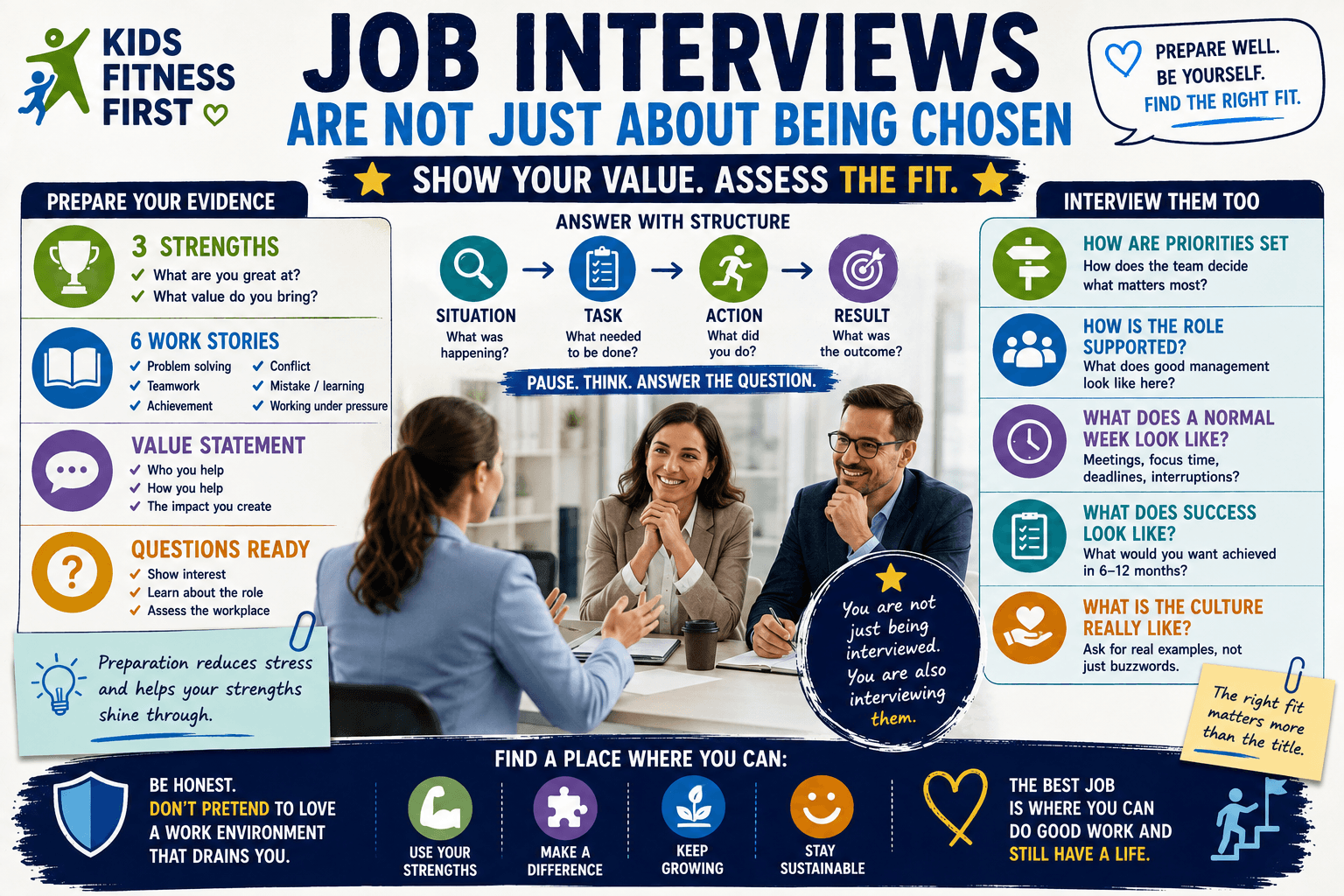
three strengths;
three work examples;
one difficult situation;
one achievement;
one mistake and what you learned;
three questions for the employer.
Therefore, instead of searching your entire career history while under pressure, you already have a smaller set of examples ready.
As a result, your answers can become clearer.
Build an Interview Evidence Bank
Create a simple document.
STRENGTH 1
Example
Result
STRENGTH 2
Example
Result
STRENGTH 3
Example
Result
Therefore, your interview preparation becomes evidence-based rather than dependent on memory alone.
Adult ADHD and Job Interviews: Use Career Archaeology
Article 19 introduced Career Archaeology.
Now use it for interview preparation.
Look back through:
previous roles;
projects;
volunteering;
side work;
difficult situations;
successful outcomes.
Then identify the examples that best demonstrate your strengths.
Therefore, you do not need to invent a perfect career story.
Instead, you use evidence you already have.
Choose Examples That Show Value
A good example should show:
what was happening;
what you did;
what changed.
For example:
“A project was repeatedly delayed at the approval stage. I mapped the process, identified the bottleneck and suggested a simpler route. As a result, the team reduced repeated delays.”
That answer shows much more than:
“I am good at problem-solving.”
Therefore, examples make strengths believable.
Adult ADHD and Job Interviews: The Simple Four-Part Answer
Use this structure:
1. SITUATION
What was happening?
2. TASK
What needed to be done?
3. ACTION
What did you personally do?
4. RESULT
What changed?
This is similar to the commonly used STAR interview structure.
Therefore, if your thoughts tend to spread in several directions, the structure can help keep answers focused.
Do Not Memorise Every Word
Memorising a perfect script can create another problem.
If you forget one sentence, you may lose the whole answer.
Therefore, memorise the structure, not every word.
For example:
Problem → action → result
That is usually enough.
As a result, the answer remains natural while still having direction.
Adult ADHD and Job Interviews: Prepare Your Opening
One of the most common questions is:
“Tell me about yourself.”
Without preparation, this can become extremely broad.
Therefore, prepare a short professional answer.
A useful structure is:
PRESENT
What do you do now?
PAST
What relevant experience have you built?
FUTURE
Why does this role interest you?
For example:
“I currently work in project operations, where my strongest areas are problem-solving and process improvement. Over the last several years, I have worked across customer service and operational roles, particularly on projects that required identifying bottlenecks and improving systems. I am now looking for a role where I can use more of that analytical and improvement-focused work.”
That is clearer than trying to tell your entire life story.
Adult ADHD and Job Interviews: Keep Answers Relevant
You may remember several related details while speaking.
However, not all of them need to be included.
Therefore, ask yourself:
“What is the interviewer actually trying to learn?”
For example:
Question:
“Tell me about a difficult customer.”
The interviewer probably wants to know how you handle:
conflict;
judgement;
communication;
professionalism.
Therefore, focus the answer on those areas.
The 90-Second Rule
Many interview answers do not need to be extremely long.
Therefore, a useful practice exercise is to answer common questions in around 60–90 seconds.
This is not a strict rule.
However, it can help you learn to select the most important information.
As a result, your answers may become more concise without becoming robotic.
Adult ADHD and Job Interviews: Pause Before Answering
Silence can feel uncomfortable.
However, you do not have to answer immediately.
For example, you can say:
“That’s a good question. Let me think of the best example.”
Then pause briefly.
Therefore, you give yourself time to organise the answer.
A thoughtful pause usually looks more professional than rushing into an answer you cannot structure.
Ask for Clarification
Interview questions can sometimes be vague.
For example:
“Tell me about a challenge.”
What type of challenge?
Technical?
Interpersonal?
Deadline-related?
Therefore, if necessary, ask:
“Would you prefer an example involving a project issue or a people-management challenge?”
As a result, you reduce ambiguity and can give a more relevant answer.
Adult ADHD and Job Interviews: Use Notes Carefully
Depending on the interview format, it may be appropriate to bring a small notebook.
For example, you might write:
three strengths;
three examples;
questions to ask;
key facts about the role.
Therefore, you do not need to hold everything in working memory.
However, avoid reading continuously from notes.
Instead, use them as prompts.
Video Interviews
Video interviews can reduce some pressures.
For example, you can keep concise notes near the screen.
However, they can also create new distractions.
For example:
notifications;
connection problems;
seeing your own image;
background noise.
Therefore, prepare the digital environment.
Before the interview:
close unnecessary tabs;
silence notifications;
test sound;
check camera position;
keep water nearby.
As a result, fewer avoidable distractions compete for attention.
Adult ADHD and Job Interviews: In-Person Interviews
For an in-person interview, reduce avoidable uncertainty.
For example:
check the location;
plan travel time;
know the contact name;
bring the job description;
bring a notebook;
arrive with reasonable time to settle.
Therefore, you preserve cognitive energy for the actual conversation.
Prepare for Competency Questions
Common questions may include:
“Tell me about a time you solved a problem.”
“Tell me about a conflict.”
“Tell me about a mistake.”
“Tell me about a time you worked under pressure.”
Therefore, prepare examples in advance.
You can often reuse the same experience for different questions by highlighting a different part.
Adult ADHD and Job Interviews: Build a Six-Story Bank
Prepare six strong stories.
STORY 1 — PROBLEM-SOLVING
STORY 2 — TEAMWORK
STORY 3 — CONFLICT
STORY 4 — ACHIEVEMENT
STORY 5 — MISTAKE / LEARNING
STORY 6 — PRESSURE / DEADLINE
Therefore, many interview questions can be answered from a small number of well-understood examples.
Strength Questions
You may be asked:
“What are your strengths?”
Avoid giving only generic words.
Instead, connect each strength to evidence.
For example:
“One of my strongest areas is pattern recognition. In my last role, I noticed that several customer complaints were coming from the same stage in the process. I raised it, we changed the workflow and the repeated issue reduced.”
Therefore, the strength becomes credible.
Adult ADHD and Job Interviews: Weakness Questions
You may also be asked:
“What is your biggest weakness?”
This question can feel uncomfortable.
However, the interviewer is often assessing:
self-awareness;
responsibility;
improvement.
Therefore, avoid saying:
“I have no weaknesses.”
Likewise, avoid sharing something so serious that it undermines your suitability for the role.
Instead, choose a genuine area you actively manage.
For example:
“I can sometimes spend too long refining detailed work, so I now define the required standard and deadline before I begin.”
That shows awareness and a practical response.
Do Not Turn ADHD Into the Weakness Answer Automatically
If you have ADHD, you do not need to use the diagnosis as your weakness answer.
Instead, answer the interview question in relation to the role.
For example:
time estimation;
over-refining work;
delegation;
public speaking.
Therefore, disclosure and interview technique remain separate decisions.
This connects directly to Article 20.
Adult ADHD and Job Interviews: Disclosure Is Your Decision
You may be wondering:
“Should I tell them I have ADHD?”
There is no universal answer.
Therefore, use the framework from Article 20.
Ask:
What would disclosure achieve?
Is an accommodation needed during the recruitment process?
Who needs to know?
How much information is necessary?
Therefore, disclosure should be purposeful rather than automatic.
Recruitment Accommodations
Some candidates may need adjustments during recruitment.
Depending on circumstances and applicable law, examples could potentially include:
additional time for certain assessments;
clear written instructions;
an accessible interview format;
other appropriate arrangements.
However, specific rights and procedures depend on jurisdiction and individual circumstances.
Therefore, where formal recruitment accommodations are needed, use authoritative guidance or appropriate professional advice.
Adult ADHD and Job Interviews: Do Not Pretend to Love Your Collapse Conditions
This is a major career-fit issue.
Suppose you know from Article 12 that constant interruption is one of your strongest Collapse Conditions.
Then the interviewer says:
“This is a very chaotic environment. Everyone is constantly interrupted and priorities change every hour. Do you enjoy that?”
You may feel tempted to say:
“Absolutely.”
However, that may win the interview while creating a poor job fit.
Therefore, do not sell yourself into a working environment you already know is unsustainable.
You Are Interviewing Them Too
An interview is not only the employer assessing you.
It is also an opportunity for you to investigate the workplace.
Therefore, ask questions about:
management;
autonomy;
work environment;
priorities;
meetings;
performance expectations.
As a result, you can assess whether the job matches your Work That Fits profile.
Adult ADHD and Job Interviews: Ask About Priorities
A useful question is:
“How are priorities normally set when several things are urgent at the same time?”
The answer may reveal a great deal.
For example:
“The manager ranks them every morning.”
suggests one system.
Meanwhile:
“Everything is urgent and people just deal with whatever is loudest.”
suggests another.
Therefore, listen carefully.
Ask About Management Style
Try:
“How does the manager normally work with the person in this role?”
Or:
“How often are one-to-one or progress meetings held?”
Therefore, you can compare the answer with your Autonomy Profile from Article 18.
Adult ADHD and Job Interviews: Ask About Focus Time
If the role contains complex individual work, ask:
“How much uninterrupted time does someone in this role normally have for focused work?”
This can reveal whether the actual environment supports deep work.
Therefore, the question connects directly to Articles 14, 16 and 17.
Ask About Meetings
You can ask:
“Roughly how much of a normal week is spent in meetings?”
That is especially useful if meeting load significantly affects your energy.
Therefore, use the interview to investigate practical working conditions.
Adult ADHD and Job Interviews: Ask What Success Looks Like
One of the strongest questions is:
“What would you want the successful person to have achieved after six or twelve months?”
This reveals:
real priorities;
expected outcomes;
whether the role is clearly defined.
Therefore, you learn what the organisation genuinely values.
Ask About Excellent Performance
Try:
“What distinguishes someone who performs exceptionally well in this role?”
The answer may reveal whether the company values:
speed;
accuracy;
relationship skills;
initiative;
problem-solving;
constant availability.
Therefore, compare those expectations with your own strengths.
Adult ADHD and Job Interviews: Look for Evidence of Culture
Employers often describe themselves using words such as:
dynamic;
fast-paced;
entrepreneurial;
supportive;
flexible.
However, these words can mean very different things.
Therefore, ask for examples.
For example:
“You mentioned that the culture is flexible. What does that look like in practice?”
As a result, you move from marketing language to actual behaviour.
“Fast-Paced” Can Mean Several Things
For one employer, fast-paced may mean:
interesting projects;
quick decisions;
high autonomy.
For another, it may mean:
constant emergencies;
unclear priorities;
understaffing.
Therefore, do not assume the phrase is good or bad.
Instead, investigate what it means in that workplace.
Adult ADHD and Job Interviews: “Flexible” Can Also Mean Different Things
Flexible might mean:
control over task order;
hybrid working;
outcome-based management.
However, it could also mean:
unpredictable hours;
constant availability;
changing responsibilities.
Therefore, ask:
“Could you give me an example of how flexibility works in a normal week?”
Watch How the Interview Is Conducted
The interview process itself can provide clues.
For example:
Were instructions clear?
Was communication organised?
Did interviewers arrive prepared?
Were you treated respectfully?
Did the questions relate to the job?
Therefore, the recruitment process can sometimes reveal aspects of the organisation’s working culture.
Adult ADHD and Job Interviews: Avoid Over-Masking
Article 4 explored workplace masking.
An interview naturally involves professional presentation.
However, there is a difference between presenting your best professional self and pretending to be somebody fundamentally different.
For example, you do not need to pretend that you:
love constant interruption;
want endless meetings;
thrive on vague instructions
if your experience consistently shows otherwise.
Therefore, aim for professional honesty.
Professional Honesty Does Not Mean Saying Everything
You do not need to tell the interviewer every dislike or difficulty.
Instead, communicate what helps you perform well.
For example:
“I perform particularly well when priorities are clear and I have ownership over how I deliver the result.”
That is positive, professional and informative.
Adult ADHD and Job Interviews: Describe Conditions as Strength Enablers
Instead of saying:
“I can’t work in noisy offices.”
you might say:
“For complex analytical work, I produce my strongest output when I have protected concentration time.”
Therefore, the statement remains focused on performance.
This mirrors the functional language used in Articles 20 and 21.
Your Strength Statement
Article 10 introduced a Cognitive Signature.
Now turn it into a short interview statement.
For example:
“My strongest work usually involves analysing a complicated problem, identifying what is actually driving it and then explaining a practical solution clearly.”
That statement is far more memorable than:
“I am hardworking and motivated.”
Adult ADHD and Job Interviews: Build Your Value Statement
Use this template:
“I create the most value when I use __________ to help __________ achieve __________.”
For example:
“I create the most value when I use systems thinking and problem-solving to help teams identify operational bottlenecks and improve delivery.”
Therefore, your interview message becomes focused on contribution.
Why Do You Want This Job?
A good answer should go beyond:
“It looks interesting.”
Instead, connect the role to your strengths.
For example:
“The part that interests me most is the process-improvement responsibility because that is where I have consistently produced my strongest work.”
Therefore, you demonstrate both motivation and fit.
Adult ADHD and Job Interviews: Research the Role Properly
Before the interview, identify:
the main responsibilities;
the likely problems;
the organisation’s priorities;
recent changes where relevant;
what skills the role appears to value.
Then ask:
“Which parts of my experience best match these needs?”
As a result, you can select relevant examples rather than telling the interviewer everything you have ever done.
Use the Job Description as a Map
Print or save the job description.
Then highlight:
MUST HAVE
Essential skills.
IMPORTANT
Major responsibilities.
THEMES
Repeated words or priorities.
Therefore, if problem-solving appears five times, prepare a strong problem-solving example.
Likewise, if stakeholder communication is central, prepare evidence for that.
Adult ADHD and Job Interviews: The Interview Match Table
Use this table.
| Employer Needs | My Evidence |
|---|---|
| Problem-solving | |
| Communication | |
| Project delivery | |
| Teamwork | |
| Technical knowledge |
Therefore, your preparation becomes directly linked to the role.
Prepare Questions in Writing
Near the end, the interviewer will often ask:
“Do you have any questions for us?”
Without preparation, your mind may go blank.
Therefore, write three to five questions beforehand.
For example:
- How are priorities normally set?
- What does excellent performance look like?
- How much autonomy does the role have?
- What does a typical week look like?
- What would you want the person to achieve in the first six months?
As a result, you do not depend on remembering them under pressure.
Adult ADHD and Job Interviews: Your 24-Hour Preparation Checklist
THE DAY BEFORE
Review the job description.
Choose six stories.
Prepare your strength statement.
Prepare employer questions.
Check interview location or video link.
Choose clothing.
Gather documents.
THE MORNING OF THE INTERVIEW
Review key points.
Do not try to learn everything again.
Allow enough travel or setup time.
Reduce avoidable distractions.
Therefore, you arrive with more cognitive capacity available.
The Five-Minute Reset
Immediately before the interview:
stop reviewing endless notes;
put away unrelated information;
drink water;
take a moment to settle;
review only:
three strengths;
three key examples;
three questions.
Therefore, your final preparation remains simple.
Adult ADHD and Job Interviews: What If You Lose Your Train of Thought?
It happens.
If you lose your place, you can say:
“Let me bring that back to the main point.”
Or:
“I think I went slightly wider than the question. The main result was…”
Then continue.
Therefore, you do not need to panic because an answer became messy.
Recovering calmly can itself demonstrate communication skill.
What If You Cannot Think of an Example?
You can ask for a moment.
For example:
“Let me think about the most relevant example.”
Alternatively, you can ask whether you may return to the question later.
Whether that is appropriate depends on the interview format.
However, a brief thoughtful pause is usually preferable to inventing a weak answer.
Adult ADHD and Job Interviews: After the Interview
Do not immediately rely on memory.
Instead, write down:
what went well;
what was difficult;
what you learned about the job;
what you learned about the workplace;
what you would answer differently next time.
Therefore, every interview becomes part of your Career Evidence File.
The Interview Debrief
Score:
| Area | Score |
|---|---|
| Preparation | /10 |
| Answer clarity | /10 |
| Strength evidence | /10 |
| Workplace fit | /10 |
| Management fit | /10 |
| Environment fit | /10 |
| Interest in role | /10 |
Then ask:
“Do I want this job more, less or the same after learning more?”
That question matters.
Adult ADHD and Job Interviews: Do Not Confuse Rejection With Worth
You may perform well and still not receive the job.
There may be:
another candidate with more experience;
an internal candidate;
a change in budget;
a different skill requirement.
Therefore, rejection is information, not a complete judgement of your ability.
Instead, identify anything useful you can learn.
One Interview Does Not Define You
Likewise, one weak interview does not mean:
“I am bad at interviews forever.”
Interviewing is a skill.
Therefore, preparation and repeated practice can improve performance.
As a result, treat interviews as learnable rather than as a test of personality.
Adult ADHD and Job Interviews: Your Interview Preparation Sheet
Complete this before your next interview.
MY THREE STRONGEST RELEVANT STRENGTHS
MY SIX INTERVIEW STORIES
- Problem-solving: ______________________
- Teamwork: ___________________________
- Conflict: _____________________________
- Achievement: _________________________
- Mistake / learning: ____________________
- Pressure: ____________________________
MY VALUE STATEMENT
WHAT I WANT TO KNOW ABOUT THE EMPLOYER
MY THREE QUESTIONS
Adult ADHD and Job Interviews: Green, Amber and Red Job-Fit Signals
GREEN — PROMISING FIT
The role uses your strengths.
Likewise, priorities appear clear.
Management sounds supportive.
The environment appears workable.
Therefore, the role may deserve further consideration.
AMBER — INVESTIGATE
Some parts sound good.
However, important questions remain around:
workload;
autonomy;
meetings;
environment.
Therefore, gather more information.
RED — POOR FIT WARNING
The role strongly depends on conditions that repeatedly appear in your Collapse Conditions.
For example:
constant chaos;
heavy interruption;
no prioritisation;
unsustainable expectations.
Therefore, do not ignore the warning simply because you want an offer.
The Most Important Interview Question
After everything else, ask yourself:
“If they offer me this job, do I actually want the working life that comes with it?”
Not:
“Do I want to be chosen?”
Those are different questions.
Therefore, do not allow the desire to succeed in the interview to replace the goal of finding work that fits.
Connect Article 23 to the Work That Fits Framework
By Article 23, you can now bring almost the whole Book Four framework into the interview.
Cognitive Signature
What are my strongest recurring abilities?
Peak Performance Formula
What conditions help those abilities appear?
Collapse Conditions
What conditions repeatedly damage performance?
Strength Portfolio
What value do I create?
Depth Portfolio
Where is my deeper expertise?
Work Environment Profile
Where do I work best?
Autonomy Profile
How much control and structure do I need?
Career Evidence File
Which examples prove my strengths?
Disclosure Planning Sheet
Do I need to disclose anything?
Accommodation Planning Sheet
Do I need recruitment or workplace support?
Burnout Prevention Plan
Is this role likely to be sustainable?
Interview Preparation Sheet
How will I communicate all of this clearly?
Therefore, the interview becomes more than a performance.
It becomes a two-way career-fit assessment.
Reflection Questions
- Which three strengths do you want the interviewer to remember?
- What evidence proves those strengths?
- Which six career stories could answer most interview questions?
- What is your strongest professional value statement?
- Which interview questions normally make you lose structure?
- Would short notes reduce cognitive load?
- What do you need to know about the workplace before accepting?
- Which management style helps you perform best?
- Which Collapse Conditions should you investigate during the interview?
- Are you tempted to pretend you enjoy conditions that you actually find unsustainable?
- Do you need any recruitment accommodations?
- If offered the job, would you actually want the working life attached to it?
Conclusion: The Goal Is Not to Win Every Interview
Adult ADHD and job interviews can be demanding because the interview environment does not always reflect the actual job.
However, preparation can reduce much of the unnecessary cognitive load.
First, prepare your strengths.
Then prepare evidence.
Afterwards, organise six strong work stories.
Likewise, prepare questions about management, environment, autonomy and priorities.
During the interview, pause when necessary.
Ask for clarification when useful.
Most importantly, do not pretend to thrive in conditions that your own career evidence repeatedly shows are unsustainable.
Therefore, the goal is not simply:
“How do I make them choose me?”
Instead, ask:
“HOW DO I SHOW THEM THE VALUE I CAN CREATE — WHILE ALSO FINDING OUT WHETHER THIS IS A PLACE WHERE I CAN CREATE IT?”
Because a successful interview is not only one that produces an offer.
It is one that helps both sides make a better decision.
SUGGESTED INTERNAL LINKS
- Adult ADHD and Burnout Recovery: How to Rebuild Energy Without Returning to the Same Working Pattern
- Adult ADHD and Workplace Accommodations: Practical Changes That May Help You Work More Effectively
DISCLAIMER
This article is provided for general educational and informational purposes only. It does not provide medical, psychological, diagnostic, occupational-health, recruitment, employment or legal advice.
ADHD experiences vary considerably between individuals. Therefore, the interview strategies discussed here should not be assumed to suit every candidate.
Likewise, recruitment procedures, accommodation rights and disclosure obligations vary by employer, role and jurisdiction.
Where formal recruitment accommodations, disability protections or legal rights are involved, seek authoritative local guidance or appropriate qualified professional advice.