
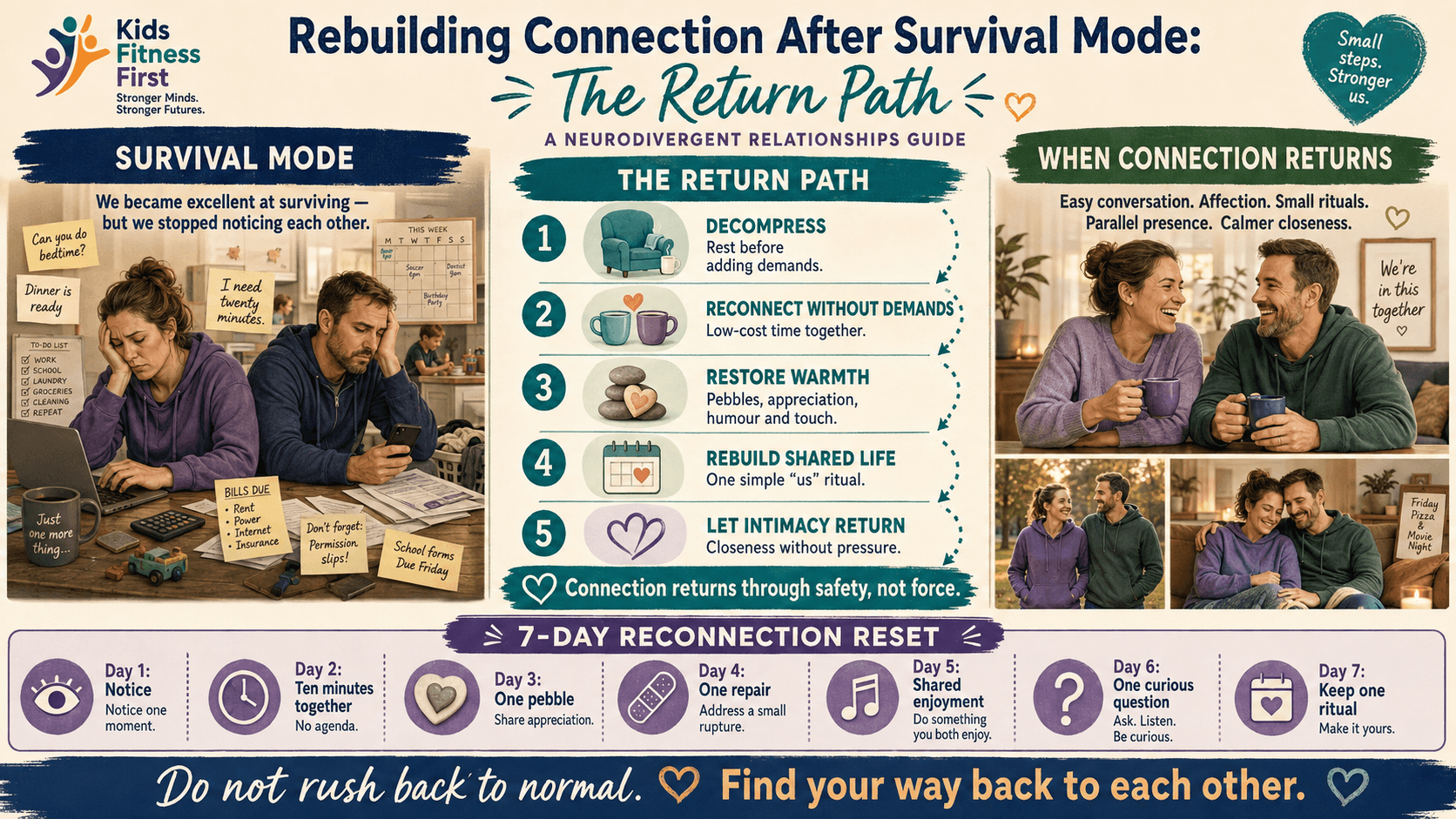
Rebuilding Connection After Survival Mode: How Neurodivergent Couples Find Their Way Back
Rebuilding connection after survival mode is not always as simple as deciding that the difficult period is over.
Perhaps the deadline has passed.
The family crisis has eased.
Likewise, sleep may finally be improving.
The household is functioning again.
However, something still feels different.
You and your partner may be sitting in the same room, yet both of you remain slightly distant.
You talk about:
- children;
- appointments;
- meals;
- work;
- bills;
- and tomorrow’s plans.
Nevertheless, you no longer seem to talk simply because you enjoy talking.
Perhaps affection has reduced.
Maybe sex or physical closeness has disappeared.
Meanwhile, humour has become less frequent.
You may even wonder:
“We survived the difficult period, so why don’t we feel normal again?”
The answer may be simpler than it appears.
Survival mode taught both nervous systems to conserve energy.
Therefore, when the external pressure reduces, emotional connection does not always switch back on immediately.
The crisis may be over.
However, the nervous systems may still be behaving as though resources are scarce.
That is why relationship recovery needs its own process.
Survival Mode Changes the Relationship Temporarily
During a prolonged period of overload, couples usually become practical.
They have to.
For example:
Dinner needs organising.
Children need collecting.
Medication needs collecting.
Bills need paying.
Someone has to work.
Someone has to remember tomorrow.
Consequently, communication becomes compressed.
You say:
“Can you do bedtime?”
“I’ve paid that.”
“Dinner is in the fridge.”
“I need twenty minutes.”
This communication is efficient.
In fact, during genuine overload, it may be exactly what keeps the household functioning.
However, there is a cost.
The relationship can gradually become operational.
You remain excellent teammates.
Nevertheless, you may temporarily stop feeling like lovers, close friends or emotionally curious companions.
Therefore, once survival mode ends, couples may need to rebuild more than the routine.
They need to rebuild the relationship underneath the routine.
Functioning Often Returns Before Feeling
This is an important distinction.
Perhaps the washing is being done again.
The calendar is under control.
Likewise, meals have returned to normal.
From the outside, everything appears recovered.
However, emotional recovery may take longer.
Why?
Because closeness requires capacity.
You need enough energy to:
- notice your partner;
- become curious;
- listen;
- play;
- flirt;
- tolerate vulnerability;
- and allow physical or emotional closeness.
During survival mode, these things may have been temporarily deprioritised.
Therefore, do not immediately interpret their absence as evidence that love has disappeared.
Instead, ask:
“Have we recovered operationally before we have recovered relationally?”
Often, that is exactly what has happened.
Do Not Demand Instant Intimacy
When the pressure finally lifts, one partner may understandably think:
“Great. Now we can get back to us.”
However, the other person’s nervous system may still be depleted.
Consequently, an invitation to reconnect can accidentally feel like another demand.
For example:
“We haven’t had sex for weeks.”
“We need to spend more quality time together.”
“Why don’t you ever want to cuddle anymore?”
These concerns may be genuine.
Nevertheless, if connection is introduced as another obligation, the overloaded partner may withdraw further.
Therefore, relationship recovery works better when closeness is invited rather than demanded.
That is the central principle behind Article 18.
The Return Path
The companion framework for Article 18 is The Return Path.
It contains five stages:
- Decompress
- Reconnect Without Demands
- Restore Warmth
- Rebuild Shared Life
- Let Intimacy Return at a Sustainable Pace
The order matters.
In particular, couples often try to jump straight from crisis to intimacy.
However, nervous systems may need several gentler steps in between.
Stage 1: Decompress
First, allow the body to believe the difficult period is actually ending.
This may require more recovery than you expected.
For example:
- extra sleep;
- quieter weekends;
- fewer commitments;
- more alone time;
- simple routines;
- familiar food;
- movement;
- or time without major decisions.
At first, this may appear unrelated to your relationship.
However, nervous-system recovery is part of relationship recovery.
A person who is still profoundly depleted may have very little capacity for closeness.
Therefore, before asking:
“Why aren’t we reconnecting?”
ask:
“Have we actually recovered?”
Recovery Is Not Laziness
After a prolonged stressful period, both partners may feel pressure to catch up.
The garden needs attention.
Friends need seeing.
Perhaps the house has become untidy.
Meanwhile, several postponed tasks are waiting.
Consequently, the first free weekend becomes another work project.
However, that may keep both nervous systems in high-demand mode.
Therefore, consider protecting some empty space before restoring the entire backlog.
For example:
Saturday morning: no plans.
Not:
Saturday morning: catch up on everything we neglected for six weeks.
The difference matters.
Sometimes relationship connection begins with simply having enough unclaimed capacity to notice one another again.
Stage 2: Reconnect Without Demands
Next, begin reconnecting in ways that do not require emotional performance.
This is particularly useful in neurodivergent relationships.
You do not necessarily need:
- a romantic weekend away;
- a three-hour relationship conversation;
- expensive dinner reservations;
- or a dramatic declaration.
Instead, start with low-pressure presence.
For example:
- drink coffee together;
- sit in the same room;
- take a walk;
- watch something you both enjoy;
- drive somewhere together;
- make a simple meal;
- or share quiet parallel time.
The goal is:
“Can being together start feeling easy again?”
That comes before:
“Can being together feel intensely romantic again?”
Parallel Presence Can Be Part of Recovery
Earlier Book Five articles explored parallel presence as a genuine form of neurodivergent connection.
Therefore, do not underestimate it during recovery.
Perhaps one person reads while the other watches football.
Maybe both sit at the same table doing separate things.
There may be very little conversation.
However, if both nervous systems feel safe, that shared space can still be relational.
It communicates:
“I can be near you without having to produce anything.”
After survival mode, that can be deeply restorative.
Replace “Quality Time” With “Low-Cost Connection”
The phrase quality time can accidentally create pressure.
It implies that the time needs to be special.
Therefore, try thinking instead about low-cost connection.
Ask:
“What can we do together that leaves both of us with the same or more energy afterwards?”
For one couple, that may be walking.
For another, cooking.
Likewise, it might be:
- watching a series;
- sitting outside;
- doing a puzzle;
- gardening;
- visiting a quiet café;
- or taking a short drive.
The activity matters less than the nervous-system effect.
Stage 3: Restore Warmth
Once being together feels easier, begin restoring small warmth.
Warmth is not the same as intense intimacy.
Instead, it includes the tiny signals that say:
“You are more to me than someone who helps operate this household.”
For example:
- touch their shoulder;
- make their drink;
- send a kind message;
- compliment something specific;
- sit a little closer;
- share a joke;
- kiss hello;
- ask about something they care about;
- or bring them a small pebble-style gesture from Article 4.
These moments are inexpensive.
However, they rebuild the emotional texture of the relationship.
Notice the Pebbles Again
Survival mode makes attention very narrow.
Therefore, acts of love may have continued without being noticed.
Perhaps your partner:
- brought you coffee;
- filled the car;
- took the children out so you could rest;
- remembered your medication;
- left you alone when you clearly needed quiet;
- or handled something difficult without mentioning it.
At the time, these may have felt like ordinary logistics.
However, perhaps some were also expressions of care.
Therefore, relationship recovery includes improving your eyesight again.
Ask:
“What love was present even while we were exhausted?”
That question can soften the story you tell about the difficult period.
Appreciation Should Be Specific
Instead of:
“Thanks for everything.”
try:
“Thank you for taking bedtime three nights this week. I know you were tired too, and it gave me room to recover.”
Specific appreciation does two things.
First, it proves you noticed.
Second, it identifies the behaviour you valued.
Consequently, appreciation becomes more believable and more emotionally useful.
Stage 4: Rebuild Shared Life
After survival mode, couples can become excellent at dividing responsibility while losing shared enjoyment.
Therefore, the fourth stage asks:
What belongs to us that is not simply household management?
Perhaps you once:
- cooked together;
- followed a football team;
- travelled;
- watched films;
- walked;
- listened to music;
- planned projects;
- met friends;
- or had a regular Sunday breakfast.
Some of those things may no longer fit.
That is fine.
However, the relationship still needs something that belongs to the we, not only the to-do list.
Do Not Recreate the Past Automatically
A common recovery mistake is trying to restore exactly what existed before the crisis.
For example:
“We used to go out every Friday, so we need to start doing that again.”
Perhaps.
However, your needs may have changed.
Therefore, ask:
“What would shared enjoyment look like for us now?”
Maybe Friday nights out become Sunday morning coffee.
Perhaps long trips become short day trips.
Likewise, busy restaurants may become takeaway and a film at home.
The goal is not nostalgia.
It is shared life.
Create One “Us” Ritual
Choose one small recurring ritual.
For example:
Sunday morning coffee
Wednesday evening walk
Friday film
Ten-minute bedtime chat
Monthly breakfast out
Keep it realistic.
Most importantly, protect it from becoming another administrative meeting.
Do not use the Sunday coffee to discuss:
- bills;
- school problems;
- family logistics;
- or household tasks
unless you both genuinely want to.
Let some relationship time remain relationship time.
Stage 5: Let Intimacy Return at a Sustainable Pace
Intimacy includes more than sex.
It may include:
- affection;
- emotional openness;
- physical closeness;
- humour;
- vulnerability;
- being seen;
- and shared pleasure.
Therefore, if sexual connection has reduced during survival mode, do not treat sex as the only measure of recovery.
First, ask:
“Are we becoming comfortable being close again?”
That may be the more useful starting point.
Physical Closeness Can Be Rebuilt Gradually
For example:
First, perhaps you sit closer.
Then perhaps you hold hands.
Later, cuddling feels natural again.
Eventually, sexual intimacy may return.
However, there is no universal sequence.
Likewise, nobody owes a particular pace.
The key principle is:
connection should create safety rather than pressure.
If either partner experiences affection as a guaranteed prelude to sex, they may begin avoiding affection altogether.
Therefore, allow some physical closeness to remain simply physical closeness.
That protects trust.
Talk About Intimacy Outside the Moment
If intimacy has become difficult, do not wait until someone initiates and gets rejected.
Instead, choose a neutral time.
Then say something like:
“I miss feeling close to you. I don’t want to pressure you. Can we talk about what closeness feels possible at the moment?”
That is very different from:
“Why don’t you want me anymore?”
The first invites information.
The second already contains an interpretation.
Therefore, use curiosity.
The Return Path at a Glance
| Stage | Main Goal | Example |
|---|---|---|
| 1. Decompress | Let nervous systems recover | Protect rest and lower demands |
| 2. Reconnect Without Demands | Make being together easy again | Walk, coffee, parallel presence |
| 3. Restore Warmth | Bring back small signs of care | Appreciation, touch, humour, pebbles |
| 4. Rebuild Shared Life | Create something that belongs to “us” | One sustainable shared ritual |
| 5. Let Intimacy Return | Rebuild closeness without pressure | Affection, conversation, physical intimacy at a mutually workable pace |
The Return Path is not a race.
Instead, couples may move backwards and forwards between stages.
That is normal.
What Reconnection Is Not
Reconnection does not mean pretending the survival period caused no damage.
Perhaps one partner carried much more.
Maybe there were sharp exchanges.
Likewise, affection may have disappeared for months.
Therefore, some repair may still be required.
You can say:
“We were both overloaded, and I still recognise that I became unfairly dependent on you.”
Or:
“I understand why you withdrew. However, being shut out without explanation hurt.”
Recovery and accountability can therefore happen together.
One does not cancel the other.
Repair Before Romance When Necessary
Sometimes couples try to reconnect romantically while unresolved hurt remains underneath.
Consequently, closeness feels artificial.
If that is happening, pause.
Perhaps the relationship needs a repair conversation before it needs a date night.
For example:
“Before we try to get back to normal, I need us to talk about what happened during those weeks.”
That is legitimate.
However, use the Repair Protocol rather than turning the conversation into a full history of everything that went wrong.
Specific harm.
Specific acknowledgement.
Specific repair.
Then move forward.
Why One Partner May Recover Faster
Two people can live through the same stressful period and recover at different speeds.
For example, one partner may feel ready for social activity within days.
Meanwhile, the other may require several weeks.
Likewise, one may want physical closeness quickly.
The other may still need more space.
This does not automatically mean one cares more.
Instead, recovery clocks can differ.
Therefore, avoid turning difference in recovery speed into difference in commitment.
Ask:
“Where are you at?”
Not:
“Why aren’t you where I am?”
That language respects two nervous systems.
Reflection: What Did Survival Mode Change Between You?
Pause here.
Think about the last period when your relationship was mainly surviving.
Then answer separately.
What Disappeared First?
Was it:
- conversation;
- affection;
- humour;
- sex;
- time together;
- friendships;
- patience;
- shared hobbies;
- or curiosity?
Complete:
“The first part of our relationship that disappeared when we became overloaded was…”
That may identify where reconnection needs to begin.
What Stayed?
This question is equally important.
Perhaps:
- teamwork stayed;
- loyalty stayed;
- practical support stayed;
- humour appeared occasionally;
- one person kept making tea;
- or both kept returning after difficult days.
Complete:
“Even when things were hard, one sign that we were still a team was…”
Do not overlook it.
What Did Your Partner Do That You Did Not Properly Notice?
Think about one specific action.
Perhaps they:
- protected your rest;
- completed a task;
- defended you;
- gave you space;
- handled the children;
- brought food;
- or stayed emotionally present.
Write:
“I want you to know that I noticed…”
Then tell them.
Specific recognition can be part of Stage 3.
What Still Needs Repair?
Ask:
“Is there anything from that period I technically moved past but still carry?”
If yes, write one sentence.
Keep it specific.
For example:
“When I was overloaded, I felt alone because you disappeared after arguments without telling me when you would return.”
That is clearer than:
“You were never there for me.”
Specificity creates a route to repair.
What Kind of Connection Feels Possible Now?
Not ideal.
Not what you had ten years ago.
Now.
Choose three:
- quiet time;
- conversation;
- touch;
- humour;
- activity;
- shared food;
- sex;
- walking;
- parallel presence;
- time outside the house;
- time with friends.
Compare answers.
Where do they overlap?
Start there.
What Would Feel Like Pressure?
This question may prevent misunderstanding.
Perhaps one partner says:
“A whole romantic weekend feels exhausting right now.”
Meanwhile, they might happily accept:
“coffee and a twenty-minute walk.”
That information is valuable.
Therefore, complete:
“Connection feels good when…”
Then:
“Connection starts feeling like pressure when…”
Share both answers.
Reflection Takeaway
Complete:
“We do not have to jump from surviving to being exactly as we were before. Instead, we can…”
Perhaps:
reconnect slowly.
notice each other again.
repair what hurt.
make being together easy.
build something new.
That is the Return Path.
Try This: The Seven-Day Reconnection Reset
For seven days, do one very small thing per day.
The exercise should not feel demanding.
If it does, make it smaller.
Day 1: Notice
Each person says one thing they appreciated during the difficult period.
For example:
“I noticed that you kept taking the children out when I was exhausted.”
Then stop.
No long conversation required.
Day 2: Ten Minutes Together
Spend ten minutes together without household administration.
For example:
- coffee;
- sitting outside;
- short walk;
- shared music.
No phones if that feels reasonable.
However, do not force conversation.
Day 3: One Pebble
Offer one small, specific sign of care.
Perhaps:
- favourite drink;
- snack;
- message;
- article;
- photograph;
- song;
- or tiny object that made you think of them.
The point is:
“I noticed you.”
Day 4: Repair One Small Thing
Choose one small hurt from the overload period.
Then use a clean repair:
“I did this. I understand its impact. I am sorry. Here is what I want to do differently.”
Keep it under ten minutes.
Day 5: Share Something Enjoyable
Choose something neither person has to manage.
For example:
- funny video;
- football match;
- favourite series;
- walk;
- dessert;
- music;
- or game.
The goal is shared pleasure rather than productivity.
Day 6: Ask One Curious Question
Not:
“What do we need to fix?”
Instead:
“What have you been thinking about lately?”
Or:
“What would you enjoy doing more of this autumn?”
Or:
“What has been giving you energy recently?”
Curiosity reminds both people that their partner is still an evolving person.
Day 7: Choose One Sustainable Ritual
Ask:
“What is one small thing from this week that we would like to keep?”
Perhaps:
- coffee together;
- evening walk;
- Friday film;
- one warm text;
- or ten minutes before bed.
Choose one.
Then repeat it.
Do not choose seven.
Sustainability matters more than ambition.
Do Not Turn Reconnection Into Another Project
This is especially important for couples who like structure.
Once you have a framework, it is tempting to create:
- schedules;
- targets;
- trackers;
- weekly intimacy goals;
- and performance measures.
However, connection can become mechanical if every affectionate moment is measured.
Therefore, use structure only to create opportunity.
Then let the relationship happen inside it.
For example:
Schedule the Sunday coffee.
However, do not score the quality of the conversation afterwards.
The system should open the door.
It should not supervise what happens once you walk through it.
When Separate Recovery Is Needed First
Sometimes one or both partners need individual recovery before shared reconnection becomes realistic.
Perhaps one person is deeply burned out.
Or they are grieving.
Likewise, health problems or severe exhaustion may still dominate.
Therefore, relational reconnection may temporarily be:
“I love you, and I am giving you room to recover.”
That can still be connection.
However, if emotional or physical disconnection remains persistent and distressing, or if either partner has substantial mental-health concerns, appropriately qualified support may be useful.
The goal is not to force recovery through a relationship exercise.
Reconnection After Parenting Overload
Parents may find this particularly familiar.
Years can pass in which the couple communicate mainly as co-managers of children.
For example:
“Did you pack the school bag?”
“Who is collecting them?”
“What time is football?”
The relationship becomes extraordinarily efficient.
However, the two adults may gradually disappear behind the parenting roles.
Therefore, rebuilding connection may involve asking:
“Who are we when nobody currently needs something from us?”
At first, that question may feel strange.
That is okay.
Identity can return slowly too.
Reconnection Is Sometimes About Meeting Again
Long-term partners often say:
“You’ve changed.”
Of course they have.
The deeper question is:
“Have I remained curious enough to notice how?”
After a major period of survival, both people may have changed.
Perhaps priorities shifted.
Maybe confidence grew.
Likewise, somebody may now need more quiet, more independence or more connection.
Therefore, recovery is not always about returning to the relationship you had.
Sometimes it is about meeting the person your partner has become.
That can be surprisingly hopeful.
A Strong Relationship Can Have Seasons
Some seasons are expansive.
You travel.
Socialise.
Laugh easily.
Perhaps intimacy feels natural.
Other seasons are narrow.
You work.
Care for children.
Manage illness.
Survive.
Neither season defines the whole relationship.
Therefore, do not judge a twenty-year relationship only by one exhausting winter.
Instead, ask whether both people can recognise the season and eventually adjust together.
That flexibility is part of long-term resilience.
Conclusion: You Do Not Have to Find Your Way Back All at Once
Rebuilding connection after survival mode does not require an instant return to romance.
Instead, begin with capacity.
First, decompress.
Then make being together easy again.
Next, restore small warmth.
Afterwards, rebuild something that belongs to the two of you.
Finally, allow intimacy to return without turning it into another demand.
Most importantly, do not assume that distance during an overloaded period means the love underneath it disappeared.
Sometimes love became practical.
It cooked dinner.
It collected the children.
It paid the bill.
It gave someone quiet.
It got everyone through the week.
Now, however, the relationship may need that love to become visible again.
A hand.
A laugh.
A question.
A walk.
A small repair.
A cup of coffee.
One ordinary moment at a time.
You do not have to recreate the exact relationship you had before survival mode.
Instead, you can build the next version — with the two people who came through it.
SUGGESTED INTERNAL LINKS
Article : Adult ADHD and Burnout Recovery: How to Rebuild Energy Without Returning to the Same Working Pattern
Article : Adult ADHD and Portfolio Careers: Could a Mix of Roles, Projects and Income Streams Fit You Better?
DISCLAIMER
This article is provided for general educational and informational purposes only. It is not medical, psychological, diagnostic, sex-therapy, relationship or couples-therapy advice.
Neurodivergent people and couples differ substantially in their needs, recovery times, levels of affection and preferred forms of intimacy. Therefore, no particular type or frequency of physical or sexual intimacy should be treated as a universal requirement.
Closeness should be mutual and consensual. Likewise, relationship frameworks should never be used to pressure a partner into emotional, physical or sexual contact.
Where disconnection is persistent, highly distressing, associated with significant burnout, depression, trauma or serious relationship conflict, appropriately qualified professional support may be helpful.