
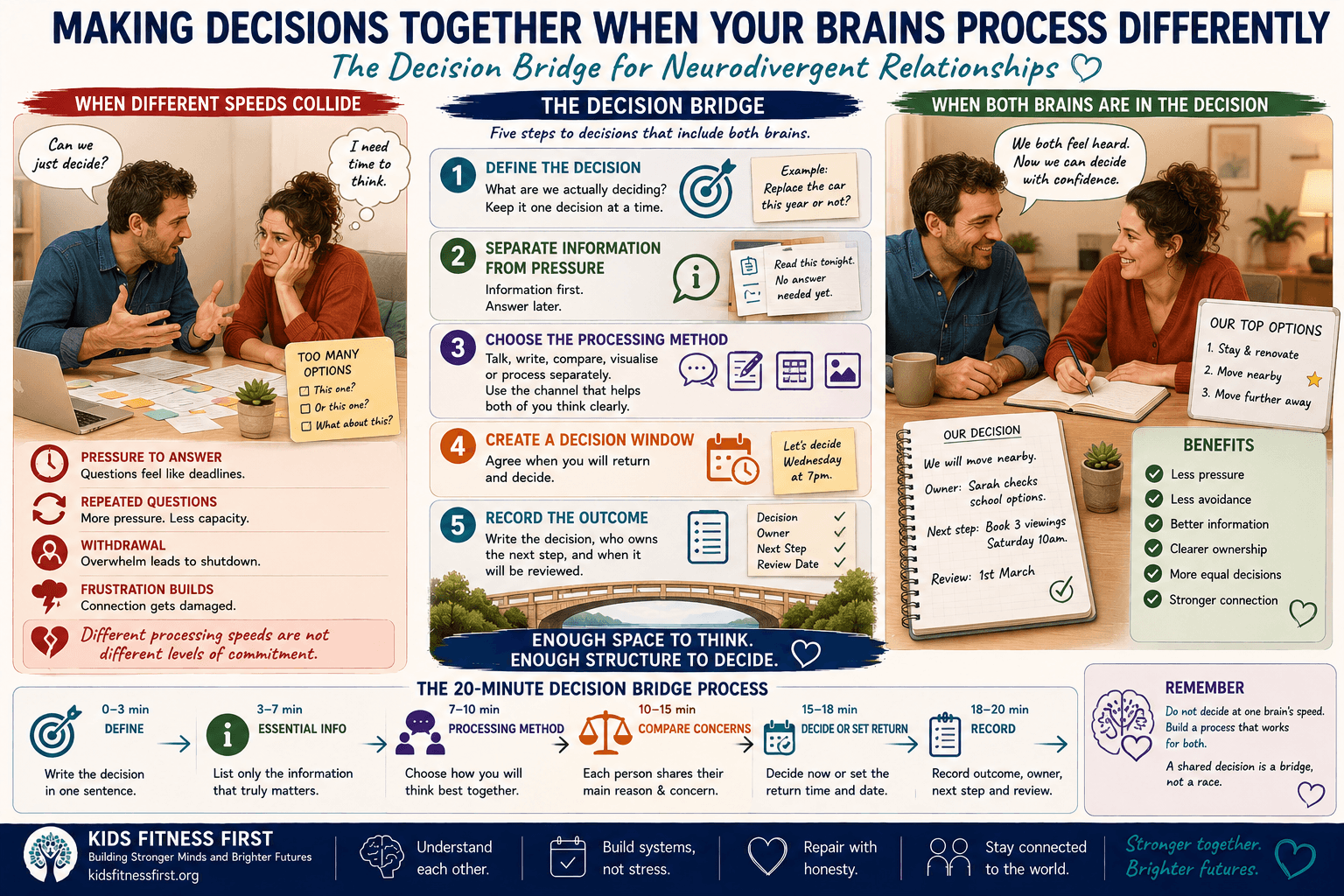
Making Decisions Together When Your Brains Process Differently: The Decision Bridge
Neurodivergent relationship decision making can become surprisingly difficult even when both partners want exactly the same thing:
a good decision.
Imagine this.
One partner says:
“Should we book the holiday tonight?”
They have already looked at the flights.
They are excited.
Likewise, they are thinking aloud.
For them, talking is part of deciding.
However, their partner hears a question that seems to require an immediate answer.
Suddenly, they need to think about:
- cost;
- dates;
- work;
- children;
- travel;
- accommodation;
- sensory demands;
- and whether they actually want to go.
Therefore, they say:
“I don’t know.”
The first partner hears hesitation.
Perhaps even rejection.
They respond:
“Why can you never just decide?”
Now the second partner feels pressured.
Consequently, they become even less capable of deciding.
A simple holiday question has become an argument.
The problem, however, may not be indecisiveness.
Instead, two brains may simply be processing the same decision differently.
That is why couples need more than good intentions.
Sometimes they need a shared decision-making structure.
Different Processing Speeds Are Not Different Levels of Commitment
Some people know what they think while they are speaking.
Therefore, conversation helps them discover their answer.
Others need to think before speaking.
Likewise, some people can compare several options quickly.
Meanwhile, others need to reduce the number of variables before they can make a confident choice.
None of these styles automatically means:
- more intelligence;
- more commitment;
- more maturity;
- or more care.
However, couples often interpret them that way.
The quick decision-maker may think:
“You are making this unnecessarily complicated.”
Meanwhile, the slower processor may think:
“You are rushing me because my opinion doesn’t really matter.”
Both interpretations can damage the decision before it is even made.
Therefore, the first principle is:
Processing speed is not the same as caring speed.
Why Decisions Can Become Emotionally Loaded
A decision is rarely only a decision.
For example, consider:
“Should we move house?”
One partner may hear:
possibility.
The other hears:
uncertainty.
One sees:
a better future.
Meanwhile, the other immediately sees:
- paperwork;
- financial risk;
- disruption;
- new routines;
- schools;
- packing;
- unfamiliar surroundings;
- and the loss of what is currently predictable.
Therefore, the same question creates very different internal workloads.
That does not mean one person is optimistic and the other negative.
Instead, they may simply be attending to different parts of the same reality.
A useful couple therefore asks:
“What is each brain noticing that the other brain may be missing?”
That turns difference into information.
ADHD and Decision Making
Some adults with ADHD may find decisions difficult when:
- there are too many options;
- the future feels abstract;
- working memory is overloaded;
- immediate reward is much more vivid than later consequences;
- or the decision requires holding several variables at once.
However, another person with ADHD may make decisions extremely quickly.
Therefore, there is no single ADHD decision-making style.
For example, one person may say:
“Let’s just book it.”
Meanwhile, another may become stuck comparing twelve possibilities.
The important question is not:
“What do people with ADHD do?”
Instead:
“What helps this person make a good decision?”
Autism and Decision Making
For some autistic adults, decisions may become easier when:
- information is clear;
- options are limited;
- expectations are explicit;
- time pressure is reduced;
- and possible consequences can be considered before responding.
Likewise, sudden decisions may be harder when they involve significant change.
Therefore, a partner saying:
“I’ve found a great house. We need to decide tonight.”
may create unnecessary pressure.
However, if the information is shared earlier and the decision window is clear, the same person may engage extremely thoughtfully.
Again, structure can unlock capacity.
Dyslexia and Decision Making
Dyslexia can also affect how decision information is easiest to process.
For example, a long comparison spreadsheet may not be the most accessible format for every dyslexic adult.
Therefore, a better approach might be:
- spoken summary;
- visual comparison;
- three key figures;
- or a short list of pros and cons.
The aim is not to reduce the seriousness of the decision.
Instead, it is to present the information in a form that allows the person to use their judgement effectively.
The Decision Bridge
Article 22 introduces The Decision Bridge.
It has five steps:
- Define the Decision
- Separate Information From Pressure
- Choose the Processing Method
- Create a Decision Window
- Record the Outcome
The aim is simple.
Both people should have enough clarity, time and structure to contribute without the decision disappearing indefinitely.
Step 1: Define the Decision
First, identify what is actually being decided.
This sounds obvious.
However, couples often start discussing one question and accidentally expand into several.
For example:
“Should we change the car?”
quickly becomes:
- whether finances are healthy;
- whether one partner drives too much;
- whether electric cars are practical;
- whether you should move house next year;
- and why somebody spent too much money last month.
Consequently, nobody knows what decision the conversation is meant to produce.
Therefore, compress.
Try:
“The decision today is whether we keep the current car for another year or replace it this autumn.”
Now the decision has edges.
That matters.
One Decision at a Time
If another issue appears, park it.
For example:
“The wider budget question matters. However, let’s put that on Friday’s list. Right now, we are deciding the car.”
This is the same compression principle used earlier in Book Five communication work.
However, it is particularly important with decision making because too many variables can create paralysis.
Therefore:
one decision, one container.
Step 2: Separate Information From Pressure
Next, provide the information without demanding the answer simultaneously.
This is one of the biggest improvements many couples can make.
For example, instead of:
“Here’s the house I found. What do you think? Should we make an offer?”
try:
“I found a house that might be worth considering. I’ll send you the details. We don’t need to decide tonight.”
The second version changes the nervous-system experience immediately.
Information arrives first.
Decision pressure comes later.
Therefore, the receiving person has time to think rather than merely react.
A Question Can Feel Like a Deadline Even When You Did Not Mean One
Some people ask questions casually.
For example:
“What do you want to do about Christmas?”
However, the other partner may hear:
“Give me the answer now.”
Therefore, be explicit.
Try:
“I’m starting to think about Christmas. You don’t need to answer now. Could we decide by Sunday?”
Now the person knows:
- the topic;
- the decision;
- and the deadline.
Consequently, uncertainty reduces.
Step 3: Choose the Processing Method
Not every decision needs to be made through live conversation.
In fact, different decisions may need different methods.
Possible methods include:
- talking together;
- written comparison;
- separate thinking first;
- spreadsheet;
- visual options;
- pros and cons;
- voice notes;
- short written summary;
- or a combination.
Therefore, ask:
“What format will help both of us think clearly?”
That is more useful than assuming every serious decision belongs at the kitchen table.
The Four Useful Decision Channels
A simple guide can help.
| Decision Type | Possible Helpful Channel |
|---|---|
| Simple practical choice | Short conversation |
| Financial comparison | Written figures + discussion |
| Major emotional decision | Processing time + scheduled conversation |
| Several concrete options | Visual shortlist or pros/cons |
| Change-heavy decision | Written preview + time to absorb |
| Urgent decision | Minimal options + clear essential facts |
Again, these are not rules.
Instead, they are prompts.
The right format is the one that allows both people to participate.
Step 4: Create a Decision Window
Processing time cannot become indefinite avoidance.
Therefore, every important shared decision needs a window.
For example:
“Let’s each think about this tonight, then decide tomorrow after dinner.”
Or:
“We need to make the school decision by Friday. Could we talk Wednesday evening?”
This protects both partners.
The slower processor gets time.
Meanwhile, the faster processor knows the issue will not disappear forever.
That is the bridge.
Processing Time Needs a Return Point
Without a return point, one partner may repeatedly say:
“I need more time.”
Meanwhile, nothing happens.
Consequently, the other person becomes frustrated and begins pushing harder.
Therefore, if you ask for time, include a return.
For example:
“I can’t answer this properly right now. Can I come back to you tomorrow morning?”
Then come back.
This is similar to the Safe Pause Protocol from Article 21.
The broader principle is the same:
space becomes safer when return is reliable.
Step 5: Record the Outcome
Finally, write down what you decided.
This may sound overly formal.
However, many arguments begin because two people remember the same conversation differently.
Therefore, after the decision, record:
- what was decided;
- who owns the next step;
- when it happens;
- and when the decision will be reviewed if necessary.
For example:
Decision: Keep current car until March.
Owner: David checks service costs.
Next step: Review replacement options in February.
Now nobody needs to carry the full decision in working memory.
The system remembers.
A Decision Is Not Finished Until Ownership Is Clear
Suppose you decide:
“Yes, let’s change energy supplier.”
Excellent.
However:
Who does it?
When?
What information do they need?
Without ownership, a decision can remain only a conversation.
Therefore, add:
“Who owns the next move?”
That one question makes decisions more likely to become action.
The Decision Bridge at a Glance
| Step | Key Question | Example |
|---|---|---|
| 1. Define | What are we actually deciding? | “Keep or replace the car this year?” |
| 2. De-Pressure | Can information arrive before the answer is required? | “Read this tonight; no answer needed yet.” |
| 3. Choose Channel | How will both brains process best? | Written comparison + talk |
| 4. Decision Window | When will we return and decide? | “Tomorrow at 7pm.” |
| 5. Record | What did we decide and who acts? | Shared note/calendar |
The framework is deliberately practical.
Because the point of a decision is eventually to produce clarity.
Fast Decisions Are Not Automatically Better Decisions
Some people take pride in being decisive.
That can be useful.
However, speed can occasionally hide missing information.
For example, one partner may see:
opportunity.
Meanwhile, the slower partner sees:
risk that has not yet been considered.
Therefore, do not automatically treat hesitation as obstruction.
Sometimes the person slowing the decision is protecting the couple from a blind spot.
Likewise, do not automatically treat speed as impulsivity.
The quicker partner may simply recognise the central issue faster.
Therefore, both styles can contribute.
Slow Decisions Are Not Automatically Better Either
The opposite mistake also exists.
More time does not always produce more clarity.
Sometimes it simply produces:
- more options;
- more worry;
- more research;
- and more uncertainty.
Therefore, if you repeatedly delay, ask:
“What new information am I actually waiting for?”
If the answer is:
“Nothing. I just want to feel completely certain.”
then the problem may be that complete certainty is impossible.
At some point, a decision must be made with the information available.
The 80% Rule
For many ordinary decisions, couples do not need 100% certainty.
Instead, you may agree:
“When we have enough information to feel around 80% confident, we decide.”
This is not appropriate for every high-stakes decision.
However, it can prevent smaller choices becoming endless projects.
For example:
- restaurant;
- weekend plans;
- furniture;
- minor purchases;
- or routine household decisions.
Not every choice deserves a full strategic review.
That protects capacity.
Separate Reversible and Irreversible Decisions
Another useful distinction is:
Can we undo this?
If yes, the decision may not need enormous analysis.
For example:
Trying a new household routine for two weeks is reversible.
Changing a shared reminder app is reversible.
Likewise, choosing a different restaurant is obviously reversible.
However, selling a house is much less reversible.
Therefore, the amount of processing should match the consequence.
A useful question is:
“How expensive would it be to change our minds?”
That can immediately clarify how much decision effort is justified.
When One Partner Keeps Pushing for an Answer
The faster processor may experience delay as unbearable.
Therefore, they ask again.
And again.
For example:
“Have you thought about it?”
“What are you thinking?”
“Can we just decide?”
However, repeated prompting can reduce the other person’s processing capacity.
Consequently, the answer takes even longer.
Therefore, once a Decision Window is agreed, respect it.
If the return point is tomorrow at six, do not ask five times before tomorrow at six.
The structure is carrying the decision now.
When One Partner Keeps Avoiding Decisions
The slower processor also has responsibility.
Processing time should not become indefinite postponement.
Therefore, if you agree to return on Friday, return on Friday.
Even if your answer is:
“I still don’t know, but here are the two things stopping me.”
That is useful.
Now the couple can decide whether more information is needed.
Avoidance creates uncertainty.
Honest incomplete thinking creates progress.
Decisions and the Parent Trap
Decision-making can also reveal manager-and-managed roles.
For example, one partner may ask:
“What do you think?”
However, they have already decided.
If their partner disagrees, they explain why the partner’s answer is wrong.
Eventually, the other person stops contributing.
Then the first partner says:
“Why do I have to make every decision?”
This is a trap.
Therefore, if you ask for input, genuinely allow that input to affect the outcome.
Otherwise, you are not requesting collaboration.
You are requesting approval.
Equal Voice Does Not Mean Equal Expertise
Sometimes one partner genuinely knows more about the subject.
For example:
One may understand investments better.
The other may understand the children’s school needs better.
Therefore, equal partnership does not require pretending knowledge is identical.
Instead, distinguish:
expertise
from:
authority over the shared consequence.
For example:
One partner may research the mortgage.
However, both should participate in a major shared financial commitment.
That is adult partnership.
Reflection: How Do You Make Decisions as a Couple?
Think about your last three shared decisions.
Then answer separately.
Who Usually Wants the Answer Faster?
Is it usually the same person?
If so, complete:
“When I want a quick answer, I am usually trying to create…”
Perhaps:
certainty.
momentum.
relief.
control.
excitement.
Knowing the underlying need can reduce pressure.
Who Usually Needs More Processing Time?
Complete:
“When I say I need time, what I actually need time to do is…”
Perhaps:
compare options.
reduce overwhelm.
understand the emotional impact.
read information.
imagine the change.
identify risk.
Make the need specific.
Which Decisions Cause the Most Conflict?
Perhaps:
- money;
- social plans;
- parenting;
- holidays;
- family;
- household spending;
- home projects;
- or major life changes.
Then ask:
“What makes this category particularly difficult for us?”
Is it:
speed?
risk?
different values?
information format?
unclear ownership?
That identifies the real design problem.
Does One Person Think Out Loud?
This matters.
If one partner says:
“Maybe we should move to Spain.”
do they mean:
“I have decided I want to move to Spain”
or:
“I am exploring an idea out loud”?
Those are very different.
Therefore, a useful phrase is:
“I’m brainstorming, not proposing yet.”
That can prevent a great deal of unnecessary anxiety.
Do You Know When Discussion Has Become Decision?
Some couples talk about possibilities for days.
However, nobody knows when the conversation shifted into an actual choice.
Therefore, use clear language:
“Are we exploring, or are we deciding?”
That question is powerful.
If you are exploring, no immediate conclusion is required.
If you are deciding, define the window.
Do You Record Important Decisions?
If not, how often do you later disagree about what was decided?
Perhaps:
“I thought you said…”
“No, we agreed…”
Therefore, consider a shared decision note.
It may feel formal at first.
However, if it prevents repeated conflict, the system is doing useful work.
Reflection Takeaway
Complete:
“Our decisions work best when…”
Then:
“Our decisions become difficult when…”
Finally:
“One change we can make is…”
Perhaps:
give information earlier.
use fewer options.
set a decision date.
separate brainstorming from deciding.
write down the result.
Choose one.
Try This: The 20-Minute Decision Bridge
Choose one moderate real decision.
Not the biggest decision of your life.
Then use this structure.
Minutes 0–3: Define the Decision
Write one sentence:
“We are deciding…”
If you cannot write the decision in one sentence, it is probably still too broad.
Minutes 3–7: Identify the Essential Information
Each partner names only the information they believe matters most.
For example:
- cost;
- timing;
- family impact;
- capacity;
- risk.
Then reduce it to a manageable list.
Do not introduce every possible variable.
Minutes 7–10: Choose the Processing Method
Ask:
“Do we want to continue now, or do either of us need time?”
If both can decide, continue.
However, if one needs time, agree exactly when you will return.
Minutes 10–15: Compare the Real Concerns
Each person completes:
“The strongest reason I favour this option is…”
Then:
“My biggest concern is…”
This keeps the conversation focused.
Minutes 15–18: Decide or Set the Return Point
If enough information exists, decide.
If not, identify the missing information and who will obtain it.
Then set the return date.
Minutes 18–20: Record the Outcome
Write:
Decision
Owner
Next action
Date
Then stop.
Do not reopen the whole discussion after deciding unless meaningful new information appears.
Build a Shared Decision Note
A simple template can be:
DECISION:
What are we deciding?
OPTIONS:
Maximum three.
KEY INFORMATION:
What genuinely matters?
EACH PERSON’S MAIN CONCERN:
One sentence each.
DECISION DATE:
When will we choose?
OUTCOME:
What did we decide?
NEXT OWNER:
Who acts?
This turns invisible processing into a shared object.
Therefore, the couple is no longer trying to hold everything verbally.
Limit the Number of Options
Too many choices can overwhelm almost anyone.
Therefore, where possible, reduce options before the final decision.
For example:
Do not compare twenty hotels together.
One partner can shortlist three.
Then the couple chooses from three.
Likewise, do not evaluate fifteen sofas.
Reduce first.
Decide second.
This respects both capacity and time.
Decision Fatigue Is Real
Couples make hundreds of tiny decisions.
What shall we eat?
Who is driving?
When are we shopping?
Are we going out?
Which bill gets paid?
What time should we leave?
Therefore, not every decision needs joint discussion.
Some should be delegated.
For example:
“You own weekday dinners.”
Or:
“I handle routine car maintenance choices under £200.”
Clear decision rights reduce mental load.
Therefore, shared life may actually improve when fewer choices require both people.
Decide Who Gets to Decide
This sounds contradictory.
However, it can be extremely useful.
For recurring low-risk areas, agree ownership.
For example:
Partner A decides: routine food shopping.
Partner B decides: household technology.
Shared decision: purchases over an agreed amount.
Now the couple knows which decisions require consultation.
That reduces unnecessary negotiation.
Urgent Decisions Need a Different Protocol
Sometimes there is no time for long processing.
For example:
- medical situation;
- urgent travel;
- school emergency;
- deadline expiring today.
Therefore, urgent decisions need fewer options.
Try:
“We have fifteen minutes. These are the two workable choices. What information do you need most?”
Then decide with the best information available.
Afterwards, if necessary, repair any emotional impact created by the rushed process.
Urgency changes the system.
However, it should not become the normal system.
What If You Still Cannot Agree?
Some decisions reveal genuine differences in values.
For example:
One person wants to move.
The other does not.
No communication framework can magically eliminate that difference.
Therefore, the Decision Bridge is not designed to force consensus.
Instead, it ensures that disagreement becomes visible clearly.
At that point, the question may become:
“Can we negotiate?”
Or:
“Is there a trial option?”
Or:
“Do we need outside support to work through this?”
A clear disagreement is still better than a confused recurring argument.
A Decision Can Be Reviewed
Not every choice needs to be permanent.
Therefore, use trial periods.
For example:
“Let’s try this household split for six weeks.”
“Let’s attend fewer social events for two months and review.”
“Let’s use this budgeting system until Christmas.”
Trial decisions reduce the emotional weight.
They turn:
“This must be right forever”
into:
“Let’s gather evidence.”
That is often much easier for both nervous systems.
Conclusion: Good Decisions Need Enough Space for Both Brains
Neurodivergent relationship decision making works best when neither speed nor slowness automatically controls the process.
One partner may think quickly.
Another may process deeply.
One may speak to discover what they think.
Meanwhile, the other may need silence before speaking.
Neither style is inherently better.
Therefore:
First, define the decision.
Next, separate information from immediate pressure.
Then, choose a processing method that works for both people.
Afterwards, create a clear decision window.
Finally, record the decision and ownership.
Most importantly, remember:
A partner who needs more time is not automatically refusing the decision.
Likewise:
A partner who wants momentum is not automatically controlling.
Often, they are simply trying to create certainty in different ways.
The goal is therefore not to decide at the speed of the fastest brain.
Nor is it to wait indefinitely for the slowest.
Instead, build a bridge.
Enough time to think.
Enough structure to return.
Enough information to decide.
And enough clarity that both people know:
“My brain was allowed into this decision too.”
That is what shared decision making should feel like.
SUGGESTED INTERNAL LINKS
Article 8: Taking Space Without Creating Distance: The Safe Pause Protocol for Neurodivergent Relationships
Article 11: Supporting Your Neurodivergent Partner Without Taking Over: The Support Ladder
DISCLAIMER
This article is provided for general educational and informational purposes only. It is not medical, psychological, legal, financial, diagnostic, relationship or couples-therapy advice.
Neurodivergent people vary widely in how they process information and make decisions. Therefore, ADHD, autism, dyslexia or another form of neurodivergence should not be assumed to determine one specific decision-making style.
Major financial, legal, medical or other high-stakes decisions may require appropriately qualified professional advice in addition to relationship discussion.
Likewise, shared decision-making frameworks should not be used to pressure, manipulate or override another person’s autonomy.