
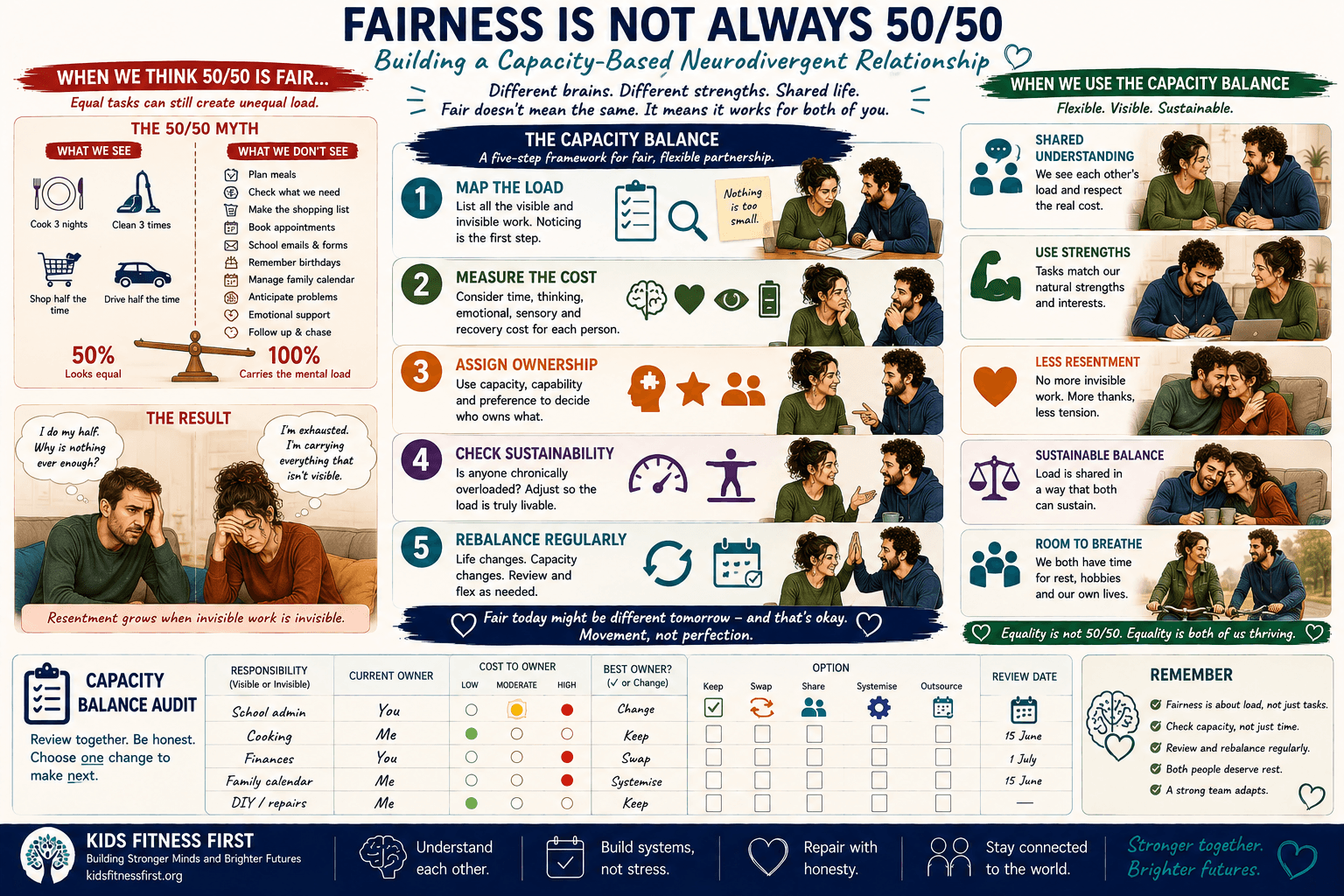
Fairness Is Not Always 50/50: Building a Capacity-Based Neurodivergent Relationship
Neurodivergent relationship fairness can become complicated when couples try to measure equality through one simple idea:
50/50.
Half the cooking.
Half the cleaning.
Half the parenting.
Half the administration.
Half the emotional work.
At first, that sounds fair.
However, real relationships rarely operate so neatly.
One partner may be excellent with finances but overwhelmed by written bureaucracy.
Meanwhile, the other may manage paperwork easily but find noisy family events exhausting.
One person may have more energy this month.
However, six months later, illness, work, parenting or burnout may reverse the situation completely.
Therefore, a thriving relationship cannot always ask:
“Are we each doing exactly half?”
Instead, a better question may be:
“Are both people contributing in a way that is visible, sustainable and fair over time?”
That difference matters.
Because equality is not necessarily identical effort in identical areas.
Sometimes equality means building a system in which both adults contribute meaningfully without one person becoming permanently overloaded or the other permanently dependent.
That is what Article 23 calls The Capacity Balance.
Why 50/50 Sounds Fair but Can Still Feel Unfair
Imagine a couple dividing dinner preparation exactly in half.
Each cooks three nights.
Then they order food on the seventh.
On paper, the arrangement looks perfectly equal.
However, perhaps one partner also:
- decides what meals to make;
- checks what food is available;
- notices what needs buying;
- creates the shopping list;
- remembers dietary needs;
- checks children’s schedules;
- and plans ahead for busy evenings.
The visible cooking is 50/50.
Nevertheless, the mental load is not.
Therefore, counting only the visible action produces an incomplete picture.
Likewise, imagine one partner spends thirty minutes completing a form.
The other spends thirty minutes cleaning.
Again, equal time.
However, if the form requires extreme concentration, decoding and recovery for a dyslexic partner, the cognitive cost may be much higher.
Therefore:
equal minutes do not always mean equal effort.
That does not make measurement impossible.
Instead, it means couples need to measure more intelligently.
Fairness Has More Than One Dimension
A task has several costs.
For example:
Time cost: How long does it take?
Cognitive cost: How much thinking, organising or remembering does it require?
Emotional cost: Does it involve conflict, anxiety or difficult social interaction?
Sensory cost: Does it involve noise, crowds or environmental stress?
Recovery cost: How much energy is needed afterwards?
Responsibility cost: Who has to keep remembering that it exists?
Therefore, household fairness cannot always be judged by counting tasks.
One task may cost one partner considerably more than another.
That is why strengths-based division can sometimes be fairer than identical division.
The Goal Is Not to Reward Avoidance
This distinction is essential.
If one partner dislikes cleaning, that does not automatically mean the other person should do all the cleaning forever.
Likewise:
“That task is harder for my ADHD.”
does not automatically mean:
“Therefore, it belongs to you.”
Difficulty and inability are not the same.
Instead, ask:
“What support, system or division would allow meaningful adult contribution?”
Perhaps the task can be modified.
For example:
- break it into smaller parts;
- use reminders;
- change the format;
- divide planning from execution;
- automate part of it;
- or exchange it for another responsibility of similar weight.
Therefore, capacity-based fairness is not an excuse to escape responsibility.
It is a way of designing responsibility more intelligently.
The Capacity Balance
The Capacity Balance has five questions:
- What Needs Carrying?
- What Does Each Task Actually Cost?
- Who Is Best Placed to Own It?
- Is the Total Load Sustainable?
- When Will We Rebalance?
These questions move couples away from:
“Who did more today?”
and towards:
“Is our overall system fair?”
Step 1: What Needs Carrying?
First, make the work visible.
Do not begin by dividing it.
Instead, identify it.
Include visible responsibilities such as:
- cooking;
- cleaning;
- shopping;
- childcare;
- transport;
- finances;
- household repairs;
- and employment.
However, also include invisible labour such as:
- remembering appointments;
- anticipating future problems;
- family communication;
- school administration;
- emotional regulation;
- planning holidays;
- maintaining friendships;
- and tracking household needs.
This step matters because couples often argue about fairness while counting different things.
One partner is counting physical tasks.
Meanwhile, the other is counting the mental system behind those tasks.
Therefore, first create one shared list.
Count Ownership, Not Just Action
Suppose one partner says:
“But I took the children to the dentist.”
That is valuable.
However, who:
- remembered the appointment;
- booked it;
- rearranged school;
- filled in the form;
- reminded everyone;
- and booked the follow-up?
Perhaps the task was shared.
Or perhaps one person performed the visible final action while the other carried most of the architecture.
Therefore, ask:
“Who owns this domain from beginning to end?”
Ownership includes noticing, planning, execution and follow-up.
That gives a clearer picture of workload.
Step 2: What Does Each Task Actually Cost?
Next, look beyond time.
For each responsibility, ask:
How demanding is this for the person currently doing it?
For example, rate each task:
Low
Moderate
High
Do not compare only objective difficulty.
Instead, consider individual nervous-system cost.
For example:
One partner may find grocery shopping easy.
The other may experience crowded supermarkets as sensory overload.
Likewise, one may enjoy dealing with tradespeople.
Meanwhile, the other finds telephone calls extremely stressful.
Therefore, if the couple wants to reduce total household strain, they may deliberately divide tasks according to cost.
That can be extremely efficient.
Strengths-Based Division Can Be Fair
Suppose one partner enjoys cooking and the other enjoys managing finances.
There is no reason both need to perform exactly half of each task simply to prove equality.
Instead:
Partner A owns cooking.
Partner B owns finances.
Then compare the total weight.
That is specialisation.
Healthy relationships often specialise.
However, specialisation becomes unfair when one person’s preferred domain is small while the other person’s domain quietly expands to include almost everything else.
Therefore, compare the total load rather than one category.
Step 3: Who Is Best Placed to Own It?
Now decide ownership.
Three factors matter:
Capacity
Who can realistically carry it now?
Capability
Who has the skills or systems to manage it?
Preference
Who genuinely prefers or dislikes it?
These factors can be combined.
For example:
One partner may be better at written administration.
However, they may currently have no capacity because of a major work project.
Therefore, the usual allocation may temporarily change.
Likewise, one person may dislike cooking but have enough capacity to do it during a period when the usual cook is exhausted.
Capacity-based relationships allow movement.
Fair Does Not Mean Comfortable All the Time
Sometimes both people dislike the same task.
For example:
Nobody wants to clean the bathroom.
Therefore, preference cannot solve everything.
Instead, the couple may:
- alternate;
- outsource it if affordable;
- divide parts;
- use a rota;
- or exchange unpleasant tasks.
Fairness does not mean nobody ever does something difficult.
It means difficulty does not permanently land on the same person without discussion.
Step 4: Is the Total Load Sustainable?
This may be the most important question.
An arrangement can appear fair in theory while exhausting one partner in practice.
For example, one person may technically own only four domains.
However, those four domains may include:
- finances;
- children’s administration;
- medical appointments;
- and family planning.
Meanwhile, the other owns:
- bins;
- gardening;
- car washing;
- and occasional repairs.
Both have four categories.
Nevertheless, the total ongoing mental load may be very different.
Therefore, ask:
“Who has to think about their responsibilities most often?”
Likewise:
“Who is most likely to wake at 3am remembering something?”
Those questions reveal cognitive weight.
Watch the Resentment Signal
Resentment is not always proof that something is unfair.
However, repeated resentment is worth investigating.
For example:
“Why am I always the one who notices?”
“Why do I have to keep asking?”
“Why can you relax while I’m still thinking about tomorrow?”
These sentences may indicate invisible workload.
Therefore, do not immediately argue about whether the resentment is justified.
Instead, ask:
“What responsibility is underneath this feeling?”
Often, there is something concrete.
Step 5: When Will We Rebalance?
Any division of labour can become outdated.
Therefore, Capacity Balance must include a review.
For example:
“This arrangement works until your project finishes in October.”
Or:
“I will carry more school administration while you’re recovering, then we review in six weeks.”
Likewise:
“During exam season, I take more household work. Afterwards, we rebalance.”
This prevents temporary flexibility becoming permanent inequality.
The relationship knows:
We are adapting, not silently rewriting the roles forever.
The Capacity Balance at a Glance
| Step | Question |
|---|---|
| 1. Map the Load | What visible and invisible work exists? |
| 2. Measure the Cost | What does each responsibility cost this person? |
| 3. Assign Ownership | Who is best placed to carry it? |
| 4. Check Sustainability | Is anyone chronically overloaded? |
| 5. Rebalance | When will we review and adjust? |
The framework is not designed to create a perfectly equal spreadsheet.
Instead, it creates a transparent system.
That transparency matters because hidden inequality creates resentment much faster than openly negotiated inequality.
50/50 Across Time May Matter More Than 50/50 Today
Imagine a twenty-year relationship.
There may be periods when one person carries 70%.
For example:
- pregnancy;
- illness;
- unemployment;
- grief;
- burnout;
- caring responsibilities;
- or professional exams.
That does not automatically mean the relationship is unfair.
However, over the long term, flexibility should move in both directions.
One useful question is:
“When I have less capacity, can I trust you to carry more — and when you have less, can you trust me to do the same?”
That is mutuality.
Therefore, fairness may be better understood across seasons than across individual days.
Chronic 80/20 Is Different From Temporary 80/20
A relationship can temporarily become 80/20 and remain healthy.
However, if the same partner carries 80% for ten years, something else is happening.
Therefore, distinguish:
temporary imbalance
from:
structural imbalance.
Temporary imbalance has:
- a reason;
- recognition;
- gratitude;
- and a review point.
Structural imbalance often has:
- normalisation;
- resentment;
- unclear ownership;
- and no realistic plan for change.
That distinction matters greatly.
Appreciation Does Not Replace Redistribution
Sometimes one partner says:
“I tell you all the time how grateful I am.”
That is valuable.
However, gratitude alone does not make an unsustainable workload sustainable.
For example:
“Thank you for carrying all the household administration.”
may feel good.
However, if the person is collapsing under the workload, the next question is:
“What can we actually move?”
Therefore, recognition should be followed by practical design when necessary.
Different Contribution Is Not Lesser Contribution
A neurodivergent adult may contribute enormous value in ways that traditional household lists miss.
For example:
- creativity;
- problem-solving;
- income;
- practical skills;
- emotional warmth;
- humour;
- parenting connection;
- technical knowledge;
- entrepreneurship;
- or crisis response.
However, those strengths should not be used to erase basic adult responsibility.
Likewise, difficulties in administration should not erase the person’s wider contribution.
Therefore, couples need a whole-person view.
Do not reduce somebody to the domain they struggle with most.
Money Can Complicate Fairness
Suppose one partner earns considerably more.
Does that mean they should do less at home?
There is no universal answer.
However, income, working hours and work intensity can reasonably influence capacity.
Therefore, rather than saying:
“I earn more, so I should do less.”
ask:
“What is the total contribution and total available capacity across our shared life?”
Perhaps one partner works sixty hours.
Meanwhile, the other works twenty.
Then household work may reasonably be divided differently.
However, caregiving, disability, unpaid work and invisible labour also count.
Therefore, income alone is not the full fairness calculation.
Outsourcing Can Be Part of Fairness
Sometimes the best division is:
neither of us.
If affordable, couples may outsource:
- cleaning;
- gardening;
- bookkeeping;
- meal preparation;
- childcare;
- or administrative help.
There is no prize for exhausting two adults doing something someone else could reasonably carry.
Therefore, ask:
“Does this task genuinely need to be performed by one of us?”
Sometimes the best relationship system removes the task from the relationship entirely.
Parenting Changes the Fairness Equation
Children create enormous amounts of invisible work.
For example:
- school messages;
- appointments;
- uniforms;
- transport;
- meals;
- emotional support;
- social lives;
- homework;
- medical needs;
- and future planning.
Therefore, couples can underestimate how much parenting altered the original balance.
A relationship that felt perfectly fair before children may become completely different afterwards.
Consequently, fairness needs reassessment rather than nostalgia.
Do not say:
“This arrangement always worked.”
Ask:
“Does it work for the family we have now?”
Capacity Is Not Fixed
A person who has high capacity today may have very low capacity next month.
For example:
- burnout;
- illness;
- work pressure;
- hormonal changes;
- grief;
- poor sleep;
- or sensory overload
can dramatically alter available energy.
Therefore, avoid creating permanent identities such as:
“You are the capable one.”
That label can become dangerous.
Eventually, the supposedly capable partner may need help too.
A flexible relationship allows roles to move.
The Capacity Check-In
A simple weekly question can help:
“What capacity are you at this week?”
Use:
High
Moderate
Low
Then ask:
“Does anything need temporarily moving?”
This should take minutes, not hours.
For example:
Partner A: Low — difficult work week.
Partner B: Moderate.
Therefore, Partner B temporarily handles dinner three nights.
However, the arrangement is reviewed next week.
Small adjustments can prevent large resentment.
Reflection: Does Your Relationship Feel Fair or Merely Equal on Paper?
Do this separately.
Then compare answers.
What Do You Currently Own?
List your responsibilities from beginning to end.
Include:
- noticing;
- planning;
- doing;
- remembering;
- and follow-up.
Do not only count visible tasks.
Then ask:
“Which responsibility occupies the most mental space?”
That may matter more than the number of items.
Which Tasks Cost You More Than Your Partner Realises?
Perhaps:
- social events;
- paperwork;
- driving;
- bedtime;
- family communication;
- planning;
- or financial administration.
Complete:
“This looks like a small task from the outside, but for me it costs…”
Explain why.
This helps turn invisible effort into shared information.
Which Tasks Cost Your Partner More Than You Realise?
Ask rather than guess.
Perhaps something you thought was easy is actually extremely demanding for them.
Then say:
“I did not realise that task cost you that much.”
Recognition does not automatically mean transferring it.
However, it improves the design conversation.
Where Has Temporary Help Become Permanent?
Complete:
“I started doing __________ because my partner was dealing with __________. However, I am still doing it even though…”
This may identify responsibility drift.
Then ask:
“Should this remain mine, move back, or be redesigned?”
Where Are You Asking for 50/50 When Strengths-Based Division Would Work Better?
Perhaps both of you are doing something inefficiently simply because exact equality seemed fair.
For example:
Both alternate difficult administration even though one finds it easy and the other finds it exhausting.
Perhaps a better exchange exists.
However, compare total load carefully.
Specialisation should improve fairness, not hide inequality.
What Does Fairness Mean to You?
Complete:
“I feel that our relationship is fair when…”
Perhaps:
- my work is noticed;
- I can ask for help;
- responsibilities are clear;
- the load changes when capacity changes;
- both adults contribute;
- or one person’s needs do not automatically dominate.
Then compare answers.
Your definitions may differ.
That itself is useful information.
Reflection Takeaway
Complete:
“Fairness for us does not have to mean identical contribution. Instead, it means…”
Write one shared sentence.
For example:
“Both people contribute meaningfully, neither person stays chronically overloaded, and temporary imbalance moves in both directions over time.”
That can become your household definition.
Try This: The Capacity Balance Audit
Create five columns:
RESPONSIBILITY
CURRENT OWNER
COST: LOW / MODERATE / HIGH
DOES THIS STILL FIT?
NEXT REVIEW DATE
Then list ten important household areas.
For example:
- finances;
- meals;
- cleaning;
- children;
- appointments;
- social planning;
- family communication;
- transport;
- repairs;
- household administration.
Next, mark each person’s current capacity:
High / Moderate / Low
Then ask:
Which two responsibilities are currently creating the most strain?
Do not redesign all ten.
Choose two.
For each, decide:
Keep
Swap
Share
Automate
Outsource
Temporarily transfer
Then choose a review date.
This creates change without creating another enormous project.
The Five Rebalancing Options
When something feels unfair, there are at least five possibilities.
1. Keep
The current division is actually working.
2. Swap
Exchange responsibilities according to strengths.
3. Share
Split ownership more deliberately.
4. Systemise
Use reminders, automation or external tools.
5. Outsource
Remove the responsibility from both partners where practical.
Therefore, the answer to unfairness is not always:
“You need to do more.”
Sometimes the system needs to do more.
Do Not Keep Score During Every Difficult Week
A capacity-based relationship will sometimes be uneven.
Therefore, keeping daily score can become toxic.
For example:
“I cooked three times and you only cooked twice.”
“I drove four times.”
“I changed more nappies.”
Occasional counting may reveal a genuine imbalance.
However, constant scoring can remove generosity from the relationship.
Therefore, evaluate patterns rather than every individual day.
The goal is fairness over time.
Not mathematical victory.
However, Do Not Use Generosity to Hide Exploitation
The opposite problem also exists.
One person may be told:
“Relationships aren’t about keeping score.”
whenever they raise a real imbalance.
That can be dismissive.
Therefore, if one person repeatedly says they are overloaded, investigate.
Do not use romantic ideas about unconditional support to avoid practical accountability.
Healthy generosity is voluntary.
Chronic unfairness is not.
Fairness Includes Rest
This is easy to forget.
Couples often divide tasks without dividing rest.
For example:
One partner completes work and then relaxes.
Meanwhile, the other begins their second shift of household work.
Therefore, ask:
“Do both adults receive genuine off-duty time?”
Rest is part of the fairness equation.
Likewise, recovery needs may differ.
One person may need more quiet after work.
However, the other also needs opportunities to stop carrying responsibility.
Therefore, protect rest for both people.
Fairness Includes Autonomy
A fair relationship also allows each person some control over their own time.
If one partner must constantly ask:
“Can I go out?”
because the other depends on them for household functioning, something may be wrong.
Likewise, if one person’s hobbies and friendships always survive while the other’s disappear under family workload, the architecture may be unequal.
Therefore, include personal time in the Capacity Balance.
A shared life should not eliminate two individual lives.
Fairness Can Change Without Anyone Being Wrong
Perhaps an arrangement worked for ten years.
Now it does not.
That does not necessarily mean somebody exploited somebody.
Perhaps circumstances changed.
Therefore, avoid beginning the conversation with blame.
Try:
“I think our old division no longer fits our current capacity.”
That sentence creates room for redesign.
It is easier to solve than:
“You have never done enough.”
When Couples Cannot Agree on What Is Fair
Sometimes both people genuinely believe they are carrying more.
This may happen because each sees their own invisible labour clearly but not the other’s.
Therefore, map it.
If disagreement remains intense, an appropriately qualified couples professional may help create a more neutral view.
The purpose is not to calculate which partner wins.
Instead, it is to build a structure both people can live inside without chronic resentment.
Conclusion: Fairness Is a Living Balance
Neurodivergent relationship fairness does not require two people to perform identical tasks, spend identical minutes or contribute identical energy every day.
Instead, fairness asks deeper questions.
What needs carrying?
What does each responsibility actually cost?
Who is best placed to own it?
Is the total load sustainable?
When will we rebalance?
Some weeks may be 50/50.
Others may be 70/30.
During genuine crisis, perhaps even 90/10.
However, healthy flexibility has movement.
Recognition.
Choice.
And return.
The danger is not temporary imbalance.
The danger is permanent imbalance that nobody is allowed to name.
Therefore, build a relationship in which contribution can change without dignity disappearing.
Where support can increase without dependency becoming permanent.
Where strengths matter.
Where difficulties are accommodated.
Where both adults remain responsible.
And where rest belongs to both people too.
Most importantly, remember:
Fair does not always mean the same.
Sometimes fair means:
“I carry more today because you genuinely cannot.”
Then, later:
“You carry more because now I need you.”
Across years, that movement becomes something deeper than 50/50.
It becomes mutuality.
And mutuality may be a far better measure of partnership than arithmetic ever was.
SUGGESTED INTERNAL LINKS
Article 10: Taking Space Without Creating Distance: The Safe Pause Protocol for Neurodivergent Relationships
Article : Making Decisions Together When Your Brains Process Differently: The Decision Bridge
DISCLAIMER
This article is provided for general educational and informational purposes only. It is not medical, psychological, diagnostic, financial, legal, relationship or couples-therapy advice.
Neurodivergent people, disabilities, household needs and relationships vary substantially. Therefore, there is no universal correct division of labour.
Capacity-based fairness should not be used to justify chronic avoidance of adult responsibilities, exploitation, financial control, coercion or an expectation that one partner permanently absorbs an unsustainable workload.
Likewise, some disabled or neurodivergent adults may require substantial ongoing support. Fairness should therefore consider actual needs rather than imposing independence as a universal standard.