
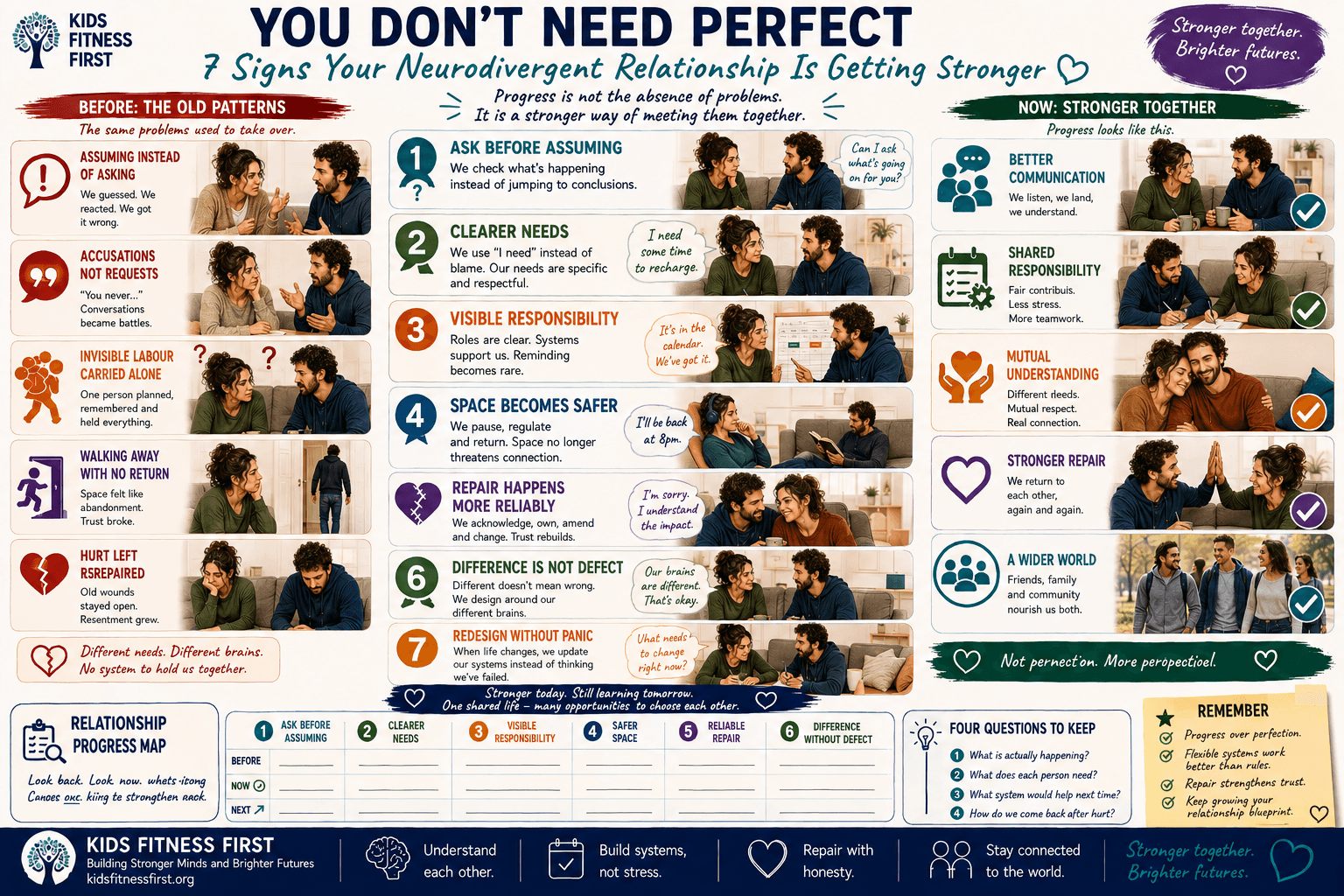
You Don’t Need Perfect: 7 Signs Your Neurodivergent Relationship Is Getting Stronger
Neurodivergent relationship progress can be surprisingly difficult to recognise.
Perhaps you still argue.
One partner still forgets things.
Likewise, somebody still becomes overloaded occasionally.
Sometimes a conversation still goes badly.
Therefore, you may look at the relationship and think:
“After all this work, why aren’t we better at this yet?”
However, that question may contain an unrealistic standard.
Because relationship progress does not usually mean:
no more problems.
Instead, it may mean:
the same problems no longer control the relationship in the same way.
Perhaps you still misunderstand one another.
However, now you notice the misunderstanding sooner.
Perhaps somebody still needs to leave a difficult conversation.
However, now they explain why, give a return time and actually come back.
Likewise, the household may still become unbalanced during difficult periods.
However, now both people can name it and rebalance before resentment becomes permanent.
These changes may look small.
Nevertheless, they are not small.
They are evidence that the relationship is learning.
That is the final message of Book Five.
You do not need a relationship that never struggles.
You need one that becomes increasingly capable of understanding, adapting, repairing and returning.
Why Perfection Is a Poor Measure of Relationship Health
Perfection gives couples an impossible checklist.
We should always communicate calmly.
We should never misunderstand each other.
Responsibilities should always be equal.
Likewise, sex, affection, social life and emotional connection should remain consistent.
Nobody should ever become defensive.
Nobody should ever need too much.
However, real adult life does not behave this way.
People become ill.
Children struggle.
Work becomes demanding.
Meanwhile, energy changes, hormones change, families age and priorities shift.
Neurodivergent nervous systems may also respond differently to:
- stress;
- sensory demands;
- uncertainty;
- change;
- executive workload;
- and emotional intensity.
Therefore, the question cannot reasonably be:
“Does our relationship function perfectly?”
Instead, ask:
“When life disrupts us, do we increasingly know how to find our way back?”
That is a far stronger measure.
Progress Is Often a Change in the Pattern, Not the Problem
Imagine the same disagreement occurring one year apart.
Previously:
A task was forgotten.
One partner accused.
The other became ashamed.
Then they defended themselves.
Consequently, the argument expanded into everything that had gone wrong for years.
Eventually, one person walked away.
Nobody repaired.
Three days later, both acted as though nothing happened.
Now imagine the same forgotten task today.
One partner says:
“I’m frustrated because I was depending on that happening.”
The other replies:
“I forgot it. I can see the impact. Let’s fix this first, then I need to change the reminder system.”
Perhaps there is still irritation.
However, the argument lasts fifteen minutes rather than three days.
The original problem still occurred.
Nevertheless, the relationship handled it differently.
That is progress.
The Seven Signs of Relationship Progress
Article 25 closes the Book Five article sequence with Seven Signs of Progress:
- You Ask Before You Assume
- Needs Become Clearer and Less Accusatory
- Responsibilities Become More Visible
- Space Becomes Safer
- Repair Happens More Reliably
- Difference No Longer Automatically Means Defect
- You Can Redesign Without Deciding the Relationship Has Failed
None of these requires perfect performance.
Instead, they reveal a relationship becoming more resilient.
Sign 1: You Ask Before You Assume
Earlier in a relationship, behaviour may be interpreted almost instantly.
Silence becomes:
“You’re angry with me.”
Forgetting becomes:
“You don’t care.”
A need for space becomes:
“You’re rejecting me.”
Likewise, a request for predictability becomes:
“You’re controlling.”
However, progress changes the space between behaviour and conclusion.
Now you ask:
“What is happening?”
Or:
“Are you upset with me, or are you overloaded?”
Perhaps:
“Did you forget this, or did something stop you doing it?”
This does not mean becoming naïve.
Likewise, it does not mean ignoring harmful behaviour.
Instead, curiosity gets one opportunity before judgement becomes final.
That is accurate mutual recognition.
Curiosity Does Not Remove Accountability
Suppose your partner repeatedly misses an important responsibility.
Asking:
“What is happening?”
is not the same as saying:
“It doesn’t matter.”
Instead, the sequence becomes:
First, understand.
Then, address the impact.
Finally, redesign what needs changing.
For example:
“I understand that working memory contributed. However, this still affects both of us. Therefore, we need a system that doesn’t depend on remembering spontaneously.”
Understanding and accountability now work together.
That is stronger than blame or excuse alone.
Sign 2: Needs Become Clearer and Less Accusatory
Another sign of neurodivergent relationship progress is a change in language.
Previously:
“You never leave me alone.”
Now:
“I need thirty minutes to decompress when I get home.”
Previously:
“You don’t spend any time with me.”
Now:
“I need some reliable connection during the week.”
Likewise, instead of:
“You pressure me all the time.”
the person may say:
“I process decisions better when I know when an answer is needed rather than being asked repeatedly.”
The underlying needs may not have changed.
However, the delivery has.
Consequently, the other partner has something practical to respond to.
Clear Needs Create Better Negotiation
Accusations require defence.
Specific needs create options.
For example:
“You don’t care about my family.”
has very few useful responses.
However:
“It matters to me that you come to some important family events”
creates possibilities.
Perhaps:
- attend the most important events;
- stay for a shorter period;
- travel separately;
- or choose quieter family contact on another day.
Therefore, clearer communication does not guarantee that everyone gets everything they want.
Instead, it makes intelligent compromise possible.
Sign 3: Responsibilities Become More Visible
A stronger relationship becomes increasingly clear about:
who owns what.
Not merely:
who performs the final task.
Instead, ownership includes:
- noticing;
- remembering;
- planning;
- doing;
- and following up.
Therefore, sentences such as:
“I thought you were doing that”
begin happening less often.
Likewise, one partner becomes less likely to serve as the invisible backup system for the entire household.
Instead, calendars, reminders, routines and clear responsibilities carry more of the load.
This is one of the strongest signs that the relationship is moving away from the Parent Trap.
Systems Start Replacing Resentful Reminders
Previously:
“Did you remember?”
“Have you done it yet?”
“Don’t forget.”
“I’ve told you three times.”
Now, perhaps:
- the appointment is in the shared calendar;
- an automated reminder appears;
- ownership is clear;
- and the couple reviews only if the system fails.
Therefore, practical architecture begins reducing emotional friction.
The relationship gets to spend less time being a reminder service.
That creates room for something else.
Connection.
Sign 4: Space Becomes Safer
In a stronger relationship, needing space no longer automatically threatens connection.
For example:
“I’m overloaded. I need thirty minutes. I’m not leaving this conversation, and I’ll come back at eight.”
The person who needs space receives regulation time.
Meanwhile, their partner receives reassurance.
Most importantly, the person returns.
Consequently, repeated experience teaches both nervous systems:
space does not equal abandonment.
This can be transformational.
Because the couple no longer has to choose between:
forcing continued conversation
and:
unexplained disappearance.
There is another route.
Pause.
Regulate.
Return.
Trust Grows Through Predictable Return
One successful pause helps.
However, ten successful pauses create something stronger:
evidence.
The partner begins believing:
“When they say they are coming back, they come back.”
Likewise, the person taking space learns:
“I am allowed to regulate without having to escape completely.”
Therefore, trust grows not through promises alone.
It grows through repeated patterns.
That principle appears throughout Book Five.
Changed behaviour becomes evidence.
Evidence gradually changes expectation.
Sign 5: Repair Happens More Reliably
Arguments still happen.
People still say things badly.
Likewise, somebody may still become defensive.
However, the relationship does not leave every injury where it fell.
Instead, somebody returns.
Perhaps:
“I spoke to you unfairly earlier.”
Or:
“I understand why that hurt.”
Then:
“I am sorry.”
Afterwards, behaviour begins changing.
This is important because successful repair does not mean delivering the most emotional apology.
Instead, repair includes:
- acknowledgement;
- ownership;
- amends;
- and evidence over time.
The relationship becomes less afraid of rupture because it increasingly trusts its ability to repair.
Faster Repair Is Progress
Perhaps arguments previously remained emotionally active for three days.
Now they last several hours.
Eventually, perhaps a small rupture repairs within twenty minutes.
That is not trivial.
Likewise, perhaps one partner still becomes ashamed after causing harm.
However, they now catch the shame before it turns into a two-hour explanation about why they are a terrible person.
Instead:
“I got this wrong. I want to repair it.”
That is enormous progress.
The nervous system is learning a different route.
Sign 6: Difference No Longer Automatically Means Defect
Perhaps one person still needs more quiet.
The other still wants more social contact.
Likewise, one processes decisions quickly while another needs time.
One may use written communication more.
Another may prefer spoken conversation.
These differences remain.
However, the emotional interpretation changes.
Instead of:
“Why can’t you be normal?”
the relationship asks:
“How do we make this work for us?”
That is the Blueprint mindset.
The goal is not identical brains.
Instead, it is compatible architecture.
Accommodation Stops Feeling Like Defeat
A relationship may use:
- written plans;
- separate travel to social events;
- alarms;
- visual reminders;
- scheduled difficult conversations;
- decompression periods;
- individual friendships;
- or explicit household ownership.
Perhaps these things once felt unromantic.
However, eventually, they simply become:
how our relationship works.
That acceptance matters.
Because couples waste enormous energy fighting the fact that they need a system.
Once the system is accepted, the energy can go somewhere more useful.
Sign 7: You Can Redesign Without Deciding the Relationship Has Failed
This may be the clearest long-term sign of strength.
Something stops working.
Perhaps:
- the household split;
- communication timing;
- social routine;
- parenting system;
- intimacy pattern;
- or support arrangement.
Previously, both people might panic.
“We’re going backwards.”
“Nothing ever changes.”
“Here we go again.”
Now, however, they ask:
“What changed?”
Then:
“What needs redesigning?”
This is a fundamentally different relationship posture.
The problem is no longer automatically proof of personal failure.
Instead, it becomes information.
Flexible Relationships Can Survive Changing Lives
The source Blueprint describes the relationship as an architecture that grows with the people inside it, with clear systems, repair, mutual recognition and continued connection to a wider world rather than one fixed formula.
Therefore, strong couples are not those who find one permanent arrangement.
They are couples who become better at changing the arrangement.
Children arrive.
Children leave.
Work changes.
Health changes.
People age.
Likewise, understanding of neurodivergence may deepen.
The design evolves.
However, the commitment to mutual dignity remains.
The Seven Signs at a Glance
| Sign of Progress | Old Pattern | Stronger Pattern |
|---|---|---|
| 1. Ask Before Assuming | “I know what this means.” | “Can I check what is happening?” |
| 2. Clearer Needs | Accusations | Specific requests |
| 3. Visible Responsibility | Reminding and drift | Clear ownership and systems |
| 4. Safer Space | Withdrawal or chasing | Pause, regulate, return |
| 5. Reliable Repair | Wait until it fades | Acknowledge, own, amend, change |
| 6. Difference Without Defect | “Why can’t you be normal?” | “What design works for us?” |
| 7. Redesign Without Panic | Problems mean failure | Problems provide information |
You do not need all seven to be strong.
Instead, notice movement.
Progress Can Be Uneven
Perhaps communication has improved enormously.
However, workload remains unfair.
Likewise, repair may be much stronger while social isolation remains a problem.
That is normal.
Relationships rarely improve evenly across every domain.
Therefore, do not say:
“We still struggle with X, so nothing has changed.”
Instead:
“X still needs work, while Y and Z are clearly stronger.”
This is more accurate.
Progress and unfinished work can coexist.
Do Not Move the Goalposts Every Time You Improve
This happens easily.
First, you want fewer explosive arguments.
Those reduce.
Then you become frustrated because conversations are not yet perfectly calm.
Likewise, you once wanted your partner to return after taking space.
Now they return, but you become disappointed because they still need space at all.
Therefore, occasionally remember where you started.
Not to lower standards.
Instead, to recognise genuine movement.
Otherwise, progress becomes invisible the moment it occurs.
The Before-and-Now Test
Choose one recurring relationship problem.
Then compare:
Before
and:
Now
For example:
Before: forgotten responsibility became a two-day argument.
Now: frustration + acknowledgement + system update in thirty minutes.
Or:
Before: one person disappeared after conflict.
Now: they ask for space and return.
Likewise:
Before: every social event became an argument.
Now: some events are shared, some separate and recovery is planned.
The problem may not have vanished.
However, the pattern changed.
That deserves recognition.
Reflection: What Is Stronger Than It Used to Be?
Do this separately first.
Then share your answers.
Which Problem Still Exists but Hurts Less?
Complete:
“We still struggle with __________, but now we…”
For example:
“We still misunderstand each other, but now we ask more questions before reacting.”
Or:
“Appointments still sometimes get missed, but now we fix the system rather than attacking each other.”
This is one of the best ways to identify genuine progress.
What Does Your Partner Do Differently Now?
Name something specific.
Not:
“They communicate better.”
Instead:
“When they need space, they now tell me when they will return.”
Or:
“They have taken complete ownership of the school calendar.”
Specific evidence makes progress believable.
Then tell them.
What Do You Do Differently Now?
Again, be specific.
Perhaps:
- you pause earlier;
- apologise without collapsing;
- ask for help sooner;
- stop using reminders as monitoring;
- explain your needs;
- attend social events separately;
- or recognise overload before it becomes conflict.
Write:
“One thing I now do that I did not do a year ago is…”
That matters.
What Used to Feel Personal That Now Feels Understandable?
Perhaps:
silence.
forgetting.
need for predictability.
need for solitude.
difficulty with paperwork.
Understanding does not mean you always enjoy the behaviour.
However, perhaps you no longer interpret it as an attack on your worth.
That reduces unnecessary pain.
What Is Still Fragile?
Progress should not become denial.
Therefore, identify one area that still needs attention.
Perhaps:
- workload;
- intimacy;
- repair;
- social connection;
- decisions;
- support;
- or boundaries.
Then say:
“This is not proof that we are failing. It is simply the next area that needs work.”
That is the Blueprint mindset.
What Are You Proud of as a Couple?
Couples often discuss what is wrong.
Rarely do they ask:
“What have we actually learned?”
Therefore, complete:
“One thing we now handle better together is…”
Perhaps:
crisis.
parenting.
social overload.
conflict.
money.
family pressure.
Recognise shared competence.
Reflection Takeaway
Complete this sentence together:
“We are not perfect, but we are stronger because now we…”
Keep the answer.
It may become one of the most important sentences in the entire Book Five exercise.
Try This: The Relationship Progress Map
Take one sheet of paper.
Draw seven rows.
Label them:
ASK BEFORE ASSUMING
CLEAR NEEDS
VISIBLE RESPONSIBILITY
SAFE SPACE
REPAIR
DIFFERENCE WITHOUT DEFECT
REDESIGN
Then create three columns:
BEFORE
NOW
NEXT
For example:
| Area | Before | Now | Next |
|---|---|---|---|
| Ask Before Assuming | Silence meant anger | We usually check | Stop assuming during tired weeks |
| Clear Needs | “You never…” | More specific requests | Practise around social plans |
| Responsibility | One person remembered everything | Shared calendar | Move medical admin |
| Safe Space | Walked away | Return windows | Pause earlier |
| Repair | Waited until conflict faded | Usually repair | Improve amends |
| Difference | Took needs personally | More understanding | Accept separate social plans |
| Redesign | Change felt like failure | We review systems | Quarterly check-in |
The map does not score the relationship.
Instead, it records movement.
Choose One Next Step, Not Seven
After completing the Progress Map, you may see several areas that could improve.
However, do not turn the final article into seven new assignments.
Instead, choose one.
Ask:
“Which next step would create the most relief or connection?”
Perhaps:
- moving one responsibility;
- building a pause agreement;
- arranging one outside friendship;
- improving one repair habit;
- or changing how a recurring decision is made.
Then work there.
Small changes accumulate.
That is how most relationship progress actually happens.
Celebrate Behaviour, Not Just Outcomes
Suppose you attempted a difficult conversation.
It still ended imperfectly.
However, somebody noticed overload early.
That deserves recognition.
Likewise, perhaps the couple did not agree.
However, neither person insulted the other.
Again, progress.
Perhaps a new reminder system failed.
However, rather than returning immediately to the Parent Trap, you redesigned it together.
That is progress too.
Therefore, measure skills as well as results.
Sometimes a stronger process appears before a better outcome.
Progress Is Not Linear
There will be weeks when old patterns return.
Stress increases.
Sleep decreases.
Likewise, illness, work or family pressure may reduce capacity.
Suddenly, an argument feels exactly like it did three years ago.
That can be discouraging.
However, one relapse does not erase accumulated learning.
Ask:
“Did we notice it sooner?”
“Did we repair more quickly?”
“Did we understand what triggered the return?”
If yes, even the setback contains evidence of progress.
The Relationship Can Get Better Without Becoming Easier in Every Way
This is another important truth.
Perhaps you now set healthier boundaries.
Therefore, some conversations become harder initially.
Likewise, stepping out of the Parent Trap may create more short-term uncertainty.
Moving responsibility back may produce occasional mistakes.
Rebuilding an outside social world may require effort.
Therefore, improvement does not always feel immediately comfortable.
Sometimes healthier architecture requires adjustment.
Measure the long-term effect.
Not only today’s comfort.
The Strongest Sign May Be Psychological Safety
Perhaps the deepest form of progress is this:
You can raise a problem without automatically fearing the entire relationship will collapse.
You can say:
“This isn’t working.”
and both people understand that the sentence means:
“Let’s work on this.”
not:
“Everything is over.”
Likewise, someone can make a mistake and still believe repair is possible.
That is powerful.
The relationship becomes a place where imperfection can be discussed.
Not hidden.
Keep a Wider World
Book Five has repeatedly emphasised that a healthy partnership needs something around it.
Friends.
Family.
Community.
Individual identity.
Therefore, relationship progress should not mean becoming increasingly fused.
Instead, strong connection can allow more independence.
Perhaps both people feel safer maintaining separate friendships.
Likewise, one may attend social events alone while the other rests.
A stronger relationship may actually need less constant togetherness, because trust has increased.
That is worth noticing.
Keep Humour
Frameworks are useful.
However, a relationship cannot live only on frameworks.
Eventually, put down the worksheets.
Laugh.
Watch football.
Go for a walk.
Make dinner.
Talk nonsense.
Send the silly message.
Sit quietly.
Relationships need maintenance.
However, they also need ordinary life.
Otherwise, the relationship becomes the project instead of the place where life happens.
Keep Choosing Each Other Without Making It Dramatic
Long-term commitment is often presented through grand gestures.
However, much of partnership is quieter.
It looks like:
“I’ll put that in the calendar.”
“I need space, but I’m coming back.”
“I understand why you reacted that way, and we still need to repair it.”
“You look tired. Shall I take this tonight?”
“I miss my friend. I’m going to arrange coffee.”
“Our system isn’t working anymore. Let’s change it.”
These are ordinary sentences.
However, repeated across years, they become architecture.
The Final Book Five Practice: Four Questions to Keep
If you remember only four questions from these articles, keep these:
1. What is actually happening here?
This interrupts assumption.
2. What does each person genuinely need?
This interrupts blame.
3. What system would make this easier next time?
This interrupts repeated friction.
4. If we hurt each other, how do we come back?
This protects trust.
You do not need to remember twenty-five complete articles during an argument.
These four questions can carry a surprising amount.
A Note to the Neurodivergent Partner
Your brain does not remove your responsibility.
However, responsibility does not require hating your brain.
You can say:
“This is harder for me.”
and:
“I still need a system.”
You can ask for accommodation.
Likewise, you can own impact.
You can need recovery.
And you can return.
The goal is not becoming less neurodivergent.
Instead, it is becoming more able to live your neurodivergence with clarity, dignity and responsibility.
A Note to the Partner
Understanding your partner does not require disappearing yourself.
You can recognise neurological difference.
However, your needs still matter.
You can support.
Nevertheless, you do not have to become another adult’s permanent operating system.
You can give space.
Likewise, you can require reliable return.
You can acknowledge difficulty.
And you can still expect repair.
Understanding should create a relationship with two visible people, not one.
A Note to Both of You
You will misread each other again.
Someone will forget something.
A system will fail.
Likewise, one of you may overreact.
Perhaps the world will become too small for a while.
Maybe overload will return.
That is not the end of the work.
However, it is also not evidence that nothing worked.
The question is:
What do you do next?
Do you assume?
Or ask?
Do you attack?
Or name the need?
Do you disappear?
Or pause and return?
Do you keep repeating the failing structure?
Or redesign?
That is where the relationship lives.
Not in perfection.
In the next move.
Conclusion: A Strong Relationship Keeps Learning
Neurodivergent relationship progress is not measured by the absence of difficulty.
Instead, look for the signs.
You ask before assuming.
You communicate needs more clearly.
Responsibilities become visible.
Space becomes safer.
Repair becomes more reliable.
Difference stops automatically becoming defect.
And when something stops working, you redesign rather than immediately deciding the relationship itself is broken.
That is progress.
Not glamorous progress.
Not perfect progress.
However, durable progress.
The final Relationship Blueprint material describes the aim as strong foundations, flexible design and an architecture that grows with the people inside it. It also leaves readers with an ongoing practice: check in, redesign as life changes, celebrate progress and keep choosing each other.
Therefore, perhaps the final lesson of Book Five is the simplest:
You do not need perfect.
You need a relationship where both people remain visible.
Where both can grow.
Where systems support rather than shame.
Where difference can be understood.
Where hurt can be repaired.
Where the outside world remains open.
And where, after all the misunderstanding, overload, learning, failure, laughter, rebuilding and change, two people can still say:
“We are learning how to do this better together.”
That is enough to keep building from.
SUGGESTED INTERNAL LINKS
Article 7: Taking Space Without Creating Distance: The Safe Pause Protocol for Neurodivergent Relationships
Article 10: Fairness Is Not Always 50/50: Building a Capacity-Based Neurodivergent Relationship
DISCLAIMER
This article is provided for general educational and informational purposes only. It is not medical, psychological, diagnostic, legal, relationship or couples-therapy advice.
Neurodivergent people and relationships vary considerably. Therefore, no single list of relationship behaviours should be treated as a diagnostic test or universal measure of relationship health.
Progress may also look different where disability, illness, trauma, caring responsibilities or other major circumstances affect one or both partners.
Likewise, improved communication or neurodivergence-related understanding should never be used to minimise abuse, coercion, intimidation, physical aggression or serious safety concerns. Appropriate qualified support may be necessary in those situations.