
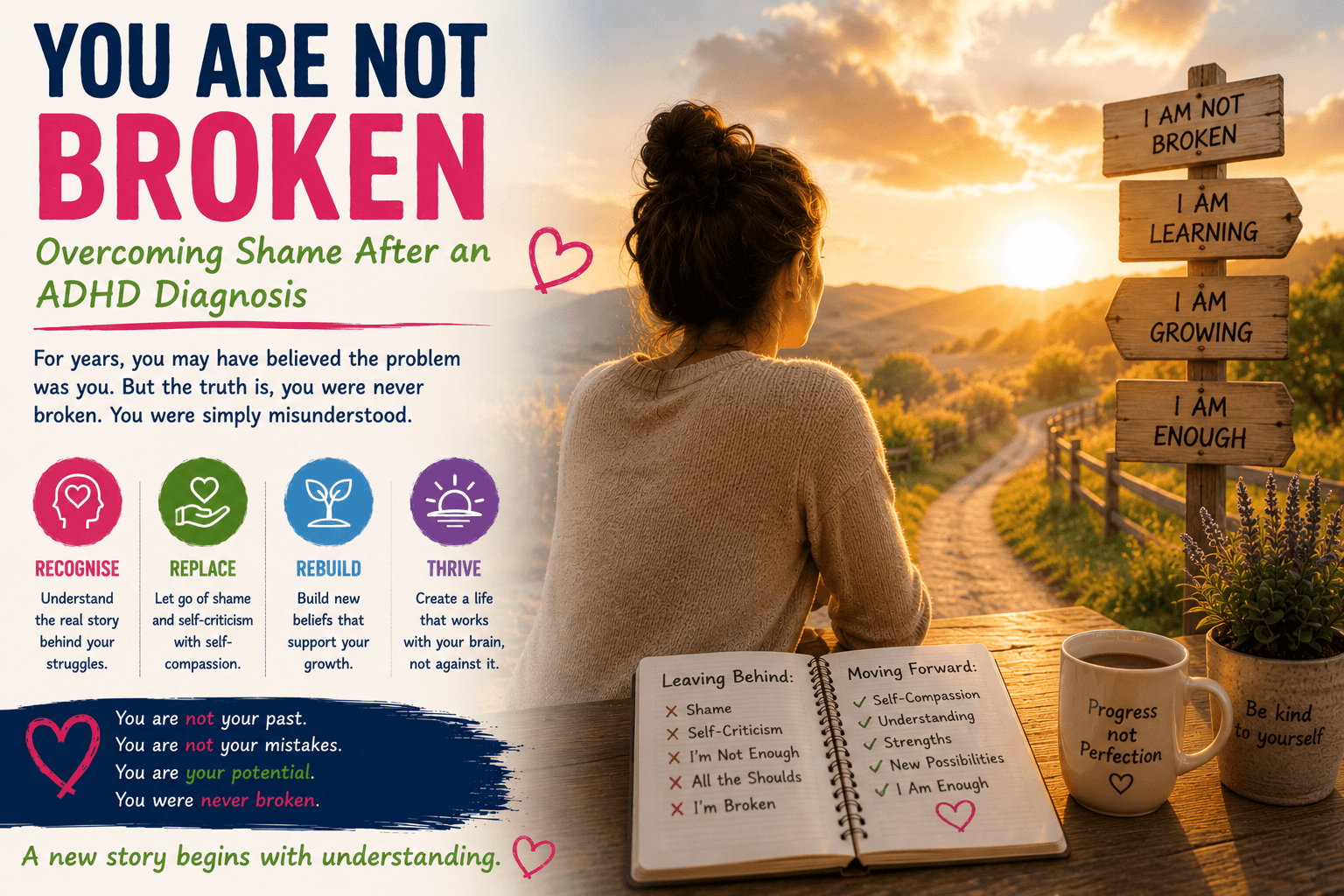
Why You Are Not Broken: Overcoming Shame After an Adult ADHD Diagnosis
One of the hardest parts of receiving an adult ADHD diagnosis is not understanding ADHD itself.
Instead, it is learning to let go of the belief that something has always been wrong with you.
Many adults spend decades collecting evidence against themselves.
Every forgotten appointment.
Every unfinished project.
Every missed deadline.
Every emotional reaction.
Every critical comment.
Slowly, these experiences create a powerful story:
“I’m broken.”
However, Book 2 explains that this story is built on misunderstanding rather than truth. What many people believed were personal failings were often the result of living with an undiagnosed neurodevelopmental difference.
Where the “I’m Broken” Belief Begins
Very few children are born believing they are failures.
Instead, those beliefs often develop over time.
A child may hear:
- “You just need to try harder.”
- “Why can’t you be more organised?”
- “You have so much potential.”
- “Stop being so lazy.”
Although these comments may be intended to encourage, they can leave a lasting impression.
Eventually, many children stop questioning the message and begin believing it.
As adults, they no longer hear the teacher’s voice or a parent’s criticism.
Instead, those words become their own inner voice.
Why Shame Feels So Real
Shame grows through repetition.
When someone repeatedly struggles with organisation, time management or emotional regulation without understanding why, they often assume the problem must be their character.
Book 2 explains that many adults build what feels like an “airtight case” against themselves over many years. Every difficult experience becomes another piece of evidence supporting the belief that they are fundamentally flawed.
However, receiving an ADHD diagnosis introduces a different explanation.
The evidence has not changed.
The interpretation has.
Understanding the Difference Between Shame and Responsibility
Learning that you have ADHD does not remove responsibility.
Instead, it changes how responsibility is understood.
For example:
You are still responsible for attending meetings.
You are still responsible for treating people kindly.
You are still responsible for managing commitments.
However, you no longer need to believe that every struggle proves you are a failure.
Instead of asking,
“What’s wrong with me?”
try asking,
“What support or system would help me succeed?”
This small change can completely alter how you approach everyday challenges.
Replacing Self-Criticism With Self-Compassion
Many adults speak to themselves in ways they would never speak to another person.
Imagine telling a close friend:
- “You’re useless.”
- “You’ll never change.”
- “You always mess everything up.”
Most people would never use those words with someone they care about.
Yet they repeat them to themselves every day.
Book 2 encourages readers to replace harsh judgement with honest compassion. Self-compassion is not about making excuses. It is about responding to difficulties with the same understanding you would offer someone else.
Changing the Story You Tell Yourself
Our thoughts shape how we see ourselves.
Consider replacing familiar criticisms with more balanced statements.
Instead of:
“I never finish anything.”
Try:
“I work best when tasks are broken into smaller steps.”
Instead of:
“I’m too emotional.”
Try:
“I experience emotions deeply, and I can learn healthy ways to manage them.”
Instead of:
“I’m unreliable.”
Try:
“I need systems that support my memory and organisation.”
These small changes help weaken old beliefs while creating healthier ways of thinking.
Finding Environments That Help You Thrive
Not every difficulty comes from within.
Sometimes the environment is part of the problem.
Book 2 explains that healing often involves finding places where neurodivergent strengths are recognised instead of criticised.
Supportive environments might include:
- Understanding employers
- Neurodiversity-friendly workplaces
- Encouraging friends
- ADHD support groups
- Family members willing to learn
The goal is not to avoid every challenge.
Instead, it is to spend more time in places where your strengths are valued.
Learning to Accept Your Needs
Many adults apologise for needing reminders, quiet time or written instructions.
However, these needs do not make someone weak.
Everyone benefits from working in ways that match how they think best.
Book 2 reminds readers that asking for support is not a sign of failure.
It is a sign of self-awareness.
Practical Ways to Unlearn Shame
Changing long-held beliefs takes time.
The following ideas may help.
Notice Your Inner Voice
Pay attention to how you speak to yourself.
Would you use those same words with someone you love?
If not, try choosing kinder language.
Keep a Success Journal
Each evening, write down three things you achieved.
They do not need to be major successes.
Perhaps you completed a task.
Helped someone.
Made an important phone call.
Small achievements matter.
Book 2 recommends regularly recording successes to help counter the brain’s natural tendency to focus on failures.
Challenge Old Beliefs
Whenever you notice thoughts such as,
“I’m hopeless,”
pause and ask:
“What evidence supports that?”
“What evidence suggests something different?”
Often, the story is more balanced than it first appears.
Celebrate Progress Instead of Perfection
Perfection is an impossible standard.
Progress is realistic.
Every positive change deserves recognition.
Healing Takes Time
You may understand intellectually that you are not broken.
Believing it emotionally usually takes longer.
That is completely normal.
Years of criticism cannot disappear overnight.
However, each compassionate choice helps weaken old beliefs.
Gradually, your inner voice becomes more encouraging.
Confidence grows.
Life becomes less about fixing yourself and more about understanding yourself.
Reflection Questions
- When did you first begin believing something was wrong with you?
- Which messages from childhood still affect you today?
- How would you speak to a close friend facing the same challenges?
- Which strengths have helped you overcome difficult situations?
- What would change if you truly believed you were not broken?
Conclusion
Many adults spend years believing they are broken when, in reality, they simply never understood how their brain worked.
An ADHD diagnosis cannot change the past.
However, it can change the meaning of the past.
Instead of seeing failure, you begin recognising resilience.
Instead of seeing weakness, you discover strength.
Instead of carrying shame, you begin building self-compassion.
Book 2 reminds us that unlearning shame is not a single decision.
It is a journey.
Each day offers another opportunity to replace self-criticism with understanding and to remember one simple truth:
You were never broken. You were simply trying to succeed without the right map.
Internal Links
- Rlief and Grief After an ADHD Diagnosis: Why Both Feelings Can Exist Together
- Emotional Intelligence in Teenagers: Helping Young People Understand Emotions and Build Strong Relationships
Disclaimer
This article is for educational purposes only and is based on the themes explored in The Late Discovery – Rewriting Your Life After an Adult ADHD Diagnosis. It is not intended to diagnose, treat or replace professional medical or psychological advice. If you have concerns about ADHD or your mental wellbeing, please consult a qualified healthcare professional