
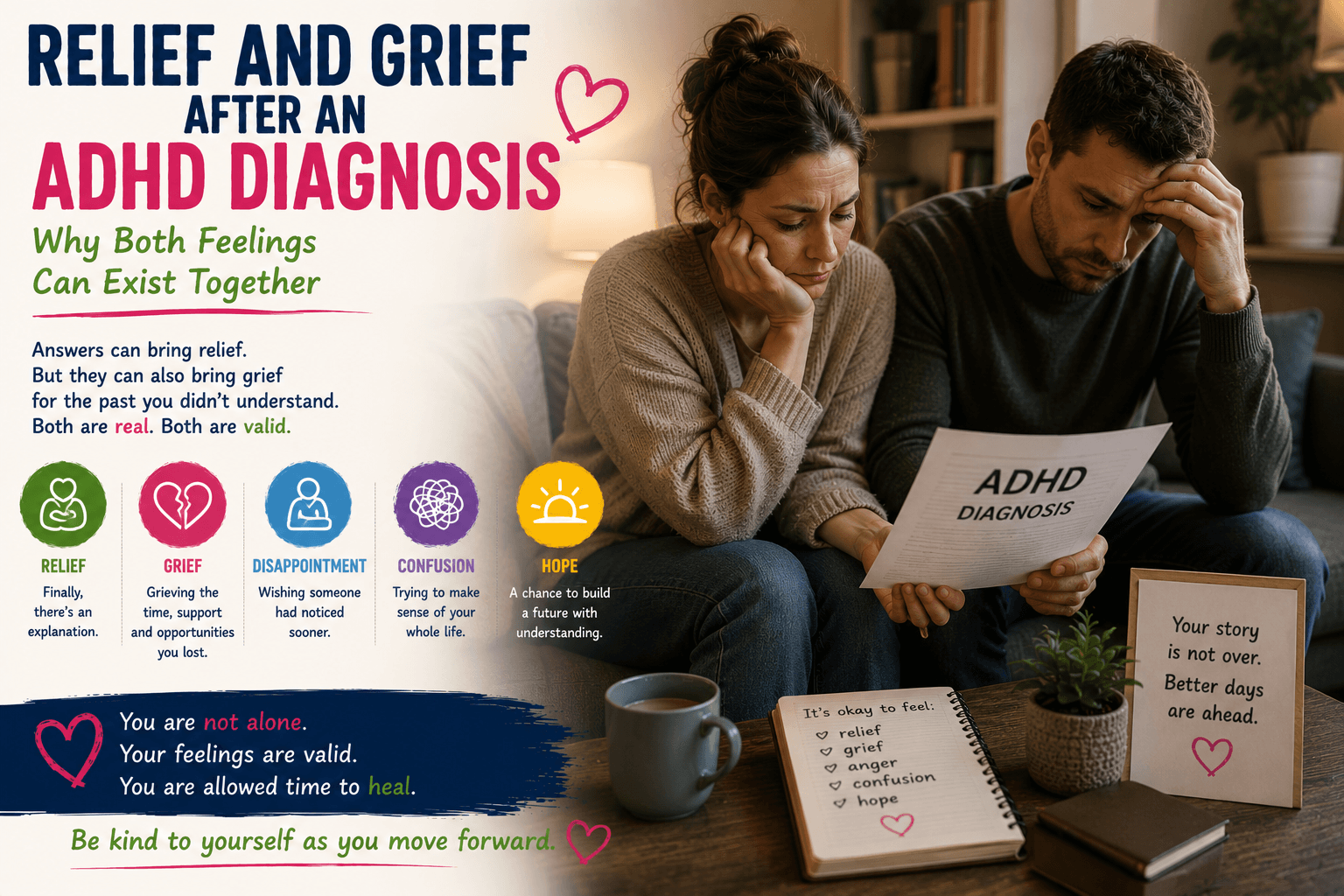
Relief and Grief After an ADHD Diagnosis: Why Both Feelings Can Exist Together
Experiencing relief and grief after an ADHD diagnosis is more common than many people expect.
For years, you may have searched for answers without finding one that truly explained your experiences. Then, suddenly, everything begins to make sense.
At first, relief often arrives because there is finally an explanation. However, that relief is frequently followed by grief.
Many people wonder why they feel sad after receiving answers they have wanted for so long.
Book 2 explains that this reaction is not unusual. Instead, it is part of understanding a lifetime of experiences through a completely new perspective.
Why Relief Comes First
Receiving an ADHD diagnosis often removes years of uncertainty.
Many adults finally realise they were never lazy.
They were never lacking intelligence.
They were not failing because they did not care.
Instead, they had been trying to live with a brain that worked differently without knowing why.
As a result, many people immediately experience relief.
They finally understand why certain tasks always felt harder.
They understand why routines were difficult.
They understand why they worked twice as hard just to keep up.
Consequently, self-blame often begins to fade.
Why Grief Often Follows
Although relief feels comforting, grief usually appears soon afterwards.
People begin thinking about the life they might have lived.
They remember school.
Career opportunities.
Relationships.
Friendships.
Dreams they abandoned.
Confidence they lost.
Book 2 explains that this grief is not only about missed opportunities.
It is also about grieving the younger version of yourself who spent years believing they were broken.
Grieving the Childhood You Never Had
Many adults realise they needed understanding rather than criticism.
Perhaps teachers called them careless.
Maybe family members believed they simply needed more discipline.
Others were constantly compared with siblings or classmates.
Children naturally believe adults.
Therefore, many accepted these labels as the truth.
Receiving a diagnosis later in life can reveal that these beliefs were never accurate.
That realisation can be painful.
Grieving Lost Opportunities
Another common part of relief and grief after an ADHD diagnosis involves wondering:
- What career might I have chosen?
- Would I have stayed in education?
- Could my relationships have been different?
- What if somebody had recognised the signs earlier?
These questions are natural.
However, they rarely have definite answers.
Instead of trying to rewrite the past, many adults gradually learn to understand it with greater compassion.
Grief Does Not Mean the Diagnosis Was Bad
Some people worry that feeling grief means they should not have pursued a diagnosis.
The opposite is often true.
Grief appears because understanding has finally arrived.
Without understanding, there would be nothing to grieve.
Book 2 describes grief as part of emotional reconstruction rather than emotional failure.
Relief and Grief Can Exist Together
One of the most surprising discoveries for many adults is that opposite emotions can exist together.
You can feel grateful for answers.
At the same time, you can feel heartbroken about how long they took.
You can feel hopeful about the future.
Meanwhile, you can feel sadness for the past.
Neither feeling cancels out the other.
Both are genuine.
How to Process These Feelings
There is no correct timetable for emotional recovery.
Nevertheless, several approaches may help.
Allow Yourself Time
Understanding decades of experiences cannot happen overnight.
Give yourself permission to process everything slowly.
Speak Kindly to Yourself
Replace old thoughts such as:
“I should have tried harder.”
with:
“I was doing the best I could with the information I had.”
Write About Your Experience
Many adults find journalling helpful.
Writing about childhood memories, school experiences and important turning points often helps organise overwhelming emotions.
Share Your Story
Talking with trusted family members, friends or support groups may reduce feelings of isolation.
Many people discover they are far from alone.
Look Towards the Future
Although the past cannot change, the future can.
Understanding how your brain works allows you to make better decisions moving forward.
Book 2 repeatedly reminds readers that late discovery is not the end of the story.
It is the beginning of living with greater understanding.
What Healing Often Looks Like
Healing does not mean forgetting the past.
Instead, it means seeing it differently.
Many adults eventually stop asking,
“What’s wrong with me?”
Instead, they begin asking,
“What do I need to thrive?”
That shift changes everything.
Reflection Questions
- Which emotion came first after learning about ADHD?
- Which memories now make more sense?
- What would you say to your younger self today?
- Which strengths helped you reach this point?
- What hopes do you have for the future?
Conclusion
Experiencing relief and grief after an ADHD diagnosis is one of the most common parts of a late discovery journey.
Relief comes because the answers finally arrive.
Grief comes because those answers took so long.
Neither emotion is wrong.
Both deserve space.
As Book 2 explains, grief is not a sign that something has gone wrong.
Instead, it is evidence that understanding has finally begun.
Over time, many people discover that relief grows into acceptance, grief softens into compassion, and the future begins to look brighter than the past ever seemed possible.
Internal Links
- Why So Many Adults Discover They Have ADHD Later in Life
- Self-Discipline in Teenagers: Building Positive Habits and Lasting Confidence
Disclaimer
This article is for educational purposes only and is based on the themes explored in The Late Discovery – Rewriting Your Life After an Adult ADHD Diagnosis. It is not intended to diagnose or treat any medical condition. If you believe you may have ADHD or need support with your mental wellbeing, please seek advice from a qualified healthcare professional.