
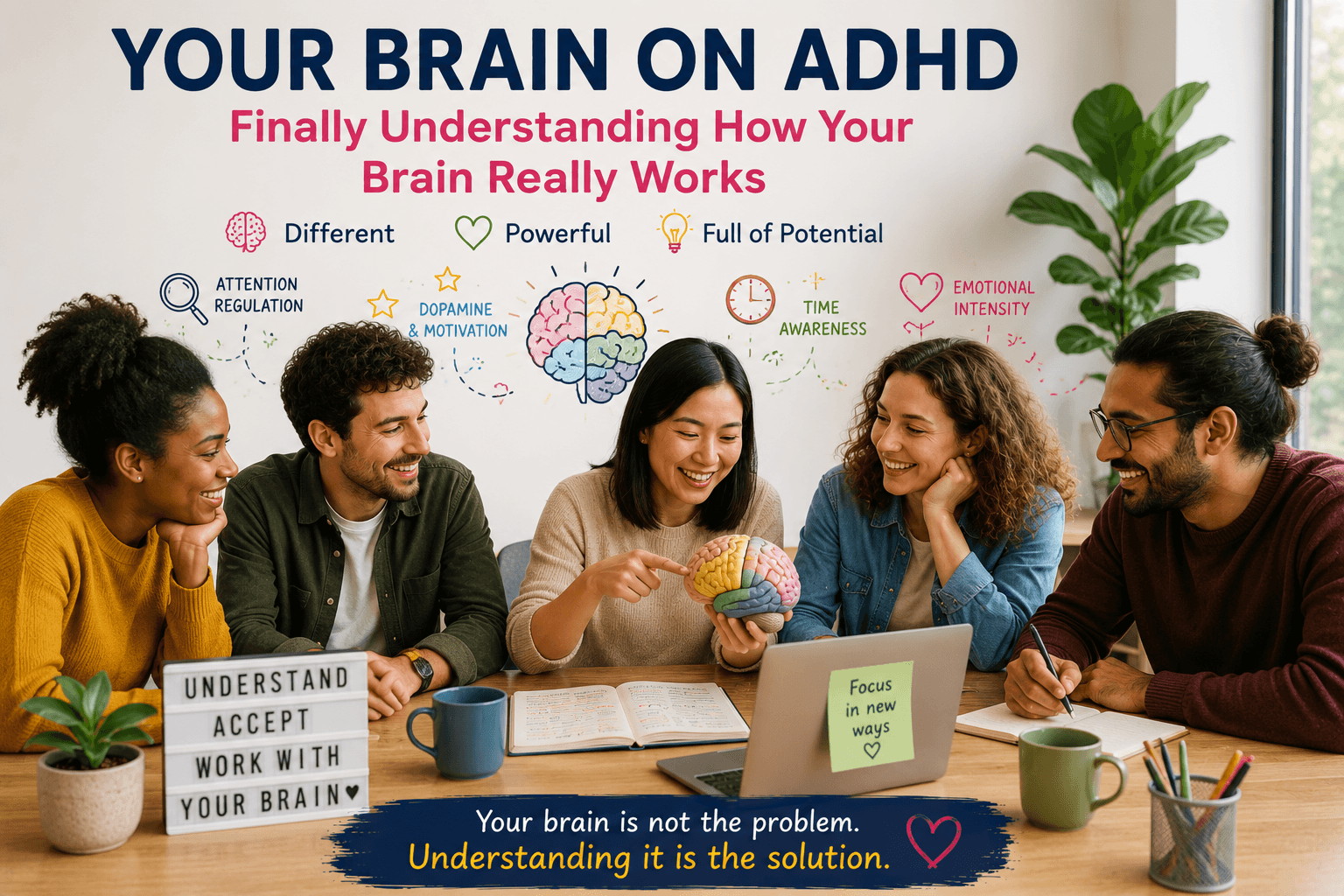
Your Brain on ADHD: Understanding How the ADHD Brain Really Works
For many adults, an ADHD diagnosis answers a question they have carried for years:
“Why does my brain seem to work differently from everyone else’s?”
Understanding how the ADHD brain works does not change who you are.
However, it can completely change how you understand yourself.
Instead of believing you lack motivation, discipline or intelligence, you begin to realise your brain processes attention, rewards and emotions differently.
Book 2 explains that this understanding is one of the most important turning points after a late ADHD diagnosis. Once you understand your brain, you can stop fighting against it and begin working with it.
ADHD Is Not About a Lack of Attention
One of the biggest misunderstandings is that ADHD means someone cannot pay attention.
In reality, attention is often inconsistent, not absent.
Many adults notice they can:
- lose focus during routine tasks
- become deeply absorbed in activities they enjoy
- overlook simple details
- notice patterns that other people miss
This is why ADHD is often described as a challenge with regulating attention, rather than simply paying attention.
Why Motivation Feels Different
Many adults ask,
“Why can I spend hours researching something I enjoy but struggle to answer one email?”
The answer is not laziness.
The ADHD brain is often driven more strongly by:
- interest
- curiosity
- challenge
- urgency
- novelty
Tasks that feel meaningful can hold attention for hours.
Tasks that feel repetitive may require much greater effort to begin.
Recognising this pattern helps explain many experiences that once felt like personal failures.
The Role of Dopamine
Researchers believe dopamine plays an important role in ADHD.
Dopamine is involved in:
- motivation
- reward
- learning
- attention
- movement
When these systems work differently, everyday activities can feel very different from how they appear to others.
This is one reason why building interest, purpose and variety into daily life can often be more effective than relying on willpower alone. Book 2 highlights modern research that helps explain these neurological differences in an accessible way.
Why Everyday Tasks Can Feel Overwhelming
Many adults wonder why simple jobs sometimes feel impossible.
Examples include:
- replying to emails
- paying bills
- starting paperwork
- organising a room
- making appointments
These tasks often involve planning, prioritising and sequencing.
Together, these skills are sometimes referred to as executive functions.
When executive functioning is affected, knowing what needs doing is not always the same as being able to start.
Understanding this difference replaces judgement with understanding.
Hyperfocus: The Other Side of ADHD
Many people are surprised to discover that ADHD can also involve hyperfocus.
Hyperfocus is a period of intense concentration on something highly engaging.
During these periods, people may:
- lose track of time
- forget meals
- ignore distractions
- produce exceptional work
Hyperfocus demonstrates that the ADHD brain is capable of remarkable concentration under the right conditions.
The challenge is not an inability to focus.
It is learning how focus is naturally triggered.
Emotions Can Feel Bigger
Many adults describe experiencing emotions more intensely.
They may:
- become excited very quickly
- feel disappointment deeply
- react strongly to criticism
- recover more slowly from emotional events
Book 2 encourages readers to see emotional intensity not simply as a weakness, but as another way the brain processes experiences. With understanding and healthy strategies, emotional awareness can become a strength rather than something to fear.
Your Brain Has Strengths Too
For years, discussions about ADHD focused almost entirely on difficulties.
Today, many researchers and adults with lived experience recognise strengths that often accompany ADHD.
These may include:
- creativity
- original thinking
- problem solving
- curiosity
- resilience
- adaptability
- enthusiasm
- innovation
Of course, not everyone experiences the same strengths.
However, recognising strengths alongside challenges creates a more balanced understanding.
Working With Your Brain Instead of Against It
Once you understand how the ADHD brain works, everyday life can become easier.
Helpful strategies may include:
Break Large Tasks Into Small Steps
Small steps reduce overwhelm and make starting easier.
Use Visual Reminders
Calendars, whiteboards, checklists and sticky notes can support memory.
Match Tasks to Energy Levels
Some jobs are easier when your energy is highest.
Others can wait until later.
Reduce Unnecessary Distractions
Creating a calmer workspace may help maintain attention.
Celebrate Progress
Notice what went well instead of focusing only on what remains unfinished.
Understanding Builds Self-Compassion
Learning about ADHD does not excuse every mistake.
However, it does replace inaccurate explanations with accurate ones.
Instead of saying:
“I’m useless.”
You might begin saying:
“My brain works differently, and I’m learning what helps it succeed.”
That small shift changes how people approach themselves every day.
Reflection Questions
- Which parts of the ADHD brain description felt most familiar?
- When do you naturally focus best?
- Which environments help you think clearly?
- What strategies have already helped you?
- Which strength would you like to develop further?
Conclusion
Understanding how the ADHD brain works is not about finding excuses.
It is about finding explanations.
For many adults, this knowledge brings enormous relief.
Years of confusion begin to make sense.
Old labels begin to lose their power.
Instead of fighting against your brain, you begin learning how to work alongside it.
Book 2 reminds readers that understanding is the foundation for every positive change that follows. Once you understand how your brain works, you are better equipped to build routines, relationships and goals that fit the way you naturally think.
Internal Links
- Why You Are Not Broken: Overcoming Shame After an Adult ADHD Diagnosis
- Relief and Grief After an ADHD Diagnosis: Why Both Feelings Can Exist Together
Disclaimer
This article is for educational purposes only and is based on the themes explored in The Late Discovery – Rewriting Your Life After an Adult ADHD Diagnosis. It is not intended to diagnose or treat any medical condition. If you think you may have ADHD or have concerns about your mental wellbeing, please seek advice from a qualified healthcare professional.