Adult ADHD and Career Archaeology: What Your Past Jobs Can Teach You About the Work That Fits
Adult ADHD and career archaeology begins with a simple idea:
Your work history contains evidence.
Perhaps you have changed jobs several times.
Alternatively, maybe one career looked perfect on paper but felt completely wrong once you were inside it.
Likewise, you may have performed brilliantly in one role but struggled in another.
At first, those experiences can look disconnected.
However, once you place them side by side, patterns may begin to appear.
For example, perhaps you repeatedly performed well when the work was interesting, the objective was clear and you had enough autonomy.
Meanwhile, perhaps you repeatedly struggled when the work became repetitive, priorities were unclear or interruptions were constant.
Therefore, instead of asking only:
“What job should I do next?”
first ask:
“What has my previous work already taught me?”
That is Career Archaeology. If you first need help making sense of a non-linear working life, read Adult ADHD and Career History. This page goes a step further by using past experience as a practical method for identifying future career fit.
What Is Career Archaeology?
Archaeology examines evidence from the past to understand what happened.
Career Archaeology applies the same principle to your working life.
However, instead of examining physical remains, you examine:
jobs;
projects;
education;
businesses;
volunteering;
side projects;
career changes;
successes;
difficult periods.
Therefore, you are not simply remembering your career.
Instead, you are investigating it.
As a result, the purpose becomes clearer: you are looking for patterns that can inform what comes next.
Adult ADHD and Career Archaeology: Stop Judging Before You Investigate
When people look backwards, they often begin with judgement.
For example:
“I should have stayed longer.”
“I wasted those years.”
“I chose the wrong career.”
“Why couldn’t I just stick with it?”
However, judgement can hide useful information.
Therefore, begin with a different question:
“What does this experience teach me?”
As a result, regret can become evidence.
Likewise, a career disappointment can become a source of practical information rather than simply something negative.
A Job You Disliked Can Still Be Useful
Suppose you spent two years in a role you disliked.
Initially, you may want to label those years a mistake.
However, perhaps the experience taught you that you struggle with repetitive administration, constant supervision or limited autonomy.
Likewise, perhaps it showed you that you need more human interaction or more variety.
Therefore, an unsuccessful career experience can still create successful career learning.
In other words, the role may not have worked, but the information can still be valuable.
Adult ADHD and Career Archaeology: Study Your Best Jobs Too
Do not analyse only what went wrong.
Instead, investigate periods when work felt unusually good.
For example, perhaps you remember thinking:
“I could do this all day.”
Or:
“I was really good at that.”
Likewise:
“People kept coming to me for help with this.”
Those moments matter.
Therefore, ask what conditions were present.
Was the work challenging?
Was it meaningful?
Did you have autonomy?
Was there variety?
Did you solve real problems?
As a result, you begin identifying the ingredients of better fit.
Look Beyond the Job Title
A job title can hide what you actually did.
For example, Operations Manager could involve:
meetings;
spreadsheets;
staff management;
problem-solving;
planning;
customer complaints;
process improvement.
Perhaps you hated some of those activities.
Meanwhile, you may have been excellent at others.
Therefore, analysing only the job title is not enough.
Instead, break each role into tasks.
As a result, you can see which parts of the job actually worked for you.
Adult ADHD and Career Archaeology: Analyse at Task Level
For each previous role, ask:
“What did I actually spend my time doing?”
Then separate the tasks.
For example:
SALES ROLE
Prospecting — disliked
Customer meetings — enjoyed
Negotiating — enjoyed
CRM administration — disliked
Solving unusual customer problems — strongly enjoyed
Standard reporting — disliked
Therefore, the conclusion may not be:
“I dislike sales.”
Instead, the conclusion may be:
“I enjoy the problem-solving and relationship parts of sales, but not the repetitive administration.”
That is a much more useful career insight.
One Difficult Job Is Not a Pattern
One difficult role may tell you relatively little.
However, the same difficulty appearing across several jobs is more interesting.
For example:
Job 1 — repetitive work became difficult.
Job 2 — repetitive work became difficult.
Job 3 — repetitive work became difficult.
Job 4 — repetitive work became difficult.
Therefore, repetition deserves attention.
Likewise, perhaps every strong period involved solving problems, learning quickly or working independently.
As a result, repeated positive experiences matter just as much as repeated difficulties.
Adult ADHD and Career Archaeology: Repetition Builds Evidence
Do not build your career around one isolated memory.
Instead, look for repeated examples.
Ask:
“Where has this happened before?”
For example, if the same strength appears across employment, education, volunteering and personal projects, the pattern becomes more meaningful.
Therefore, repeated evidence is more useful than one memorable success.
Meanwhile, isolated incidents should be treated more cautiously.
Your Career Is Bigger Than Paid Employment
Important evidence may exist outside formal jobs.
For example:
a voluntary project;
a hobby;
helping somebody with their business;
organising an event;
building something;
researching a subject;
running an online community.
Perhaps you demonstrated strong abilities there that never appeared in your formal job description.
Therefore, Career Archaeology should examine your broader working life.
As a result, your profile becomes richer than your CV alone.
Adult ADHD and Career Archaeology: Follow the Work You Chose Voluntarily
Ask:
“What have I repeatedly chosen to do even when nobody paid me?”
Perhaps you:
research subjects deeply;
fix technical problems;
organise events;
create content;
analyse markets;
build systems;
help people understand complicated information.
This does not automatically mean the activity should become a career.
However, voluntary effort can reveal genuine interest.
Therefore, notice it without forcing it into an immediate career decision.
Invisible Work Can Reveal Hidden Strengths
Article 3 explored Invisible Work.
Now bring that idea into Career Archaeology.
For example, perhaps your official role was administration.
However, colleagues repeatedly asked you to train new staff, solve technical problems or explain complicated procedures.
Likewise, perhaps customers relied on you when situations became difficult.
Therefore, ask:
“What did people rely on me for that was not technically my job?”
As a result, hidden strengths may become visible.
Adult ADHD and Career Archaeology: Follow Repeated Requests
Repeated requests are useful evidence.
Perhaps people often said:
“Can you explain this?”
“Can you look at this problem?”
“Can you speak to the customer?”
“Can you work out what’s going wrong?”
Therefore, record those requests.
For example, they may reveal strengths in communication, pattern recognition, problem-solving or relationship management.
As a result, other people’s behaviour can become part of your evidence.
Investigate Your Strongest Performance Periods
Think about the periods when you performed particularly well.
Perhaps it was during:
a difficult project;
a crisis;
a new business;
a product launch;
a complex investigation.
Then ask:
“Why did I perform so well?”
Do not settle for:
“I just worked hard.”
Instead, examine the conditions.
For example:
Was the challenge clear?
Was the outcome meaningful?
Did you have autonomy?
Was there urgency?
Therefore, strong performance becomes something you can analyse rather than something you simply remember.
Adult ADHD and Career Archaeology: Reconstruct Your Peak Performance Formula
Article 11 introduced your Peak Performance Formula.
Now use your career history to test it.
For each strong period, record:
challenge level;
interest;
autonomy;
deadline pressure;
environment;
social contact;
feedback;
meaning;
novelty.
Then compare the results.
As a result, repeated conditions may become obvious.
Therefore, your Peak Performance Formula becomes based on historical evidence rather than guesswork.
Study Your Collapse Periods Too
Now examine the opposite.
When did work become particularly difficult?
Perhaps you:
lost motivation;
became overwhelmed;
started procrastinating;
made more mistakes;
felt exhausted;
wanted to leave.
However, instead of judging yourself, ask:
“What conditions were present?”
That question connects directly to Article 12’s Collapse Conditions.
Adult ADHD and Career Archaeology: Repeated Collapse Conditions
Perhaps difficult periods repeatedly involved:
unclear priorities;
constant interruption;
micromanagement;
high social demand;
repetitive tasks;
long periods without feedback.
One difficult period may be coincidence.
However, several similar periods may indicate a meaningful pattern.
Therefore, your career history can help distinguish temporary problems from recurring fit issues.
Separate the Job From the Environment
This distinction is essential.
Perhaps you loved the work but hated the office.
Alternatively, you may have liked your colleagues but disliked the actual tasks.
Likewise, perhaps the work itself was interesting, but the manager made the role difficult.
Therefore, when reviewing a past job, score different aspects separately.
Otherwise, one negative factor can cause you to reject an entire career category.
Adult ADHD and Career Archaeology: The Six-Layer Job Review
For every significant previous role, score these areas from 1–10.
| Area | Score |
|---|---|
| Tasks | /10 |
| Environment | /10 |
| Autonomy | /10 |
| Management | /10 |
| People / social fit | /10 |
| Meaning / purpose | /10 |
Then compare the roles.
As a result, you may discover that the profession itself was not the main problem.
Instead, perhaps management, autonomy or environment was consistently the weakest factor.
Ask Why You Left
Every departure contains information.
Ask:
“Why did I actually leave?”
Not the polite interview answer.
Instead, identify the real reason.
Perhaps:
the work became boring;
there was no progression;
management changed;
you felt controlled;
the environment became exhausting;
the challenge disappeared;
you wanted something new.
Therefore, reasons for leaving can reveal important career needs.
Adult ADHD and Career Archaeology: Ask Why You Stayed
The opposite question is equally useful.
Why did you remain in certain roles longer?
Perhaps:
you liked the team;
the work changed frequently;
you had autonomy;
you were learning;
the mission mattered;
you were trusted.
Therefore, staying patterns can be just as revealing as leaving patterns.
As a result, you begin understanding what helps you remain engaged over time.
Follow the Energy
For each past role, divide tasks into three categories.
GAVE ME ENERGY
NEUTRAL
DRAINED MY ENERGY
Then compare jobs.
Perhaps the same activities repeatedly appear in the same category.
Therefore, energy becomes another form of career evidence.
Adult ADHD and Career Archaeology: Skill and Energy Are Different
You may be very good at something that drains you.
For example, perhaps you are excellent at administration, presentations or crisis management.
However, doing those tasks continuously may be exhausting.
Likewise, you may enjoy something that you are not yet particularly skilled at.
Therefore, separate two questions:
“Can I do this well?”
and:
“Can I sustainably do this often?”
Both matter.
The Success Trap
Sometimes a strength can create a career trap.
Imagine you are excellent at solving emergencies.
Therefore, everybody gives you emergencies.
Eventually, your entire role becomes crisis management.
You remain successful.
However, you become exhausted.
Therefore, Career Archaeology should not only identify what you were good at.
Instead, ask:
“Which strengths do I actually want to use regularly?”
Adult ADHD and Career Archaeology: Validate Your Strength Portfolio
Article 13 introduced the Strength Portfolio.
Now test each strength against your history.
For example:
Pattern Recognition
Job A — spotted recurring customer problem.
Job B — identified process weakness.
Personal project — noticed trend others missed.
Therefore, the pattern has several pieces of evidence.
As a result, the strength becomes more credible than simply saying:
“I think I’m good at spotting patterns.”
Evidence Is Better Than Labels
Avoid relying too heavily on labels such as:
“I’m creative.”
Instead, ask:
“Where did I create something useful?”
Likewise:
“I’m strategic.”
becomes:
“Where did my strategic thinking improve an outcome?”
Therefore, Career Archaeology turns vague self-description into evidence.
Adult ADHD and Career Archaeology: Validate Your Depth Portfolio
Article 14 introduced the Depth Portfolio.
Now look backwards.
Ask:
Where did I produce my deepest work?
What subject did I understand unusually well?
Which difficult problems did people trust me to solve?
Where did I make judgements rather than simply follow instructions?
Therefore, your career history may reveal where your Depth Economy value already exists.
Follow the Problems You Enjoy Solving
Jobs change.
Industries change.
However, the type of problem you enjoy may remain surprisingly consistent.
For example, across several roles you may repeatedly enjoy:
finding what is wrong;
making systems more efficient;
explaining difficult ideas;
persuading people;
building something new.
Therefore, your career pattern may exist at the problem level rather than the job-title level.
Adult ADHD and Career Archaeology: Find the Problem Thread
Complete this sentence for each important role:
“The part I enjoyed most was solving problems involving __________.”
Then compare the answers.
For example:
Job 1 — difficult customers.
Job 2 — team disagreements.
Job 3 — supplier negotiations.
At first, those tasks look different.
However, the deeper thread may be:
resolving human conflict.
Therefore, several different careers may contain the same underlying type of work.
Look at Learning Patterns
Ask:
“What did I learn unusually quickly?”
Perhaps:
software;
systems;
technical information;
people;
markets;
equipment;
processes.
Then ask:
“Why did I learn it quickly?”
For example, was it interesting?
Was there a real problem?
Could you experiment?
Did you receive fast feedback?
Therefore, learning history can reveal both strengths and ideal conditions.
Adult ADHD and Career Archaeology: Notice When Learning Stopped
Sometimes a job feels exciting at first.
There is new information.
Likewise, there are new people, systems and challenges.
However, eventually the learning curve flattens.
As a result, motivation may fall.
Therefore, ask:
“Did I lose interest when the job stopped teaching me something?”
If this pattern repeats, ongoing learning may be an important career requirement.
Novelty and Long-Term Interest Are Different
Novelty can create temporary excitement.
However, sustainable interest is different.
Therefore, ask:
“Which subjects did I keep returning to after the novelty disappeared?”
That question helps distinguish short-term fascination from long-term depth.
As a result, you may identify potential Depth Domains from Article 14.
Adult ADHD and Career Archaeology: Review Your Autonomy History
Article 18 explored autonomy.
Now examine your career history.
In your strongest jobs, how much control did you have over:
task order;
method;
timing;
location;
decision-making?
Then compare your weakest roles.
Perhaps a pattern appears.
Therefore, your Autonomy Profile should be informed by real past experience.
Review Your Management History
Think about your best manager.
Perhaps they:
gave clear goals;
trusted you;
provided feedback;
left you alone when you were working well;
helped when you became blocked.
Now think about your most difficult manager.
What was different?
Therefore, Career Archaeology can reveal the management style that supports your best work.
Adult ADHD and Career Archaeology: Review Your Environment History
Article 16 explored the Work Environment Profile.
Now test it against your career history.
Perhaps your strongest roles involved:
small teams;
quiet workspaces;
movement;
remote work;
varied locations.
Meanwhile, perhaps difficult roles involved:
open-plan noise;
constant interruption;
long meetings;
little privacy.
Therefore, past workplaces provide real-world environmental evidence.
Do Not Rewrite History Around One Experience
Suppose one remote job went badly.
That does not automatically mean:
“Remote working doesn’t suit me.”
Perhaps the real issue was poor management, unclear priorities or the wrong tasks.
Likewise, one difficult office job does not prove that office work is unsuitable.
Therefore, separate variables carefully.
Career Archaeology is investigation, not confirmation of existing beliefs.
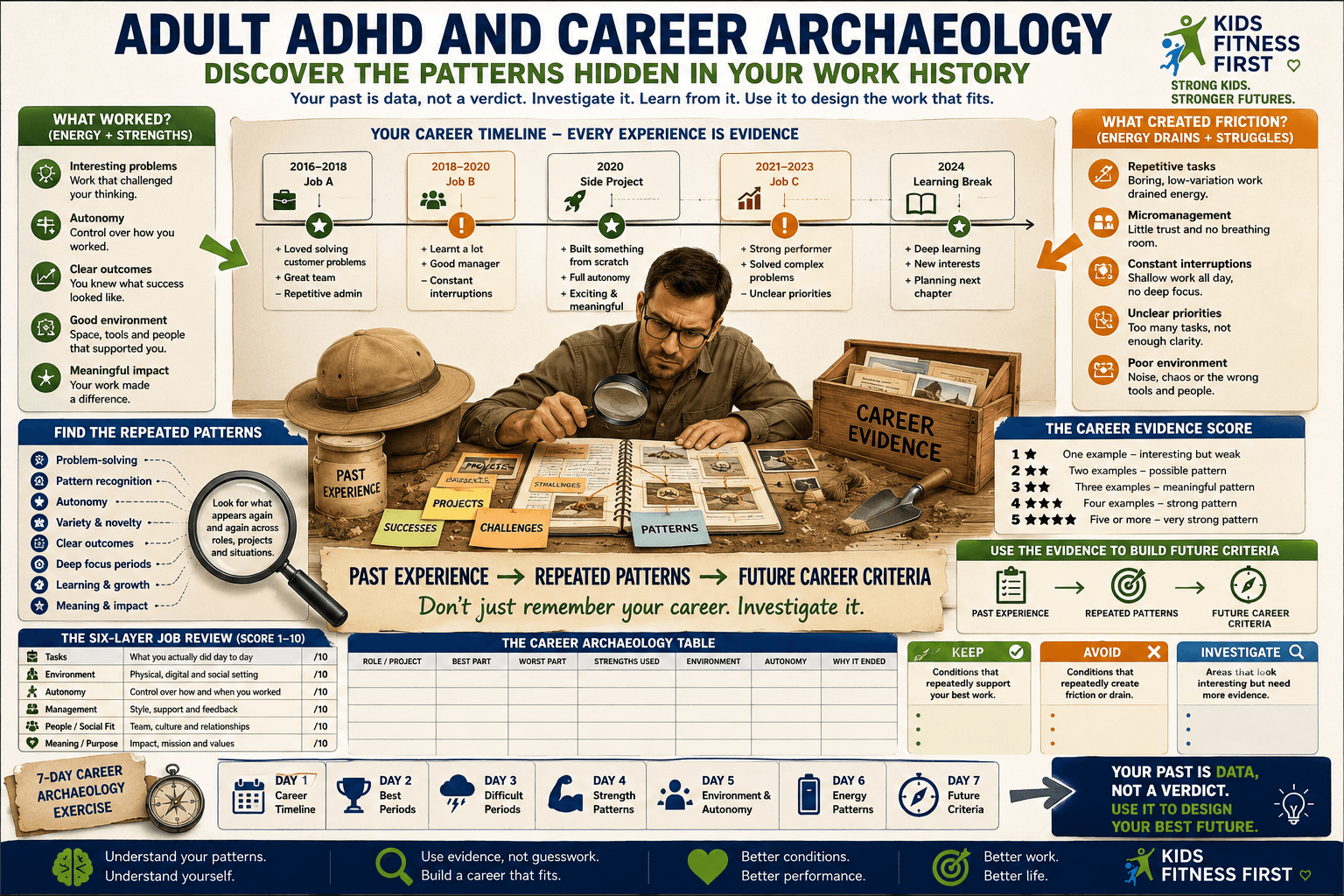
Adult ADHD and Career Archaeology: Create Your Career Timeline
Draw a horizontal line.
Then add every important period.
For example:
2016–2018
Job A
2018–2020
Job B
2020
Side project
2021–2023
Job C
2024
Training / career break
For each period, add:
+ what worked
– what did not
★ strongest performance
! major difficulty
→ why you moved on
As a result, your career becomes visible as a pattern rather than a collection of memories.
The Career Archaeology Table
Now create a detailed table.
| Role | Best Part | Worst Part | Strength Used | Environment | Autonomy | Why It Ended |
|---|---|---|---|---|---|---|
| Job A | ||||||
| Job B | ||||||
| Job C | ||||||
| Project |
Do not rush this exercise.
Instead, complete it carefully.
Therefore, you create a practical evidence base for future decisions.
Adult ADHD and Career Archaeology: The Repeat Pattern Test
After completing the table, identify anything that appears three or more times.
For example:
REPEATED STRENGTH
Solving unusual problems — 5 times.
REPEATED DRAIN
Repetitive paperwork — 4 times.
REPEATED SUCCESS CONDITION
High autonomy — 3 times.
REPEATED COLLAPSE CONDITION
Constant interruptions — 4 times.
Therefore, these repeated patterns deserve particular attention.
The Career Evidence Score
For each suspected pattern, score the evidence.
1 — ONE EXAMPLE
Interesting, but weak evidence.
2 — TWO EXAMPLES
Possible pattern.
3 — THREE EXAMPLES
Meaningful pattern.
4 — FOUR EXAMPLES
Strong pattern.
5 — FIVE OR MORE EXAMPLES
Very strong historical pattern.
Therefore, the Career Evidence Score reduces the risk of one memorable event dominating your conclusions.
Adult ADHD and Career Archaeology: Build Your Career Evidence File
Create five sections.
1. REPEATED STRENGTHS
2. REPEATED ENERGY SOURCES
3. REPEATED DRAINS
4. REPEATED COLLAPSE CONDITIONS
5. REPEATED SUCCESS CONDITIONS
As a result, you now have a Career Evidence File.
Turn the Past Into Future Criteria
The purpose of Career Archaeology is not to remain focused on the past.
Instead, use the evidence to create future criteria.
For example:
Historical Pattern
I consistently perform better when I control task order.
Future Criterion
Look for roles with reasonable autonomy.
Likewise:
Historical Pattern
I repeatedly lose energy in highly repetitive roles.
Future Criterion
Look for work containing meaningful variation.
Therefore, past experience becomes a practical decision-making tool.
Adult ADHD and Career Archaeology: Create Keep, Avoid and Investigate Lists
KEEP
Conditions repeatedly associated with strong performance.
For example:
autonomy;
interesting problems;
clear outcomes.
AVOID
Conditions repeatedly associated with difficulty.
For example:
constant interruption;
extreme repetition;
unclear priorities.
INVESTIGATE
Patterns that seem important but need more evidence.
For example:
remote working;
leadership;
self-employment.
Therefore, your criteria remain flexible rather than becoming rigid rules.
Your 7-Day Career Archaeology Exercise
You do not need to complete your whole working history in one sitting.
Instead, use seven days.
DAY 1 — Career Timeline
First, list significant roles and projects.
DAY 2 — Best Periods
Then, identify your strongest experiences.
DAY 3 — Difficult Periods
Afterwards, identify your hardest experiences.
DAY 4 — Strength Patterns
Next, look for repeated abilities.
DAY 5 — Environment and Autonomy
Then, compare working conditions.
DAY 6 — Energy Patterns
Afterwards, identify what gave and drained energy.
DAY 7 — Future Criteria
Finally, write your Keep, Avoid and Investigate list.
As a result, the exercise becomes manageable.
Adult ADHD and Career Archaeology: Green, Amber and Red Evidence
GREEN — REPEATED POSITIVE EVIDENCE
A condition has repeatedly supported strong performance.
Therefore, prioritise it when considering future work.
AMBER — MIXED EVIDENCE
Sometimes the condition helped.
However, sometimes it did not.
Therefore, investigate the surrounding circumstances.
RED — REPEATED HIGH FRICTION
The same condition repeatedly appears during difficult periods.
Therefore, treat it as an important warning sign rather than ignoring the pattern.
Do Not Turn Patterns Into Rigid Rules
Suppose your evidence says:
“I dislike repetitive work.”
Do not immediately conclude:
“I must never do anything repetitive.”
Every job contains some repetition.
Therefore, ask:
“How much repetition can I sustainably tolerate?”
Likewise, if autonomy helps, that does not mean you need complete freedom.
Therefore, patterns should inform decisions rather than become absolute rules.
Adult ADHD and Career Archaeology: Career Changes Can Still Have a Thread
A varied CV can sometimes look disconnected.
For example:
sales;
construction;
marketing;
education;
business.
However, underneath those roles there may be a consistent thread.
Perhaps you repeatedly:
start projects;
solve practical problems;
persuade people;
identify opportunities;
build systems.
Therefore, career coherence may exist at the level of strengths rather than industries.
Your Career Story May Be More Coherent Than It Looks
Instead of saying:
“I’ve jumped around.”
you may eventually be able to say:
“Across several industries, I repeatedly performed best when solving complex practical problems with autonomy and visible outcomes.”
That is a very different career story.
Therefore, Career Archaeology can transform apparent inconsistency into useful self-understanding.
Adult ADHD and Career Archaeology: Write Your Career Pattern Statement
Complete this sentence:
“Across my working life, I tend to perform best when I am __________, particularly in environments that provide __________. Meanwhile, I tend to struggle when __________. The strengths that appear most consistently are __________.”
For example:
“Across my working life, I tend to perform best when I am solving difficult real-world problems, particularly in environments that provide autonomy, clear outcomes and variety. Meanwhile, I tend to struggle when work becomes highly repetitive and constantly interrupted. The strengths that appear most consistently are pattern recognition, communication and strategic thinking.”
Therefore, this becomes your Career Pattern Statement.
Connect Career Archaeology to the Work That Fits Framework
By Article 19, you now have substantial evidence to combine.
Cognitive Signature
How you naturally tend to think and work.
Peak Performance Formula
Conditions associated with your strongest performance.
Collapse Conditions
Conditions repeatedly associated with difficulty.
Strength Portfolio
Abilities that create useful value.
Depth Portfolio
Where deeper thinking creates distinctive contribution.
Automation Boundary
Where technology can support rather than replace your judgement.
Work Environment Profile
Physical, digital and social conditions that support your work.
Open-Plan Balance
How collaboration and concentration interact.
Autonomy Profile
How much structure and control support performance.
Career Evidence File
Historical evidence showing where these patterns have already appeared.
Therefore, your framework is no longer based only on what you think might suit you.
Instead, it is increasingly based on what your own history shows.
Reflection Questions
- Which previous job brought out your best work?
- What exactly were you doing during that period?
- Which previous role drained you most?
- Was the problem the task, environment, management or something else?
- Which strengths have appeared across several roles?
- What have people repeatedly asked you for help with?
- Which tasks repeatedly give you energy?
- Which tasks repeatedly drain you?
- When did you have the most useful autonomy?
- Which management style brought out your best work?
- Which working conditions repeatedly caused difficulty?
- What three patterns have appeared most consistently across your working life?
Conclusion: Your Past Is Data, Not a Verdict
Adult ADHD and career archaeology is not about living in the past.
Instead, it is about learning from it.
Perhaps your career contains several changes.
Likewise, there may be unfinished projects or roles you wish you had never taken.
However, each experience can still contain useful information.
First, examine what you enjoyed.
Then examine what drained you.
Afterwards, look at the environment, autonomy and management.
Likewise, identify the strengths that repeatedly appeared.
Finally, search for patterns across several experiences.
Therefore, stop asking only:
“Why didn’t that job work?”
Instead, ask:
“What did that job teach me about the conditions under which I work best?”
One difficult role is an experience.
However, five similar experiences may reveal a pattern.
Likewise, one successful project is encouraging.
Meanwhile, several successful projects using the same strengths may reveal something much more important.
Therefore, your work history is not simply a record of where you have been.
Instead, it can become evidence for deciding where you should go next.
Reflection Questions
- Which previous job brought out your best work?
- What exactly were you doing during that period?
- Which previous role drained you most?
- Was the problem the task, environment, management or something else?
- Which strengths have appeared across several roles?
- What have people repeatedly asked you for help with?
- Which tasks repeatedly give you energy?
- Which tasks repeatedly drain you?
- When did you have the most useful autonomy?
- Which management style brought out your best work?
- Which working conditions repeatedly caused difficulty?
- What three patterns have appeared most consistently across your working life?
Conclusion: Your Past Is Data, Not a Verdict
Adult ADHD and career archaeology is not about living in the past.
Instead, it is about learning from it.
Perhaps your career contains changes.
Perhaps there are unfinished projects.
Likewise, there may be jobs you wish you had never taken.
However, each experience can contain information.
First, examine what you enjoyed.
Then examine what drained you.
Afterwards, look at the environment, autonomy and management.
Likewise, identify the strengths that repeatedly appeared.
Finally, search for patterns across several experiences.
Therefore, stop asking only:
“Why didn’t that job work?”
Instead, ask:
“What did that job teach me about the conditions under which I work best?”
One difficult role is an experience.
However, five similar experiences may reveal a pattern.
One successful project is encouraging.
Meanwhile, several successful projects using the same strengths may reveal something much more important.
Therefore, your work history is not simply a record of where you have been.
It can become evidence for deciding where you should go next.
SUGGESTED INTERNAL LINKS
- Adult ADHD and Autonomy at Work: Why Having More Control Can Improve Focus, Motivation and Performance
- Adult ADHD and Work Environment: Why the Right Conditions Can Change How Well You Work
DISCLAIMER
This article is provided for general educational and informational purposes only. It does not provide medical, psychological, diagnostic, occupational-health, employment, financial or career advice.
ADHD experiences vary considerably between individuals. Therefore, the career patterns discussed in this article should not be assumed to apply to every adult with ADHD.
Likewise, past career difficulties may have many causes, including organisational circumstances, management, health, economic conditions and personal circumstances.
Therefore, Career Archaeology should be used as a reflective tool rather than as a diagnostic assessment or a guarantee that a particular career choice will succeed.
Where significant career, employment, health or financial decisions are involved, consider obtaining appropriate qualified professional advice.