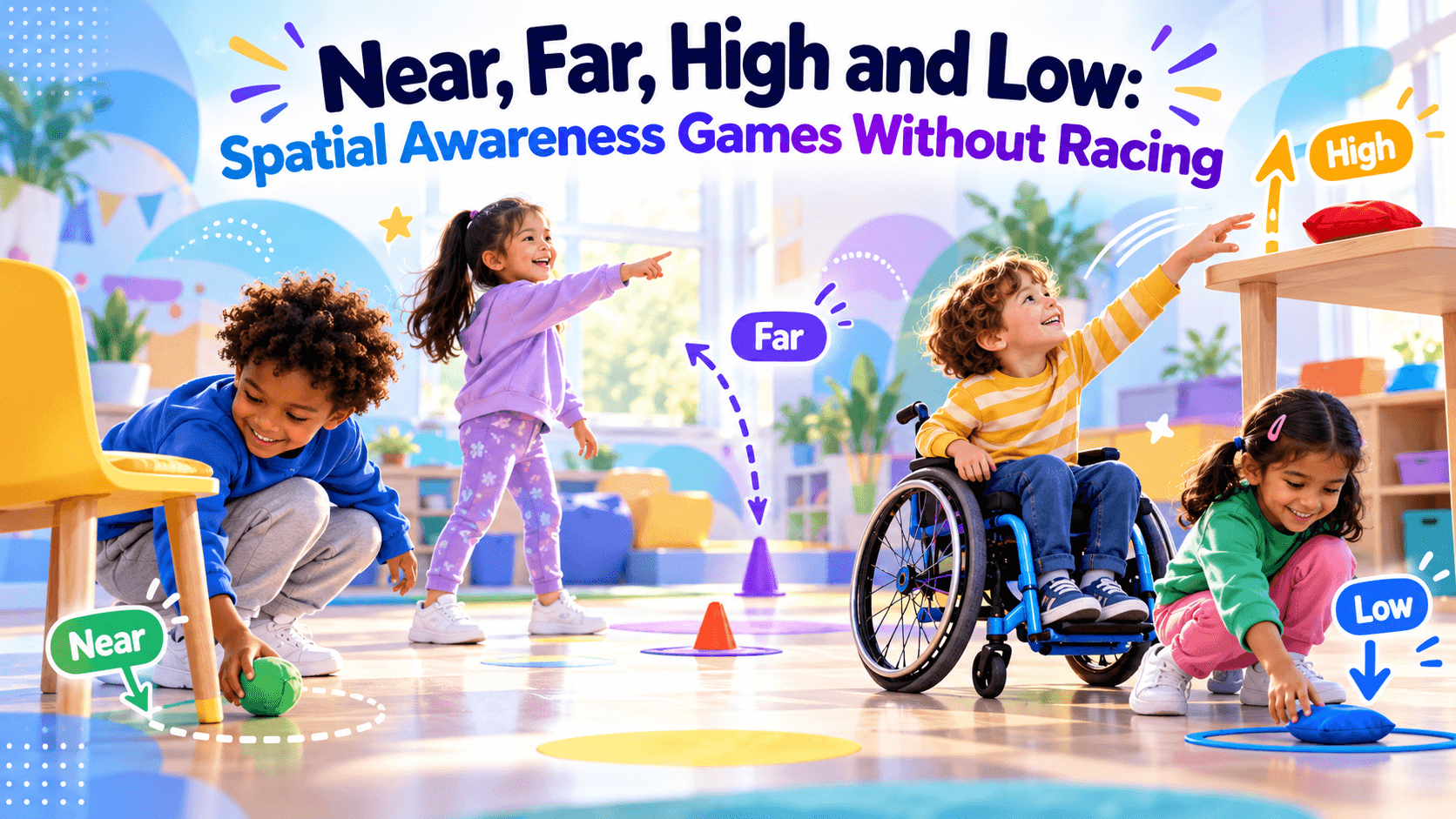
“Put the ball near the chair” invites a child to notice objects, directions and distance. Spatial language can be practised through play without turning the activity into a test. These games focus on noticing and choosing rather than speed or competition.
They suit many primary-age children, with supervision and adjustments for movement, communication and sensory needs. If a direction is confusing, demonstrate it and offer another attempt without correction in front of the group.
Start with four useful words
Use near for a short distance, far for a longer one, high for an elevated position and low for a lower position. Their meaning depends on the space and child. Place familiar lightweight objects where everyone can see or locate them. Keep routes clear and avoid climbing or uncomfortable overhead reaching.
Five games to explore position and distance
1. Near-and-far object hunt
Place two coloured cushions or markers at different distances. Ask a child to point, look, reach or move towards the nearer one. Swap positions and let the child choose the instruction. For a child with visual impairment, agree tactile markers and verbal orientation.
2. High-and-low target choice
Offer two targets at comfortably reachable heights, such as one on a tabletop and another on a low wall. The child can place a beanbag, touch a marker or point. “High” need never mean beyond comfortable reach. Seated participants can use two levels on a table.
3. Build a route with words
Arrange three safe markers: “Start near the blue square, go around the yellow cone, then stop beside the green circle.” Children can walk, wheel, guide a toy or direct a partner with consent. Let them design the next route.
4. Copy the position, not the person
An adult places a soft object near, far, high or low. Children place their own object in a matching relationship. This removes pressure to copy another child’s body position.
5. Become the instructor
Invite a child to give one direction to the group. Others can respond with a gesture, object or movement. Different solutions are welcome when they express the same spatial idea.
Adapt the task instead of excluding a child
Shorten distances, use larger markers, provide tactile cues or work in pairs. These options reflect inclusive principles described by Activity Alliance. Avoid blindfold games, timed races and obstacles that risk collisions. Ask permission before physical assistance and follow established support plans.
Notice engagement, not scores
Does the child make a choice, try a new word or suggest a route? Some prefer to watch first. Repeat favourite games with one small change rather than constantly increasing difficulty. For related ideas see coordination and balance activities and mirror movement games.
Takeaway: Everyday spatial words become more meaningful when children can see, feel and choose what they mean in a safe game.