
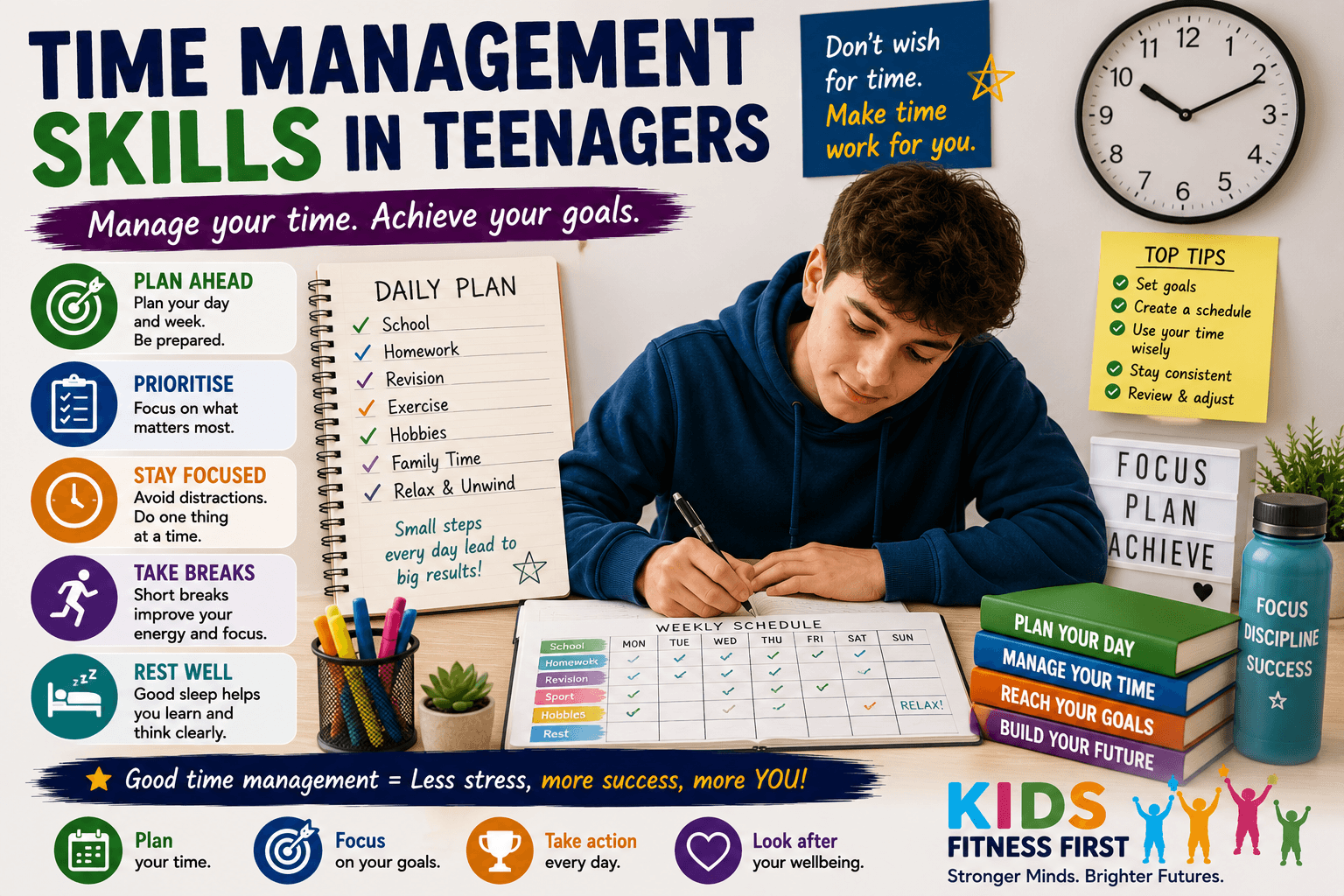
Time Management Skills in Teenagers: Helping Young People Balance School, Goals and Wellbeing
Teenagers often have many demands competing for their attention. They may need to complete schoolwork, prepare for exams, attend activities, maintain friendships, help at home and find time to relax. Without a clear plan, these responsibilities can quickly feel overwhelming.
Developing time management skills in teenagers helps young people organise their responsibilities while protecting their wellbeing. These skills allow teenagers to decide what matters most, plan realistic routines and complete tasks without leaving everything until the last moment.
Time management is not about filling every minute with work. Instead, it is about creating balance. Teenagers need time for learning, exercise, sleep, friendships, creativity and rest.
At Kids Fitness First, we believe young people thrive when they understand their strengths and learn practical life skills. By improving time management, teenagers can become more confident, independent and prepared for future opportunities.
Why Time Management Skills in Teenagers Matter
Time is one of the few resources everyone receives equally. However, people use it in very different ways.
Teenagers who learn to manage their time effectively are often better able to:
- complete schoolwork on time;
- prepare for exams gradually;
- reduce last-minute stress;
- balance responsibilities and leisure;
- maintain healthier sleep routines;
- work towards personal goals;
- avoid feeling constantly rushed;
- become more independent.
Poor time management does not always mean a teenager is lazy or unmotivated. Sometimes, they may feel overwhelmed, distracted or uncertain about where to begin.
Therefore, adults should focus on teaching practical strategies rather than criticising young people for struggling.
What Is Time Management?
Time management means deciding how to use available time in a thoughtful and organised way.
It involves several connected skills:
- identifying priorities;
- estimating how long tasks may take;
- creating a realistic plan;
- starting tasks without unnecessary delay;
- reducing distractions;
- reviewing progress;
- allowing enough time for rest.
Good time management does not require a perfect schedule.
Instead, it provides enough structure to help teenagers know what they should do next.
Time Management Skills in Teenagers Begin With Priorities
Teenagers often face several tasks at the same time.
For example, they may have homework, revision, sports practice, family responsibilities and social plans. When everything feels important, choosing where to begin can become difficult.
A useful first step is to separate tasks into three groups:
Must Do
These are urgent or important responsibilities, such as completing homework due the next day.
Should Do
These tasks matter, but they may not require immediate attention, such as revising for an exam next month.
Could Do
These are optional activities that can be completed when time allows.
This simple method helps teenagers recognise that not every task has equal urgency.
As a result, they can focus on what matters most.
Creating a Realistic Weekly Plan
A weekly plan gives teenagers a clear picture of their responsibilities.
They can use:
- a paper diary;
- a wall calendar;
- a notebook;
- a whiteboard;
- a digital planner;
- a calendar application.
The best system is the one the teenager will actually use.
A weekly plan should include fixed commitments first, such as:
- school hours;
- sports training;
- appointments;
- travel time;
- family responsibilities.
Afterwards, teenagers can add homework, revision, exercise, hobbies and rest.
Importantly, the plan should not become too crowded. Leaving some free space allows young people to respond when plans change.
Breaking Tasks Into Smaller Steps
Large tasks often lead to procrastination because they feel difficult or unclear.
For example, “finish the history project” may feel overwhelming. However, the task becomes easier when divided into smaller actions:
- Read the instructions.
- Choose a topic.
- Find three reliable sources.
- Write the introduction.
- Complete one section at a time.
- Review and correct the work.
- Submit the project.
Each step feels more achievable than the whole task.
Furthermore, completing small actions gives teenagers a sense of progress, which can increase motivation.
Estimating How Long Tasks Take
Many teenagers underestimate the time needed to complete work.
They may believe a task will take 20 minutes when it actually requires an hour. Consequently, they may begin too late and feel rushed.
Adults can help teenagers improve this skill by encouraging them to:
- estimate the time before beginning;
- record the actual time afterwards;
- compare the two;
- adjust future plans.
Over time, teenagers become better at judging how much time they need.
This is an important skill for school, work and adult life.
Reducing Distractions
Distractions are one of the biggest challenges facing teenagers.
Phones, social media, games, messages and videos can interrupt concentration repeatedly. Even short interruptions may make it harder to return to the original task.
Helpful strategies include:
- placing the phone in another room;
- turning off unnecessary notifications;
- using website blockers during study time;
- keeping the workspace clear;
- completing one task at a time;
- setting a short period of focused work.
Teenagers do not need to avoid technology completely. Instead, they should learn to control when and how they use it.
Using Focused Work Periods
Long study sessions are not always productive.
Many teenagers concentrate better when they work for a shorter period and then take a brief break.
For example:
- work for 25 minutes;
- take a five-minute break;
- repeat the cycle;
- take a longer break after several sessions.
During the break, teenagers can stand, stretch, drink water or walk around.
This method helps protect concentration while reducing mental fatigue.
However, each teenager is different. Some may prefer 20-minute sessions, while others may focus well for 45 minutes.
The aim is to discover a routine that works.
Avoiding Procrastination
Procrastination means delaying a task even when completing it would be beneficial.
Teenagers may procrastinate because:
- the task feels boring;
- they fear making mistakes;
- they do not know where to start;
- the task feels too large;
- distractions appear more enjoyable;
- they feel tired or stressed.
A helpful solution is the five-minute start.
The teenager agrees to work on the task for only five minutes. Once they begin, continuing often feels easier.
Starting is usually the hardest part.
Time Management and Sleep
Sleep is essential for learning, concentration, mood and physical health.
However, teenagers may stay awake late because they are completing work, using social media or watching videos.
Poor sleep can make time management more difficult the following day. The teenager may feel tired, work more slowly and struggle to concentrate.
Therefore, healthy time management should include:
- a regular bedtime;
- enough time to prepare for the next day;
- reduced screen use before sleep;
- realistic homework schedules;
- time to relax.
Sleep should not be treated as spare time that can be removed whenever the schedule becomes busy.
It is a necessary part of wellbeing and productivity.
Balancing Work and Rest
Productive teenagers are not necessarily those who work every minute.
Young people also need time to recover.
Rest can include:
- physical activity;
- music;
- hobbies;
- outdoor time;
- reading;
- family conversations;
- time with friends;
- quiet relaxation.
Breaks help restore energy and improve concentration.
Therefore, a healthy schedule should include both responsibility and enjoyment.
Time Management Skills in Teenagers at School
Schools provide many opportunities to practise time management.
Students may need to organise:
- homework deadlines;
- revision schedules;
- coursework;
- group projects;
- extracurricular activities;
- exam preparation.
Teachers can support students by helping them break larger assignments into smaller deadlines.
For example, rather than setting one final submission date, teachers may create separate dates for research, planning, drafting and editing.
This approach makes progress easier to manage and teaches valuable planning skills.
How Parents Can Support Time Management
Parents and carers can help teenagers without taking complete control.
Useful support may include:
- discussing upcoming responsibilities;
- helping create a weekly plan;
- encouraging realistic goals;
- providing a quiet workspace;
- praising effort and organisation;
- reviewing what worked;
- allowing teenagers to make suitable choices.
Adults should avoid constantly reminding or controlling every task.
Although reminders may sometimes be necessary, teenagers also need opportunities to become responsible for their own routines.
The long-term goal is independence.
Learning From Missed Deadlines
Even organised teenagers will sometimes miss a deadline or forget a task.
These situations can become useful learning opportunities.
Instead of focusing only on blame, adults can ask:
- What happened?
- When did the problem begin?
- Was the task larger than expected?
- Did distractions interfere?
- What could make the next plan more realistic?
- Which reminder system might help?
Reflection encourages improvement.
Shame, however, may make teenagers hide problems rather than learn from them.
A Simple Daily Planning Method
Teenagers can use the following method each evening or morning:
1. List
Write down everything that needs attention.
2. Choose
Select the three most important tasks.
3. Schedule
Decide when each task will be completed.
4. Focus
Work on one task without unnecessary distractions.
5. Review
Check what was completed and move unfinished tasks to a realistic new time.
This process can take only a few minutes, yet it may greatly improve organisation.
Building Consistent Routines
Routines make time management easier because teenagers do not need to make the same decisions every day.
For example, a regular after-school routine may include:
- having a short break;
- eating a snack;
- checking the day’s priorities;
- completing the most important task;
- taking a short rest;
- preparing for the next day.
A routine should provide structure without becoming too strict.
Some days will change because of appointments, school activities or family plans. Therefore, flexibility remains important.
The purpose of a routine is to reduce confusion, not to remove all freedom.
Managing Schoolwork and Exams
Exams and coursework can create pressure, especially when several deadlines arrive at the same time.
Teenagers can reduce this pressure by planning early.
Useful strategies include:
- creating a revision timetable;
- dividing subjects into smaller topics;
- starting with the most difficult area;
- reviewing material regularly;
- using short study sessions;
- checking progress each week;
- asking for help before problems grow.
Cramming everything into one evening may create stress and reduce learning.
In contrast, regular preparation allows the brain more time to understand and remember information.
Time Management and Social Media
Social media can easily consume more time than expected.
A teenager may open an application for a few minutes and then discover that much longer has passed.
This does not mean social media must be removed completely. However, teenagers benefit from setting clear boundaries.
Helpful approaches include:
- choosing specific times for social media;
- keeping phones away during homework;
- using screen-time limits;
- turning off unnecessary notifications;
- avoiding social media before sleep;
- taking regular digital breaks.
The goal is not to create fear around technology.
Instead, teenagers should learn to use it intentionally rather than allowing it to control their attention.
Overcoming Perfectionism
Some teenagers delay starting because they fear the result will not be perfect.
They may spend too long on small details, repeatedly change their work or avoid submitting tasks because they feel uncertain.
Perfectionism can damage time management because it makes ordinary tasks take far longer than necessary.
A healthier approach is to focus on progress.
Teenagers can ask:
- Is this work clear and complete?
- Have I met the main requirements?
- Is more time likely to improve it significantly?
- Am I trying to improve the work, or am I afraid to finish?
Learning when something is “good enough” is an important life skill.
Recognising Energy Levels
Time management is not only about the clock.
Energy also affects concentration.
Some teenagers think more clearly in the morning. Others work better in the afternoon or early evening.
Therefore, it can help to schedule difficult tasks during periods of stronger concentration.
For example:
- complete challenging homework when energy is highest;
- save easier tasks for later;
- include movement between study periods;
- avoid planning every difficult task for the same day.
Understanding personal energy patterns helps teenagers work more effectively.
Saying No to Too Many Commitments
Teenagers may feel pressure to join every activity, help everyone and accept every invitation.
However, saying yes to too many commitments can lead to exhaustion.
Good time management includes recognising limits.
Before accepting a new responsibility, teenagers can ask:
- Do I have enough time?
- What will I need to reduce?
- Is this opportunity important to me?
- Will this affect my sleep or wellbeing?
- Can I complete it properly?
Saying no does not mean being selfish.
Sometimes, it is a responsible decision that protects existing commitments.
Preparing the Night Before
A few minutes of preparation can make the following morning much easier.
Teenagers may benefit from:
- packing their school bag;
- checking homework;
- preparing clothes;
- charging devices;
- reviewing the next day’s schedule;
- setting an alarm;
- placing important items near the door.
This routine reduces rushing and helps young people begin the day calmly.
It also lowers the risk of forgetting important materials.
Using Reminders Effectively
Reminders can support independence when they are used well.
Teenagers may use:
- calendar alerts;
- alarms;
- sticky notes;
- checklists;
- whiteboards;
- task applications.
However, too many reminders can become easy to ignore.
Therefore, it is better to use a small number of clear reminders for important tasks.
A reminder should lead to action, not simply create another notification.
Time Management Builds Confidence
When teenagers complete tasks on time, they begin to trust themselves more.
They learn that they can:
- organise responsibilities;
- prepare for challenges;
- reduce last-minute pressure;
- recover from missed deadlines;
- balance work and rest;
- make independent decisions.
Each successful experience strengthens confidence.
As a result, teenagers feel more capable when larger responsibilities appear.
Preparing Teenagers for Adult Life
Time management remains important long after school.
Adults use these skills when they:
- attend work on time;
- meet deadlines;
- manage appointments;
- organise finances;
- care for family members;
- complete training;
- maintain relationships;
- protect their health.
Teenagers who practise planning and prioritising become better prepared for these responsibilities.
They also learn that being busy is not the same as being productive.
Productivity means using time in a way that supports important goals and personal wellbeing.
A Five-Step Time Management Model
Teenagers can remember the following process:
1. Prioritise
Decide what matters most.
2. Plan
Choose when each task will be completed.
3. Begin
Start with one clear action.
4. Protect
Reduce distractions and protect focused time.
5. Review
Check progress and adjust the plan when needed.
This model can be used for schoolwork, hobbies, exercise, appointments and personal goals.
Reflection Questions
- Which part of your day often feels rushed?
- What task do you usually delay?
- Which distraction takes most of your time?
- When do you normally concentrate best?
- What is one routine that could make your week easier?
- How could you protect more time for rest?
Conclusion
Developing time management skills in teenagers helps young people balance school, goals, relationships and wellbeing.
These skills are not about creating a perfect schedule. Instead, they help teenagers decide what matters, begin tasks with greater confidence and make realistic choices about their time.
Parents, teachers and mentors can support this process by providing structure without taking complete control. Young people need guidance, but they also need opportunities to practise responsibility and learn from mistakes.
At Kids Fitness First, we believe practical life skills help teenagers recognise their strengths and prepare for future opportunities. When young people learn to plan, prioritise and protect their wellbeing, they become more confident, independent and resilient.
Good time management is not about doing more every minute.
It is about making time for what matters most.
Suggested Internal Links
- Goal-Setting Skills in Teenagers: Turning Ambition Into Positive Action
- https://kidsfitnessfirst.org/2026/07/17/adaptability-skills-in-teenagers/
Disclaimer
This article is provided for educational and informational purposes only. It is not intended as medical, psychological or professional advice. Every teenager develops at a different pace. Parents or carers who are concerned about a young person’s wellbeing should seek support from an appropriately qualified professional.