
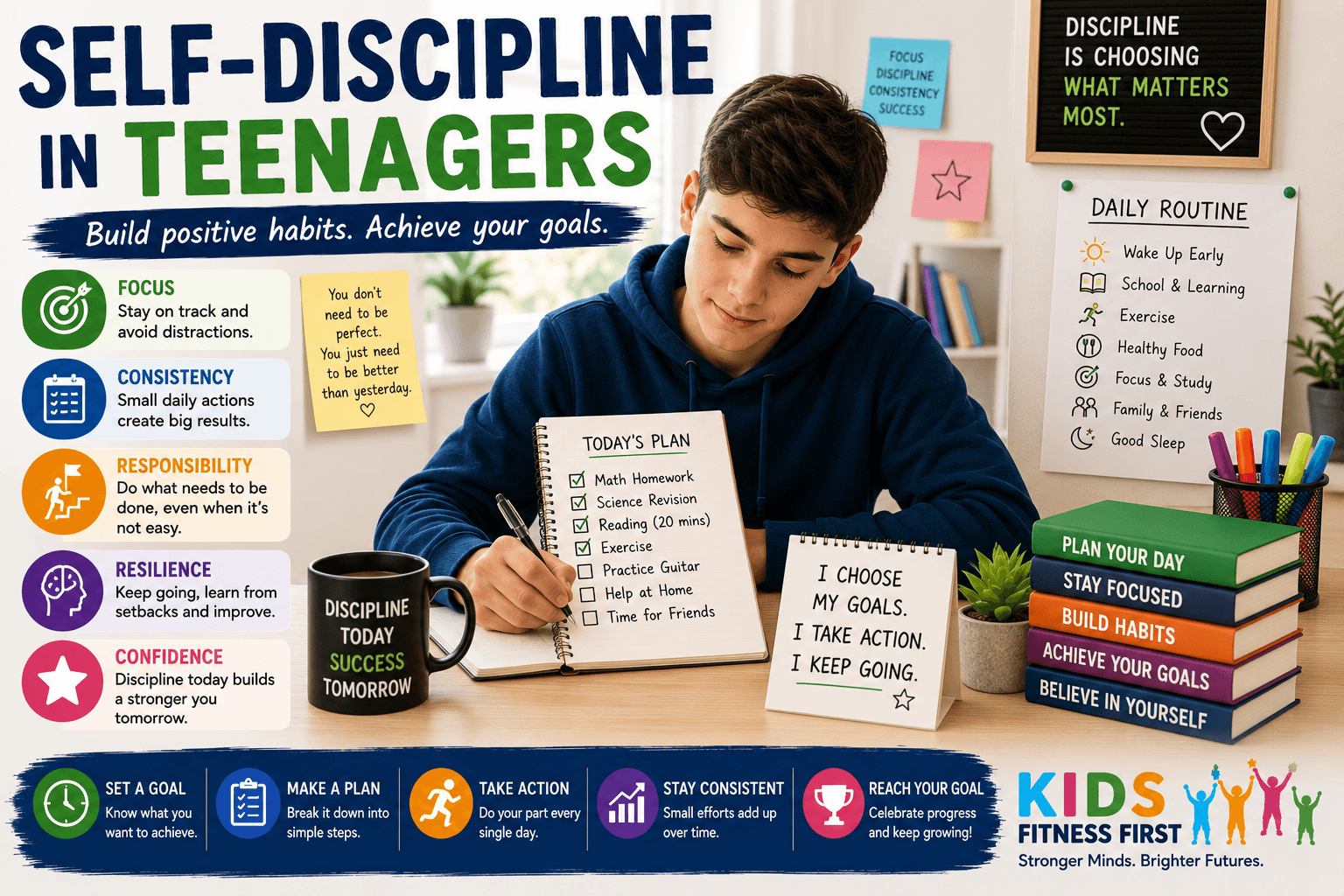
Self-Discipline in Teenagers: Building Positive Habits and Lasting Confidence
Self-discipline in teenagers helps young people make positive choices even when easier or more enjoyable options are available. It supports their ability to complete responsibilities, manage distractions and continue working towards meaningful goals.
Teenagers are surrounded by competing demands. Schoolwork, social media, friendships, hobbies and family responsibilities all require time and attention. As a result, staying focused can sometimes feel difficult.
Self-discipline does not mean working constantly or following strict rules without question. Instead, it means learning how to balance immediate wants with longer-term priorities.
At Kids Fitness First, we believe every young person has strengths that can be developed. By building self-discipline alongside confidence, emotional intelligence and time-management skills, teenagers become better prepared for education, employment and adult life.
Why Self-Discipline in Teenagers Matters
Self-discipline helps teenagers turn intentions into action.
A young person may genuinely want to improve their grades, become fitter or learn a new skill. However, progress usually requires repeated effort rather than one moment of motivation.
Developing self-discipline in teenagers can help young people:
- begin tasks without constant reminders;
- manage digital distractions;
- complete responsibilities;
- follow healthy routines;
- continue after setbacks;
- control impulsive reactions;
- work towards long-term goals;
- become more independent.
These abilities support academic progress. However, they are equally valuable in friendships, sport, work and personal development.
Self-discipline also builds confidence. Every time teenagers follow through on a commitment, they gain evidence that they can rely on themselves.
What Is Self-Discipline?
Self-discipline is the ability to guide your actions according to your values, responsibilities and goals.
It may involve:
- doing homework before gaming;
- saving money instead of spending it immediately;
- attending practice when motivation feels low;
- pausing before responding angrily;
- following a bedtime routine;
- completing an important task before checking social media.
Self-discipline does not require perfect behaviour.
Everyone becomes distracted, changes plans or loses motivation sometimes. The important skill is recognising what happened and returning to the positive routine.
Self-Discipline in Teenagers Begins With a Clear Reason
Teenagers are more likely to remain committed when they understand why something matters.
For example, “Revise because I told you to” may produce temporary cooperation. However, “Revision can help you qualify for the course you want” connects the task with a meaningful outcome.
Parents and teachers can ask:
- What would you like to achieve?
- Why is this important to you?
- How could this habit help your future?
- What might improve if you stay consistent?
- How would completing this make you feel?
A clear personal reason strengthens commitment.
When teenagers understand the purpose behind an action, discipline feels less like punishment and more like a choice.
The Difference Between Motivation and Self-Discipline
Motivation is the feeling that makes someone want to act.
Self-discipline is the ability to act even when that feeling is weak.
Motivation can be powerful, but it often changes. A teenager may feel highly motivated when beginning a new goal. A few days later, however, the excitement may disappear.
Self-discipline provides consistency when motivation changes.
For example, a teenager who wants to become fitter may not feel enthusiastic about every training session. Nevertheless, following a manageable routine creates progress over time.
Motivation may begin the journey. Self-discipline helps continue it.
Building Self-Discipline Through Small Habits
Large changes are difficult to maintain.
Therefore, self-discipline usually develops more successfully through small, repeatable actions.
A teenager who wants to read more could begin with ten minutes each evening. Someone who wants to improve schoolwork might start by completing one focused study session after school.
Small habits are effective because they:
- feel manageable;
- reduce resistance;
- create quick progress;
- build confidence;
- become easier through repetition.
Once the habit feels natural, the teenager can gradually increase the challenge.
Consistency matters more than beginning with a perfect routine.
Creating Positive Routines
Routines reduce the number of decisions teenagers need to make.
For example, if homework always begins after a short break and snack, the teenager does not need to decide when to start every day.
A useful after-school routine might include:
- Arrive home and relax briefly.
- Eat a snack and drink water.
- Check the day’s priorities.
- Complete one focused work session.
- Take a short break.
- Continue with another task if necessary.
- Make time for exercise, hobbies or friends.
A routine should provide structure without becoming too rigid.
Teenagers need enough flexibility to respond to changing circumstances.
Managing Distractions
Modern teenagers face more distractions than previous generations.
Phones, notifications, videos, games and social media can interrupt concentration repeatedly. Therefore, learning to manage technology is an important part of self-discipline in teenagers.
Helpful strategies include:
- placing the phone in another room;
- turning off unnecessary notifications;
- using focus mode;
- setting screen-time limits;
- studying away from the television;
- completing one task before opening another application;
- choosing specific times for social media.
The aim is not to suggest that all technology is harmful.
Instead, teenagers should learn to decide when technology supports them and when it distracts them.
Making the Right Choice Easier
Self-discipline becomes easier when the environment supports the desired behaviour.
For example:
- keeping books on the desk makes reading easier;
- preparing sports clothes encourages exercise;
- removing the phone reduces distraction;
- packing a school bag the night before prevents rushing;
- placing healthy snacks nearby supports better choices;
- using a visible planner keeps priorities clear.
This approach is more effective than relying on willpower alone.
A well-organised environment gently guides teenagers towards positive actions.
Self-Discipline in Teenagers at School
School provides many opportunities to practise self-discipline.
Students may need to:
- listen during lessons;
- complete homework;
- meet deadlines;
- revise regularly;
- manage group projects;
- behave respectfully;
- ask for help;
- continue when work becomes difficult.
Teachers can encourage these skills by providing clear expectations and manageable steps.
Large assignments may be divided into smaller deadlines. Students can also be encouraged to reflect on their own progress rather than relying only on adult reminders.
As independence grows, teenagers begin to take greater responsibility for their learning.
How Parents Can Encourage Self-Discipline in Teenagers
Parents can support self-discipline without controlling every decision.
Useful approaches include:
- agreeing on clear expectations;
- creating predictable routines;
- allowing suitable choices;
- encouraging teenagers to solve problems;
- recognising effort and consistency;
- discussing consequences calmly;
- modelling responsible behaviour;
- avoiding constant criticism.
Teenagers often resist when they feel every action is being controlled.
Therefore, adults should gradually provide more responsibility as young people show they can manage it.
The goal is not permanent obedience. The goal is independent decision-making.
Using Natural and Reasonable Consequences
Consequences can help teenagers understand that choices produce outcomes.
For example, leaving homework until late may reduce free time that evening. Spending all available money may mean waiting before buying something else.
Where appropriate and safe, allowing teenagers to experience reasonable consequences can be more effective than repeated lectures.
Adults can then ask:
- What happened?
- What did you learn?
- What could you do differently?
- What support would help next time?
The purpose should be learning rather than humiliation.
Avoiding Excessive Pressure
Self-discipline should not become perfectionism.
Teenagers need rest, friendships, creativity and enjoyment. A healthy routine includes both responsibility and recovery.
Warning signs of excessive pressure may include:
- constant worry;
- loss of sleep;
- fear of making mistakes;
- believing that rest is lazy;
- avoiding enjoyable activities;
- feeling worthless after a setback.
Adults should remind teenagers that their value does not depend on constant achievement.
Healthy self-discipline supports wellbeing. It should not damage it.
Self-Discipline and Emotional Control
Self-discipline also affects how teenagers respond emotionally.
A strong emotional reaction may encourage someone to shout, post an angry message or make a rushed decision.
Developing self-discipline helps teenagers pause.
They can ask:
- What am I feeling?
- What caused this reaction?
- Do I have all the facts?
- What might happen if I respond immediately?
- Which response would improve the situation?
A short pause can prevent a small disagreement from becoming a larger problem.
This ability supports emotional intelligence and stronger relationships.
Learning From Setbacks
Every teenager will occasionally lose focus or break a positive routine.
A missed study session does not mean the entire goal has failed. Likewise, one poor decision does not define a young person’s character.
Instead of giving up, teenagers can reflect:
- What made the habit difficult?
- Was the goal realistic?
- Which distraction caused the problem?
- Did I need more support?
- What is the smallest action I can take now?
Returning to the routine quickly is more important than criticising the mistake.
Self-discipline grows through recovery as well as success.
Self-Discipline Builds Confidence
Confidence increases when teenagers learn that they can keep promises to themselves.
Each completed action sends a positive message:
- I can begin difficult tasks.
- I can manage distractions.
- I can make responsible choices.
- I can recover after mistakes.
- I can work towards something meaningful.
- I can improve through practice.
Over time, these experiences create a strong sense of personal responsibility.
The teenager begins to see themselves as someone who can take action rather than someone who must always be pushed by others.
Preparing Teenagers for Adult Life
Self-discipline remains important throughout adulthood.
Adults use it when they:
- arrive at work on time;
- manage money;
- meet deadlines;
- care for their health;
- maintain relationships;
- complete training;
- manage a household;
- pursue career goals.
Strong self-discipline in teenagers prepares young people for these responsibilities.
It also helps them recognise that freedom and responsibility are connected. Greater independence brings more choices, but it also requires the ability to manage those choices wisely.
A Five-Step Model for Self-Discipline in Teenagers
Teenagers can use this simple process:
1. Choose
Identify one habit or responsibility that matters.
2. Connect
Understand why the action supports an important goal.
3. Prepare
Remove distractions and make the positive choice easier.
4. Act
Complete one small action, even when motivation is low.
5. Review
Recognise progress, learn from difficulties and adjust the routine.
This process can be used for education, exercise, saving money, relationships and personal goals.
Reflection Questions
- Which positive habit would improve your daily life?
- Why does this habit matter to you?
- What distraction makes it difficult to stay focused?
- How could you make the right choice easier?
- What is one action you could complete today?
- How will you respond if you miss a day?
- Who could support and encourage you?
Conclusion
Developing self-discipline in teenagers helps young people turn positive intentions into steady action.
Through small habits, clear routines and thoughtful choices, teenagers learn to manage distractions and work towards meaningful goals. They also discover that discipline does not require perfection. Instead, it involves returning to the right path after setbacks.
Parents, teachers and mentors can support this development by providing clear expectations, positive examples and growing levels of responsibility. Young people need guidance, but they also need opportunities to make choices and learn from experience.
At Kids Fitness First, we believe every teenager has strengths that can be developed. When young people learn to guide their own actions, they become more confident, resilient and prepared for future opportunities.
Self-discipline is not about controlling every moment.
It is about learning to make choices that support the person you want to become.
Suggested Internal Links
- Screens as Mirrors: How Digital Engagement Reveals Ability
- Superpowers in Disguise: Recognising Strengths Others Often Miss
Disclaimer
This article is provided for educational and informational purposes only. It is not intended as medical, psychological or professional advice. Every teenager develops at a different pace. Parents or carers concerned about a young person’s behaviour or wellbeing should seek guidance from an appropriately qualified education, healthcare or support professional.