Growth Mindset in Teenagers: Helping Young People Learn, Adapt and Succeed
Growth mindset in teenagers helps young people understand that intelligence, confidence and ability are not permanently fixed. Through effort, practice, feedback and support, they can continue learning and improving.
Teenagers often face situations that test their confidence. They may receive a disappointing grade, struggle with a new skill, experience friendship difficulties or worry about future choices. During these moments, they may begin to believe they are simply “not good enough.”
However, one difficult experience does not define a young person’s ability or future.
A growth mindset encourages teenagers to replace the thought “I cannot do this” with a more hopeful question:
“What could help me improve?”
At Kids Fitness First, we believe every young person has abilities and strengths waiting to be developed. Our Teen Life Skills and Development guide connects these capabilities across the wider library. A growth mindset supports related but distinct skills such as adaptability and self-discipline: teenagers learn that ability can develop, then practise adjusting and following through when challenges arise. By encouraging curiosity, resilience and positive action, adults can help teenagers become confident lifelong learners.
Why a Growth Mindset in Teenagers Matters
Teenagers are still discovering who they are and what they can achieve.
During adolescence, young people may compare themselves with classmates, friends, siblings or people they see online. As a result, they may believe that other people are naturally more intelligent, talented or successful.
A growth mindset helps challenge this belief.
It teaches teenagers that:
- skills can improve through practice;
- mistakes provide useful information;
- asking for help is a strength;
- progress often takes time;
- effort can create new opportunities;
- feedback can support improvement;
- setbacks do not determine the future.
Developing a growth mindset in teenagers can improve confidence because young people begin to see challenges differently.
Instead of viewing difficulty as evidence that they should stop, they start to recognise it as part of learning.
What Is a Growth Mindset?
A growth mindset is the belief that abilities can develop.
It does not mean that everyone will become equally skilled at everything. People have different interests, experiences and natural strengths. However, most abilities can improve when someone receives the right support and continues practising.
For example, a teenager may initially find public speaking difficult.
With preparation, encouragement and repeated opportunities to practise, that young person may gradually become more confident.
The change may not happen immediately. Nevertheless, steady progress can transform both skill and self-belief.
Understanding a Fixed Mindset
A fixed mindset is the belief that ability cannot change very much.
A teenager with a fixed mindset may say:
- “I am terrible at mathematics.”
- “I will never be confident.”
- “Creative people are born that way.”
- “There is no point trying.”
- “Everyone else is better than me.”
- “If I ask for help, people will think I am incapable.”
These thoughts can make teenagers avoid challenges.
They may decide that not trying feels safer than trying and making a mistake.
However, avoiding every difficult situation prevents young people from discovering what they could learn.
Growth Mindset in Teenagers Changes the Meaning of Difficulty
Difficulty does not always mean that something is wrong.
Sometimes, difficulty means the brain is learning something new.
A teenager who finds a task challenging may need:
- more practice;
- a different explanation;
- additional time;
- a quieter environment;
- smaller steps;
- encouragement;
- support from another person.
Therefore, adults should avoid treating every struggle as failure.
A better question is:
“What does this young person need in order to move forward?”
This strengths-based approach helps teenagers remain engaged while respecting their individual learning needs.
The Power of the Word “Yet”
One small word can change how a teenager views a challenge.
Consider the difference between these statements:
- “I cannot understand this.”
- “I cannot understand this yet.”
The first statement sounds final.
The second suggests that improvement remains possible.
Teenagers can use “yet” in many situations:
- “I am not confident speaking in front of people yet.”
- “I have not found the right study method yet.”
- “I cannot complete this exercise yet.”
- “I do not know which career suits me yet.”
The word does not guarantee instant success. However, it leaves the door open for effort, learning and new possibilities.
Learning From Mistakes
Mistakes are an unavoidable part of learning.
A child learning to walk falls many times. A musician plays incorrect notes. An athlete misses opportunities. A student gives wrong answers.
Nevertheless, each mistake can provide information.
Teenagers can ask:
- What happened?
- Which part went well?
- Where did I become confused?
- What could I practise?
- Who could help me?
- What will I try next?
These questions turn mistakes into practical lessons.
A mistake becomes less frightening when it is viewed as part of improvement rather than proof of failure.
How Adults Respond to Mistakes
The reactions of adults can strongly influence how teenagers view failure.
If every mistake leads to anger, embarrassment or criticism, young people may begin hiding difficulties. They may avoid asking questions because they fear appearing unsuccessful.
A supportive response might include:
- “Let us look at what happened.”
- “Which part did you understand?”
- “What could you try differently?”
- “It is normal to need more practice.”
- “Asking for help was a sensible decision.”
- “You kept going even when it became difficult.”
This does not mean ignoring poor choices or avoiding responsibility.
Instead, it means helping teenagers learn from what happened.
Praising Effort in a Meaningful Way
Adults are often encouraged to praise effort. However, praise should remain honest and specific.
Simply saying “good effort” after every task may lose its meaning.
More useful comments include:
- “You changed your approach when the first plan did not work.”
- “You practised regularly, and your confidence has improved.”
- “You asked a thoughtful question.”
- “You remained calm and tried again.”
- “You organised the task into smaller steps.”
- “You listened carefully to the feedback.”
Specific praise helps teenagers understand which actions supported progress.
It also shows that success involves more than the final result.
Growth Mindset in Teenagers at School
Schools provide many opportunities to develop a growth mindset.
Students regularly encounter new ideas, challenging assignments and unfamiliar skills. Therefore, classrooms should be places where questions and mistakes are treated as part of learning.
Teachers can support a growth mindset by:
- explaining that improvement takes practice;
- allowing students to correct work;
- providing clear and constructive feedback;
- recognising different learning approaches;
- encouraging thoughtful questions;
- celebrating progress;
- showing examples of improvement over time;
- avoiding labels such as “naturally clever” or “not academic.”
When students understand that learning is a process, they may become more willing to attempt challenging work.
Growth Mindset at Home
Families can encourage a growth mindset through everyday conversations.
Parents and carers may ask:
- What did you learn today?
- What was difficult?
- Which strategy helped?
- What mistake taught you something useful?
- What are you proud of improving?
- What could you try next?
- Who could support you?
These questions shift attention away from perfect results.
They encourage teenagers to reflect on effort, strategy and progress.
Adults can also share their own learning experiences. Hearing a parent explain how they overcame a difficulty shows that adults continue learning too.
Avoiding Unhelpful Labels
Labels can influence how teenagers see themselves.
Positive-sounding labels can still create pressure.
For example, a teenager repeatedly described as “the clever one” may become afraid of making mistakes. They may avoid difficult work because struggle could threaten that identity.
Negative labels can be even more harmful.
Statements such as “lazy,” “difficult,” “bad at school” or “not sporty” may become beliefs that follow the young person for years.
Instead, adults can describe the situation without defining the teenager:
- “You are finding it difficult to begin this task.”
- “This learning method may not suit you.”
- “You need more practice with this skill.”
- “Let us find a different approach.”
Behaviour and ability can change. A label can make them appear permanent.
Recognising Different Ways of Learning
A growth mindset does not mean forcing every teenager to learn in exactly the same way.
Young people may respond differently to:
- written instructions;
- demonstrations;
- discussion;
- practical activities;
- visual examples;
- repetition;
- movement;
- independent exploration.
Teenagers may also have strengths that traditional classroom activities do not always reveal.
One young person may struggle with written tests but demonstrate excellent practical reasoning. Another may find group discussions difficult while producing highly creative independent work.
A strengths-based growth mindset asks:
“How does this teenager learn best?”
This question can reveal possibilities that labels may hide.
Growth Mindset and Neurodiversity
Neurodiverse teenagers may experience education and everyday life differently from their peers.
They may have strengths in creativity, intense focus, problem-solving, visual thinking, curiosity or original ideas. At the same time, they may need support with organisation, communication, attention or emotional regulation.
A growth mindset should never suggest that a young person can overcome every difficulty through effort alone.
Support, adjustments and understanding may also be necessary.
The message should not be:
“Try harder.”
Instead, it should be:
“Let us understand your strengths, identify the barrier and find an approach that works.”
This respectful approach supports genuine development.
Dealing With Comparison
Comparison can weaken confidence.
Teenagers may believe other people are progressing faster, achieving better results or living more successful lives.
Social media can increase this pressure because it often presents carefully selected moments rather than complete reality.
A growth mindset encourages personal comparison:
- What can I do now that I could not do before?
- Which skill has improved?
- What have I learned about myself?
- Which challenge have I managed?
- What is my next step?
Progress should be measured against the teenager’s own starting point whenever possible.
Developing Persistence
Persistence means continuing when progress is slow.
However, persistence does not mean repeating the same unsuccessful action forever.
A growth mindset combines effort with strategy.
When something is not working, teenagers can:
- pause;
- review the problem;
- seek feedback;
- try another method;
- ask for support;
- continue with a better plan.
This is intelligent persistence.
It teaches teenagers that changing approach is not the same as giving up.
Knowing When to Rest
Growth also requires rest.
Teenagers cannot perform at their best when they are exhausted, overwhelmed or constantly under pressure.
A healthy growth mindset includes:
- sufficient sleep;
- exercise;
- friendships;
- enjoyable activities;
- quiet time;
- realistic goals;
- breaks during demanding tasks.
Rest does not mean failure or laziness.
It helps restore the physical and mental energy needed for learning.
Building Confidence Through Evidence
Confidence becomes stronger when it is based on real experiences.
Every time a teenager learns something new, manages a difficulty or returns after a setback, they gain evidence that they can grow.
They may begin to think:
- I can improve with practice.
- I can ask for support.
- I can use feedback.
- I can change my strategy.
- I can recover from mistakes.
- I can face unfamiliar challenges.
- I have strengths that matter.
This confidence is more durable than praise alone because it comes from experience.
Preparing Teenagers for Future Change
Teenagers are preparing for a world that will continue changing.
Technology, careers and workplaces will evolve. Young people may need to learn new skills several times throughout adulthood.
A strong growth mindset in teenagers prepares them for this uncertainty.
Employers and communities need people who can:
- learn continuously;
- adapt to new situations;
- solve unfamiliar problems;
- receive feedback;
- work with different people;
- recover from setbacks;
- remain curious.
A teenager who believes they can continue learning is better prepared for opportunities that do not yet exist.
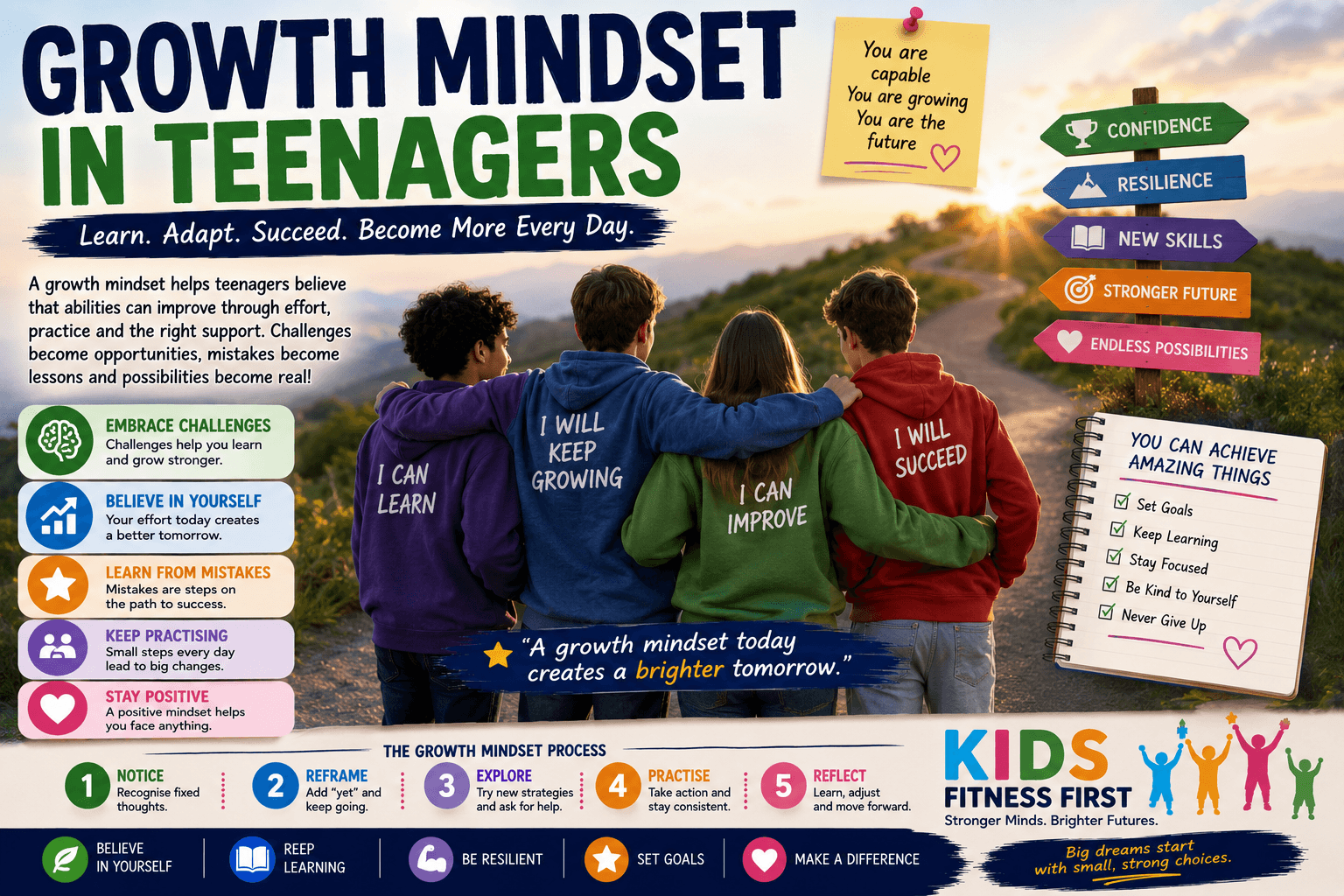
A Five-Step Growth Mindset Model
Teenagers can use this simple process:
1. Notice
Recognise fixed thoughts such as “I cannot do this.”
2. Reframe
Add “yet” and consider what improvement might require.
3. Explore
Find another strategy, explanation or source of support.
4. Practise
Take one manageable step and repeat it consistently.
5. Reflect
Recognise progress, learn from the result and decide what to try next.
This model can be used in education, sport, relationships, creativity and future planning.
Reflection Questions
- Which skill have you improved through practice?
- What challenge are you currently facing?
- Which fixed thought could you replace with “yet”?
- What did your most recent mistake teach you?
- Which learning method works best for you?
- Who could provide helpful advice or support?
- What is one manageable step you could take today?
Conclusion
Developing a growth mindset in teenagers helps young people see that abilities, confidence and knowledge can change.
Challenges no longer need to mean that a teenager is incapable. Instead, they can become opportunities to explore new methods, ask for help and discover previously hidden strengths.
Parents, teachers and mentors can encourage this mindset by responding calmly to mistakes, recognising meaningful effort and avoiding limiting labels. They can also help teenagers understand that improvement requires more than effort alone. The right environment, support and strategy matter too.
At Kids Fitness First, we believe every young person deserves the opportunity to discover what they can become. Through confidence, resilience, critical thinking, emotional intelligence and practical life skills, teenagers can prepare for a future filled with possibility.
A young person does not need to know everything today.
They simply need to believe that they can continue learning tomorrow.
Suggested Internal Links
Building Self-Confidence Through Achievement
Goal-Setting Skills in Teenagers: Helping Young People Turn Ideas into Action
Disclaimer
This article is provided for educational and informational purposes only. It is not intended as medical, psychological or professional advice. Every teenager develops differently and may require different forms of support. Parents or carers concerned about a young person’s learning, behaviour or wellbeing should seek guidance from an appropriately qualified education, healthcare or support professional.