
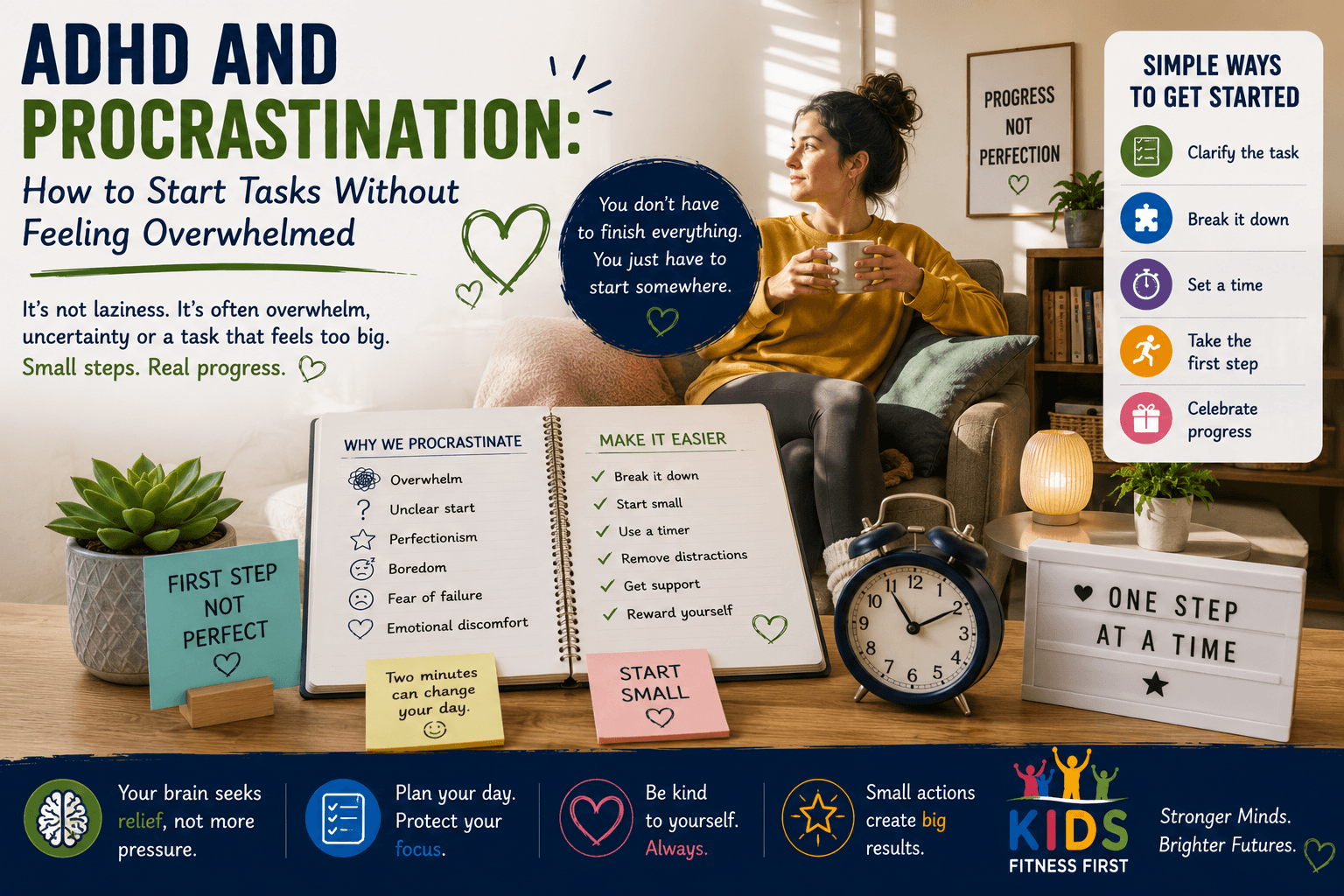
ADHD and Procrastination: How to Start Tasks Without Feeling Overwhelmed
Procrastination is often misunderstood.
From the outside, it may look as though someone is avoiding responsibility, lacking discipline or simply refusing to make an effort. However, for many adults with ADHD, procrastination is not about being careless.
Instead, the real difficulty may be starting.
You may know exactly what needs to be done. The task may be important, and you may genuinely want to complete it. Nevertheless, the moment you try to begin, your mind becomes crowded with questions.
Where should you start?
How long will it take?
What if you do it badly?
What if another task is more urgent?
Should you research more first?
Before long, the task feels larger, heavier and more complicated than it did at the beginning.
As a result, you may delay it until pressure becomes intense. Then, urgency finally creates enough momentum to act.
This pattern is common in the relationship between ADHD and procrastination. Although it can be frustrating, it does not mean that you are lazy or incapable.
More often, it means the task is not providing enough clarity, interest, urgency or immediate reward to help your brain engage.
Fortunately, there are practical ways to reduce that barrier and make starting easier.
Why Procrastination Happens
Procrastination is rarely caused by one single factor.
Instead, several challenges may combine.
These can include:
- difficulty deciding where to begin
- feeling overwhelmed by the size of the task
- low interest or boredom
- fear of making mistakes
- perfectionism
- unclear instructions
- difficulty estimating time
- too many competing priorities
- emotional discomfort
- lack of immediate reward
- mental or physical exhaustion
For example, completing a form may appear simple. However, the task may involve finding documents, checking dates, locating account details and understanding unfamiliar questions.
When your brain sees all those hidden steps at once, avoiding the task can feel easier than beginning it.
Recognising this matters because the solution is not always “try harder.”
Instead, the task itself may need to become clearer, smaller or more rewarding.
Procrastination Is Often an Emotional Response
Many people assume procrastination is only a time-management problem.
However, emotions often play a major role.
You may avoid a task because it creates:
- boredom
- anxiety
- uncertainty
- embarrassment
- frustration
- fear of criticism
- fear of failure
- fear of success
- resentment
- shame
For instance, replying to an email may take only a few minutes. Yet if the message feels uncomfortable, the emotional weight can make it seem much harder.
Likewise, beginning a project may feel risky if you believe the result must be perfect.
Therefore, ask yourself:
“What feeling am I trying to avoid?”
The answer may reveal more than the task itself.
Once you understand the emotion, you can respond to it more directly.
Stop Waiting for the Right Mood
One of the biggest traps is waiting until you feel ready.
Unfortunately, readiness may never arrive on its own.
You might think:
“I will start when I feel more focused.”
“I will do it when I have more energy.”
“I will begin after I have organised everything else.”
However, action often creates focus.
For example, opening the document may make the next step clearer. Writing one sentence may reduce the fear of the blank page. Putting one item away may create enough momentum to continue.
Therefore, instead of waiting for motivation, aim to create movement.
The first step does not need to be impressive.
It only needs to happen.
Make the First Step Extremely Small
Large tasks often create resistance because the starting point feels unclear.
Rather than writing “complete report” on your list, identify the smallest physical action required.
For example:
- open the document
- write the title
- find the relevant email
- place the paperwork on the table
- put on your walking shoes
- wash one plate
- write the first sentence
- make one phone call
- read the first question
These actions may appear almost too small to matter.
Nevertheless, they reduce the gap between thinking and doing.
Once the task has started, continuing often becomes easier.
A useful question is:
“What is the smallest action I can complete in the next two minutes?”
Break the Task Into Visible Steps
A task can feel overwhelming when all its parts remain mixed together in your mind.
Writing the steps down creates structure.
For example, instead of:
“Apply for the course”
write:
- Find the application page.
- Check the closing date.
- Gather identification documents.
- Write the personal statement.
- Review the form.
- Submit the application.
Now the task is no longer one large, uncertain problem.
Instead, it is a sequence of smaller actions.
You do not need to complete every step at once. You only need to choose the next one.
Use a Five-Minute Start
If a task feels difficult, commit to working on it for five minutes.
Set a timer and give yourself permission to stop when the time ends.
This reduces pressure because you are not promising to finish everything.
You are only agreeing to begin.
After five minutes, you may choose to continue. Alternatively, you may stop and return later.
Either outcome is useful.
You have broken the pattern of complete avoidance.
Over time, these short starts can create meaningful progress.
Create Artificial Urgency Carefully
Many adults with ADHD notice that they work well under pressure.
A deadline creates urgency, and urgency increases focus.
However, relying only on last-minute panic can lead to exhaustion, mistakes and unnecessary stress.
Instead, create smaller, safer deadlines.
For example:
- send a draft to someone by Wednesday
- complete the first section before lunch
- set a timer for twenty minutes
- book a working session with a colleague
- arrange to show your progress to a friend
- divide the project into weekly milestones
These deadlines create structure without waiting for a crisis.
Use Body Doubling
Body doubling means working while another person is present.
They do not need to help with the task. Their presence simply creates structure and accountability.
You might:
- work beside a colleague
- complete paperwork while a friend reads
- join an online focus session
- tidy while speaking to someone on the phone
- ask a partner to sit nearby while you begin
- work in a library or shared space
For some adults with ADHD, another person’s presence makes it easier to remain connected to the task.
The effect can be surprisingly powerful.
Remove the First Barrier in Advance
Sometimes procrastination begins because the task requires too much preparation.
For example, exercise may be delayed because the clothes are not ready. Paperwork may be avoided because the documents are scattered. Cooking may feel impossible because no ingredients have been prepared.
Therefore, reduce the first barrier before the task begins.
You could:
- prepare clothing the night before
- leave the document open on your desk
- place the tools where they are needed
- gather paperwork into one folder
- pre-cut ingredients
- write tomorrow’s first task before finishing work
- charge your devices in advance
A small amount of preparation can make the next day’s starting point much clearer.
Make Boring Tasks More Interesting
Some tasks are difficult because they provide very little stimulation.
Adding interest can help.
For example, you could:
- listen to music while cleaning
- use a timer challenge
- work in a different location
- alternate between two tasks
- reward yourself after completing a section
- use colourful notes or checklists
- listen to a podcast while doing repetitive work
- race against a reasonable personal target
The aim is not to distract yourself completely.
Instead, it is to give the task enough interest to hold your attention.
Separate Starting From Finishing
You may avoid a task because you believe that once you begin, you must finish everything.
That expectation creates pressure.
Instead, separate the two goals.
Today’s goal may simply be to begin.
Tomorrow’s goal may be to complete the next stage.
For example:
- Today: open the form and read the questions.
- Tomorrow: complete the personal details.
- The next day: gather supporting documents.
Progress does not need to happen in one continuous session.
Breaking the work across several shorter sessions may make it more manageable.
Use Clear Time Boundaries
Open-ended tasks can feel endless.
Therefore, define when you will start and stop.
For example:
“I will work on this from 10:00 until 10:20.”
A clear boundary reduces uncertainty.
It also reassures your brain that the task will not consume the entire day.
Short, focused sessions may be particularly useful for:
- paperwork
- cleaning
- emails
- planning
- studying
- administrative tasks
- financial organisation
After the session, take a planned break.
Then decide whether another short period is needed.
Avoid Overloading Your Daily List
A long to-do list can make every task feel urgent.
As a result, you may spend more time choosing than doing.
Instead, identify three main priorities.
For example:
- Send the important email.
- Complete the first section of the report.
- Attend the appointment.
Other tasks can remain on a separate list.
This does not mean they are unimportant. Rather, it prevents them from competing for attention at the same moment.
A shorter list can make the next action much easier to see.
Use Rewards That Happen Soon
Distant rewards may not feel motivating enough.
Therefore, connect effort with something immediate.
For example:
- make a favourite drink after finishing
- take a short walk
- watch one episode of a programme
- listen to music
- tick the task off visibly
- share your progress with someone
- take a guilt-free break
- move to a more enjoyable activity
The reward should be realistic and proportionate.
Its purpose is to help your brain connect effort with a positive outcome.
Be Careful With Perfectionism
Perfectionism often hides behind procrastination.
You may delay beginning because you believe the task must be completed flawlessly.
However, aiming for perfect work can make starting feel impossible.
Ask yourself:
“What would a good-enough version look like?”
A first draft does not need to be polished.
A room does not need to be completely reorganised.
A meal does not need to be elaborate.
A workout does not need to last an hour.
Completing a reasonable version is often more valuable than endlessly planning an ideal one.
Use Self-Compassion Instead of Shame
After procrastinating, many adults become extremely critical of themselves.
They may think:
“Why do I always do this?”
“I have wasted the whole day.”
“I am completely useless.”
Unfortunately, shame usually increases avoidance.
When a task becomes connected with self-criticism, returning to it feels even harder.
A more helpful response might be:
“I have been avoiding this because it feels overwhelming. What can I do to make the next step easier?”
This approach does not remove responsibility.
Instead, it creates a better chance of action.
Return Without Starting Over
Missing one day does not mean the entire plan has failed.
You do not need to create a brand-new system every time you lose momentum.
Simply return to the next step.
For example:
- reopen the document
- complete one small section
- restart the timer
- check the list
- ask for support
- reduce the task again
Progress is rarely perfectly consistent.
The ability to return matters more than avoiding every interruption.
Know When the Problem Is Exhaustion
Sometimes procrastination is not a strategy problem.
It may be a sign that you are physically or mentally depleted.
If every task feels impossible, consider whether you need:
- sleep
- food
- hydration
- a break
- movement
- emotional support
- fewer commitments
- professional advice
Pushing harder is not always the best solution.
Occasionally, rest is the most productive next step.
Ask for Help Earlier
A task may remain delayed because one part is unclear.
Instead of struggling alone, ask for clarification.
You could say:
- “Can you explain what the first step should be?”
- “Which part is most important?”
- “Can we break this into smaller stages?”
- “Could you review my first draft?”
- “Can you sit with me while I begin?”
- “When exactly does this need to be completed?”
Clear information reduces uncertainty.
In addition, support can prevent a manageable task from becoming a last-minute crisis.
Progress Begins With One Action
ADHD and procrastination can create a frustrating cycle.
You delay the task because it feels overwhelming.
The delay creates pressure.
Pressure creates guilt.
Guilt makes the task feel even heavier.
The way out is not always a dramatic burst of motivation.
More often, it begins with one small action.
Open the document.
Put on your shoes.
Write the first sentence.
Send the first message.
Set the timer.
Once movement begins, the task often becomes less frightening.
Final Thoughts
Procrastination with adult ADHD is not simply a lack of effort.
It may reflect difficulties with task initiation, emotional discomfort, unclear priorities, perfectionism or low stimulation.
Understanding those barriers allows you to respond more effectively.
Make the task smaller.
Clarify the first step.
Use short time limits.
Create visible reminders.
Ask for support.
Most importantly, stop expecting yourself to feel completely ready.
You do not need to finish everything today.
You only need to begin the next manageable step.
Reflection Questions
- Which types of tasks do you procrastinate on most often?
- What emotion usually appears when you think about starting?
- Is the task unclear, boring, difficult or emotionally uncomfortable?
- What is the smallest first action you could take?
- Would a timer or body double help you begin?
- Which barrier could you remove in advance?
- Are you expecting the task to be perfect?
- What immediate reward could support your effort?
- How could you make returning easier after a missed day?
- Who could help you clarify the next step?
Internal Links
- Decision Fatigue and Adult ADHD: How to Reduce Everyday Overwhel
- Emotional Regulation and Adult ADHD: How to Respond More Calmly
Disclaimer
This article is provided for educational and informational purposes only. It is not a substitute for medical, psychological or therapeutic advice. If ADHD symptoms, procrastination or emotional distress are significantly affecting your work, relationships or daily life, please seek guidance from a suitably qualified healthcare professional.