
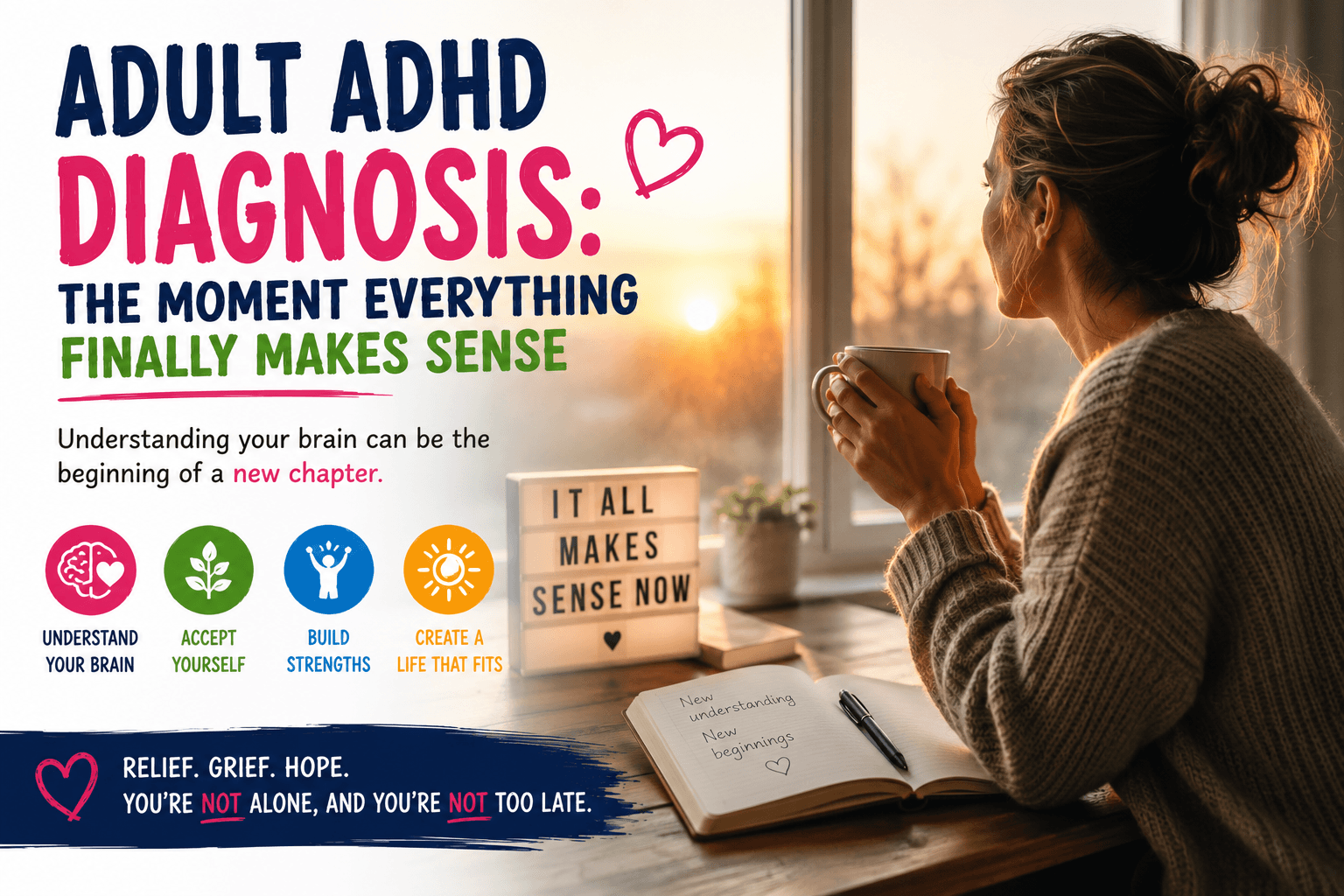
Adult ADHD Diagnosis: The Moment Everything Finally Makes Sense
For many people, an adult ADHD diagnosis is not simply another medical appointment. If you are looking for the wider library rather than diagnosis specifically, start with our Adult ADHD practical guide to everyday challenges.
It is the moment decades of confusion suddenly begin to make sense.
Many adults spend years believing they are lazy, unreliable, disorganised or somehow “not trying hard enough.” They often compare themselves with other people who seem to cope effortlessly with everyday life.
Then one conversation changes everything.
Instead of asking,
“What’s wrong with me?”
they begin asking,
“Could there have been another explanation all along?”
That single shift in thinking can change the way someone views their past and future. A diagnosis or assessment outcome is only one part of the picture: adults may also want to understand commonly missed adult ADHD signs, decision fatigue, motivation, work environment and burnout recovery. These guides address different everyday questions rather than replacing professional assessment.
Why an Adult ADHD Diagnosis Can Feel So Emotional
Receiving answers after years of uncertainty is often a huge relief.
Many people finally understand why school felt harder than expected.
Why careers never seemed to follow a straight line.
Why relationships sometimes became exhausting.
Why ordinary daily tasks seemed far more difficult than everyone else made them appear.
However, alongside relief often comes grief.
People begin wondering:
- What if someone had noticed earlier?
- How different could life have been?
- Which opportunities did I lose?
- How much energy did I spend blaming myself?
Book 2 explains that this combination of relief and grief is completely understandable because a late diagnosis often means reinterpreting an entire lifetime of experiences.
Adult ADHD Diagnosis Often Changes Your Life Story
One of the biggest changes after receiving an adult ADHD diagnosis is not external.
It is internal.
Many memories suddenly look completely different.
School reports.
Previous jobs.
Friendships.
Relationships.
Missed opportunities.
Years of self-criticism.
Instead of seeing personal failure, many adults begin recognising patterns that were never understood before.
Book 2 describes this as beginning to rewrite your life story using a framework that finally makes sense.
Why So Many Adults Are Diagnosed Later in Life
Many people assume ADHD is only recognised during childhood.
In reality, Book 2 explains that a large number of adults are never diagnosed when they are young, with diagnosis rates even lower among women and some underrepresented groups.
Adults often discover ADHD after events such as:
- A child’s diagnosis
- Workplace challenges
- Relationship difficulties
- Burnout
- Reading an article
- Hearing someone else’s story
Recognition often happens unexpectedly.
Many people describe it as finally seeing themselves for the first time.
Adult ADHD Diagnosis Is the Beginning—Not the End
Receiving a diagnosis does not instantly solve every challenge.
Life remains life.
Responsibilities remain.
Habits still need changing.
However, something important does change.
People stop fighting an invisible battle without understanding why.
Instead of constantly trying to become someone else, they can begin learning how their own brain works.
Book 2 introduces this as the beginning of a four-stage journey: Recognition, Processing, Rebuilding and Integration.
You Are Not Starting Over
Many adults worry they are “too late.”
Book 2 offers a different perspective.
Years of experience often bring resilience.
People have already developed coping strategies.
They understand themselves far better than they realise.
Although the discovery feels late, it can become the start of a more authentic future built around understanding rather than self-blame.
Moving Forward After an Adult ADHD Diagnosis
Every person’s journey is different.
Some people choose to learn more about ADHD.
Others speak with family members.
Some explore coaching, workplace adjustments or medical advice.
Many simply allow themselves time to process everything they have learned.
There is no single correct path.
The important step is recognising that understanding yourself is not the finish line.
It is the starting point.
Reflection Questions
- What thoughts went through your mind when you first began wondering about ADHD?
- Has understanding ADHD changed the way you view your past?
- Which experiences now make more sense?
- What strengths have helped you reach this point in life?
Conclusion
An adult ADHD diagnosis is far more than receiving a label.
For many people, it becomes the moment their life finally begins to make sense.
It allows years of confusion to be viewed through a new lens.
Although relief and grief often arrive together, understanding opens the door to acceptance, growth and a future built around who you really are—not who you believed you should have been.
As Book 2 emphasises, this is not the end of your story.
It is the beginning of understanding it.
Internal Links
- Critical Thinking Skills in Teenagers: Helping Young People Think Clearly and Make Better Decisions
- Growth Mindset in Teenagers: Helping Young People Learn, Adapt and Succeed
Disclaimer
This article is for educational purposes only and is based on the themes presented in The Late Discovery – Rewriting Your Life After an Adult ADHD Diagnosis. It is not intended to diagnose or treat any medical condition. If you have concerns about ADHD or your health, seek advice from a qualified healthcare professional.