
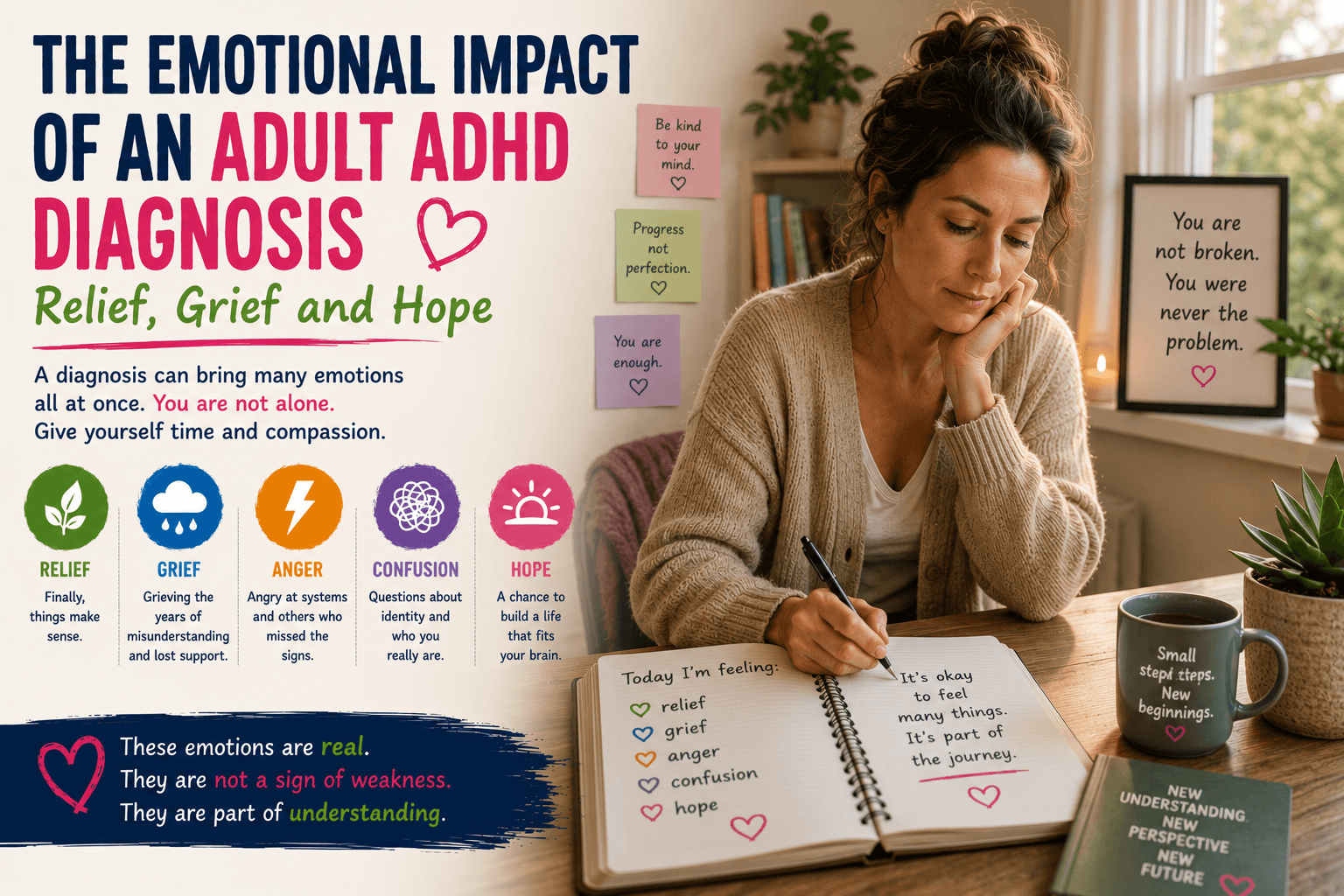
FocusEmotional Impact of an Adult ADHD Diagnosis: Relief, Grief and Hope
The emotional impact of an adult ADHD diagnosis can be powerful, confusing and unexpected. Although many people feel relieved to receive an explanation, they may also experience sadness, anger, regret and uncertainty about who they really are.
Sometimes, these emotions arrive immediately. However, they can also appear days or weeks after the diagnosis.
At first, a person may feel excited because everything finally makes sense. Later, though, the meaning of that discovery begins to settle in.
According to The Late Discovery, this is not simply an emotional breakdown. Instead, it can be understood as a period of emotional reconstruction. A person is processing years of misunderstood experiences within a very short time.
Why the Emotional Impact of an Adult ADHD Diagnosis Feels So Intense
An adult ADHD diagnosis does not only explain current difficulties.
It can change how someone understands their whole life.
School experiences may look different. Previous job problems may gain new meaning. Likewise, relationship difficulties, unfinished plans and years of self-criticism may suddenly fit into a clearer pattern.
As a result, the person is not processing one new fact. They are reconsidering decades of memories.
This can feel overwhelming because each memory raises new questions:
- Why did nobody notice?
- Why was I blamed?
- How much effort did I spend trying to cope?
- What might have been different?
- Who am I now that I understand this?
Book 2 describes this as an emotional avalanche involving relief, sadness, anger and confusion about identity. Often, several of these feelings appear at the same time.
Relief After an Adult ADHD Diagnosis
For many adults, relief is the first emotion.
There is finally an explanation for patterns that once felt impossible to understand.
Perhaps the person could focus deeply on interesting work but could not begin a simple household task. Maybe they performed brilliantly during a crisis yet struggled with routine paperwork. In other cases, they repeatedly forgot appointments despite caring deeply about the people involved.
Before diagnosis, these experiences may have been treated as evidence of laziness, carelessness or weak character.
Afterwards, however, a different explanation becomes possible.
The person may realise:
- “I was not failing on purpose.”
- “There was a reason certain tasks felt harder.”
- “My difficulties were real.”
- “I am not the only person who experiences this.”
Consequently, relief can feel enormous. For the first time, years of confusion have a framework. Keyphrase
Why Relief Can Be Followed by Grief
Although relief may arrive first, grief often follows.
The book captures this contrast through adults who felt grateful to have answers but heartbroken that those answers came so late.
This grief can be difficult to explain because nobody has died. Nevertheless, something important has been lost.
A person may grieve:
- The childhood support they never received
- The opportunities they avoided
- The careers they left
- The relationships affected by misunderstanding
- The confidence damaged by criticism
- The younger version of themselves who believed they were defective
Therefore, late-diagnosis grief is not only about the past. It is also about the life someone imagines they might have lived with earlier understanding.
These thoughts may be painful. Even so, they are a natural part of making sense of the diagnosis.
Anger at the Systems and People Who Missed the Signs
The emotional impact of an adult ADHD diagnosis may also include anger.
A person might remember teachers who called them lazy, family members who said they were careless, or employers who questioned their commitment.
They may also feel angry with healthcare systems that treated anxiety, low mood or exhaustion without recognising the possible role of ADHD.
This anger does not always mean those people acted with bad intentions. Often, they lacked the knowledge needed to understand what they were seeing.
Still, the consequences were real.
Years of criticism may have shaped the person’s confidence, choices and relationships. Therefore, anger can be a reasonable response to finally recognising how often their behaviour was misunderstood.
Rather than suppressing the anger, it may help to ask what it is revealing.
Perhaps it shows where compassion was missing. Alternatively, it may reveal which boundaries or changes are now necessary.
Confusion About Identity
An adult ADHD diagnosis can create difficult questions about identity.
A person may wonder whether their habits, personality and coping methods are truly theirs or simply strategies they developed to survive.
For example, someone who appeared extremely organised may realise that their strict systems were built to prevent forgotten tasks. Another person may recognise that constant people-pleasing developed from fear of criticism or rejection.
As a result, they may ask:
- Which parts of me are authentic?
- Which behaviours are forms of masking?
- Would I have made different choices?
- Am I still the same person?
- How should I describe myself now?
The diagnosis does not erase the person they were before.
Instead, it gives them more accurate information about how that person developed.
Their creativity, humour, values, relationships and experiences remain real. However, the diagnosis may help them understand why certain coping strategies became necessary.
The Emotional Avalanche Often Follows a Pattern
Book 2 describes a recognisable progression after late discovery. Although every person is different, the process may include five broad stages.
1. Absorbing Information
At first, many people research ADHD constantly.
They may read articles, watch videos, join online groups or revisit childhood memories late into the night.
This stage can feel exciting because each new piece of information explains another part of life. However, too much information may also affect sleep and increase emotional overload.
Therefore, it can help to take breaks rather than trying to understand everything at once.
2. Integrating the Reality
After the first rush of recognition settles, grief and anger may become stronger.
The diagnosis begins to feel real rather than theoretical.
At this point, a person may replay old experiences and think about what could have been different. Although this stage is painful, it can help release beliefs that were built on misunderstanding.
3. Questioning Identity
Next, deeper questions may appear.
The person may examine masking, perfectionism, people-pleasing or repeated career choices. They may also begin separating their natural preferences from behaviours they adopted to meet other people’s expectations.
This process takes time. Therefore, there is no need to decide immediately who the “real” person is.
4. Beginning Practical Rebuilding
Gradually, attention may shift towards everyday life.
The person starts considering new routines, communication methods, workplace changes or professional support.
Rather than trying to fix themselves, they begin asking what conditions help them function well.
5. Integrating ADHD Into Identity
Eventually, ADHD can become one part of a person’s identity without controlling the whole story.
They may still experience difficulties. However, those difficulties no longer automatically become proof of personal failure.
Instead, they become information that helps the person make better choices.
Physical Effects of Emotional Processing
Strong emotions do not only affect thoughts.
The body may also respond.
Book 2 notes that sleep disruption, appetite changes and fatigue may appear while someone processes a major life revelation.
A person might feel:
- Mentally tired
- Physically tense
- Restless at night
- Less interested in food
- More hungry than usual
- Emotionally sensitive
- Unable to concentrate on ordinary tasks
Therefore, basic care becomes especially important.
Regular meals, gentle movement, rest and reduced pressure may help the nervous system settle. In addition, limiting late-night research can protect sleep.
If physical or emotional symptoms remain severe, worsen, or interfere significantly with daily life, professional support should be considered.
Why Mixed Emotions Are Normal
One of the hardest parts of late discovery is accepting that opposite feelings can exist together.
A person can feel relieved and heartbroken.
They can feel hopeful about the future while grieving the past.
Likewise, they can appreciate the diagnosis yet feel angry that it took so long.
These emotions do not cancel one another out.
Instead, each one reflects a different part of the experience:
- Relief says, “I finally understand.”
- Grief says, “I wish I had known earlier.”
- Anger says, “I deserved better understanding.”
- Confusion says, “I am rebuilding my identity.”
- Hope says, “I can make different choices now.”
Recognising this can reduce the pressure to choose one “correct” emotional response.
Practical Ways to Process the Emotional Impact
There is no single way to process an adult ADHD diagnosis. However, Book 2 offers several gentle approaches.
Name the Feeling
Begin by identifying what you feel.
Is it relief, anger, sadness, confusion or fear?
Next, rate the intensity from one to ten.
Naming an emotion can make it feel more manageable. In addition, it helps separate the feeling from the belief that it will last forever.
Write a Grief Letter
Book 2 suggests writing letters to people or systems that failed to recognise the signs.
The letter might be addressed to:
- A former teacher
- A parent
- A healthcare professional
- An employer
- A younger version of yourself
These letters do not need to be sent.
Instead, the purpose is to express feelings that may have remained trapped for years.
Write to Your Younger Self
A compassion letter can help change the meaning of painful memories.
Choose an age when life felt especially difficult. Then explain what that younger person did not yet understand.
You might write:
“You were not lazy.”
“You were trying very hard.”
“You needed support, not shame.”
“You were not too much.”
Although this exercise can bring tears, it may also create relief.
Avoid Immediate Major Decisions
During periods of intense emotion, perspective can change quickly.
Therefore, Book 2 advises focusing on understanding patterns before making major career decisions.
The same principle may apply to relationships, relocation or other major changes.
Some adjustments may eventually be helpful. However, allowing the first emotional wave to settle can lead to clearer decisions.
Speak With Someone Supportive
A trusted friend, partner, support group or neurodiversity-informed professional may help a person process the diagnosis.
However, not everyone will understand immediately.
A simple explanation may be useful:
“Part of me feels relieved because I finally have an explanation. At the same time, I am processing years of experiences that now look completely different. I need time and support while I work through both feelings.”
This helps others understand that relief does not remove grief.
When Additional Support May Be Helpful
Emotional processing does not follow a fixed timetable.
Nevertheless, additional help may be useful when emotions remain overwhelming or begin affecting daily functioning.
Possible signs include:
- Persistent low mood
- Increasing isolation
- Inability to manage basic responsibilities
- Severe sleep disruption
- Constant rumination about the past
- Anger that repeatedly damages relationships
- Feeling unable to imagine a worthwhile future
Seeking support does not mean someone is handling the diagnosis badly.
On the contrary, it means they recognise when the process requires more help.
A qualified healthcare professional can discuss appropriate support and consider whether other conditions or circumstances may also be contributing.
The Emotional Impact Can Lead to Self-Compassion
Although the emotional avalanche feels difficult, it may also create meaningful change.
Grief can encourage compassion for the younger self.
Anger can support stronger boundaries and advocacy.
Meanwhile, relief can grow into appreciation for finally having better information.
Book 2 explains that the emotional intensity does not last forever. Over time, the experience can help someone become more understanding of both themselves and other people facing invisible challenges.
The goal is not to erase the past.
Instead, it is to interpret the past more accurately.
Reflection Questions
Take a quiet moment to consider:
- Which emotion appeared first after learning about ADHD?
- Has relief been followed by grief or anger?
- Which past experience now looks different?
- What did your younger self need to hear?
- Are you giving yourself enough time to process?
- Who can support you without dismissing your feelings?
- Which major decisions could wait until your emotions settle?
There are no correct answers.
However, honest reflection can help turn emotional overload into greater understanding.
Conclusion: Making Space for Relief, Grief and Hope
The emotional impact of an adult ADHD diagnosis is rarely simple.
Answers may bring relief. At the same time, they may uncover grief for years of misunderstanding, anger about missed support and uncertainty about identity.
However, these emotions do not mean the diagnosis has made life worse.
Instead, they may show that a person is finally processing experiences they could not previously explain.
As understanding grows, self-blame can begin to soften. Consequently, the diagnosis can become more than an explanation of the past. It can become the foundation for a future built with greater honesty, compassion and hope.
The emotional avalanche will pass.
What remains is the opportunity to understand yourself more fully and begin building a life that fits the brain you have always had.
Internal Links
- Why So Many Adults Discover They Have ADHD Later in Life
- Signs of Adult ADHD That Are Often Missed Until Later in Life
Disclaimer
This article is for educational and informational purposes only. It is based on themes from The Late Discovery: Rewriting Your Life After an Adult ADHD Diagnosis and is not a substitute for medical, psychological or diagnostic advice. Anyone concerned about ADHD or their emotional wellbeing should consult a suitably qualified healthcare professional