
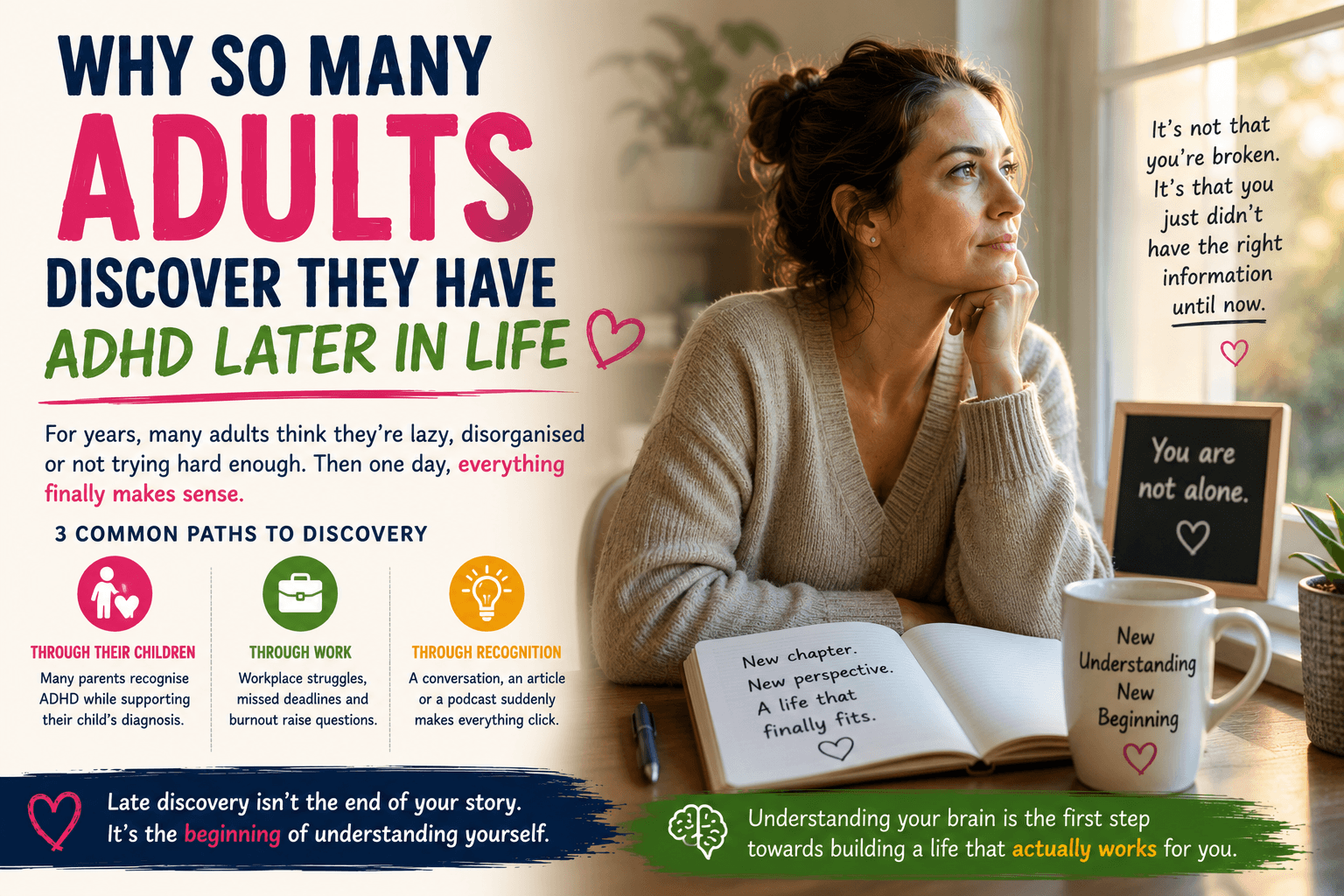
Why So Many Adults Discover They Have ADHD Later in Life
Many adults discover ADHD later in life without ever realising their lifelong challenges could have another explanation. Adults discover ADHD later in life for many different reasons, yet the moment of recognition often changes everything.
Why Childhood ADHD Was Often Missed
Many adults grew up when ADHD was far less understood than it is today.
Teachers often expected children to sit quietly, complete work on time and follow instructions without difficulty.
If a child was not disruptive, they could easily go unnoticed.
Likewise, children who achieved reasonable grades were often assumed to be coping well.
However, many were working much harder than anyone realised.
Some became experts at hiding their difficulties.
Others simply blamed themselves.
Consequently, years passed without anyone recognising the real reason behind their struggles.
Learning to Cope Without Understanding
As children became teenagers and later adults, many developed their own coping strategies.
For example, they relied on:
- Endless reminder notes
- Multiple alarms
- Working late into the evening
- Last-minute bursts of effort
- Double-checking everything
- Depending on family or friends for organisation
These strategies often helped them succeed.
Nevertheless, they also required enormous mental effort.
Book 2 describes these coping strategies as part of surviving without understanding the underlying neurological differences.
The Three Common Paths to Discovery
Book 2 identifies three common ways people finally discover ADHD later in life.
1. Through Their Children
Many parents first begin learning about ADHD after their child receives a diagnosis.
While reading about symptoms, they suddenly recognise their own childhood.
School reports.
Forgotten homework.
Constant daydreaming.
Always feeling different.
Suddenly, everything starts making sense.
2. Through Workplace Challenges
Others discover ADHD after struggling at work.
Perhaps they miss deadlines.
Maybe organisation becomes overwhelming.
Sometimes repeated job changes raise difficult questions.
Book 2 shares Michael’s story, explaining how understanding ADHD helped him realise his difficulties were not character flaws.
3. Through Personal Recognition
Sometimes the discovery happens unexpectedly.
An article.
A podcast.
A book.
A conversation.
Many adults describe reading about ADHD and thinking:
“This sounds exactly like me.”
That single moment often begins a completely new understanding of themselves.
Looking Back Through a New Lens
One of the biggest changes after recognising ADHD is the way people see their past.
School suddenly makes more sense.
Career choices become easier to understand.
Relationship difficulties may appear in a different light.
Instead of seeing failure, people begin recognising patterns.
Book 2 explains that an adult diagnosis often requires reinterpreting an entire life history because every struggle suddenly has a framework that makes sense.
Relief and Grief Often Arrive Together
Many adults expect to feel relieved.
They do.
However, Book 2 explains that another emotion often follows.
Grief.
People begin wondering:
- What if someone had noticed earlier?
- What opportunities did I miss?
- How different could life have been?
These questions are common.
Although painful, they are also part of understanding years of misunderstood experiences.
Late Discovery Also Brings Advantages
Although discovering ADHD later in life can feel overwhelming, Book 2 highlights several important advantages.
Many adults have already developed:
- Resilience
- Problem-solving skills
- Creative thinking
- Sophisticated coping strategies
- Life experience
- Greater self-awareness
Research discussed in the book also suggests many adults report feeling more authentic after diagnosis. Furthermore, many make positive career changes, while others experience reduced anxiety as they begin understanding themselves better.
Recognition Is Only the Beginning
Learning about ADHD is not the end of the journey.
Instead, it marks the beginning.
Book 2 introduces four stages that many adults experience:
- Recognition
- Processing
- Rebuilding
- Integration
Each stage helps people move away from confusion and towards understanding.
Understanding Yourself Changes Everything
Many adults spend decades trying to become someone else.
They promise to be more organised.
They tell themselves to try harder.
They blame themselves whenever life feels difficult.
However, understanding ADHD changes the conversation.
Instead of asking,
“What’s wrong with me?”
people often begin asking,
“What do I need to work with my brain instead of against it?”
That simple change can transform confidence, relationships and everyday life.
Reflection Questions
- When did you first begin wondering about ADHD?
- Which childhood memories make more sense today?
- Have you developed coping strategies without realising it?
- What would you say to your younger self if you could?
Conclusion
Many adults discover ADHD later in life because the signs were never recognised during childhood.
Instead of receiving answers, they learned to cope, adapt and blame themselves.
Fortunately, understanding can arrive at any age.
Book 2 reminds readers that late discovery is not about finding out something is wrong with you.
Rather, it is about finally understanding yourself, rewriting your story and building a life that fits your brain.
Internal Links
- Signs of Adult ADHD That Are Often Missed Until Later in Life
- Learning From Mistakes in Teenagers: Turning Experience Into Growth
Disclaimer
This article is for educational purposes only and is based on the themes presented in The Late Discovery – Rewriting Your Life After an Adult ADHD Diagnosis. It is not intended to diagnose or treat any medical condition. If you have concerns about ADHD, please seek advice from a qualified healthcare professional.