
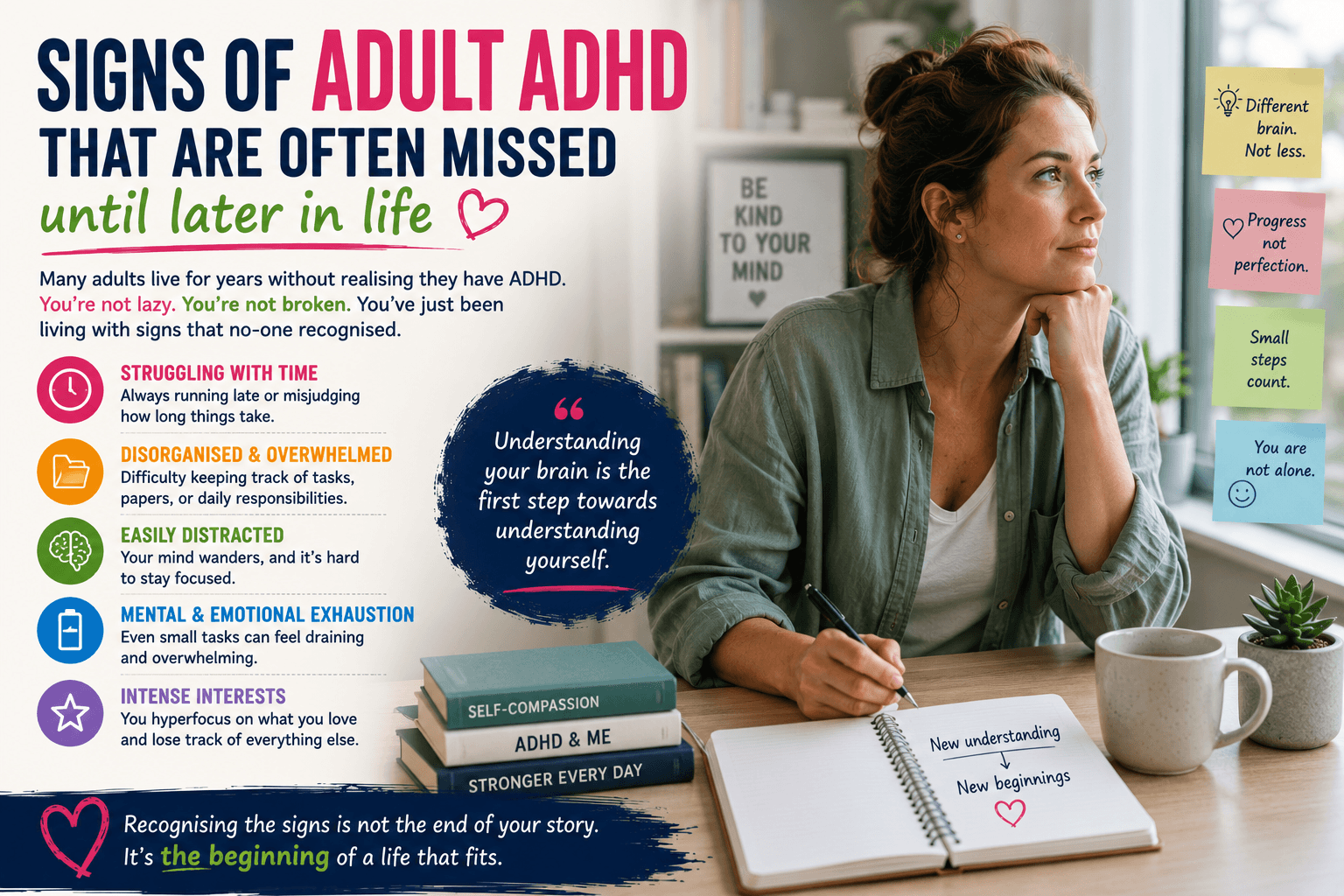
Signs of Adult ADHD That Are Often Missed Until Later in Life
Many people think ADHD is mainly a childhood condition.
They may picture a child who cannot sit still, interrupts often, or struggles to focus in class. However, ADHD can continue into adulthood, and many people do not recognise the signs until much later in life.
For years, adults may believe they are lazy, careless, disorganised, or simply not trying hard enough. In reality, there may be another explanation for the patterns they have experienced.
Recognising possible signs does not confirm a diagnosis. Nevertheless, it can encourage someone to learn more and seek advice from a qualified healthcare professional. For a structured overview of related everyday topics, use our Adult ADHD practical guide.
Why the Signs of Adult ADHD Are Often Missed
Adult ADHD is often missed because many people learned how to hide or manage their difficulties.
For example, some became perfectionists. Others relied on strict routines, long working hours, repeated reminders, or constant checking. As a result, they may have appeared organised even though staying organised required enormous effort.
In addition, many adults grew up when ADHD was not widely understood. If they achieved reasonable grades, behaved quietly, or avoided causing problems, teachers and parents may not have noticed anything unusual.
Women, in particular, may have developed strong masking strategies. Instead of showing obvious hyperactivity, they may have experienced daydreaming, emotional overwhelm, forgetfulness, or mental exhaustion.
Therefore, the signs can remain hidden for decades.
Common Signs of Adult ADHD
The signs of adult ADHD can appear differently from person to person. However, some patterns are reported frequently.
These may include:
- Losing keys, phones, documents, or other important items
- Forgetting appointments, tasks, or conversations
- Starting projects with enthusiasm but struggling to finish them
- Finding it difficult to estimate how long tasks will take
- Feeling overwhelmed by paperwork and daily responsibilities
- Becoming distracted during conversations or meetings
- Delaying simple tasks until they become urgent
- Experiencing strong emotions after criticism or rejection
- Focusing deeply on interesting activities while ignoring everything else
- Feeling mentally exhausted from trying to stay organised
Occasional forgetfulness happens to everyone. However, when these patterns are frequent, long-lasting, and affect several areas of life, they may deserve closer attention.
Struggling With Time
Difficulty managing time is one of the most commonly overlooked signs of adult ADHD.
A person may genuinely intend to arrive on time but still leave too late. They may also underestimate how long it takes to get ready, travel, or complete a task.
This experience is sometimes described as time blindness. In simple terms, time may feel less clear or less easy to judge.
Consequently, the person may appear careless or unreliable, even though they are making a real effort.
They may set several alarms, prepare early, or repeatedly check the clock. Even so, moving from one activity to another can remain difficult.
Forgetfulness and Working Memory Difficulties
Another possible sign is frequent forgetfulness.
Someone may walk into a room and forget why they went there. During a conversation, they might lose track of what they planned to say. Likewise, they may hear several instructions but remember only the final part.
This does not mean the person does not care.
Instead, their mental workspace may become overloaded more quickly. As a result, information can disappear before they have acted on it.
To manage this, many adults depend heavily on notes, calendars, alarms, lists, and reminders. These tools can be useful. However, needing them constantly may reveal how much effort daily life requires.
Starting Tasks but Struggling to Finish
Many adults with possible ADHD traits can begin new projects with excitement.
At first, the task may feel interesting, fresh, or challenging. Therefore, motivation is strong.
Later, once the novelty fades, maintaining attention may become much harder. The person may then move to another idea before completing the first one.
Over time, unfinished projects can create guilt and frustration. People may call themselves undisciplined or unreliable.
However, Book 2 explains that ADHD attention often responds strongly to interest, urgency, novelty, and challenge. Therefore, the problem may not be a lack of ability. It may be difficulty keeping attention engaged when a task becomes routine.
Feeling Overwhelmed by Everyday Tasks
Some adults can manage complex work but struggle with basic daily responsibilities.
For instance, they may solve difficult problems at work yet feel unable to begin the laundry. They might perform brilliantly during a crisis but become overwhelmed by emails, forms, household tasks, or routine planning.
This contrast can be confusing.
Because they know they are capable, they may believe they should be able to manage everything equally well. When they cannot, self-criticism often follows.
However, different tasks place different demands on the brain. A stimulating challenge may activate attention, while a repetitive task may provide too little interest to get started easily.
Hyperfocus on Interesting Activities
ADHD is not always a lack of attention.
In fact, some adults experience intense focus on activities they enjoy. This is often called hyperfocus.
During hyperfocus, hours may pass without being noticed. The person may forget meals, messages, appointments, or other responsibilities because they are deeply absorbed.
Although hyperfocus can produce excellent work, it can also create problems when attention becomes difficult to shift.
Therefore, a person may struggle to focus during a short, boring task while concentrating for many hours on something meaningful. This difference can make their behaviour appear inconsistent.
Emotional Intensity
Strong emotional reactions can also be part of the picture.
Some adults feel criticism, disappointment, or rejection very deeply. A small comment may remain in their mind for hours or even days.
They may also become overwhelmed more quickly when tired, stressed, or overstimulated.
As a result, others may describe them as too emotional or too sensitive. However, the person may simply experience emotions with greater intensity and need more time to recover.
Book 2 repeatedly highlights how years of misunderstanding can turn emotional differences into shame. Once a person gains better information, they may begin responding to themselves with greater kindness.
Mental and Emotional Exhaustion
Many adults with undiagnosed ADHD spend years trying to appear calm, organised, and in control.
They may rehearse conversations, check everything repeatedly, hide their confusion, or work longer hours than other people. Although these strategies may help them cope, they also use a great deal of energy.
Consequently, the person may feel exhausted after work, social events, meetings, or ordinary responsibilities.
They may believe they are weak or unable to cope with normal life. In reality, they may be using extra mental effort simply to meet everyday expectations.
Recognising ADHD Through a Child
One common path to recognition begins with a child’s ADHD assessment.
A parent may read about ADHD to support their child. Then, while learning about the signs, they begin recognising the same patterns in themselves.
Suddenly, childhood memories may look different.
They may remember school reports describing them as bright but careless. Perhaps they were always daydreaming, losing homework, talking too much, or leaving everything until the last minute.
Therefore, the child’s diagnosis can become the beginning of the parent’s own journey towards understanding.
Recognising ADHD Through Work
Workplace demands can also reveal long-hidden signs.
Some people perform well in busy, varied, or high-pressure roles. However, when their responsibilities shift towards administration, long-term planning, or repetitive detail, their coping systems may begin to fail.
For example, someone may thrive while working directly with people but struggle after being promoted into management. Similarly, a creative worker may excel at generating ideas yet feel overwhelmed by schedules and reports.
At this point, the person may start asking why certain parts of work feel much harder than others.
Rather than lacking ability, they may simply be working in conditions that do not support their natural thinking style.
Recognising ADHD Through Burnout
For others, recognition begins after burnout.
They may have coped successfully for years by working harder, sleeping less, overpreparing, or pushing through exhaustion. Eventually, however, these methods stop working.
Major life changes can increase the pressure. Parenthood, promotion, relationship stress, remote work, hormonal changes, or caring responsibilities may all expose hidden difficulties.
When demands rise beyond a person’s ability to compensate, the signs can become impossible to ignore.
Although this period may feel like failure, it can also create the first real opportunity for understanding.
Looking Back at Childhood
Adult ADHD does not suddenly begin in adulthood.
Therefore, an assessment usually considers patterns that were present during childhood, even if nobody recognised them at the time.
Possible early signs may have included:
- Daydreaming during lessons
- Forgetting homework
- Losing school supplies
- Talking frequently
- Becoming bored easily
- Struggling to sit still
- Working well only under deadline pressure
- Showing strong ability in preferred subjects
- Receiving comments such as “could do better with more effort”
Looking back can be emotional. However, it can also replace blame with context.
The child who seemed lazy may have been understimulated. The teenager labelled difficult may have been overwhelmed. The student described as careless may have needed different support.
Why Success Does Not Rule Out ADHD
Some adults assume they cannot have ADHD because they have a degree, career, business, family, or other achievements.
However, success does not mean daily life has been easy.
A person may have reached their goals through intense effort, anxiety, perfectionism, deadline pressure, or sophisticated coping strategies.
For example, they may complete excellent work while neglecting sleep. They might appear organised because they check everything repeatedly. Likewise, they may succeed in a stimulating career while struggling privately with basic administration.
Therefore, achievement should not be used as proof that ADHD is impossible.
The more useful question is how much effort the person has needed to maintain that success.
Recognition Is Not the Same as Diagnosis
Reading about the signs of adult ADHD can create a powerful sense of recognition.
However, many conditions can cause similar difficulties. Stress, anxiety, depression, sleep problems, trauma, health conditions, and other neurodevelopmental differences may affect attention and organisation.
For that reason, self-recognition should be treated as a starting point rather than a final answer.
A qualified professional can consider childhood history, current difficulties, medical factors, and other possible explanations.
Seeking an assessment is not about collecting a label. Instead, it is about gaining accurate information.
Understanding Can Reduce Self-Blame
One of the most important changes after recognising possible ADHD is the way someone speaks to themselves.
Before understanding, they may say:
“I am lazy.”
“I never finish anything.”
“I cannot manage normal life.”
“I always let people down.”
After learning more, the language may begin to change:
“I need more support with routine tasks.”
“My attention responds strongly to interest and urgency.”
“I work better with written reminders.”
“I need systems that fit the way my brain works.”
This change does not remove responsibility. Instead, it makes practical problem-solving possible.
When shame decreases, people often become more willing to seek support, explain their needs, and build better systems.
What to Do When the Signs Feel Familiar
When several signs feel familiar, begin by observing patterns rather than judging yourself.
You could write down examples from childhood, school, work, relationships, and home life. In addition, note how often the difficulties occur and how strongly they affect daily functioning.
Next, consider speaking with a qualified healthcare professional.
It may also help to prepare questions such as:
- Could these patterns be related to ADHD?
- What other explanations should be considered?
- What does an adult ADHD assessment involve?
- What support is available while I wait?
- How can I manage the difficulties I am experiencing now?
Meanwhile, practical tools such as calendars, visible reminders, quiet workspaces, movement breaks, and shorter task steps may still be helpful.
Reflection Questions
Consider the following questions:
- Which patterns have followed you since childhood?
- Do simple tasks often require more effort than other people realise?
- Are you highly focused on interesting activities but distracted during routine ones?
- Have you developed strict systems to avoid forgetting things?
- What first made you wonder about ADHD?
- How might your past look different with greater understanding?
There are no right or wrong answers. However, honest reflection can help you decide whether professional advice would be useful.
Conclusion
The signs of adult ADHD are often missed because many people become skilled at coping, masking, and working harder.
As a result, recognition may not happen until adulthood, when work, family life, stress, or burnout places greater pressure on existing coping strategies.
Although identifying familiar traits does not confirm ADHD, it can open the door to better questions.
Most importantly, understanding these patterns can replace years of self-blame with compassion and practical support.
You may not have been lazy, careless, or broken.
Instead, you may have been living with differences that nobody had yet helped you understand.
Internal Links
Disclaimer
This article is for educational purposes only and is based on the themes explored in The Late Discovery – Rewriting Your Life After an Adult ADHD Diagnosis. It is not intended to diagnose or treat any medical condition. If you believe you may have ADHD or another health concern, please seek advice from a qualified healthcare professional.