Adult ADHD and Disclosure at Work: How to Decide Whether to Tell Your Employer
Adult ADHD and disclosure at work can feel like a very personal decision.
Perhaps you are wondering:
“Should I tell my manager?”
Alternatively, you may be asking:
“Do I need to tell anyone at all?”
Likewise, you may want support but still feel uncomfortable sharing a diagnosis.
Therefore, the first important point is simple:
Disclosure is not one single decision.
Instead, there are several possible decisions.
For example, you may decide to disclose:
nothing;
a particular working difficulty;
a need for a practical adjustment;
a diagnosis;
or more detailed personal information.
Therefore, before asking whether you should “disclose”, first ask:
“What information actually needs to be shared, and for what purpose?”
That question can make the decision much clearer. Disclosure is about deciding what information to share, with whom and for what purpose. It is different from the practical adjustment itself. If your objective is a change in working conditions, see our separate guide to ADHD workplace accommodations. If the difficulty has remained hidden because you appear to cope well, our article on workplace masking examines that hidden effort.
Disclosure Is Not All or Nothing
Many people imagine disclosure as a binary choice.
Either:
“Tell everyone.”
or:
“Tell nobody.”
However, workplace communication can be much more selective.
For example, you may tell:
your direct manager;
HR;
occupational health;
one trusted colleague;
nobody beyond those who need to know.
Likewise, you may explain only the practical issue rather than your whole personal history.
Therefore, disclosure can be limited, purposeful and specific.
Adult ADHD and Disclosure at Work: Start With the Reason
Before sharing personal information, ask:
“What am I hoping this conversation will achieve?”
For example, perhaps you want:
clearer written priorities;
fewer unexpected interruptions;
access to a quieter workspace;
more predictable check-ins;
a change in communication style.
Alternatively, perhaps you simply want your manager to understand why a particular working condition is difficult.
Therefore, identifying the objective comes before deciding how much information to share.
Disclosure Without a Clear Goal Can Feel Riskier
Imagine telling a manager:
“I have ADHD.”
The manager may genuinely want to help.
However, they may not know what help means.
Therefore, the conversation could remain vague.
By contrast, you might say:
“I have ADHD, and I have noticed that I produce much more accurate detailed work when priorities are written down and I have a protected focus period.”
As a result, the diagnosis is connected to a practical workplace issue.
Therefore, useful disclosure usually benefits from a clear purpose.
Adult ADHD and Disclosure at Work: You May Not Need to Lead With a Diagnosis
Sometimes the practical issue can be discussed without beginning with ADHD.
For example:
“I produce better work when the priority order is clear.”
Or:
“Could we schedule progress check-ins rather than having several unexpected updates during the day?”
Likewise:
“I find detailed analysis easier when I have an uninterrupted block.”
Therefore, functional language may sometimes solve the problem without requiring broader personal disclosure.
Functional Language Focuses on Performance
Functional language describes:
the condition;
the effect;
the useful change.
For example:
Condition
Frequent interruptions.
Effect
Detailed concentration becomes harder.
Useful Change
Protected focus time.
Therefore, instead of focusing only on a label, you focus on the work.
That can make workplace conversations more practical.
Adult ADHD and Disclosure at Work: When a Diagnosis May Be Relevant
There may also be situations where explaining the diagnosis itself is useful.
For example, you may be seeking formal workplace support.
Likewise, you may want HR, occupational health or management to understand the context behind a request.
However, the exact legal and employment implications depend on individual circumstances and jurisdiction.
Therefore, this article does not provide legal advice.
Instead, where formal rights or adjustments are involved, appropriate professional or workplace guidance may be necessary.
Privacy Matters
A diagnosis is personal information.
Therefore, before disclosing, consider:
who needs to know;
why they need to know;
how much detail is necessary.
You may not want several colleagues discussing something that was intended to remain private.
Therefore, if you do disclose, consider asking:
“Who will have access to this information?”
and:
“How will this information be handled?”
Those are reasonable practical questions.
Adult ADHD and Disclosure at Work: Separate Need-to-Know From Nice-to-Know
Imagine three groups.
NEED TO KNOW
People directly involved in a formal adjustment or support process.
USEFUL TO KNOW
Perhaps a manager who needs to understand a particular working arrangement.
DOES NOT NEED TO KNOW
People who have no practical reason to receive personal information.
Therefore, disclosure should not automatically spread wider than necessary.
Instead, think about relevance.
Consider the Workplace Culture
Workplace culture can influence how comfortable disclosure feels.
For example, ask:
Does the organisation openly discuss wellbeing and neurodiversity?
Do managers respond constructively when employees ask for support?
Is confidentiality taken seriously?
Are differences treated professionally?
Therefore, observe the environment before deciding how much you want to share.
However, culture alone should not determine the decision.
Your own needs remain central.
Adult ADHD and Disclosure at Work: Look at Your Manager
Your direct manager can make a significant difference.
Perhaps your manager is:
clear;
supportive;
practical;
discreet.
Alternatively, the manager may be:
inconsistent;
dismissive;
over-controlling;
poor at confidentiality.
Therefore, consider the person as well as the organisation.
A disclosure strategy that feels appropriate with one manager may feel very different with another.
Do Not Assume Support Requires Full Personal History
You do not necessarily need to explain every part of your experience.
For example, a practical conversation may only need:
what is difficult;
what helps;
what outcome you are trying to improve.
Therefore, avoid feeling pressured to explain more than is relevant.
Your personal history remains yours.
Adult ADHD and Disclosure at Work: The Minimum Useful Disclosure
A useful concept is Minimum Useful Disclosure.
Ask:
“What is the smallest amount of information necessary to achieve the practical objective?”
For example:
Objective
Reduce interruption during complex reporting.
Minimum Useful Disclosure
“I find detailed work substantially more accurate when I have one protected focus block in the morning.”
Perhaps that is enough.
Alternatively, if formal support is being requested, more information may be necessary.
Therefore, the correct amount depends on the situation.
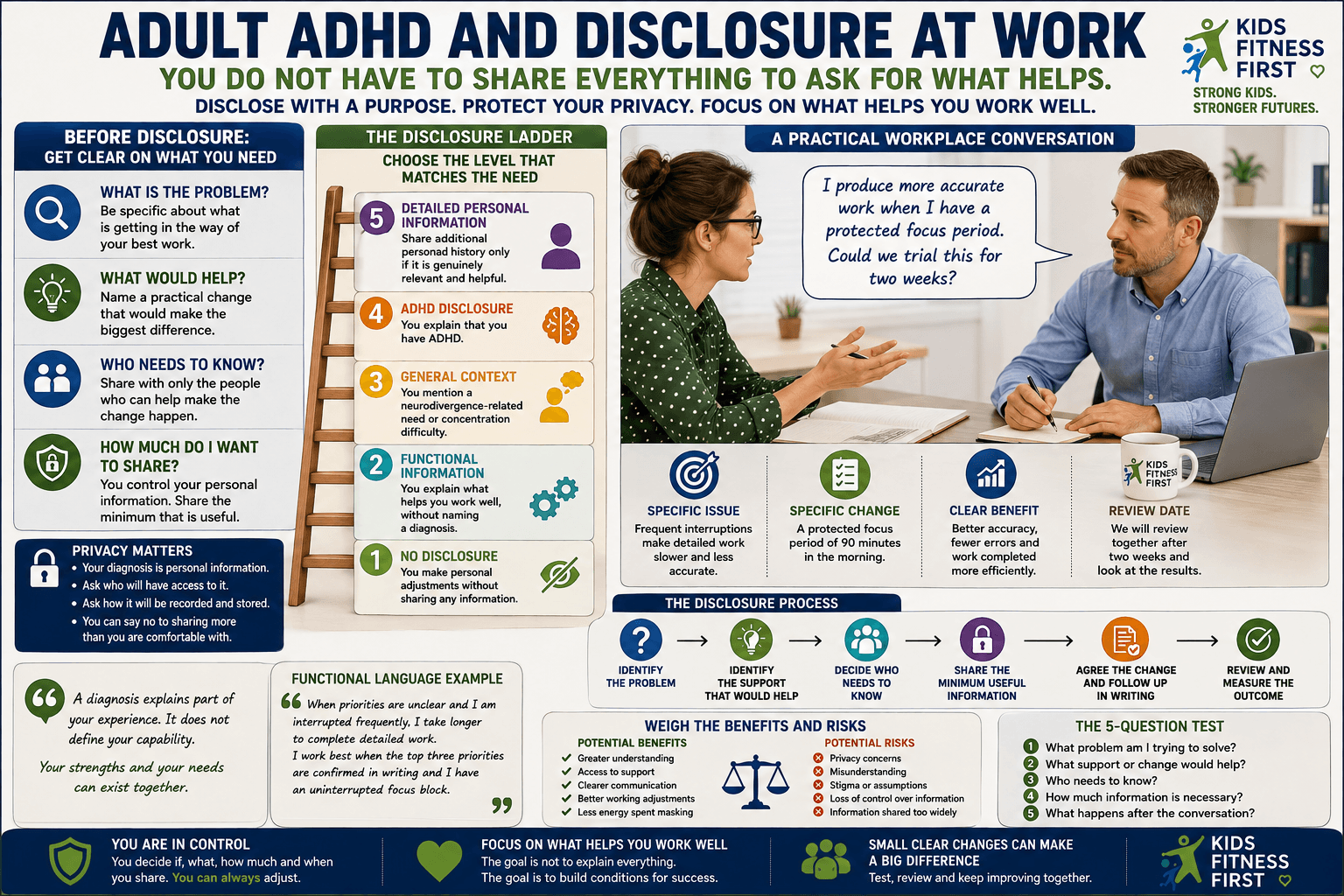
The Disclosure Ladder
Think of disclosure as a ladder.
LEVEL 1 — NO DISCLOSURE
You make personal working changes where possible.
LEVEL 2 — FUNCTIONAL INFORMATION
You explain what helps you work well.
LEVEL 3 — GENERAL CONTEXT
You mention a concentration or neurodivergence-related need.
LEVEL 4 — ADHD DISCLOSURE
You explicitly disclose ADHD.
LEVEL 5 — DETAILED PERSONAL INFORMATION
You provide additional history where genuinely relevant.
Therefore, you can choose the level that matches the need.
You do not automatically have to move to the highest level.
Adult ADHD and Disclosure at Work: What Are You Asking For?
Before any conversation, write down the request.
For example:
“I would like the top three priorities confirmed in writing at the beginning of the day.”
Or:
“I would like to discuss using the quieter workspace for detailed report writing.”
Then ask:
“Do I actually need to disclose ADHD to make this request?”
Sometimes yes.
Sometimes no.
Therefore, separate the request from the diagnosis first.
Connect the Request to Business Value
Workplace requests are often clearer when they connect to performance.
For example:
“When priorities are written down, I make fewer mistakes and complete work more efficiently.”
Or:
“Using the quiet room for this task would help me produce the report more accurately.”
Therefore, the conversation becomes:
problem → solution → performance.
That can be easier for managers to understand.
Adult ADHD and Disclosure at Work: Prepare Before the Conversation
Do not rely on remembering everything in the moment.
Instead, prepare three points.
1. WHAT IS HAPPENING?
Describe the practical issue.
2. WHAT WOULD HELP?
Give a specific suggestion.
3. WHAT RESULT WOULD IMPROVE?
Explain the benefit.
For example:
“Frequent interruptions make detailed report work slower. A ninety-minute protected block would help me maintain concentration and improve accuracy.”
Therefore, preparation keeps the conversation focused.
Avoid Overexplaining
When a conversation feels important, you may be tempted to explain everything.
However, too much information can dilute the core request.
Therefore, keep returning to:
the issue;
the impact;
the solution.
If additional information is necessary, it can be provided later.
Adult ADHD and Disclosure at Work: Use Written Follow-Up
After an important conversation, it may be useful to confirm the main points in writing.
For example:
“Thank you for discussing this today. As agreed, I will use 9:00–10:30 for uninterrupted report work, and we will review how this is working after two weeks.”
Therefore, written follow-up creates clarity.
Likewise, it reduces the risk of different people remembering the conversation differently.
Trial Periods Can Help
Not every workplace change needs to be permanent immediately.
For example, you could suggest:
“Could we try this arrangement for two weeks and then review the result?”
That can make the request feel practical and measurable.
Therefore, a trial can turn uncertainty into evidence.
Adult ADHD and Disclosure at Work: Measure the Outcome
Suppose you receive a quieter focus period.
Then track:
accuracy;
completion;
energy;
interruptions;
output.
Afterwards, compare the results.
As a result, the workplace change becomes easier to evaluate objectively.
This connects directly to the experimental approach used throughout Work That Fits.
Disclosure Does Not Guarantee Understanding
It is important to remain realistic.
A manager may know very little about ADHD.
Likewise, they may have misconceptions.
Therefore, simply saying:
“I have ADHD.”
does not guarantee that the person understands what that means for you.
Instead, explain your own working pattern.
For example:
“For me, the biggest issue is repeated interruption during detailed tasks.”
That is far more useful than expecting the diagnosis to explain everything automatically.
Adult ADHD and Disclosure at Work: Avoid ADHD Stereotypes
Do not assume you must fit a standard profile.
For example, you may not:
hate offices;
need silence;
want remote working;
struggle with every repetitive task.
Likewise, strengths vary between individuals.
Therefore, speak about your own experience.
The goal is not to explain ADHD in general.
Instead, explain what affects your work specifically.
A Diagnosis Does Not Define Your Capability
Disclosure should not mean presenting yourself only through difficulty.
For example, you can say:
“I am particularly strong at solving complex problems. However, I work best when I can protect uninterrupted time for that work.”
Therefore, strengths and support needs can be discussed together.
That creates a more balanced picture.
Adult ADHD and Disclosure at Work: Link Back to Your Cognitive Signature
Article 10 introduced your Cognitive Signature.
Before a disclosure conversation, review it.
Ask:
What do I do well?
Which conditions unlock those strengths?
Which conditions block them?
Therefore, your conversation can focus not only on reducing problems but also on improving performance.
Use Your Collapse Conditions
Article 12 identified Collapse Conditions.
For example:
constant interruption;
unclear priorities;
heavy social demand;
task switching.
Therefore, if you need workplace support, start with your strongest evidence.
Do not say:
“Everything is difficult.”
Instead:
“The biggest problem is unpredictable interruption during detailed work.”
Precision helps.
Adult ADHD and Disclosure at Work: Use Your Work Environment Profile
Article 16 created your Work Environment Profile.
Perhaps you already know:
where you concentrate best;
which sounds affect you;
which digital interruptions cause difficulty.
Therefore, use that profile before asking for environmental changes.
As a result, the request is based on observation rather than assumption.
Use Your Autonomy Profile
Article 18 explored autonomy.
Perhaps you perform better when:
priorities are clear;
the deadline is fixed;
you choose task order.
Therefore, you could ask:
“Could we agree the day’s priorities and allow me some flexibility over the sequence?”
That is much more specific than:
“I need more autonomy.”
Adult ADHD and Disclosure at Work: Consider the Benefits
Possible benefits of disclosure may include:
greater understanding;
access to support processes;
clearer communication;
better workplace adjustments;
reduced need to hide difficulties.
However, the actual outcome will depend heavily on the workplace and individual circumstances.
Therefore, treat these as possibilities rather than guarantees.
Consider the Risks Too
There may also be concerns such as:
privacy;
misunderstanding;
stigma;
unhelpful assumptions;
loss of control over personal information.
Therefore, a decision should consider both potential benefit and potential cost.
Neither side should be ignored.
The Disclosure Decision Matrix
Use this framework.
| Question | Low | Medium | High |
|---|---|---|---|
| How much is work being affected? | |||
| How useful would support be? | |||
| How much do I trust the manager/process? | |||
| How comfortable am I sharing? | |||
| How important is privacy to me here? | |||
| Is formal support needed? |
Then review the pattern.
Therefore, the decision becomes more structured.
Adult ADHD and Disclosure at Work: The Five-Question Test
Ask:
1. WHAT PROBLEM AM I TRYING TO SOLVE?
Be specific.
2. WHAT SUPPORT OR CHANGE WOULD HELP?
Name it.
3. WHO NEEDS TO KNOW?
Do not assume everyone.
4. HOW MUCH INFORMATION IS NECESSARY?
Use Minimum Useful Disclosure.
5. WHAT HAPPENS AFTER THE CONVERSATION?
Plan a review.
Therefore, disclosure becomes a process rather than a single emotional moment.
Who Should You Speak to First?
That depends on the organisation.
Possible routes may include:
your manager;
HR;
occupational health;
another designated workplace contact.
However, organisational procedures vary.
Therefore, if you are unsure, check the employer’s own policies or obtain appropriate advice.
Adult ADHD and Disclosure at Work: Disclosure to Colleagues
You may also wonder whether colleagues need to know.
Often, they may not.
For example, a team may simply know:
“I use 9:00–10:30 for focused work.”
They may not need to know the underlying personal information.
Therefore, distinguish:
what colleagues need to understand operationally
from:
what you want to share personally.
You Control the Personal Story
Workplace disclosure should not automatically become public storytelling.
Therefore, decide in advance:
what you are comfortable sharing;
what is private;
what is irrelevant.
If somebody asks a question you do not want to answer, you can return to the workplace issue.
For example:
“I’d prefer to keep the medical details private, but I am happy to discuss what helps me perform the role effectively.”
That keeps the boundary clear.
Adult ADHD and Disclosure at Work: Ask About Confidentiality
If you are sharing medical or diagnostic information through a formal process, consider asking:
“Who will see this?”
“Where will it be recorded?”
“Who will be informed about the adjustment?”
“Will colleagues be told anything?”
Therefore, you understand how information may be handled.
Again, specific legal rights and data-protection requirements depend on jurisdiction and circumstances.
What If the First Conversation Goes Badly?
A poor first response does not always mean the situation is finished.
Perhaps the manager does not understand the issue.
Therefore, you may need to:
clarify the request;
provide it in writing;
use a formal workplace route;
seek HR or occupational-health guidance;
obtain appropriate professional advice.
However, the correct next step depends on the circumstances.
Adult ADHD and Disclosure at Work: Do Not Argue About ADHD in General
You do not need to convince somebody of every aspect of ADHD.
Instead, return to the practical issue.
For example:
“Regardless of the broader discussion, I am asking whether we can trial a protected focus period because interruptions are affecting the accuracy of this task.”
Therefore, the conversation remains centred on work.
The 10% Support Question
Before making a large request, ask:
“What single change could improve this situation by 10%?”
Perhaps:
written priorities;
one quieter workspace;
fewer unexpected check-ins;
a planned communication window.
Then decide whether disclosure is necessary to achieve that change.
As a result, you may find a smaller, practical first step.
Adult ADHD and Disclosure at Work: The Disclosure Planning Sheet
Complete this before the conversation.
THE WORKPLACE ISSUE IS…
THE IMPACT IS…
THE CHANGE I WOULD LIKE TO TEST IS…
THE BENEFIT TO MY WORK WOULD BE…
THE PERSON WHO NEEDS TO KNOW IS…
THE INFORMATION I AM COMFORTABLE SHARING IS…
THE INFORMATION I WANT TO KEEP PRIVATE IS…
WE WILL REVIEW THE CHANGE AFTER…
This becomes your Disclosure Planning Sheet.
Green, Amber and Red Disclosure Readiness
GREEN — CLEAR PURPOSE
You understand:
why you are disclosing;
what you want;
who needs to know;
what information you are comfortable sharing.
Therefore, you can approach the conversation with greater clarity.
AMBER — UNCLEAR
You know something needs to change.
However, you are unsure what support would help.
Therefore, gather more evidence first.
RED — EMOTIONAL PEAK
You feel pressured to disclose immediately but have no clear objective or plan.
Therefore, where possible, clarify the purpose before sharing more personal information than necessary.
Adult ADHD and Disclosure at Work: Your Rights Are a Separate Question
This article focuses on decision-making and communication.
However, workplace rights are a separate legal matter.
Depending on jurisdiction and individual circumstances, ADHD may interact with disability law, equality law, workplace-adjustment requirements or data-protection rules.
Therefore, where legal rights matter, use authoritative local guidance or qualified advice.
Do not rely solely on general internet articles.
Disclosure Is Not a Measure of Courage
Choosing to disclose does not automatically make someone brave.
Likewise, choosing privacy does not make someone ashamed.
These are personal and situational decisions.
Therefore, the goal is not:
“Be open at all costs.”
Instead, the goal is:
“Make the decision that best supports your work, privacy and circumstances.”
Adult ADHD and Disclosure at Work: Connect the Framework
By Article 20, the Work That Fits framework now includes:
Cognitive Signature
What you do well.
Peak Performance Formula
Conditions that help you perform well.
Collapse Conditions
Conditions that make performance harder.
Strength Portfolio
Where your abilities create value.
Depth Portfolio
Where your deeper contribution matters.
Automation Boundary
Where AI can support your work.
Work Environment Profile
The conditions around the work.
Open-Plan Balance
Connection versus concentration.
Autonomy Profile
The level of structure and control that helps.
Career Evidence File
Historical evidence from your working life.
Disclosure Planning Sheet
How to communicate a workplace need while deciding what personal information to share.
Therefore, you are moving from self-understanding towards practical workplace application.
Reflection Questions
- What workplace problem are you trying to solve?
- Could it be solved without disclosing ADHD?
- What exact change would help?
- Who genuinely needs to know?
- How much information are you comfortable sharing?
- What information do you want to keep private?
- How supportive is your manager likely to be?
- How does the organisation handle confidentiality?
- Could a trial arrangement help?
- What evidence would show that the change worked?
- Do you need formal workplace or legal guidance?
- What would Minimum Useful Disclosure look like for you?
Conclusion: Disclose With a Purpose, Not From Pressure
Adult ADHD and disclosure at work is not a simple yes-or-no question.
Sometimes disclosure may help.
However, sometimes a functional workplace conversation may be enough.
Likewise, formal support may require more information than an informal request.
Therefore, start with the purpose.
First, identify the problem.
Then identify the change that would help.
Afterwards, decide who genuinely needs to know.
Next, decide how much information you are comfortable sharing.
Finally, agree how the outcome will be reviewed.
Therefore, do not begin with:
“How much of myself do I have to explain?”
Instead, begin with:
“What does this workplace need to understand so I can perform effectively?”
That distinction can protect both your privacy and your clarity.
Most importantly, remember:
A diagnosis is personal information. A workplace need is practical information. They can overlap, but they are not the same thing.
Therefore, disclose deliberately.
Share what is useful.
Protect what is private.
And keep the conversation focused on building conditions in which you can do your work well.
SUGGESTED INTERNAL LINKS
- Adult ADHD and Career Archaeology: What Your Past Jobs Can Teach You About the Work That Fits
- Adult ADHD and Autonomy at Work: Why Having More Control Can Improve Focus, Motivation and Performance
DISCLAIMER
This article is provided for general educational and informational purposes only. It does not provide medical, psychological, diagnostic, occupational-health, employment, data-protection or legal advice.
Disclosure decisions are personal and depend on individual circumstances, workplace relationships, organisational procedures and applicable law.
Therefore, this article should not be used as a substitute for authoritative workplace policies, occupational-health guidance, employment advice or qualified legal advice.
Likewise, ADHD experiences vary considerably between individuals. Consequently, no single disclosure approach will be suitable for everyone.
Where formal workplace rights, disability protections, confidentiality obligations or employment disputes are involved, seek appropriate authoritative or professional guidance.