
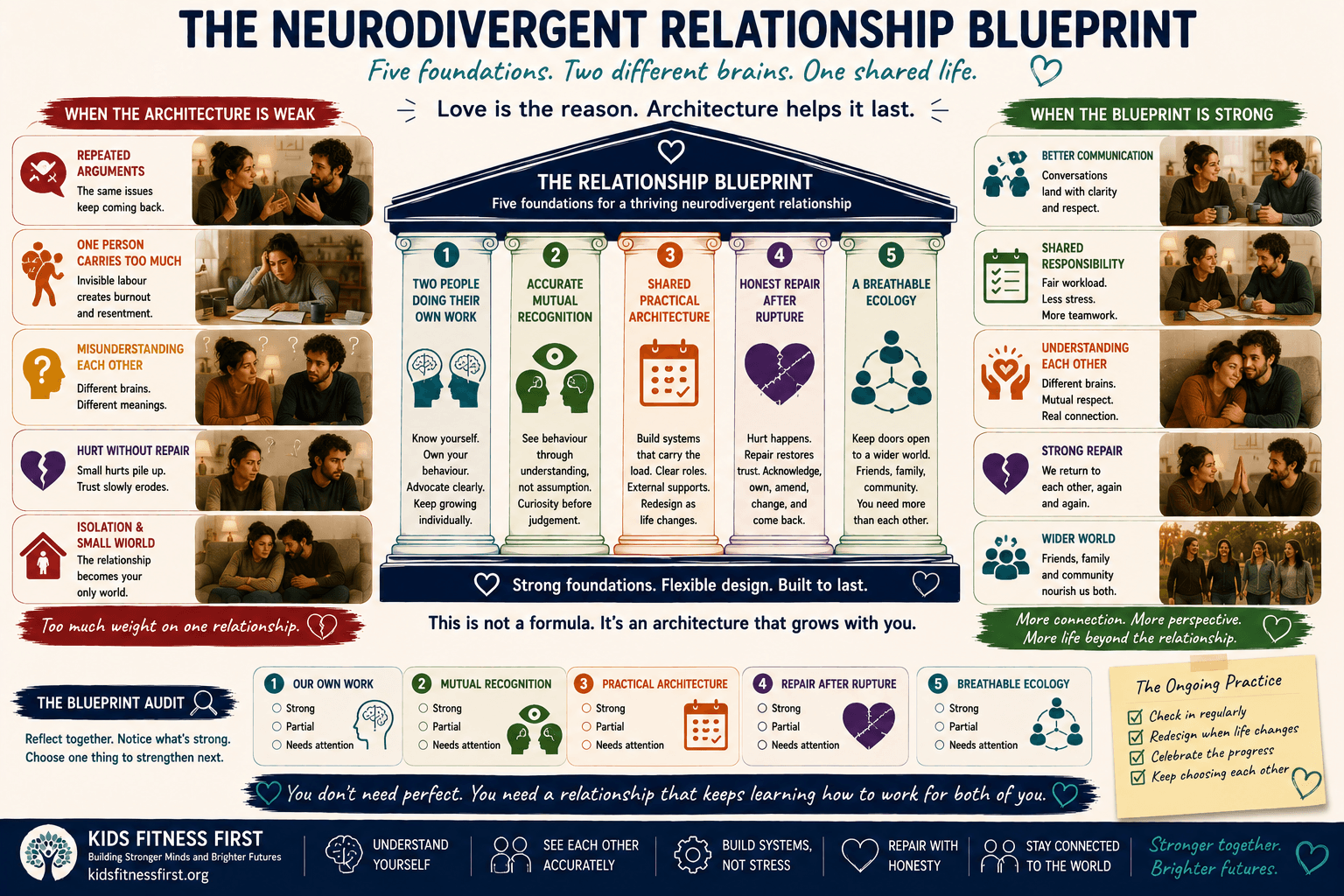
The Relationship Blueprint: 5 Foundations of a Thriving Neurodivergent Relationship
The neurodivergent relationship blueprint begins with a different question from the one many couples have been asking.
Not:
“Which one of us needs to change?”
Instead:
“What does our relationship need in order to work for both of our brains?”
That shift matters.
Across the earlier articles in Book Five, we have looked closely at the places where neurodivergent relationships can become stuck.
We have examined:
- repeating conversations;
- different ways of processing the same moment;
- shame;
- expressions of love;
- chronic apologising;
- receiving understanding;
- relationship repair;
- self-advocacy;
- misreading behaviour;
- invisible labour;
- the Parent Trap;
- communication;
- parenting;
- and the Inward Drift.
Each subject matters on its own.
However, a long-term relationship is not built from isolated techniques.
It is a system.
Therefore, Article 15 brings those pieces together into one structure.
The Relationship Blueprint contains five foundations:
- Two People Who Have Done Their Own Work
- Accurate Mutual Recognition
- Shared Practical Architecture
- Honest Repair After Rupture
- A Breathable Ecology
None requires perfection.
Instead, together they describe the conditions in which two different nervous systems have a better chance of building one sustainable life.
The Blueprint Is an Architecture, Not a Formula
Relationship advice often sounds as though there is a correct sequence.
Communicate better.
Share the chores.
Go on date nights.
Apologise properly.
Spend quality time together.
Naturally, all of these things can help.
However, relationships are not machines with a fixed operating manual.
A system that works when two people are twenty-eight may stop working when they become parents.
Likewise, something that works during a quiet year may fail during illness, bereavement, career change or financial pressure.
Therefore, the Blueprint is not:
“Build this once and you are finished.”
Instead, it is:
“Keep these five parts alive and redesign them when life changes.”
That is a much more realistic model of a relationship across decades.
A strong relationship is not one that never needs rebuilding.
It is one that knows how to rebuild.
Foundation 1: Two People Who Have Done Their Own Work
The first foundation begins before the relationship.
It begins inside each person.
A thriving partnership cannot rely on one person doing all the emotional, practical or psychological work for two.
Therefore, both adults need an individual practice of self-awareness and responsibility.
However, the work may look different for each person.
What the Neurodivergent Partner’s Work May Include
For the neurodivergent partner, the work may involve:
- understanding their nervous system;
- separating shame from identity;
- stopping chronic unnecessary apologies;
- taking responsibility when behaviour causes harm;
- learning how to ask clearly for what they need;
- building external systems instead of relying entirely on willpower;
- recognising overload earlier;
- and allowing themselves to receive understanding.
For example, saying:
“My ADHD explains why I forgot this.”
may be useful information.
However, personal work continues with:
“Therefore, what system will make this less likely next time?”
Likewise:
“I am overloaded.”
is useful self-awareness.
However, mature self-advocacy adds:
“I need twenty minutes, and then I will come back.”
Understanding the brain is therefore only the beginning.
Eventually, understanding has to become behaviour, systems and communication.
What the Other Partner’s Work May Include
Meanwhile, the other partner also has personal work.
They may need to:
- reconsider automatic interpretations of neurodivergent behaviour;
- recognise invisible labour honestly;
- stop over-functioning where possible;
- step out of the Parent Trap;
- reduce unnecessary monitoring;
- communicate needs rather than expecting mind-reading;
- and allow their partner’s systems to look different from their own.
For example, perhaps they have spent years thinking:
“If I stop checking, everything will collapse.”
That belief may have historical evidence behind it.
However, if the relationship is to become more equal, they may eventually need to tolerate a different arrangement:
“The system is now responsible for reminding you. I am not.”
That transition can feel frightening.
Nevertheless, adult equality requires both responsibility and room to exercise it.
The First Foundation Is Not About Blame
This foundation does not ask:
“Who needs more work?”
Instead, it asks:
“What is mine to work on?”
That question protects the relationship from a common trap.
One person spends years studying their partner.
They understand ADHD.
Or autism.
Or dyslexia.
They know every framework.
However, they rarely turn the same level of curiosity towards themselves.
A Relationship Blueprint needs two people willing to ask:
“What do I bring into this pattern?”
That does not mean equal blame.
It means shared adulthood.
Foundation 2: Accurate Mutual Recognition
The second foundation is the ability to see the person in front of you accurately.
Not perfectly.
However, accurately enough that neurological difference does not automatically become character judgement.
For example:
Forgetting may not equal indifference.
Silence may not equal rejection.
A need for written information may not equal lack of intelligence.
A strong reaction may not always be deliberate drama.
Likewise, exhaustion in the other partner may not equal lack of compassion.
Resentment may be signalling years of invisible labour.
Frustration may be evidence that a need has gone unmet for too long.
Therefore, accurate recognition must move in both directions.
Recognition Is More Than Knowing a Diagnosis
You can know that somebody has ADHD and still misunderstand them constantly.
Likewise, you can know that somebody is autistic while continuing to expect them to read indirect emotional signals.
A diagnostic label is therefore not the same as relational understanding.
Accurate recognition asks more specific questions:
How does this particular person’s attention work?
What overwhelms this person?
How do they show love?
How do they recover after conflict?
How does this partner experience reliability?
What creates safety for them?
The answers belong to the individual.
Therefore, the goal is not to become an expert in a diagnostic category.
The goal is to become more accurate about the person you actually share a life with.
Recognition Does Not Mean Excusing
This is worth repeating.
Accurate recognition can say:
“I understand why you forgot.”
and:
“We still need a more reliable system.”
Likewise:
“I understand that you were overwhelmed.”
and:
“The way you spoke to me still hurt.”
Therefore, understanding and accountability are not opposites.
In fact, accurate recognition improves accountability because it helps couples repair the correct problem.
If the cause is working memory, build memory support.
If the cause is sensory overload, change the environment or timing.
If the problem is unfair workload, redistribute ownership.
If the problem is harmful behaviour, repair it.
The more accurate the reading, the more useful the response.
Foundation 3: Shared Practical Architecture
Love alone cannot remember the dentist.
Good intentions cannot automatically renew insurance.
Likewise, affection cannot reliably carry the family calendar.
Therefore, the third foundation is practical architecture.
This means deliberately building the systems that allow two different brains to run one shared life.
Examples may include:
- shared calendars;
- recurring reminders;
- clearly owned responsibilities;
- automated payments;
- written plans;
- agreed communication channels;
- weekly planning meetings;
- sensory recovery routines;
- household checklists;
- and clear rules around difficult conversations.
The principle is straightforward:
If something repeatedly fails through memory, timing or executive function, stop treating it as a moral problem and start treating it as a design problem.
Systems Should Carry Tasks, Not One Partner’s Brain
Many relationships become exhausted because one person functions as the household operating system.
They remember.
They anticipate.
They prompt.
They monitor.
Then, if something fails, they intervene.
Eventually, they are carrying both the task and the mental architecture around it.
That is not sustainable.
Therefore, shared practical architecture asks:
What can the system remember so a partner does not have to?
For example:
Instead of:
“Please remind me about the appointment.”
use a recurring calendar alert.
Instead of:
“Tell me when the payment is due.”
use automation.
Instead of:
“Keep checking whether I have done it.”
assign clear ownership and schedule one agreed review point.
Good systems reduce the amount of relationship energy spent on monitoring.
Consequently, more energy becomes available for connection.
Practical Architecture Must Change as Life Changes
A system that worked before children may fail after children.
Likewise, a system that worked when both people worked from home may stop working after one person changes jobs.
Therefore, systems should not become sacred.
If they stop working, replace them.
Do not say:
“But this used to work.”
Instead, ask:
“What does our current life require now?”
That question keeps the Blueprint alive.
A household architecture should serve the people living inside it.
The people should not have to serve the architecture.
Foundation 4: Honest Repair After Rupture
Every long-term relationship experiences rupture.
Someone forgets.
Someone reacts badly.
A promise is broken.
A difficult conversation goes wrong.
Therefore, the defining question is not:
“Do we ever hurt each other?”
Instead:
“What happens after we do?”
The fourth foundation is reliable repair.
The Book Five Repair Protocol gives a useful sequence:
- Arrive rather than flee
- Acknowledge before explaining
- Own without collapse
- Make specific amends
- Commit to change over time
The aim is not a perfect apology.
Instead, it is restoration of trust through clear responsibility and visible action.
A Relationship Cannot Live Forever on Unrepaired Moments
Many couples do not explicitly repair.
Instead, time passes.
The argument becomes less intense.
Someone makes tea.
The television goes back on.
Eventually, both act as though the incident has ended.
Sometimes that is enough for minor friction.
However, genuine hurt that repeatedly goes unaddressed tends to accumulate.
One incident becomes evidence for the next.
Therefore, the next argument is never only about today.
It carries yesterday too.
This is how relationships become heavy.
By contrast, regular repair prevents the relationship from collecting an archive of unattended wounds.
Not every irritation needs a summit meeting.
However, when somebody has genuinely been hurt, the relationship needs a route back.
Repair Is Not Self-Punishment
Some neurodivergent adults find this particularly difficult because accountability activates shame.
Therefore, instead of:
“I did something hurtful.”
the internal message becomes:
“I am a terrible person.”
However, self-condemnation does not repair the other person’s experience.
Sometimes it actually creates another job for them: comforting the person who caused the harm.
Therefore, clean repair says:
“I did this.”
“I understand its effect.”
“I own my part.”
“Here is the repair.”
“Here is what will change.”
Then stop.
You do not need to destroy yourself to prove that you care.
Foundation 5: A Breathable Ecology
The fifth foundation is what surrounds the relationship.
A thriving partnership needs doors.
It needs some connection to a human world beyond the two people inside it.
That does not mean a busy social calendar.
Likewise, it does not mean forcing neurodivergent people into exhausting social environments.
Instead, it means maintaining enough outside connection that the relationship does not become responsible for everything.
Article 14 called these connections the Four Anchors:
- one individual friendship each;
- one chosen family connection each;
- one community membership each;
- one couple friendship together.
The exact form can vary.
However, the structural principle matters.
Your partner can be your most important person.
Nevertheless, they should not have to become your entire social world.
Why a Wider Ecology Protects the Couple
Outside relationships provide:
- perspective;
- identity;
- companionship;
- humour;
- different conversations;
- support;
- and opportunities to exist beyond the couple role.
Therefore, a wider ecology actually protects intimacy.
It reduces the pressure on one partner to be:
- best friend;
- therapist;
- colleague;
- social world;
- emotional regulator;
- hobby partner;
- and sole witness to adult life.
That is too much for any one human being.
Therefore, breathable relationships have connection inside and outside the partnership.
The Five Foundations at a Glance
| Foundation | Core Question |
|---|---|
| 1. Two People Doing Their Own Work | What is mine to understand, own and develop? |
| 2. Accurate Mutual Recognition | Am I seeing my partner accurately rather than through assumption? |
| 3. Shared Practical Architecture | What systems make our shared life more reliable? |
| 4. Honest Repair After Rupture | What happens after one of us causes hurt? |
| 5. A Breathable Ecology | Does our relationship still exist inside a wider human world? |
The five foundations support one another.
For example, good repair is easier when both people have done individual work.
Likewise, practical systems reduce the number of unnecessary ruptures.
Meanwhile, accurate recognition prevents neurological differences being interpreted as moral failures.
Finally, outside connections reduce the emotional pressure on the relationship itself.
Therefore, the Relationship Blueprint is not five separate techniques.
It is one integrated structure.
What Happens When One Foundation Is Weak?
No relationship will have all five foundations equally strong all the time.
Perhaps you communicate well and repair cleanly.
However, your practical systems are weak.
Alternatively, perhaps your household runs beautifully while your wider social world has disappeared.
Maybe you understand each other accurately but have not yet stepped out of the Parent Trap.
That does not mean the Blueprint has failed.
Instead, the weak foundation tells you where to work next.
This is why the Blueprint should be treated as a diagnostic map, not a scorecard.
The question is not:
“Are we a good relationship?”
Instead:
“Which part currently needs attention?”
Reflection: What Does Your Relationship Already Have?
Pause here.
Do this reflection separately first.
Then compare your answers.
Do not negotiate while writing.
Your perceptions may differ, and that difference is useful information.
Foundation One: Individual Work
Ask yourself:
Am I genuinely working on my own patterns, or am I mostly waiting for my partner to change?
Then score this foundation:
Strong / Partial / Needs Attention
Now write one example.
For instance:
“I am better at recognising overload, but I still become defensive when I cause harm.”
Or:
“I have stopped carrying some of my partner’s responsibilities, but I still monitor them.”
Foundation Two: Mutual Recognition
Ask:
Do I believe my partner generally understands what happens inside my nervous system?
Then:
Do I understand theirs?
Where do you still feel misread?
Perhaps:
- forgetting;
- silence;
- emotional intensity;
- need for recovery;
- need for reliability;
- resentment;
- social capacity;
- or communication style.
Score:
Strong / Partial / Needs Attention
Foundation Three: Practical Architecture
Ask:
Which parts of our shared life rely too heavily on memory, reminders or one person’s mental load?
Then list:
- calendar;
- finances;
- household work;
- children;
- social plans;
- appointments;
- admin;
- communication;
- or recovery routines.
Score:
Strong / Partial / Needs Attention
Foundation Four: Repair
Ask:
When one of us genuinely hurts the other, do we know how to come back?
Or do we:
- defend;
- withdraw;
- wait until it fades;
- apologise without changing;
- or pretend nothing happened?
Then ask:
Do both people repair, or mostly one?
Score:
Strong / Partial / Needs Attention
Foundation Five: Breathable Ecology
Ask:
Who exists in our lives beyond each other?
List:
- individual friends;
- family connections;
- community;
- couple friends;
- and meaningful regular contact.
Then ask:
Is our social world small because we consciously like it that way, or because it has quietly disappeared?
Score:
Strong / Partial / Needs Attention
Reflection Takeaway
Now put the five scores together.
Do not focus first on the weakest one.
Instead, notice the strongest.
Ask:
“What are we already doing that works?”
That matters because the Blueprint should identify strengths as well as gaps.
Then choose one weaker element and complete:
“Over the next three months, the part of our relationship we most want to strengthen is…”
Keep it to one.
You are building architecture.
You do not renovate the whole house at once.
Try This: The Relationship Blueprint Audit
Set aside around forty-five minutes together.
Draw five boxes on a page.
Label them:
1. OUR OWN WORK
2. MUTUAL RECOGNITION
3. PRACTICAL ARCHITECTURE
4. REPAIR
5. OUTSIDE ECOLOGY
For each box, write three short headings:
WHAT ALREADY WORKS
WHAT FEELS FRAGILE
ONE NEXT STEP
For example:
| Blueprint Element | What Works | What Feels Fragile | One Next Step |
| Individual Work | We both recognise overload earlier | Shame still appears during conflict | Practise one clean repair each week |
| Mutual Recognition | We understand sensory recovery | Forgetting still becomes personal | Use the Four Misreadings check |
| Practical Architecture | Shared calendar works | School admin still depends on one person | Assign full ownership + reminders |
| Repair | We usually return | We explain too early | Acknowledge before explaining |
| Breathable Ecology | Strong family ties | Few independent friends | One reach-out each this month |
Then ask:
Which single next step would create the most relief?
Start there.
Not with the most intellectually interesting item.
Start with the change that may improve ordinary life.
Review the Blueprint Every Three Months
The Blueprint should move as life moves.
Therefore, return to the five boxes every three months.
Ask:
What became stronger?
What weakened?
What changed in our life?
What system no longer fits?
What new demand appeared?
Perhaps:
- a new child;
- teenagers;
- a job change;
- caring for parents;
- menopause;
- illness;
- retirement;
- financial pressure;
- or a move.
Each life stage may require a different practical architecture.
However, the five foundations remain useful.
That is what makes the Blueprint durable.
Do Not Use the Blueprint as a Relationship Score
There is an obvious danger.
You could turn this into:
“We scored three out of five. That means our marriage is bad.”
That is not what the framework is for.
Relationships are not examinations.
Likewise, the five foundations are not pass/fail categories.
Instead, they are structural questions.
Perhaps one element has been neglected.
Good.
Now you know where the pressure may be coming from.
Perhaps three are already strong.
Good.
Those strengths can support the weaker areas.
Therefore, use the Blueprint to create clarity, not judgement.
The Blueprint Is Built From Repeated Small Acts
The architecture sounds large.
However, daily practice is small.
Foundation One may look like:
“I noticed I was becoming defensive.”
Foundation Two:
“I asked what your silence meant instead of assuming.”
Foundation Three:
“We put the appointment straight into the shared calendar.”
Foundation Four:
“I came back and repaired what happened.”
Foundation Five:
“I messaged my friend and arranged coffee.”
None sounds transformational.
However, repeated across years, those small actions become the relationship.
That is the deeper meaning of architecture.
Buildings are not made from one dramatic gesture.
They are made from many ordinary components placed in the right relationship to one another.
A Thriving Neurodivergent Relationship Is Not a Neurotypical Relationship With Extra Accommodation
This is an important final point.
The aim is not to make a neurodivergent relationship imitate an imagined normal relationship.
Instead, the partnership may need its own shape.
Perhaps:
- you communicate partly in writing;
- recovery time is built into weekends;
- household systems are unusually explicit;
- your social life is lower-frequency;
- you schedule difficult conversations;
- or responsibilities are divided according to strengths rather than convention.
That is not a lesser relationship.
It is a designed relationship.
The question is not:
“Does this look normal?”
Instead:
“Does this allow both people to live with dignity, responsibility, connection and enough room to breathe?”
That is the standard that matters.
Love Is Necessary, but Architecture Helps Love Survive
People can love each other very deeply and still build an unsustainable system.
That is one of the hardest truths in relationship work.
Love may be present.
However:
- shame may still dominate conflict;
- workload may still be unfair;
- systems may still fail;
- repair may still be absent;
- and the wider social world may still disappear.
Therefore, the Blueprint does not replace love.
It protects it.
It gives love somewhere more stable to live.
This is perhaps the central practical message of Book Five:
Do not ask love to do work that belongs to structure.
Love cannot remember everything.
Love cannot carry every task.
Love cannot automatically translate two nervous systems.
However, love combined with understanding, accountability, systems, repair and wider connection can become far more durable.
Conclusion: Build the Relationship That Fits Both Brains
The neurodivergent relationship blueprint does not ask two people to become the same.
Instead, it asks them to build something that can contain their differences.
The five foundations are:
Two People Who Have Done Their Own Work
Because neither partner can permanently outsource adulthood to the other.
Accurate Mutual Recognition
Because a relationship cannot thrive when both people are continually misreading each other.
Shared Practical Architecture
Because love should not be forced to function as a calendar, reminder system and household operating platform.
Honest Repair After Rupture
Because hurt will happen, and what happens afterwards shapes trust.
A Breathable Ecology
Because even a strong partnership needs a wider human world around it.
None of these foundations stays finished.
Instead, life will repeatedly test them.
Some years, your systems will need the most work.
Other years, repair will.
At another stage, the outside world may need rebuilding.
That is not failure.
That is maintenance.
Most importantly, the Blueprint gives you a different way to think about relationship difficulty.
Instead of:
“Something is wrong with us.”
you can ask:
“Which part of the architecture needs attention?”
Then work there.
Together.
Because the goal was never two identical brains.
It was always:
two whole adults, one shared life, and a structure strong enough to hold them both.
SUGGESTED INTERNAL LINKS
Article 3: : Stop Apologising for Your Brain: Neurodivergence, Shame and Better Repair
Article 7: ADHD Love Language: 6 Ways Neurodivergent People Show Love
DISCLAIMER
This article is provided for general educational and informational purposes only. It is not medical, psychological, diagnostic, relationship or couples-therapy advice.
Neurodivergent people and relationships are highly individual. Therefore, the five elements of the Relationship Blueprint should be used as a reflective framework rather than as a diagnostic test or universal formula.
A relationship may require different practical arrangements depending on the people involved, their neurologies, family situation, health, culture and circumstances.
Likewise, relationship frameworks should never be used to explain away abuse, intimidation, coercive control or persistent harmful behaviour. Where serious conflict or safety concerns exist, appropriately qualified professional support may be