
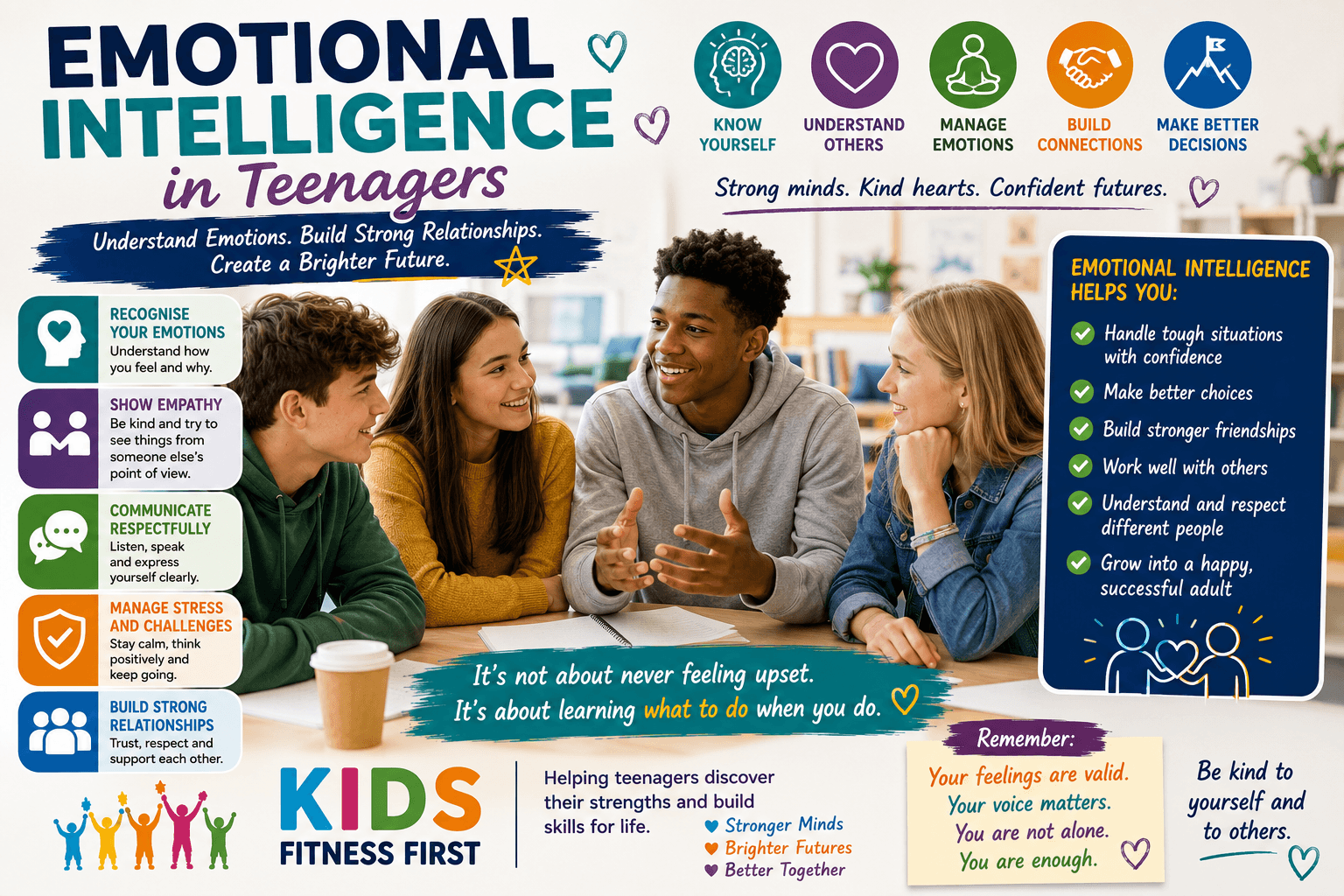
Emotional Intelligence in Teenagers: Helping Young People Understand Emotions and Build Strong Relationships
Success in life depends on more than academic knowledge. Teenagers also need the ability to understand themselves, recognise how others feel and respond thoughtfully in different situations. These abilities form the foundation of emotional intelligence in teenagers, one of the most valuable life skills they can develop.
Emotional intelligence does not mean hiding emotions or pretending everything is fine. Instead, it means recognising emotions, understanding why they occur and learning how to respond in healthy, constructive ways. Young people who develop emotional intelligence often communicate more effectively, build stronger friendships and cope better with life’s challenges.
At Kids Fitness First, we believe every teenager has unique strengths. By helping young people develop emotional intelligence alongside confidence, resilience and critical thinking, we prepare them for success at school, at work and throughout adult life.
Why Emotional Intelligence in Teenagers Matters
Teenagers experience enormous physical, emotional and social changes as they grow.
Friendships change.
Responsibilities increase.
Academic expectations become greater.
Future career choices begin to appear.
Meanwhile, social media and technology create new pressures that previous generations rarely experienced.
During this important stage of life, emotional intelligence helps teenagers remain calm, thoughtful and resilient.
Research consistently shows that emotionally intelligent young people often:
- communicate more confidently;
- resolve disagreements peacefully;
- build stronger friendships;
- cope better with stress;
- show greater empathy;
- work well in teams;
- demonstrate stronger leadership qualities.
These skills benefit teenagers both now and throughout adulthood.
What Is Emotional Intelligence?
Emotional intelligence is the ability to recognise, understand and manage emotions—both our own and those of other people.
It involves several connected skills, including:
- recognising feelings;
- understanding why emotions occur;
- managing emotional responses;
- showing empathy;
- communicating respectfully;
- building positive relationships;
- making thoughtful decisions.
Importantly, emotional intelligence can be learned and strengthened throughout life.
Like any skill, it improves with practice.
Understanding Your Own Emotions
The first step towards emotional intelligence is self-awareness.
Teenagers who understand their own emotions are better able to manage them.
Rather than saying, “I’m just angry,” they begin to recognise more specific feelings such as:
- disappointed;
- frustrated;
- embarrassed;
- nervous;
- excited;
- overwhelmed;
- hopeful.
Naming emotions accurately helps reduce confusion.
It also makes it easier to decide how to respond positively.
Parents and teachers can support this by encouraging open conversations about feelings without judgement.
Learning to Manage Emotions
Every teenager experiences strong emotions.
Feeling anxious before an exam, frustrated after an argument or disappointed following a setback is completely normal.
Emotional intelligence teaches teenagers that emotions themselves are not the problem.
Instead, the important question becomes:
“How will I respond?”
Healthy strategies include:
- taking slow, deep breaths;
- pausing before reacting;
- talking with a trusted adult;
- exercising or spending time outdoors;
- writing thoughts in a journal;
- focusing on practical solutions.
These habits help teenagers respond thoughtfully instead of reacting impulsively.
Developing Empathy
Empathy means trying to understand how another person feels.
It allows teenagers to build trust, strengthen friendships and improve communication.
For example, imagine a classmate seems unusually quiet.
Rather than making assumptions, an emotionally intelligent teenager might ask:
“Is everything okay?”
A simple question can make someone feel seen, valued and supported.
Empathy does not always mean solving another person’s problems.
Often, listening carefully is enough.
Listening Is an Important Skill
Many people listen with the intention of replying.
Emotionally intelligent teenagers learn to listen with the intention of understanding.
Good listening includes:
- maintaining eye contact;
- avoiding interruptions;
- asking thoughtful questions;
- showing genuine interest;
- respecting different opinions.
These habits strengthen relationships and reduce misunderstandings.
Managing Conflict Positively
Disagreements are a normal part of life.
However, emotional intelligence helps teenagers resolve conflict respectfully.
Instead of reacting immediately, they learn to:
- stay calm;
- explain their thoughts clearly;
- listen carefully;
- consider different viewpoints;
- work towards practical solutions.
These skills build confidence while improving relationships with family members, teachers and friends.
Understanding That Everyone Experiences Emotions Differently
Not everyone reacts in the same way.
Some teenagers openly express emotions.
Others prefer quiet reflection.
Neither approach is automatically right or wrong.
Emotional intelligence teaches respect for these differences.
Understanding that everyone has unique experiences encourages kindness, patience and stronger friendships.
Emotional Intelligence at School
Schools provide countless opportunities for teenagers to develop emotional intelligence.
Every lesson, group project and playground interaction allows young people to practise understanding themselves and working effectively with others.
Students strengthen their emotional intelligence when they:
- work respectfully in teams;
- listen to different opinions;
- accept constructive feedback;
- encourage classmates;
- resolve disagreements calmly;
- celebrate other people’s achievements.
Teachers also play an important role by creating classrooms where kindness, respect and open communication are encouraged.
When young people feel safe to express themselves, they are more likely to participate, ask questions and develop confidence in their own abilities.
Emotional Intelligence at Home
Families provide the first environment where emotional intelligence begins to grow.
Parents and carers can encourage healthy emotional development through simple daily conversations.
Helpful questions include:
- How are you feeling today?
- What made you feel proud?
- What was the biggest challenge today?
- How do you think your friend felt?
- What could you do differently next time?
- What are you grateful for today?
These discussions help teenagers recognise emotions without feeling judged.
Furthermore, parents who model calm communication and respectful problem-solving provide powerful examples that teenagers naturally observe and learn from.
Emotional Intelligence and Social Media
Social media connects young people with friends, ideas and opportunities. However, it can also create pressure, misunderstandings and unrealistic expectations.
Emotionally intelligent teenagers learn to pause before reacting online.
They ask themselves:
- Is this message respectful?
- Could my words hurt someone?
- Am I reacting emotionally or thoughtfully?
- Would I say this face-to-face?
- Is this information reliable?
Learning to think before posting helps teenagers build a positive digital reputation while reducing unnecessary conflict.
Just as importantly, they learn that likes, comments and followers do not determine their value or self-worth.
Building Healthy Relationships
Healthy relationships are built on trust, honesty, respect and understanding.
Teenagers with strong emotional intelligence are more likely to:
- communicate openly;
- respect personal boundaries;
- apologise when appropriate;
- forgive mistakes;
- support their friends;
- appreciate different opinions.
They also recognise unhealthy behaviours such as bullying, manipulation or peer pressure and are better equipped to respond confidently.
Developing these relationship skills during adolescence lays the foundation for healthy friendships, family relationships and future workplaces.
Developing Resilience Through Emotional Intelligence
Life does not always go according to plan.
Exams may not go well.
Friendships may change.
Plans sometimes fail.
Emotionally intelligent teenagers understand that setbacks are part of learning.
Instead of asking:
“Why did this happen to me?”
They begin asking:
- What can I learn?
- What can I improve?
- Which strengths helped me cope?
- Who can support me?
- What positive step can I take next?
This mindset encourages resilience, confidence and continuous personal growth.
Preparing Teenagers for Adult Life
The workplace of tomorrow values far more than academic qualifications.
Employers consistently look for people who can:
- communicate effectively;
- work well with others;
- manage pressure;
- solve problems calmly;
- lead with empathy;
- adapt to change;
- build positive relationships.
These qualities are all strengthened through emotional intelligence.
Whether teenagers choose university, apprenticeships, employment or entrepreneurship, emotional intelligence helps them build successful careers while maintaining healthy relationships.
It is a skill that benefits every stage of life.
How Adults Can Encourage Emotional Intelligence
Parents, teachers, coaches and mentors all influence a teenager’s emotional development.
Simple actions can make a lasting difference.
Adults can help by:
- listening without interrupting;
- encouraging honest conversations;
- recognising effort rather than perfection;
- discussing emotions openly;
- praising empathy and kindness;
- helping teenagers solve problems rather than solving everything for them;
- modelling respectful behaviour every day.
Most importantly, teenagers learn emotional intelligence by observing the adults around them.
Positive role models remain one of the strongest influences on healthy emotional development.
Emotional Intelligence Builds Confidence
As teenagers become more aware of their emotions, they begin to trust themselves more.
They discover that they can:
- stay calm during challenges;
- communicate confidently;
- manage disappointment;
- support others;
- make thoughtful decisions;
- recover from setbacks.
Each positive experience builds confidence for the next challenge.
Over time, emotional intelligence becomes one of the strongest foundations for lifelong wellbeing and success.
Reflection Questions
- When have your emotions helped you make a good decision?
- What strategies help you stay calm during difficult situations?
- How can listening more carefully improve your relationships?
- What is one way you could show empathy to someone this week?
Conclusion
Emotional intelligence in teenagers is far more than understanding feelings. It is the ability to recognise emotions, communicate effectively, build healthy relationships and make thoughtful decisions.
As teenagers develop self-awareness, empathy and resilience, they become better equipped to navigate school, friendships, family life and future careers.
At Kids Fitness First, we believe every young person has unique strengths. By nurturing emotional intelligence alongside critical thinking, adaptability, leadership and confidence, we help teenagers prepare for a future filled with opportunity, purpose and meaningful relationships.
The goal is not to avoid emotions—it is to understand them, learn from them and use them as a source of strength.
Suggested Internal Links
Critical Thinking Skills in Teenagers: Helping Young People Think Clearly and Make Better Decisions
Understanding Children’s Behaviour: Looking Beyond What You See
Disclaimer
This article is provided for educational and informational purposes only. It is not intended as medical, psychological or professional advice. Every teenager develops at their own pace. If you have concerns about a young person’s emotional wellbeing or development, please seek advice from an appropriately qualified healthcare or education professional.